

This article first appeared in The Edge Malaysia Weekly on June 29, 2026 - July 5, 2026
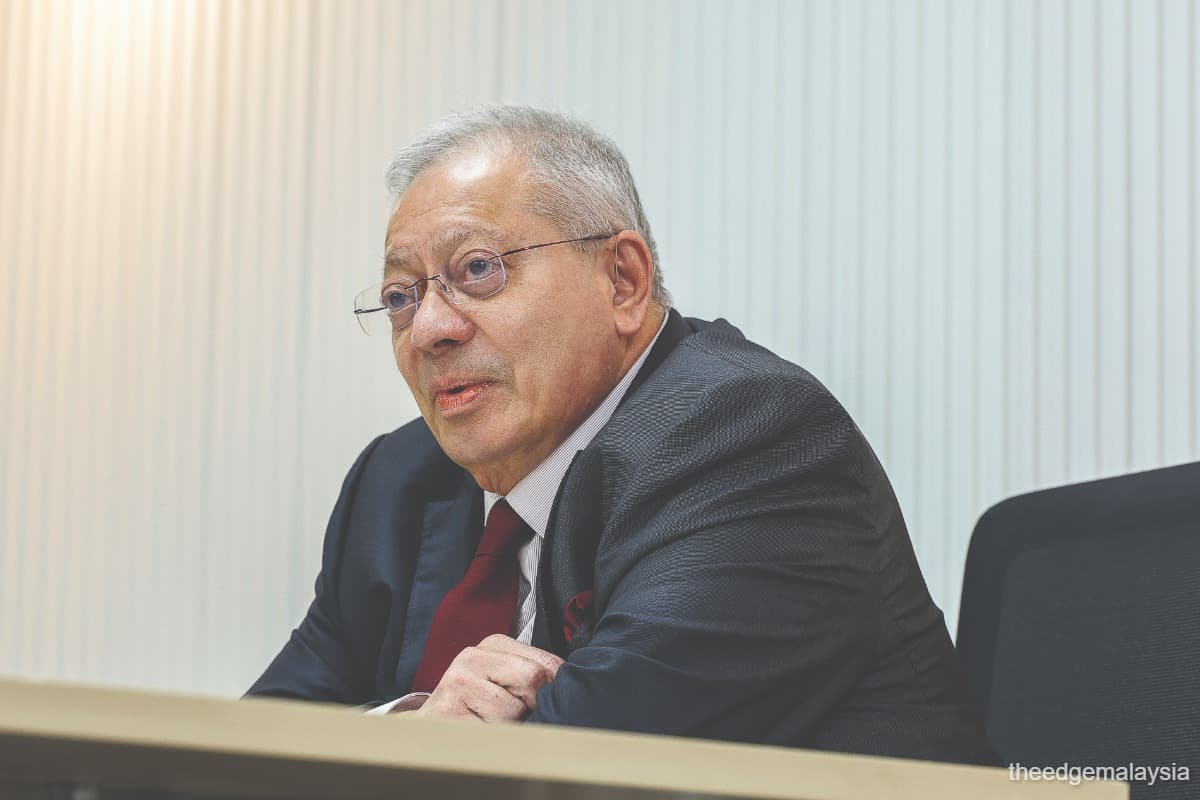
WHEN Tan Sri Abdul Rashid Hussain took over the chairmanship of Lembaga Tabung Haji (TH) in late 2023, it was a surprise to many simply because the former investment banker had stepped away from the corporate scene after the 1998 Asian financial crisis.
Like many appointments at government-linked institutions, his inevitably invited questions on whether politics played a role — a speculation he outright denies.
“I came back from retirement reluctantly. This is a national service. I have always been a corporate man.
“To label me as a political nominee … the appointment of the chairman of Tabung Haji, under the existing Tabung Haji Act, is the prerogative of the Minister of Agama (Religious Affairs),” says the 80-year-old. (See ‘Transformation programme expected to increase funds significantly over the next 20 years’ on Page 58.)
Rashid co-founded stockbroking firm Rashid Hussain Securities with Tan Sri Chua Ma Yu in the early 1980s. The duo then took over D&C Bank and renamed it RHB Bank Bhd (KL:RHBBANK). Chua sold his stake in RHB Bank in 1992.
Rashid moved on to grow the banking group by acquiring Kwong Yik Bank in the late 1990s. However, he was “pressured” to sell his stake in RHB during the politically driven banking consolidation of 2002 that was linked to the sacking of Datuk Seri Anwar Ibrahim as deputy prime minister and finance minister in 1998.
The tycoon had stayed away from any public roles until his appointment at TH in 2023. His experience in corporate finance and investment banking certainly comes in handy in this job.
Furthermore, the pilgrims’ fund wasn’t new to Rashid. The co-founder of RHB Bank was one of six members of the Royal Commission of Inquiry (RCI) set up in 2022 to investigate the management and operations of TH from 2014 to 2020.

“We did eight volumes of reports for the government. So, I was certainly [joining TH] with both eyes open, knowing how deep the problem was.
“It is because it is an Islamic fund, and it is for the ummah. And I thought, because I was in the RCI, I felt very sad [to see] what had happened to Tabung Haji. And therefore, I thought if I could put things right and stabilise Tabung Haji ... If this is the last thing I do in my life, let me do it.
“I have nothing to do with politics,” Rashid tells The Edge in a candid interview, in which he does not dodge any of the questions raised.
Almost three years into the job, he believes TH has moved beyond the most difficult phase of its recovery but acknowledges that the work is far from complete. This explains the two-year extension of his tenure until mid-December 2027.
Cleaning up the financial mess
After the fall of the Barisan Nasional government in 2018, an RCI was set up to probe TH’s RM11 billion asset-liability gap. Red flags had been raised over the fund’s compliance with the Tabung Haji Act 1995.
“Where we got into trouble before 2018, the liability was more than the asset, even though there were some people disputing it. That is true. And the dividend was created, created to be declared even when the liability was greater than any asset,” says Rashid.


To fix the pilgrims’ fund’s financial problems, a big chunk of its non-performing assets were transferred to Urusharta Jamaah Sdn Bhd (UJSB), a special-purpose vehicle wholly owned by the Minister of Finance Inc. In exchange, UJSB issued two sukuk worth RM19.6 billion and injected RM300 million into the fund. (See “Urusharta Jamaah and the legacy assets” on Page 57.)
Even so, according to Rashid, there were still some legacy assets sitting in TH’s books that needed to be resolved when he took office. “What is unknown is that, effectively, that was not a total clean-up either because, in our books, there was a residual of almost RM2.6 billion of assets that we had to work out.
“I’ve done it, cleaned it up, have written everything off, whatever needed to be gotten rid of. And I think, in the last two years, in our results, we have demonstrated that we have turned around, from a balance sheet point of view. And we have turned [out] to be profitable,” he says.
“And with profit, the first thing is to pay out a dividend. And we have done that in two stages. From 3%, we jumped up to 3.25%, and last year, we did 3.5%.”
Juggling deposits, dividends and subsidies
TH manages roughly RM95.3 billion in savings from nearly 10 million depositors. It is different from other government-linked institutions as it is tasked with growing depositors’ savings to enable them to perform the haj pilgrimage. Another task is to help subsidise the depositors’ haj.
Rashid, who has weathered the economic and political crisis of the late 1990s, admits that leading TH is unlike anything he has done before. “It’s showing on my face, right?” he quips when asked whether his job is stressful.
The challenge lies in balancing multiple objectives.
The fund needs to strategise its investments to generate decent returns for its depositors, ensuring that they continue saving with TH. It also gives financial assistance to depositors who are short of money for their pilgrimage while striving to rebuild its balance sheet, namely its reserves — an essential buffer against external shocks.
TH’s deposits have grown from RM70 billion in 2019 to RM93.4 billion in 2025 and about RM95.3 billion as at mid-2026. The numbers suggest that the confidence level in the institution has improved.
Deposit growth has also rebounded from 1.8% in 2025 to 2% as at May 2026, driven by measures to encourage members to save consistently with TH.
Growing the depositor base is an important component of Rashid’s transformation agenda.
“The sustainability of TH is on its deposits. A number of measures have now been put in place. I mean, there are major measures,” says Rashid, noting that the fund will soon unveil the transformation programme in detail.
“The intention of which is to win investors’ confidence, [to have them] accept us as a respectable Islamic savings institution, and [to encourage them] to save with us on a consistent and regular basis,” he adds.
For years, the Hajj Financial Assistance Scheme (HAFIS), through which TH subsidises pilgrimage costs for eligible pilgrims, has been a big financial commitment. The targeted assistance for lower-income groups that started in 2022 has helped lighten TH’s financial burden.
“We’re now educating people (telling them) that there is no need to go to haj, at least until you can afford it. There is an Islamic word called Istito’ah, which is, you only go to haj when you can afford it,” says Rashid. (See “A sustainable path to fulfilling the haj obligation” on Page 56.)
“Tabung Haji was set up to help you save and for us to grow your fund. Don’t depend on subsidy to go for haj, please.
“We have to phase out the subsidy, in terms of the reality check of (a) your religious conscience on that issue; and (b) to basically get a fairer return for the depositors, as it surely belongs to them,” he adds.
TH is in the midst of finalising its new Strategic Asset Allocation (SAA) framework, which is designed to guide investment decisions over the coming years.
“It has to be a very balanced portfolio. That is why we go through this exercise every two to three years to review our strategic asset allocation,” Rashid says.
At present, the institution’s SAA framework for 2024-2026 remains heavily tilted towards fixed income, which accounts for 54% of the portfolio. Equities make up 26%, followed by real estate at 12%, cash at 5% and private equity at 3%.
“I’m not averse to property per se. But when you are balancing a portfolio ... it’s a risk issue. If you invest in real estate, you have to hold it for the slightly longer term. I’m going to run a portfolio that gives me sustainable returns, which is key,” says Rashid.
“Don’t forget, liquidity is also a very important element of my investment, because all your accounts are basically like current accounts — you can withdraw it tomorrow.”
Unlike the Employees Provident Fund (EPF), the savings at TH are largely voluntary and can be withdrawn at any time. This creates structural liquidity pressure, which has historically contributed to withdrawal stress.

Lesson from the past
Since last year, TH has been rebuilding its profit equalisation reserve (PER), a financial buffer created after the 2018 restructuring to help cushion future earnings fluctuations and support stable distributions. This compares with the years between 2012 and 2017, when its reserves were depleted as the fund had paid out more to depositors than it earned.
The PER is part of the fund’s distributable reserves, together with retained earnings, which comprise accumulated profits generated by TH, including profits recognised on the income statement and realised income recognised as other comprehensive income. Any utilisation of the distributable reserves is subject to the approval of the board.
Separately, TH maintains non-distributable reserves comprising the Statutory Reserve, which is required under the Tabung Haji Act 1995, and the Fair Value through Other Comprehensive Income Reserve, which reflects fair value movements of investment instruments recognised as other comprehensive income. Any utilisation of the Statutory Reserve is also subject to the approval of the minister responsible for TH.
TH’s profit distribution of 3.5% for FY2025 was its highest in eight years. Depositors, however, may consider it as relatively low compared with the historical peak of 4.5% to 6.5%.

“We gave you 3.5% last year, wrote off everything, created even a reserve for you, and provided the best haj services in the world ... You know, juggling all that, we have done it. Right? Please give us a due credit. We’ve tried very hard in very difficult circumstances,” says Rashid.
It is worth noting that the high profit distributions then were not in compliance with the Tabung Haji Act, which requires its assets to exceed liabilities before any dividend distribution can be declared.
In late 2015, a letter from Bank Negara Malaysia to TH’s management was leaked, exposing the deepening financial hole in the pilgrims’ fund. In the missive, then governor Tan Sri Zeti Akhtar Aziz warned that TH held only 98 sen in assets for every RM1 in liabilities.
Having been involved in the probe of TH’s financial mess, Rashid is firm that such a situation cannot recur.
“Without my asset over my liability, I cannot pay out any dividend under the law. That is sacred,” he says, pointing out that earlier practices had bypassed proper accounting discipline.
“Where we got into trouble before 2018, the liabilities were more than the assets. And dividend was created to be declared even when the liabilities were greater than any assets — they did what’s called creative accounting. Not accounting to the accounting standards.”
Seven years on, according to him, 70% of the RCI’s recommendations have been implemented. The remaining measures include legislative amendments, stronger regulatory oversight and further enhancements to governance structures.
Rashid dismisses the notion that political leaders determine who sits on the board now. According to him, since he became the chairman in 2023, there has not been a single politician on TH’s board. “This is now the policy and practice.
“We have checks and balances in place. We have accounting standards that must [be] adopted. Accountants must basically sign off before we can pay our dividends.
“We have a balanced board with the right competencies and, basically, with integrity to fit in with Bank Negara’s criteria of ‘fit and proper’ person as in the Banking Act. These corporate governance and accounting best practices probably aren’t new to Tabung Haji, but the crux of the matter lies in execution, specifically in ensuring long-term adherence. Perhaps that will be Rashid’s biggest challenge.
Read also:
Cabinet declassifies Tabung Haji RCI report for public release today
Anwar vows action against those responsible for Tabung Haji losses
Anwar: Budget 2027 must improve lives, not just economic numbers
Cover Story: A sustainable path to fulfilling the haj obligation
Cover Story: Urusharta Jamaah and the legacy assets
Cover Story: ‘I can’t apply my level of creativity here that I could do in investment banking’
Save by subscribing to us for your print and/or digital copy.
P/S: The Edge is also available on Apple's App Store and Android's Google Play.