

This article first appeared in The Edge Malaysia Weekly on June 29, 2026 - July 5, 2026
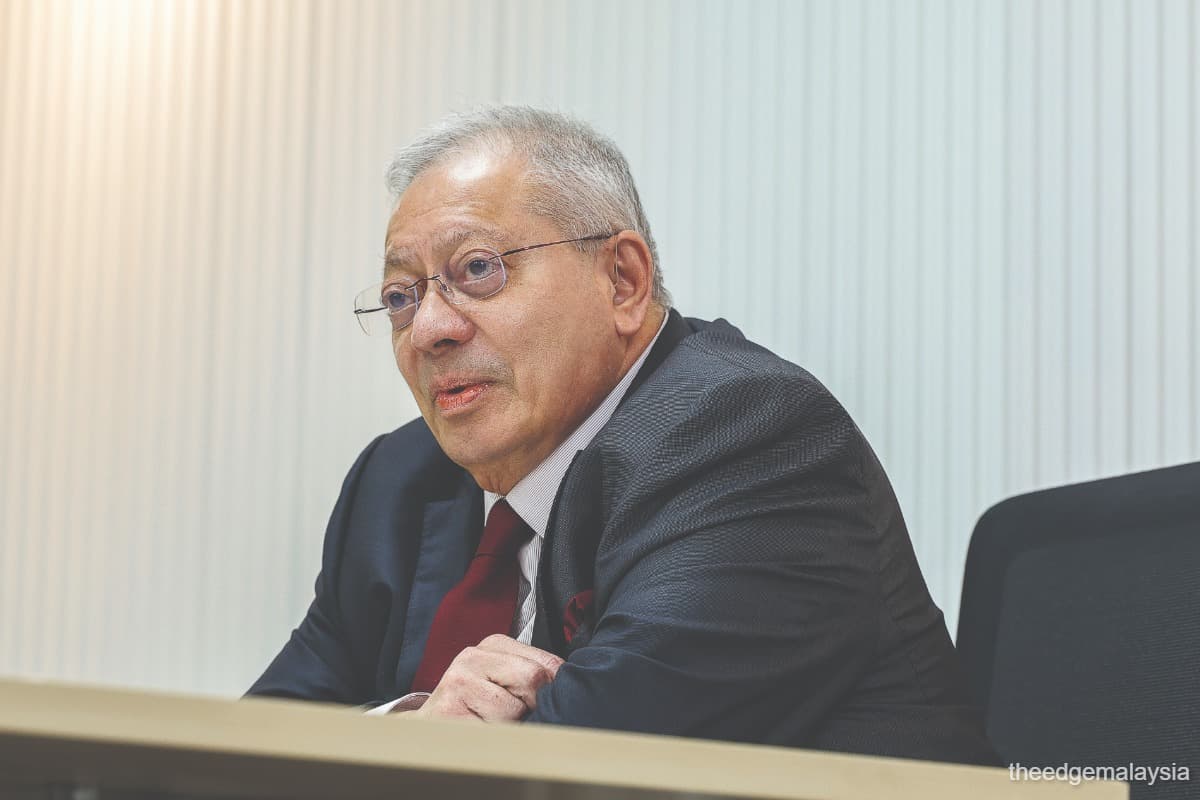
IN a candid interview with The Edge, the charismatic former banker Tan Sri Abdul Rashid Hussain, who is now chairman of Lembaga Tabung Haji, says his job is stressful, but he finds it meaningful to put the pilgrims’ fund back in order. The following is an excerpt from the interview.
The Edge: What was the mandate given to you when you took office?
Tan Sri Abdul Rashid Hussain: It is looking at basically transforming this place, all right, put it right and rebuild it again. And as the noble institution that it is — it is for a noble cause, for going on the haj, which is a religious practice. It is also a financial savings institution — to bring back confidence and direct investments in the way it should be, to make it sustainable for future growth.
When you were offered the position of chairman, did you have any hesitation?
You think I would jump in with both feet? (laughs). I was called and asked: ‘Can you do something and turn around this place and transform it?’ And I felt, ‘Well, I’m old. If this is the last thing I do in my life, let me do it.’
What made you decide to take the job?
I only accepted it for the ummah.
Tan Sri, how different is it between being an investment banker and chairman of Lembaga Tabung Haji (TH)?
(Laughs) Very good question! Oh, there’s a world of difference between being an investment banker and chairman of TH for sure. I mean, I can’t apply my level of creativity here that I could do in investment banking, can I? Here I’ve got to juggle so many balls in the air, which is stressful, right? And to make it work and make it feasible and sustainable. There’s a world difference. But it’s a different calling, I’m aware. I wish it were an investment-backing job. How fun [would that be]? (laughs)
Would you say that you took office with your eyes wide open?
Yeah, because I was a member of the RCI (Royal Commission of Inquiry) that looked into TH’s affairs, to look at what went wrong. And we did an eight-volume report for the government. So, I certainly had both eyes open, to know how deep the problem was. But I thought it was challenging enough. The stressful bit is, do I want to do it at my age? (laughs)
After you took over, what was in your way when you wanted to do something?
The mountains (laughs).
What were the challenges?
I think politics is always in my way, in terms of political expectation and in terms of what a reality check, or what an institution like this can do and must do.
Do you work longer hours now than when you were an investment banker?
Ask my special officer. I don’t normally leave here before 8 o’clock at night. I start late, at 11 o’clock in the morning.
Since you are able to build the reserves, TH’s assets are more than its liabilities now?
That is, shall we say, an accounting must in my act and is therefore sacred to me, and sacred to the senior management here, particularly financial management. Without assets over liabilities, I cannot pay out any dividends under the law. That is sacred.
Where we got into trouble before 2018, the liabilities were more than the assets, even though some people dispute it. That is true. And dividends were created, created to be declared even when the liabilities were greater than the assets. It was then known basically how they did it. They did what’s called creative accounting. Not accounting to the accounting standards. Hopefully, never again.
What do you think about TH’s withdrawal policy? Is there something that needs to be changed?
Yeah, that’s part of my biggest challenge, my most stressful challenge, which is the current accounts. How much do you get in your current account? I’m giving you 3.5% after paying your zakat, and it’s a government-guaranteed fund, right? And strictly speaking, we have to do something about it. Whether it will be purely a current account or something slightly more sophisticated than that.
Are you looking to do something like the Employees Provident Fund (EPF) — having different kinds of accounts?
Yeah, I must learn from them (laughs).
As it stands, depositors get the benefits from TH in terms of preparing themselves for the haj. But they are also spoilt for choice, for example, they can save on other platforms like Amanah Saham Bumiputera. And even EPF allows you to withdraw some funds if you are going for the haj. So that is the situation where perhaps TH is competing to retain those deposits.
Reality check, that is true. What to do? That’s the market. I’m here basically as someone professional stepping up to that reality. And here we are, there are no differentiating features ... [or rather] there are features which are unique to TH. TH is a unique partner — it is government-guaranteed and it is shariah-compliant. [In fact, it was established] even before Islamic banking came into effect in Malaysia, remember? It was set up in 1969.
Second, we are paying zakat, so that automatically builds up funds. And to a lot of Muslims, that is sacred. They understand the religious calling and religious need.
So here we are: government-guaranteed, shariah-compliant, zakat-paying, conservatively run. And practically [speaking], I don’t think our returns are that low. By the time you minus all these things and you add up all those things — give and take, we are in about the same range. Some are much better than us, and that means because purely on [their] strategic asset allocation as a fund.
We are a little bit restricted in terms of strategic asset allocation, mainly because we are shariah-compliant. And second, I’m governed by government guidelines in terms of strategic asset allocation. We are not very great in terms of overseas investments. But by and large, our strategic asset allocation is not static — it is always under review from time to time. And we are in the process of reviewing it to meet the challenging conditions of the day.
What is your strategy to ensure TH remains attractive to depositors?
Well, I pride myself on the transformation programme of TH. At the end of the day, the key word is sustainability. I think the sustainability of TH [depends] on its deposits. A number of measures have now been put in place. I mean, there are major measures.
Last year, when I made the announcement about the transformation programme, we declared what we wanted to do. But what we have not done is unveil the transformation programme in detail. Obviously, we’ve been working very hard over the last seven months, putting a lot of programmes into place, the intention of which is to win investor confidence, [to have them] accept us as a respectable Islamic savings institution and [to encourage them] to save with us on a consistent and regular basis. [The goal is] to build up their savings to a level that is appropriate for them to perform the haj.
We believe that what we have in store, once unveiled, will increase funds significantly over the next 20 years.
So when will you reveal this plan?
Bear with me. I have to get all the notes [in order]. The plans are ready, actually, to be honest with you. I’m just getting the timing right.
It seems that private equity is one area that some government-linked funds are pursuing. What is your view?
We are in private equity, but relatively. In TH’s portfolio, [the allocation] is relatively small. Are we prepared to increase our allocation to private equity? I [will] leave it to the consultants who are working with us at the moment to make the appropriate recommendation. It is still early days for the finalisation of that. My personal view is that it is easier to scale down on private equity because there is too much money chasing the very few opportunities.
Some RM100 million-plus a year is given to the B40 and M40 income groups under HAFIS (Haj Financial Assistance).
In other words, it is a subsidy. The subsidy has been a problem for TH since 2001. It was a political decision.
And obviously, we can’t go on subsidising people to go for the haj. In the first place, we’re now educating people, telling them that there is no need to go for the haj, at least until you can afford it. There is an Islamic word called istito’ah, which is, you only go for the haj when you can afford it. Therefore, what we’re supposed to do is to help you to save — with us early, systematically and regularly.
In 2022 when we said, ‘Look, this cannot go on, right?’ And the government said, ‘Okay, let’s do it on the sasaran (targeted) principle — and the subsidy varies for the B40 and M40. Our point is, this cannot be right from a religious principle point of view, and it cannot be right from a sustainability point of view. We have to phase it out.
Will this be something that you are looking to revamp?
We basically have to get people to save enough, so that this problem does not arise. I don’t think we can wash it out completely — I mean, from a political point of view, we accept the reality check. So the government, together with us, agree on the sasaran principle, but gradually we’re bringing down the subsidy burden that we have had to bear so that it is fair to the depositors’ returns.
So how do you fund this subsidy? Is it from the government or from TH?
Thank you for asking that question. A very good question. The government is not the one paying the subsidy. It is the TH depositors who are paying the subsidy. TH is self-funded, meaning the cost of running the haj operation — I mean the haj office and the subsidy — depends on what we earn [investment income], minus this figure, and the balance is for us to pay dividends to depositors, plus the reserve that we have to stabilise for the sake of stability of the fund.
Your appointment as chairman of TH drew criticism. Some see you as a political appointee. What is your comment on this?
I came out of retirement reluctantly, as a national service. Why am I a political person? Which political party am I involved with? What policies have I ever been involved in throughout my life?
The person who called me to appoint me was the Minister of Agama (Religious Affairs). I did not even know him from before ... he was a shariah court judge. What do I have to do with the shariah court?
He said to me, ‘Would you do national service? Would you do this, please, to put TH right? And would you, since you were a member of the RCI, be able to transform TH?” I said yes, I would do this, but with no political interference. And I said so.
What is being done to ensure past mistakes do not happen again?
I am not a fortune teller (laughs).
We have checks and balances in place. We have accounting standards that must be adopted. Accountants must basically sign off before we can pay out dividends. We have a balanced board with the right competencies and basically with integrity to fit in with Bank Negara Malaysia’s criteria of ‘fit and proper’ person, as in the Banking Act. Those are now being implemented.
What are the bitter lessons TH has had to learn so that the pilgrims’ fund does face the same financial troubles in the future?
This has been covered extensively by the RCI. Further to that, you can also do your own research. As far as we are concerned, we have now implemented 70% of the RCI’s recommendations to ensure that TH is protected and well run for the future. We are now waiting for the resolution for TH to be regulated, and discussions are well underway.
For the record, since I’ve been chairman from 2023, there has not been a single board member who is a politician. This is now the policy and practice.
Read also:
Cover Story: Putting Tabung Haji in order
Cover Story: A sustainable path to fulfilling the haj obligation
Cover Story: Urusharta Jamaah and the legacy assets
Save by subscribing to us for your print and/or digital copy.
P/S: The Edge is also available on Apple's App Store and Android's Google Play.