

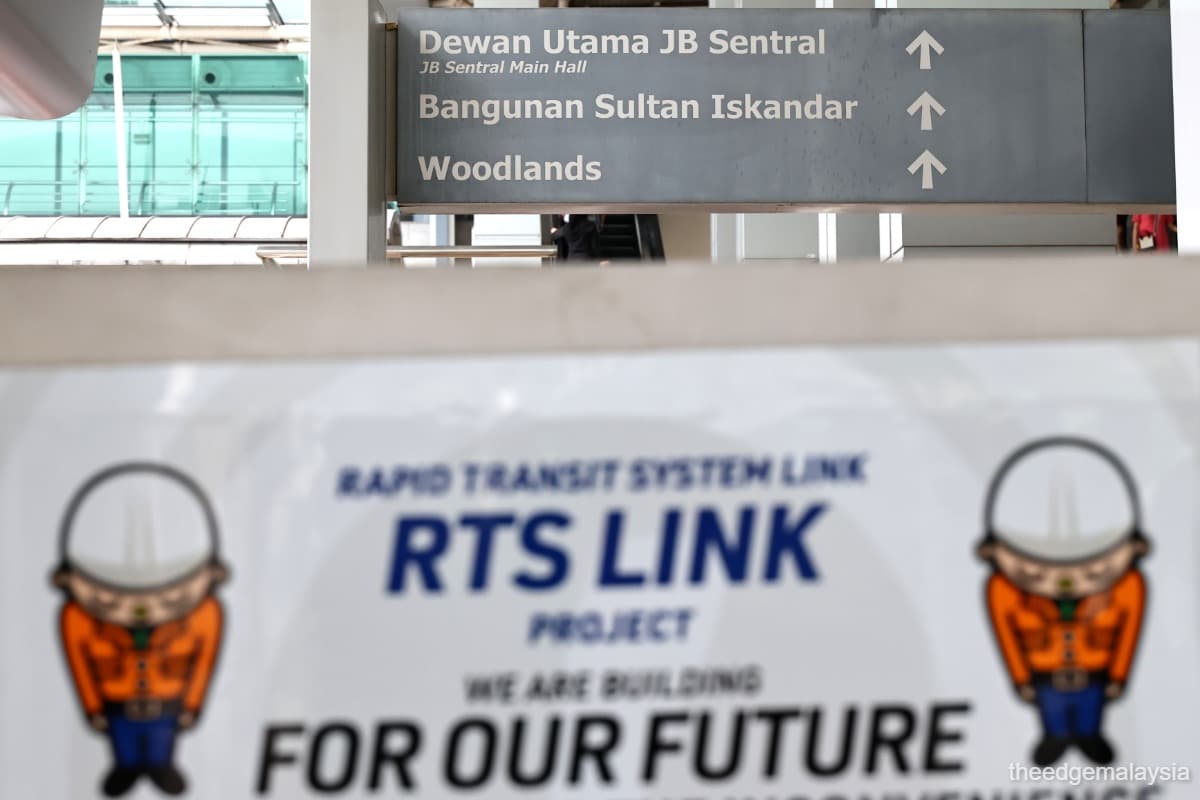
ISKANDAR PUTERI (Nov 25): Official fares for the Johor Bahru-Singapore Rapid Transit System (RTS) Link is expected to be announced by Malaysia's Transport Ministry (MOT) in January, ahead of the service's scheduled launch a month later.
State Public Works, Transport, Infrastructure and Communications Committee chairman Mohamad Fazli Mohamad Salleh said the matter is still under discussion between RTS Operations Pte Ltd and the governments of Malaysia and Singapore.
“In February 2026, media reports quoted an estimated fare of between S$5 and S$7 per trip, or RM15.50 to RM21.70.
“However, the official fare is expected to be announced by the MOT in January 2027, before the RTS Link begins operations in February 2027. Therefore, the one-way and return fares have yet to be finalised at this stage,” he said.
He was replying to a supplementary question from Baharudin Mohamed Taib (Barisan Nasional-Permas) on RTS Link fares during the Johor state assembly sitting here on Wednesday.
Meanwhile, in reply to questions from J Kartiyaini (Pakatan Harapan-Skudai) and Baharudin on measures to address traffic congestion, Mohamad Fazli said the state government is implementing various traffic dispersal measures and strengthening the public transport network in Johor Bahru as part of comprehensive preparations ahead of the RTS Link's operations.
He said based on the 2025 Traffic Congestion Index, Johor Bahru ranked fifth, with its congestion index rising from 36.9% in 2024 to 39.5%, while peak-hour time lost increased from an estimated 61 hours to 65 hours.
“An estimated 400,000 Malaysians commute daily across the Johor Causeway to work in Singapore. Behind these figures are people striving to earn a living and support their families.
“The state government understands that this issue is not merely about the traffic flow, but also about people's time, well-being and daily lives. That is why preparations for the RTS Link's expected operations in February must be comprehensive,” he said.
Through the Johor Public Transport Corporation, the state government is focusing on coordinating passenger movement around the RTS Bukit Chagar Station, including the construction of pedestrian overhead bridges and restricting private vehicle access along Jalan Bukit Chagar to facilitate feeder bus services.
He said the public transport network would also be strengthened through the federal government's agreement to introduce southern sector commuter services along the Paloh-Kulai-Kempas Baru-JB Sentral route, with 10 trips daily, and the Kempas Baru-Pasir Gudang route, with four trips daily, in addition to 168 BAS.MY buses and 39 Bas Muafakat Johor buses.
For short-term traffic dispersal measures, smart traffic light systems have been implemented at 210 intersections, while the six-kilometre contra-flow lane along Jalan Skudai, introduced on July 13, had received positive feedback. The tidal-flow system for commercial vehicles along the Johor Causeway will also be implemented from Dec 1.
For long-term planning, he said the state government is looking into the proposed 36.2km Elevated Autonomous Rapid Transit (E-ART) system involving 22 stations along the Skudai and Tebrau routes, as well as improvements to six major road corridors in Greater Johor Bahru.
He said these six corridors were identified as roads requiring attention, and they involve substantial costs.
“Therefore, through cooperation with the Works Ministry and the Iskandar Regional Development Authority, we are seeking to ensure that these projects are properly planned, including new interchanges, alternative routes and elevated intersections to increase the capacity of the Greater Johor Bahru road network.
“Long-term planning must take into account urban growth and residents' needs so that solutions can be implemented and provide lasting benefits to the people,” he said.
Read also:
Special Report: Completing RTS Link’s intricate journey
Special Report: MRT Corp’s RM75 bil ambition spans beyond rail
Uploaded by Tham Yek Lee