

This article first appeared in The Edge Malaysia Weekly on November 16, 2026 - November 22, 2026
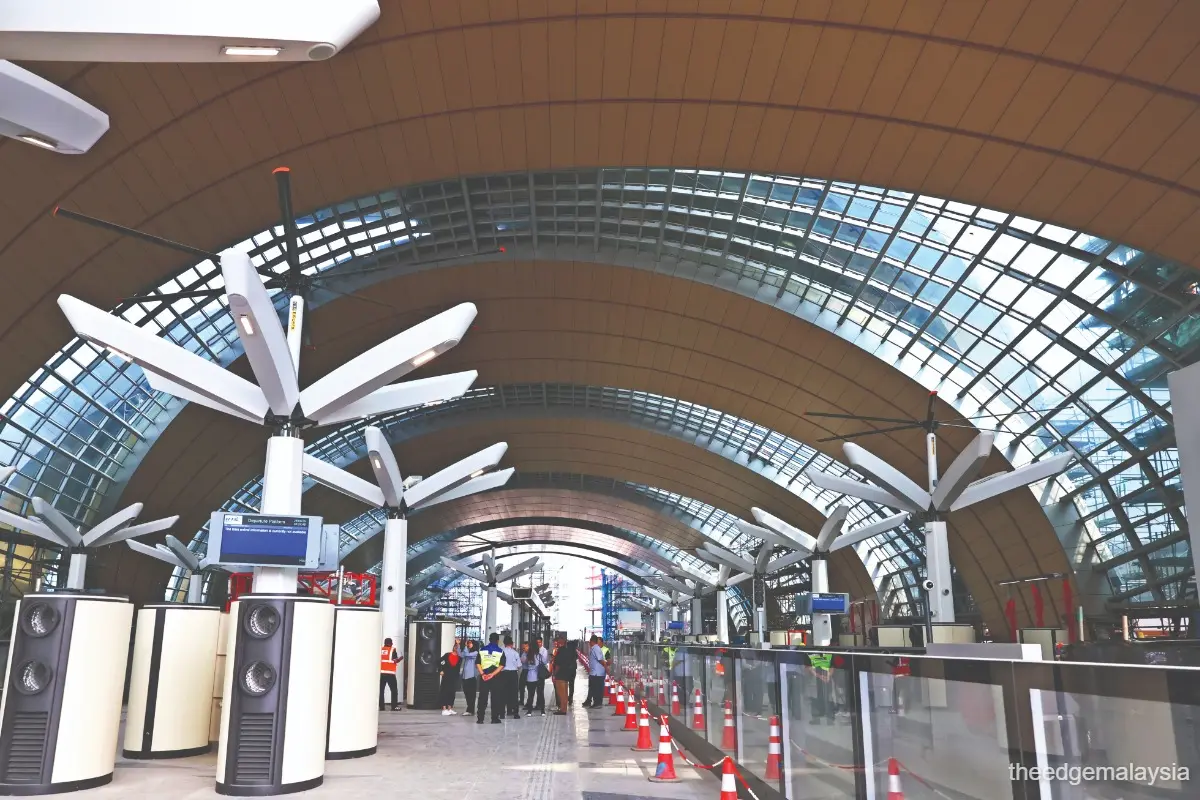
IN late September, The Edge was granted an exclusive tour inside the Bukit Chagar station — the Malaysian terminus station of the Johor Bahru-Singapore Rapid Transit System (RTS) Link.
The infrastructure that commuters have waited a decade for looks striking. The station itself is spread over three operational levels with total floor space measuring 25,891 sq m. The bigger Immigration, Customs and Quarantine (ICQ) Complex located next to the Bukit Chagar station is equally impressive.
Standing on the platform covered by a domed roof, a commuter can be forgiven for thinking he is travelling in a first world country.
Operationally, the current timeline points to a February 2027 commercial rollout, depending on the final safety certifications and cross-border regulatory approvals. With system integration tests and trial runs scheduled to wrap up by year end, the functional rollout of this third gateway between Malaysia and Singapore remains a critical measure of success after the project faced years of execution hurdles involving many stakeholders.
“The testing is currently being done just to ensure the safety of the train. But infrastructure-wise, it’s actually completed ahead of time,” MRT Corp CEO Datuk Mohd Zarif Hashim tells The Edge in a recent interview.
“The remarkable experience about the RTS is how we as a country come together, because RTS is not only about one person or one agency ... Because we had to change the law, to be able to get our Singaporean counterparts working in Johor Bahru and vice versa, so we had to enact an RTS Act,” says Mohd Zarif as he reminisces on the challenges faced in bringing to reality the mammoth RM5.24 billion RTS project.
MRT Corp supported the Ministry of Home Affairs, the Attorney-General’s Chambers and the Ministry of Transport in the task, with various agencies from the Immigration Department Malaysia, the Malaysian Quarantine and Inspection Services Department to the Border Control and Protection Agency coming together to develop the operating procedures for the RTS project. The objective was to integrate the separate agencies into one border-crossing system.
In the latest Oct 2 update, Malaysia’s transport ministry and Singapore’s Land Transport Authority (LTA) described infrastructure works on both sides as substantially complete. Singapore had already announced the completion of its Woodlands North station on Sept 4.
On the Malaysian side, Mohd Zarif points to the Aug 18 declaration by former transport minister Anthony Loke of the physical completion of the station and rail infrastructure of the RTS Link.
A long road to the station
First announced in 2010, the link was designed to make travel seamless for the thousands who commute between Johor Bahru and Singapore on a daily basis. However, it was only on Jan 16, 2018, that former Malaysian prime minister Datuk Seri Najib Razak and his then Singaporean counterpart, Lee Hsien Loong, signed an agreement to build the mass rail transit (MRT) line across the Causeway.
Within two weeks of the signing, LTA had already shortlisted contenders for the main civil works. The two nations were originally scheduled to assign a joint-venture (JV) company to own and operate the RTS Link by June 2018. However, the Pakatan Harapan government, which came into power in Malaysia in May 2018, subsequently sought extensions to firm up the JV structure with a view to reducing overall costs.
During this period, the scope of the project was fundamentally altered from a heavier passenger load MRT system to a Light Rail Transit (LRT) hybrid system.
Also, the status of the land in Bukit Chagar came under scrutiny. The land parcel, initially thought to be under the purview of the federal government, was reported to belong to the Johor Palace. His Majesty Sultan Ibrahim Sultan Iskandar (now the King) responded that he had been unaware the Bukit Chagar land was part of the RTS layout and graciously offered to surrender it without charge if required for the project.
Had it been a standard commercial acquisition, the project cost was estimated to escalate to RM5.3 billion from RM4.81 billion. Tun Dr Mahathir Mohamad, the prime minister at the time, had firmly stated that the federal government would not pay for the land premium.
By then, Pakatan Harapan had extended the deadline to form the JV company three times, pushing it to April 2020. However, in February 2020, the administration was replaced by the Perikatan Nasional coalition.
When the project officially resumed in July 2020, the design blueprint had completely changed. The RTS was reconfigured as a standalone LRT system rather than sharing core systems with Singapore’s Thomson-East Coast MRT Line. A new maintenance depot at Wadi Hana in Johor Bahru replaced the proposed use of Singapore’s Mandai depot.
The revised arrangements also brought MRT Corp into the picture. Its subsidiary, Malaysia Rapid Transit System Sdn Bhd, replaced Prasarana Malaysia Bhd as Malaysia’s designated infrastructure company, taking over full responsibility for funding, building, owning, maintaining and renewing the Malaysian civil infrastructure and stations.
Mohd Zarif had joined MRT Corp just a fortnight earlier, on July 15, 2020, succeeding Abdul Yazid Kassim, whose tenure ended on June 30. Alongside managing the completion of the Klang Valley’s Putrajaya Line (also known as MRT2), he also had a high-stakes bilateral project to deliver.
Mohd Zarif recalls that one of his first critical executive decisions was to resist intense pressure to award construction packages before fully understanding the underlying project risks.
“One of the things I was very clear about was that I could not afford to let this project become a white elephant. That could not happen. You and I, as the project owner and contractor, may disagree. But you cannot stop my project,” Mohd Zarif says, reflecting on his early days in the hot seat at the rail network provider.
MRT Corp spent three months completely restructuring the overarching contract, dividing it into six distinct modules and mapping out contingency plans to ensure construction could continue even through legal disputes or contractor replacements. The agency also managed and integrated the packages itself, departing from the project delivery partner (PDP) model previously used for the Klang Valley MRT lines.
“Despite not having a contractor at that particular time, we actually moved the project forward ourselves, with our own people. We were making the calls ourselves,” he says.
On a contractor transition that took place in 2022, he adds, “We structured it in such a way that, when we held the tender process to appoint a new contractor, they could simply come in and continue the momentum seamlessly.”
It was during this period that Ekovest Bhd (KL:EKOVEST) was brought in as a collaborative partner for privately held Adil Permata Sdn Bhd — the main contractor for the RTS Link project — to accelerate the rail line’s construction. Since then, Ekovest and Adil Permata have partitioned the RM2 billion worth of construction works into six packages valued between RM300 million and RM400 million each, with restricted tenders being called.
Concurrently, MRT Corp had to expedite the finalisation of the complex façade design. The architectural design was personally selected by the King, and Johor crown prince Tunku Ismail Idris, requiring thousands of intricate pieces to be meticulously assembled on-site.
Mohd Zarif’s team worked late nights before engaging a Hong Kong-based consultant to rigorously validate their structural approach. He recalls telling his staff not to issue any tender documents unless “we ourselves are convinced that we know exactly how to execute this”.
The price for a quicker crossing
During the on-site tour, RTS Link project director Zulkifli Mohamed shared that MRT Corp is targeting a tight 25-minute transit window from station entry to the train platform. That timeline encompasses ticketing, security screening and clearance through both countries’ co-located immigration checkpoints, which are situated on different levels. The roughly five-minute shuttle journey to Singapore follows immediately after.
And to fluidly manage the massive human flow, the complex is already equipped with 18 luggage scanners and nine body scanners, alongside 100 automated immigration e-gates integrated into the National Integrated Immigration System (NIISe) network. The extensive layout is structurally engineered to withstand an anticipated peak capacity of 10,000 passengers per hour in each direction.
Even with those immediate operational selling points, the defining factor for long-term passenger demand will ultimately hinge on the final ticket price.
Loke had previously floated indicative fares of S$5 to S$7 each way, though these remain unapproved price points. Charged in both directions without discounts, 22 return journeys would cost a daily commuter between S$220 and S$308 (RM700 and RM980) a month.
Thus, existing public transport options are considerably cheaper.
Causeway Link’s published single-journey bus fares between JB CIQ and Kranji MRT sit at RM2.60 heading into Singapore and S$2.60 on the return. Its Queen Street service costs RM4.80 outbound and S$4.80 back. These are the two available routes via Causeway Link.
Assuming the same 22-day commuting per month, that works out to be RM57.20 plus S$57.20 for return journeys on the Kranji route, or RM105.60 plus S$105.60 on the Queen Street service, excluding connecting transport.
Even Malaysians commuting on KTM’s Shuttle Tebrau pay RM5 each way, coming up to exactly RM220 for 22 return journeys a month for a worker plying the Johor-Singapore route.
However, the shuttle’s capacity is strictly limited to 320 seats per train, and the underlying bilateral agreement provides for its complete withdrawal within six months of the RTS commencing passenger operations.
It should also be noted, however, that from January 2027, a Malaysia-registered car entering Singapore without the city state’s new on-board unit would incur S$67.20 in Singapore-side charges for a weekday return through Woodlands on an ERP operational day. That figure includes the vehicle entry permit, a flat-rate electronic road pricing charge, the reciprocal road charge, and the exit toll — but explicitly excludes fuel, parking, and Malaysian tolls. For a motorcycle without an on-board unit, the equivalent Singapore-side toll structure would be S$10.
Mohd Zarif leaves the final price modelling to RTS Operations Pte Ltd (RTSO) — the Prasarana Malaysia Bhd-SMRT JV that holds the initial 30-year operating concession. Meanwhile, MRT Corp retains full responsibility for the Malaysian infrastructure, while border enforcement remains with the relevant state authorities.
“It’s supposed to run on a commercial basis. So it has commercial needs to consider, and it’s finalising [the fare structure] with both governments,” he notes.
Mohd Zarif puts the absolute project cost at RM5.238 billion, emphasising that MRT Corp’s structural obligations will continue long after construction payments wind down.
“We are going to operate the infrastructure. RTSO operates the trains, but we operate the infrastructure. We are responsible for the maintenance and running of the station. We are also responsible for the running of the ICQ,” he says.
Penang LRT and MRT3 next?
Even as questions surrounding his contract tenure persist, and with his operational job scope expanding towards the delivery of the Penang LRT and the MRT3, Mohd Zarif maintains that the vital lessons shaping MRT Corp’s next projects include acquiring a deep understanding of the engineering, retaining strict control of delivery, and comprehensively planning for maintenance before committing to high-end technology.
Penang’s Mutiara Line is intended to demonstrate this exact cost-efficiency argument. Its technical specifications provide for Grade of Automation 3, keeping an attendant onboard during the initial years of public service.
“Put it this way, we do not need to go for the high-end Rolls-Royce system. There must be an optimal curve,” Mohd Zarif argues, placing greater emphasis on recurring upkeep over upfront capital expenditure (capex).
“In terms of upfront capex, you may not see that much [difference],” he says, noting that lower system complexity fundamentally reduces long-term maintenance requirements.
However, that remains a proposition to be tested over the rail system’s operational life cycle. While reduced technical complexity may trim component maintenance budgets, the comparison must ultimately include staffing lines, system reliability, and eventual asset replacements.
MRT3 presents yet another structural test. At the interview, Mohd Zarif put baseline construction costs for the circle line at roughly RM31 billion to RM32 billion based on estimates calculated prior to the Middle East conflict, with land acquisition adding an estimated RM6.5 billion. Final construction authorisation still awaits a formal government decision.
For now, those numbers remain projected estimates rather than a locked-in financial bill. Either way, Mohd Zarif still has many critical details to anchor at the transport agency.
Save by subscribing to us for your print and/or digital copy.
P/S: The Edge is also available on Apple's App Store and Android's Google Play.