

This article first appeared in The Edge Malaysia Weekly on November 9, 2026 - November 15, 2026
THREE years ago, Hong Leong Bank Bhd (KL:HLBANK) embarked on an ambitious transformation journey, with the aim of becoming Malaysia’s best-run bank across five key financial metrics.
The country’s fifth-largest banking group announced targets — including a return on equity (ROE) of more than 12.5% — to be achieved within the three to five-year span of its so-called “transformative” plan. However, its internal goal was to hit those milestones by the third year.
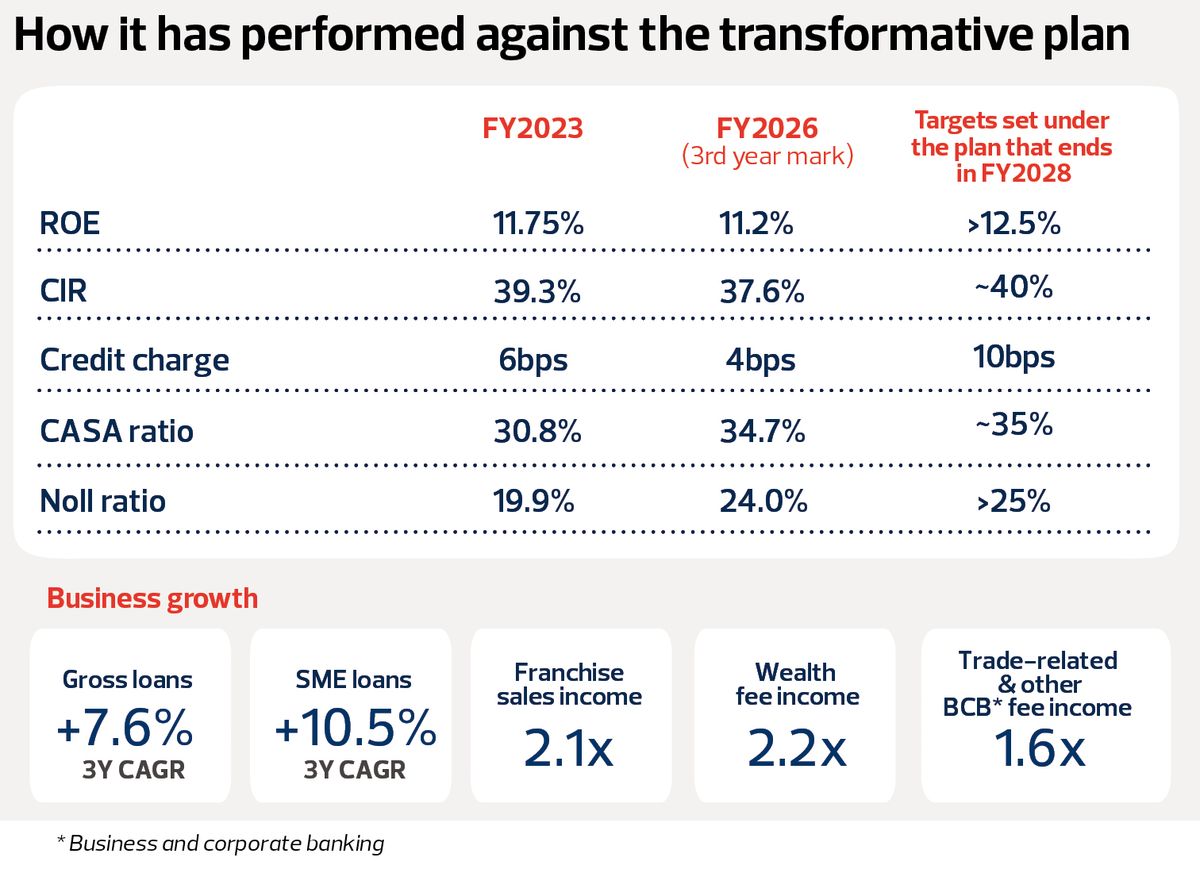
Having recently crossed that three-year mark, the group has made significant headway, with four of the five metrics — namely, cost-to-income ratio (CIR), current account and savings account (CASA) ratio, non-interest income (NOII) ratio and credit charge — either meeting or nearing the targets. The ROE target, however, remains elusive (see chart).
In a recent interview with The Edge, group managing director and CEO Kevin Lam discusses the bank’s priorities, including further building up NOII and CASA deposits to complement its lending business and drive long-term profitability. He reveals that the group has also identified a new growth opportunity: deepening its reach into the Malay market.
Seated in his 18th-floor office of Menara Hong Leong, Lam shows little sign of wear despite the turbulence of the past few years. From escalating US-China tensions and tariffs to the conflict in the Middle East, these developments have heightened economic uncertainty, adding to borrowers’ financial pressures and presenting challenges for banks.
Despite all that, HLBB managed to bring down its CIR — an indicator of how efficiently it runs the bank — to 37.6% in the financial year ended June 30, 2026 (FY2026), from 39.3% three years earlier, even beating its target of about 40%.
Its CASA ratio has risen to 34.7%, from 30.8% previously, hitting its target of about 35%. Its NOII ratio has climbed to 24% from 19.9%, nearing the 25% target, and credit charges have improved to four basis points from 6bps, well under the plan to keep it at around 10bps.
But ROE, which the bank had targeted at 12.5% to 13%, came in at 11.2% compared with 11.75% three years earlier. “We are not quite there yet fully, but we are near,” says Lam, who got into the driving seat at HLBB in July 2023.
He says the shortfall in ROE was mainly due to two factors: the unexpected dilution of its equity stake in its Chinese associate, Bank of Chengdu Co Ltd (BoCD), from 19.8% to 17.8%, and the strengthening of the ringgit against currencies like the Singapore dollar and renminbi, which reduced the contribution from its overseas operations. Had it not been for these two factors, HLBB’s ROE would have been closer to 12%, he notes.
Another key aspect of HLBB’s transformation — reducing BoCD’s historically large contribution to group earnings — is also gaining ground. BoCD accounted for a peak 37.9% of HLBB’s profit after tax in FY2024, but this fell to 30.5% in FY2026 and is expected to decline further to 29% in the current financial year, says Lam.
The lower contribution reflects HLBB’s faster growth in its core business relative to BoCD, whose own growth has moderated, as well as the dilution of HLBB’s stake in the Chinese lender. The dilution happened in February 2025 following the conversion of convertible bonds by some of BoCD’s minority shareholders.
Nevertheless, what is particularly interesting is how HLBB is quickly narrowing the gap with Public Bank Bhd (KL:PBBANK), which has long been regarded as the industry leader in returns, cost efficiency and asset quality. “We are closing in [on them]. They can hear our footsteps,” remarks Lam.
As a rough comparison, Public Bank recorded an ROE of 12.8% and a CIR of 34.9% in its financial year ended Dec 31, 2025. As at June 30 this year, its gross impaired loan (GIL) ratio stood at 0.51% compared with HLBB’s 0.57% — far better than the industry average of 1.43% in Malaysia.
HLBB is retaining its existing five-year targets under the transformative plan. “We are not shifting the goalposts,” he says.
Public Bank and HLBB are the only two lenders in Malaysia with a CIR below 40%. Lam says he expects to maintain a low CIR of “around 38% or 38.5%” for HLBB even as it continues to make investments in technology and branch transformation.
“The thing about CIR was that the impact of AI (artificial intelligence) realisation surprised us positively. The speed at which we could realise its impact was a lot faster than I expected,” he admits.
Lam considers a NOII ratio of above 25% a “respectable” target for HLBB to stick to. He points out that comparisons of NOII ratios between banks need to take into account the differences in business models. HLBB does not have an investment bank or insurance business within the bank itself, unlike some of its competitors.
Prolonged deposit competition to weigh on NIM
The challenge for HLBB is that meeting its NOII and CASA targets may not be enough to lift ROE to the desired level if its net interest margin (NIM) — the difference between what it earns on loans and pays on deposits — continues to narrow, analysts note.
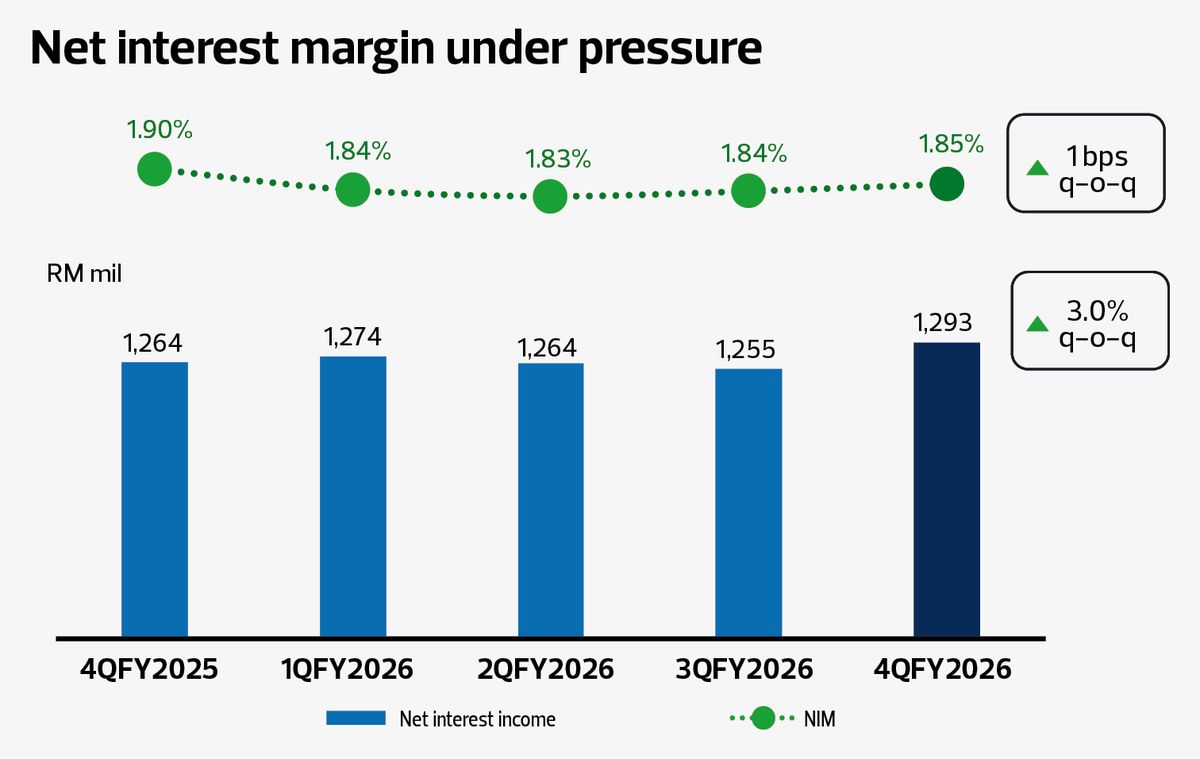
HLBB’s NIM fell to 1.84% in FY2026, from 1.9% the year before and 1.98% in FY2023.
Banks in Malaysia have been facing persistent NIM pressure amid intense competition for fixed deposits (FDs) to shore up their funding base. Lam says he expects the competition to persist well beyond the usual year-end seasonal period.
“If our NIM had been at the original plan, with more stable deposit costs, then I think easily now we should be north of 1.9%, closing on 2%. Whereas now, I think honestly, NIM looks very, very challenging,” he says.
For HLBB, the emphasis remains on growing CASA rather than competing aggressively through higher FD rates. The bank does offer tactical promotions from time to time, particularly for high-net-worth customers whose expectations are higher, but Lam says it generally tries to keep these campaigns short and targeted.
The house view is for one 25bps increase in the overnight policy rate (OPR) next year, likely in the first quarter. A 25bps increase would help recover lost ground rather than deliver a meaningful improvement in NIM, he says.
Another development complicating the earnings environment in recent months has been the sharp rise in global bond yields. For banks, higher yields can affect both the valuation of existing bond portfolios and the income generated from fixed-income investments.
Lam says HLBB is not particularly concerned about the risk implications of elevated yields, given its relatively conservative approach to the size of its bond portfolio. The group has traditionally kept its bond holdings proportionate to its loan book, which has helped contain the potential exposure to valuation movements as yields rise.
However, the impact on income is more difficult to avoid. “From an income perspective, yes, I think it’s certainly a drag,” he notes. Historically, the bond portfolio provided HLBB with an additional source of accrual income relative to its funding costs.
“If that part of the engine is switched off, then to meet your NOII ratio, you have to work harder on other stuff — customer flow, wealth management, cross-selling and others — to generate the income and that’s exactly what we’re trying to do,” he says.
Wealth management is one area in which HLBB has made considerable progress since developing the business three years ago. Its strategic partnership with Lombard Odier, a 230-year-old Swiss private bank with expertise in wealth preservation and intergenerational wealth transfer, has been a boon for the business, says Lam.
Total assets under management have increased by RM20 billion or 40.9% over the past three years from a small base, says Lam. HLBB has set up a private banking centre on the 32nd floor of Guoco Tower in Singapore’s Tanjong Pagar district and recruited teams of relationship managers.
Doubling down on the Malay market
Perhaps the most significant new development in HLBB’s domestic strategy is its intention to become more relevant and accessible to Malay customers. This is a segment in which the historically Chinese-focused bank is underpenetrated, Lam acknowledges.
The initiative will be driven primarily through its Islamic subsidiary Hong Leong Islamic Bank Bhd, recently rebranded as HLB Islamic.
HLBB’s retail customer base currently comprises about 1.05 million Malays. “We see the potential to double that within three to five years,” says Lam, adding that the bank has identified specific customer segments to serve.
He shares that its research involving almost 1,000 Malays within its target market found that a strong shariah-compliant product proposition was the most important factor influencing whether customers would consider switching to HLBB. This ranked ahead of competitive rates, lower fees and even the digital banking experience.
As Lam puts it, the bank’s challenge, obtained through feedback, can be summed up in the Malay expression, “Tak kenal maka tak cinta” — loosely translated as “You can’t love what you don’t know”.
Interestingly, though, HLBB data shows that once a Malay customer is onboarded, the person tends to stick with the bank. Lam reveals that its main-bank conversion rate — a measure of the proportion of customers who use the bank and eventually make it their primary bank — is 26%, which is higher than for most banks, including Bank Islam Malaysia Bhd (KL:BIMB) (23%), Public Bank (21%) and RHB Bank Bhd (KL:RHBBANK) (20%).
Hence, HLBB is expanding its Islamic banking suite through HLB Islamic and is also looking to attract more Malay bankers who can help it develop stronger relationships with the target market. One of its main propositions is Hayat, an Islamic wealth management concept designed around the financial life cycle of customers.
For Lam, the strategy is ultimately about making HLBB more of a bank for all Malaysians. “If you look at the Chinese segment, there’s still a lot of room to grow, and we’ll continue to compete in that space.”
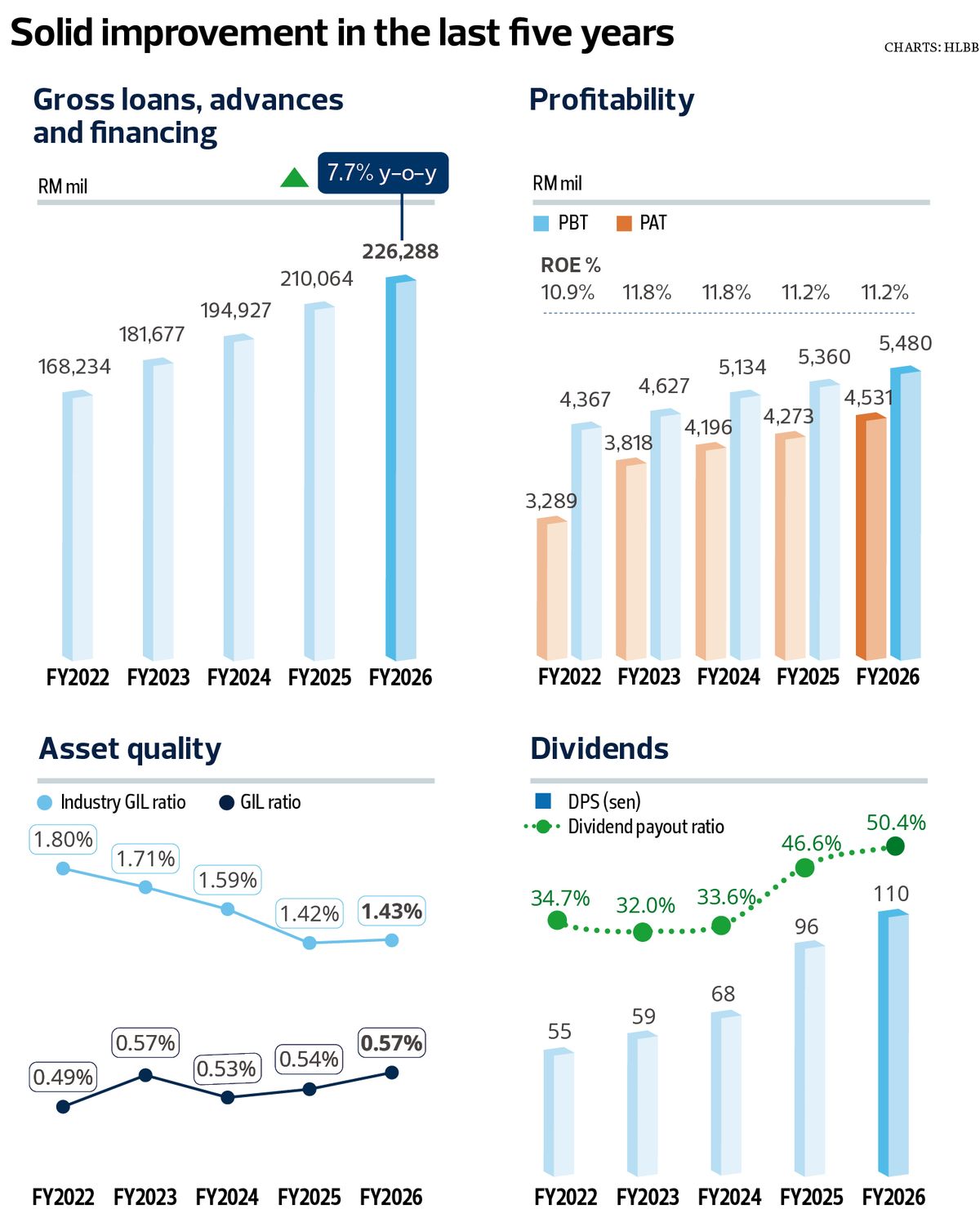
Meanwhile, HLBB’s small and medium enterprise (SME) business remains a key growth engine and has continued to expand strongly without significant deterioration in asset quality. Despite growing cost pressures on businesses, the GIL ratio for the SME segment improved to 0.99% in 4QFY2026, from 1.09% in the preceding quarter and 1.06% in the quarter before that.
SME loans have grown at a compound annual growth rate of 10.5% over the past three years. Lam sees no reason to slow down the growth.
“We must be thankful that credit quality has held up, and that still continues to be the case,” he says, adding that the bank’s proactive approach to engaging with customers early to suss out potential problems has helped. Take-up of the bank’s assisted repayment programme has remained “relatively muted”, he adds. “Our observation across the whole SME spectrum, when we review all the cases, is that they remain stable.”
Nevertheless, Lam is mindful of a more structural threat facing local SMEs: competition from Chinese online companies that are increasingly able to deliver products to Malaysia at significantly lower costs. This is affecting a wide range of local wholesalers and retailers. “That is a concern,” he observes.
Strengthening leadership in overseas markets
Lam acknowledges that HLBB’s international business has not performed as well as originally expected. It faces significant competition, particularly in Singapore, Hong Kong and Vietnam, where the group operates alongside much larger and more established banks.
HLBB had targeted a 7% contribution to profit before tax from its overseas businesses, excluding BoCD, but this has yet to be achieved.
According to him, over the past year, HLBB has made several CEO changes across its overseas operations, reflecting both management transitions and efforts to strengthen leadership. Of note, incumbent CEOs in Singapore and Vietnam have left, with successors awaiting regulatory approval at the time of the interview.
Lam says HLBB’s immediate priority is to strengthen its presence in Singapore and Vietnam, while maintaining its operations in Hong Kong and Cambodia.
The bank’s niche lies increasingly in facilitating business between China and Southeast Asia under the so-called China-plus-one strategy. Chinese manufacturers and companies relocating to or expanding operations in Malaysia, Singapore and Vietnam represent a significant opportunity, he says.
The bank is developing a China desk, comprising relationship managers and business development personnel, to serve these companies and work with Chinese financial institutions seeking local banking partners.
M&A being considered
On potential mergers and acquisitions (M&A), Lam says it is something HLBB is considering, but he declines to discuss any specific opportunities or speculation involving other banks. “We can say that we’re thinking about it, but we don’t want to talk about it publicly,” he adds.
Nevertheless, speculation over potential M&A at HLBB persists, given that its chairman and major shareholder Tan Sri Quek Leng Chan — a prominent businessman in his eighties whose interests also span property and manufacturing — has been said to be considering estate planning for some time.
Lam says that for now, the bank remains committed to its transformation agenda, with the focus on improving returns while maintaining disciplined growth and progressively reducing its reliance on earnings from BoCD. “We could be more,” he points out, referring to the opportunities available to the bank through its domestic and international franchises.
Cover Story 2: Eyes on Hong Leong Bank’s scaled-back BoCD stake sale plan
Save by subscribing to us for your print and/or digital copy.
P/S: The Edge is also available on Apple's App Store and Android's Google Play.