


This article first appeared in The Edge Malaysia Weekly on November 9, 2026 - November 15, 2026


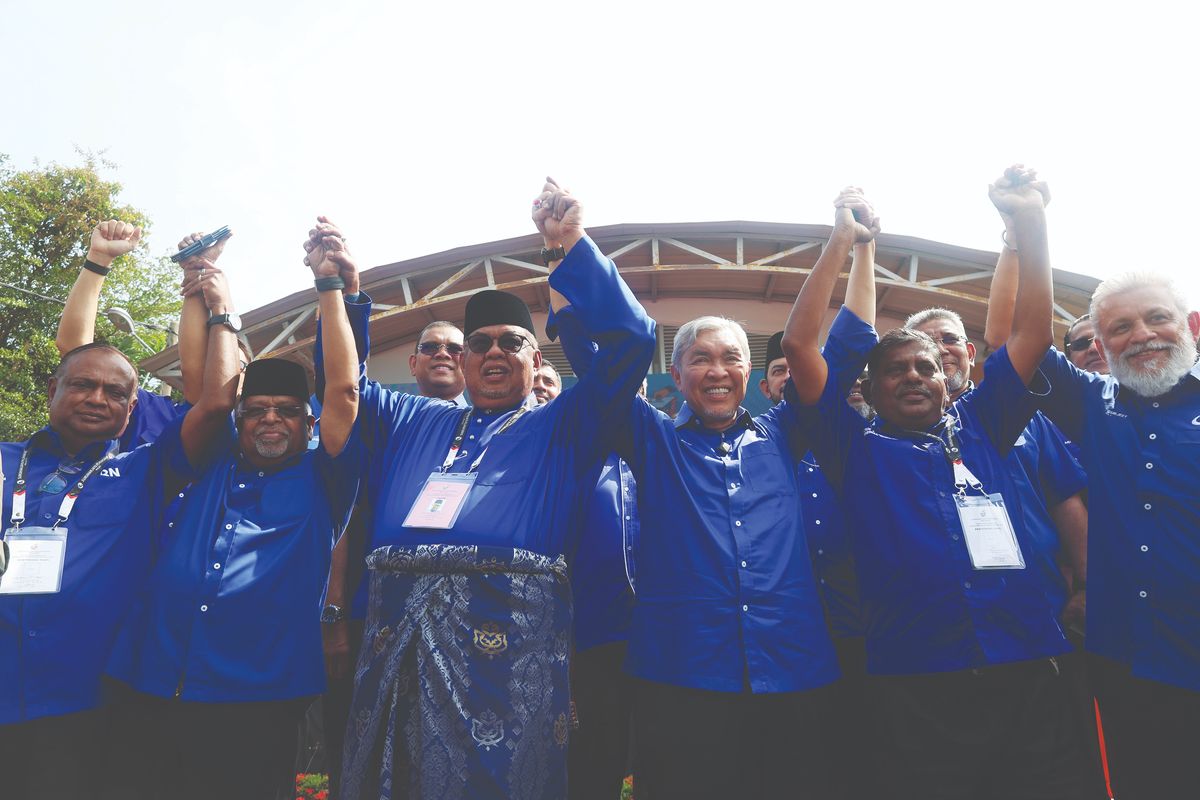
AS the candidates and their supporters marched towards nomination centres across Melaka on Oct 31, ahead of the Nov 14 state election, the contrasting dynamics of two emerging political partnerships were on full display.
On one side, Barisan Nasional (BN) and Perikatan Nasional (PN), having agreed to divide the state's 28 constituencies between them, openly rallied behind each other's candidates.
On the other, Pakatan Harapan (PH) and Parti Pribumi Bersatu Malaysia (Bersatu) appeared considerably less united. Despite reaching an electoral understanding, the former-allies-turned-bitter-rivals-turned-reluctant-tactical-partners have stopped short of fully embracing one another, with neither side showing visible support for the other's candidates at nomination centres. The two are also set to clash in three constituencies.
This contrast extends beyond nomination-day scenes, reflecting the markedly different circumstances under which the two alliances formed.
BN and PN enter the polls with the wind in their sails, having progressively refined their electoral cooperation over two successive victorious state elections.
In Johor, BN secured 48 of the 56 seats with some support from PAS, a PN component party which instructed its supporters to back BN in constituencies where PAS did not field candidates. A more formal arrangement followed in Negeri Sembilan, where BN and PN avoided direct contests, jointly winning a two-thirds majority and wresting control of the state government from PH.
Their latest collaboration also unfolds on familiar ground for BN, which has traditionally dominated Melaka’s political landscape, capturing 21 of the state’s 28 seats in the state election five years ago.
PH and Bersatu, meanwhile, are attempting to forge an uneasy partnership amid declining electoral fortunes. Their recent setbacks also coincide with increasingly complicated political relationships — PH with its federal unity government partner BN, and Bersatu with its former allies in PAS-led PN.
With BN-PN entering the polls on familiar ground with a tested track record, can PH and Bersatu’s pact overcome their recent hurdles to mount a credible challenge in Melaka?
BN-PN alliance: Home turf and demographic advantage
Based on state demographics, past election results and political analysts' views, PH and Bersatu face an uphill battle.
With 23 of Melaka’s 28 state constituencies being Malay-majority seats, winning 19 of them would be sufficient to secure a two-thirds majority in the state assembly.
Since independence, BN and its predecessor, Parti Perikatan, have lost Melaka only once — in 2018, when PH swept to power.
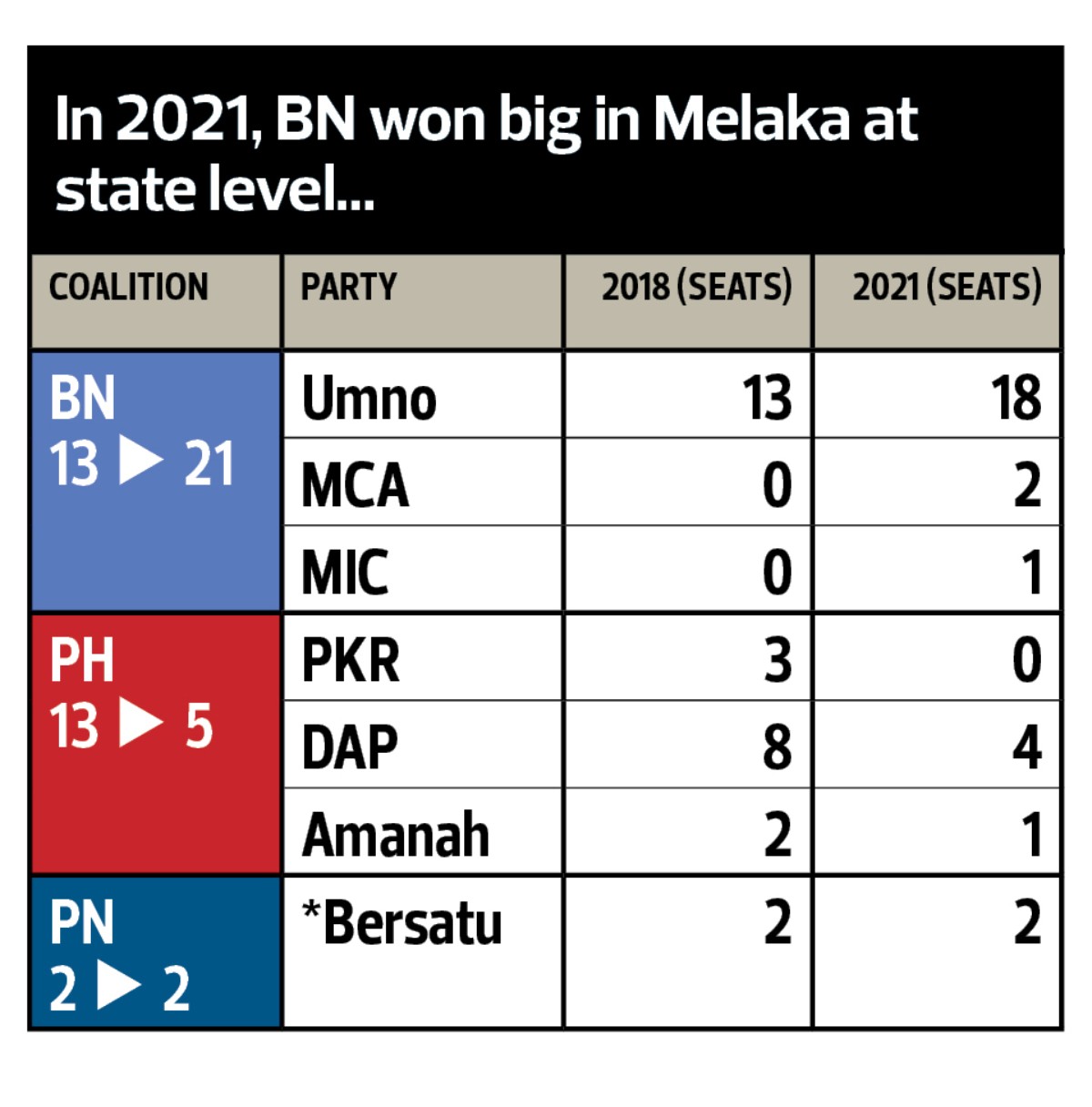
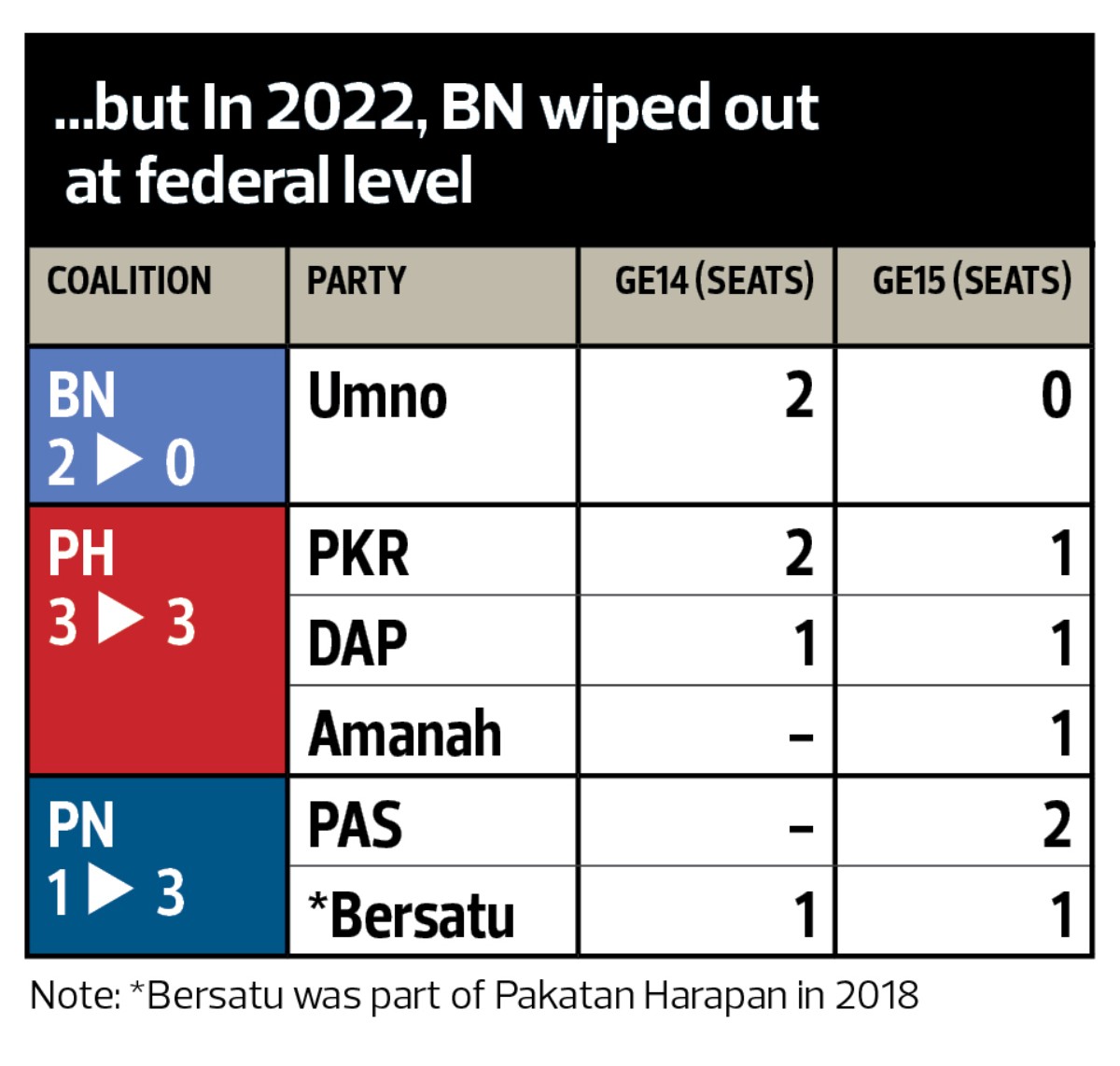
Although BN triumphantly reclaimed the state with a two-thirds majority in the 2021 state election, its momentum was short-lived. Just a year later in the 15th General Election (GE15), BN’s support plummeted again, with the coalition failing to win any of Melaka’s six parliamentary seats.
However, an analysis of GE15 voting trends across Melaka's state constituencies shows that BN's declining vote share coincided with a substantially larger increase in support for PN than for PH.
In 20 of the 28 state constituencies, PN registered greater gains in vote share than PH compared to the 2021 state election (see Table 1).
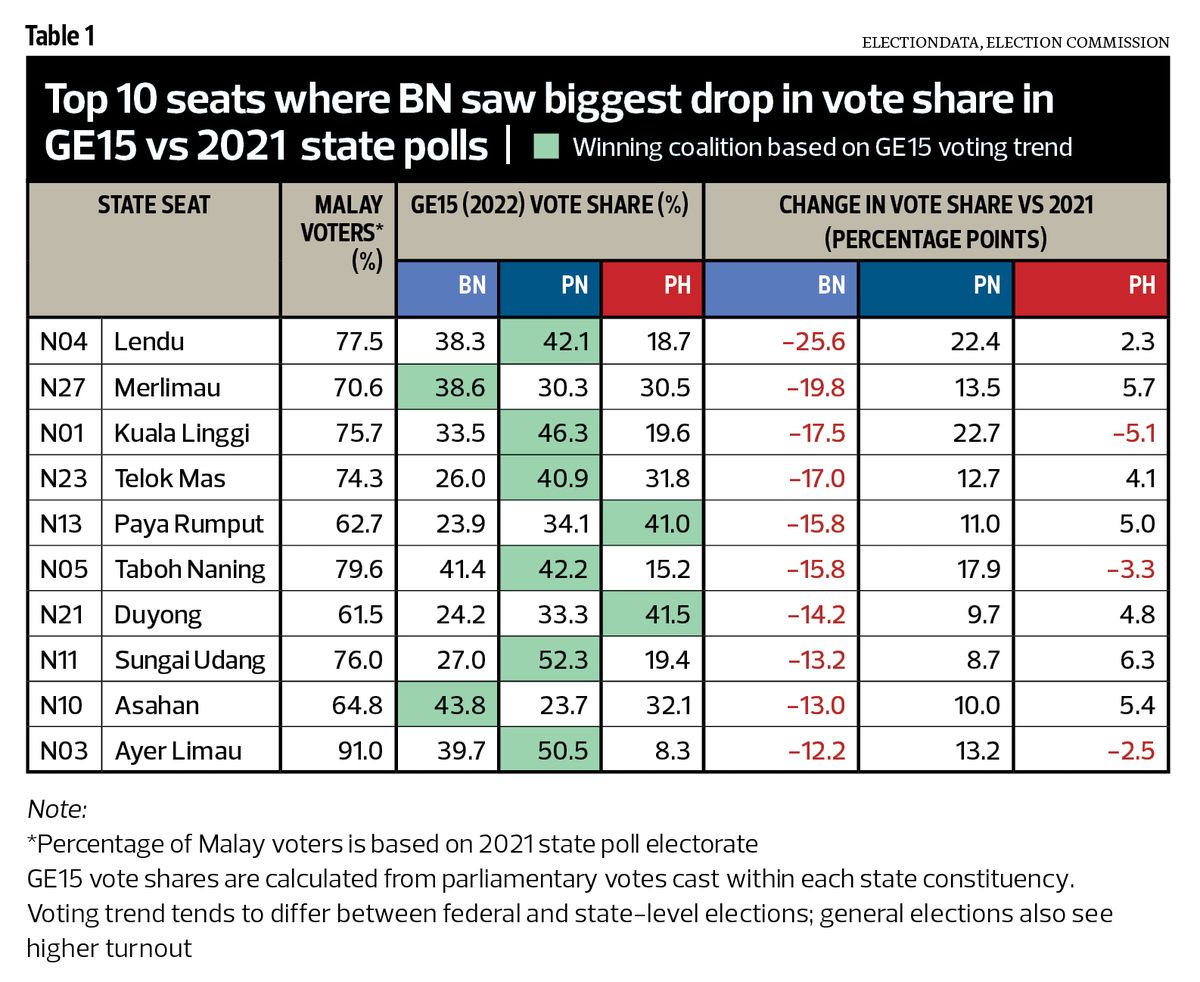
This shift is particularly significant, given that BN and PN are now electoral partners, although differences in voter turnout and voting patterns between state and federal elections mean that past results cannot be directly extrapolated to the coming polls.
Furthermore, Melaka's electoral roll has expanded by 30,373 voters since GE15, following the implementation of Undi18 and automatic voter registration.
Against this backdrop, Oh Ei Sun, principal adviser at the Pacific Research Centre of Malaysia (PRC), believes BN-PN could secure “something very close” to a clean sweep.
To Oh, internal tensions within the alliance are secondary. “What matters is the sweeping, genuine and insurmountable Malay voters’ desire to ensure an all-Malay government,” he says.
Under the banner of Penyatuan Ummah (Malay unity), BN and PN have carved out Melaka’s 28 state seats. BN is contesting in 23 seats, while PN is fielding candidates in five.
PH-Bersatu pact: Utility in vagueness
Meanwhile, the PH-Bersatu pact remains ambiguous. Beyond clashing in three seats, Bersatu noted that it had not been informed about the specific ground support it would receive from the PH machinery.
Bersatu information chief Datuk Tun Faisal Ismail Aziz told the press that the party is “open to cooperation with any party, as long as our seats aren’t sacrificed. If (PH) can help us win in Bemban, that’s good”.
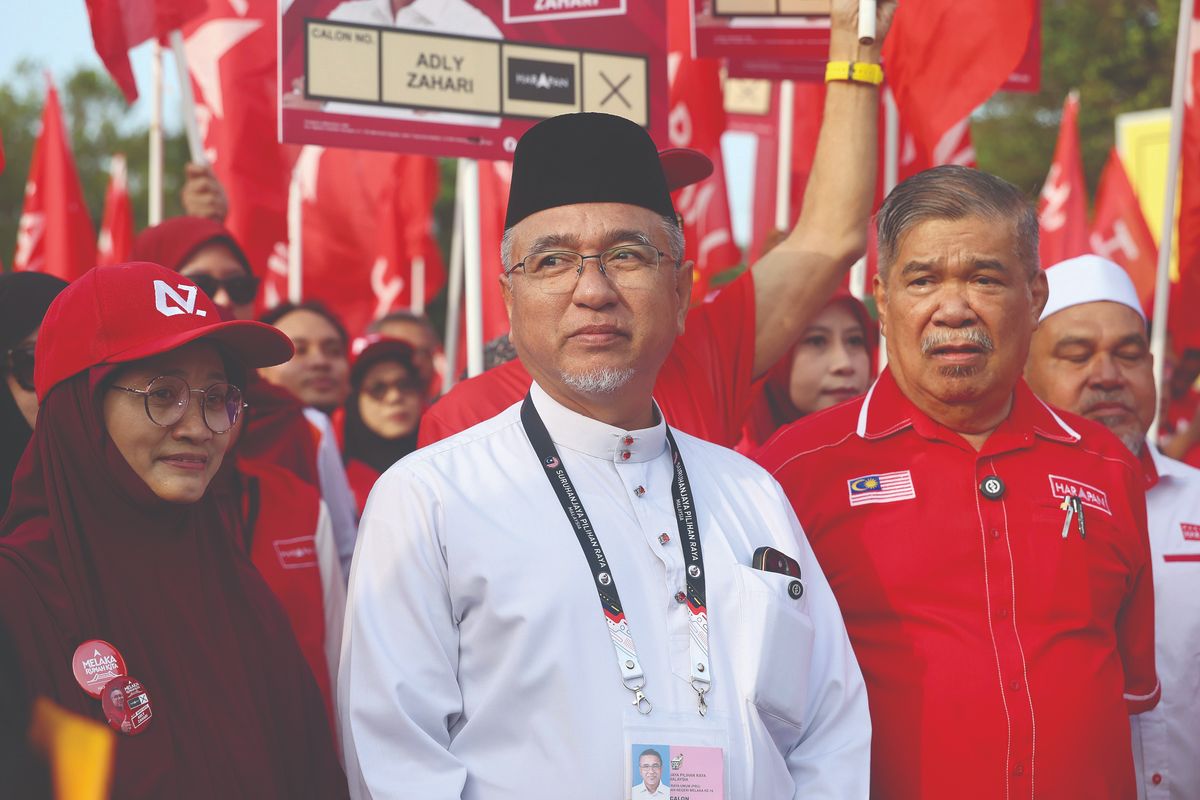
Ground checks show that PH has begun helping its partner in Bemban, though its machinery has yet to turn up to fully support Bersatu's campaign.
A Democratic Action Party (DAP) grassroots representative says he is introducing Bersatu’s candidate for N24 Bemban, Muhammad Rabaie Ab Hamid, to the villages served by DAP. Rabaie also says members of Parti Keadilan Rakyat (PKR) and Parti Amanah Negara (Amanah) have been supporting him.
Behind the scenes, however, some DAP grassroots members “were sulking, some were disappointed”, the representative admits. But “whether they like it or not, they have to accept it because this was a decision made by the central leadership to give the seat to Bersatu”, he adds.
This discontent among some PH members may be the reason behind the vagueness in the cooperation between PH and Bersatu — to minimise the backlash among core PH supporters.
“Sometimes in politics, there is utility in vagueness,” says Ahmad Fauzi Abdul Hamid, professor of political science, School of Distance Education, at Universiti Sains Malaysia (USM).
He suggests that an overly explicit pact between PH and Bersatu could feel like a “stab in the back” to supporters still resentful of Bersatu's role in the 2020 Sheraton Move, which collapsed the PH 1.0 federal government.
“Giving a direct instruction to PH supporters to support Bersatu for this election would be too drastic a turnaround of events, which will likely cause them to sit out the election, thus giving away free seats to BN-PN,” Ahmad Fauzi explains.
“Such supporters will need time to adjust to the new political equations as negotiated by their political bosses. Vagueness leaves room for post-election political manoeuvring should such a need arise later.”
The wildcards: Bersatu and Bersama
Beyond grassroots alignment, uncertainty remains over how much electoral strength Bersatu brings to the table.
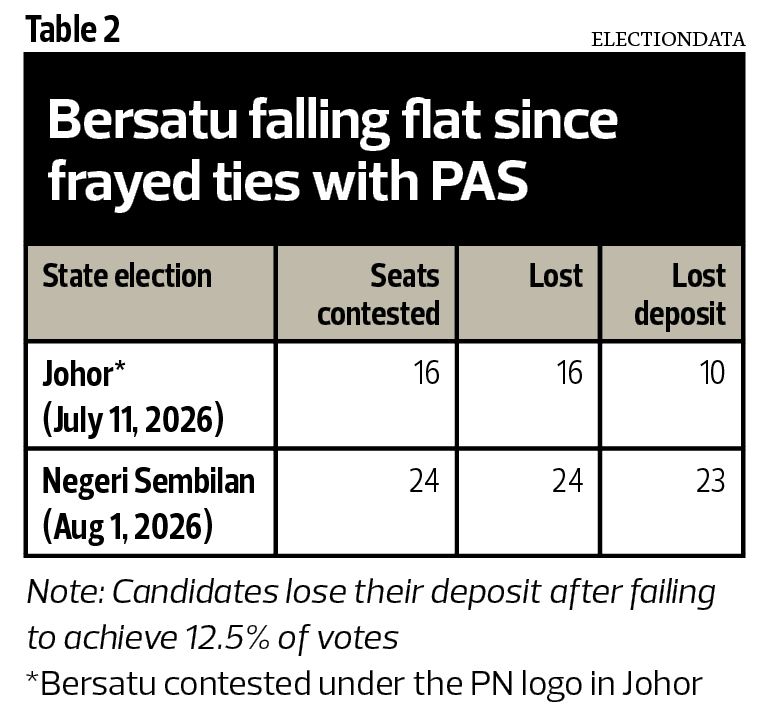
Since its partnership with PAS unravelled earlier this year, Bersatu has struggled, suffering poor results in both the Johor and Negeri Sembilan state elections (see Table 2).
In Johor, it lost all 16 seats it contested under the PN logo and had to forfeit its deposit in 10 after failing to secure at least 12.5% of votes cast.
In Negeri Sembilan, where it contested under its own logo, the party lost all 24 seats it contested, saving its deposit in only one.
"It remains to be seen if they could really reinforce each other’s electoral support, as until not so long ago they were at each other’s political throats," Oh notes.
Residents in Bemban were quick to confuse Bersatu for its now-splinter party Parti Wawasan Negara (Wawasan), led by former Bersatu secretary-general Datuk Seri Hamzah Zainudin.
This confusion could undermine Bersatu, as it faces its former member and Bemban incumbent, Dr Mohd Yadzil Yaakub of Wawasan, together with another wildcard, Parti Bersama Malaysia (Bersama).
For Bersama, the goal in Melaka is not to win but to secure a 15% vote share across the 16 seats it is contesting, according to leader Datuk Seri Rafizi Ramli during a walkabout at Pasar Pagi Bukit Beruang in Ayer Keroh.
Achieving that target will be tough. In Johor, Bersama lost its deposit in all 15 seats it contested, while opting not to contest in Negeri Sembilan. Although some argued the poor showing was unsurprising given the party's electoral debut in the state, it was nevertheless viewed by some within PH as a "spoiler" that cost the coalition victories in Perling and Bukit Batu.
In Ayer Keroh — a DAP seat that party insiders see as vulnerable — incumbent Kerk Chee Yee acknowledges Bersama’s potential to siphon off PH votes. Ayer Keroh is also one of the three constituencies where PH and Bersatu will face off directly.
One election too late?
With the new political realignments drawn, Melaka serves as the final testing ground in Peninsular Malaysia before the 16th General Election (GE16) that is expected next year.
This raises the question: Has the PH-Bersatu pact arrived one election too late?
While BN-PN has had two elections to hone their machinery, PH-Bersatu must contend with lingering resentment, seat overlaps and unproven grassroots synergy.
USM’s Ahmad Fauzi agrees that earlier joint efforts in Negeri Sembilan could have given voters and party grassroots more time to digest the realignment.
With GE16 approaching, the Melaka polls will quickly reveal whether PH and Bersatu can turn their uneasy pact into an effective alliance — or whether they have left themselves too little time to bridge their differences.
Read also:
MELAKA: ELECTION WAR DRUMS BEATING | Last state polls in Peninsular Malaysia before GE16
MELAKA: ELECTION WAR DRUMS BEATING | DAP faces tough fight to hold ground in Ayer Keroh
Save by subscribing to us for your print and/or digital copy.
P/S: The Edge is also available on Apple's App Store and Android's Google Play.