

This article first appeared in The Edge Malaysia Weekly on November 9, 2026 - November 15, 2026

Malaysia is producing more tertiary graduates. Yet, many of them work in jobs that do not require their qualifications (or even a qualification), earn modest salaries and struggle to find the careers they expected. Meanwhile, employers complain that they cannot find people with the skills they need.
How can both be true? We will examine this apparent contradiction in the third and final part of this education series.
Wages are ultimately driven by the market — not dictated by policy
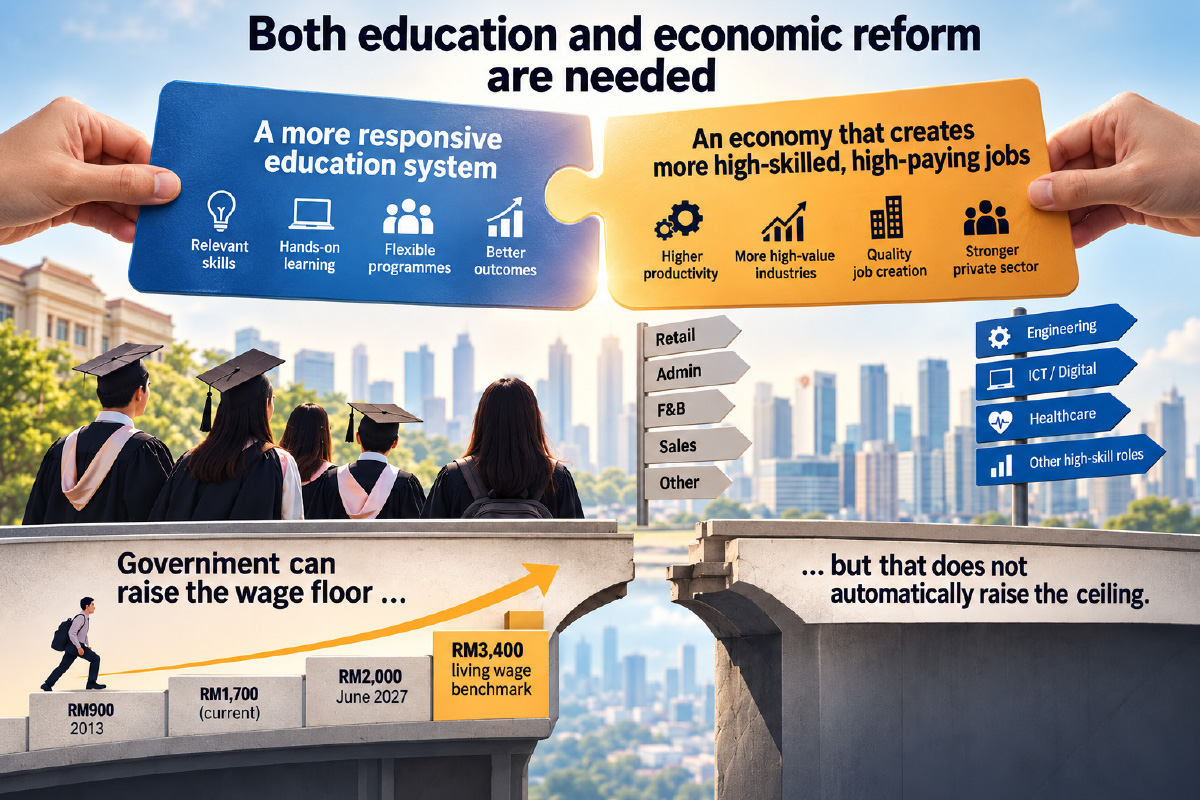
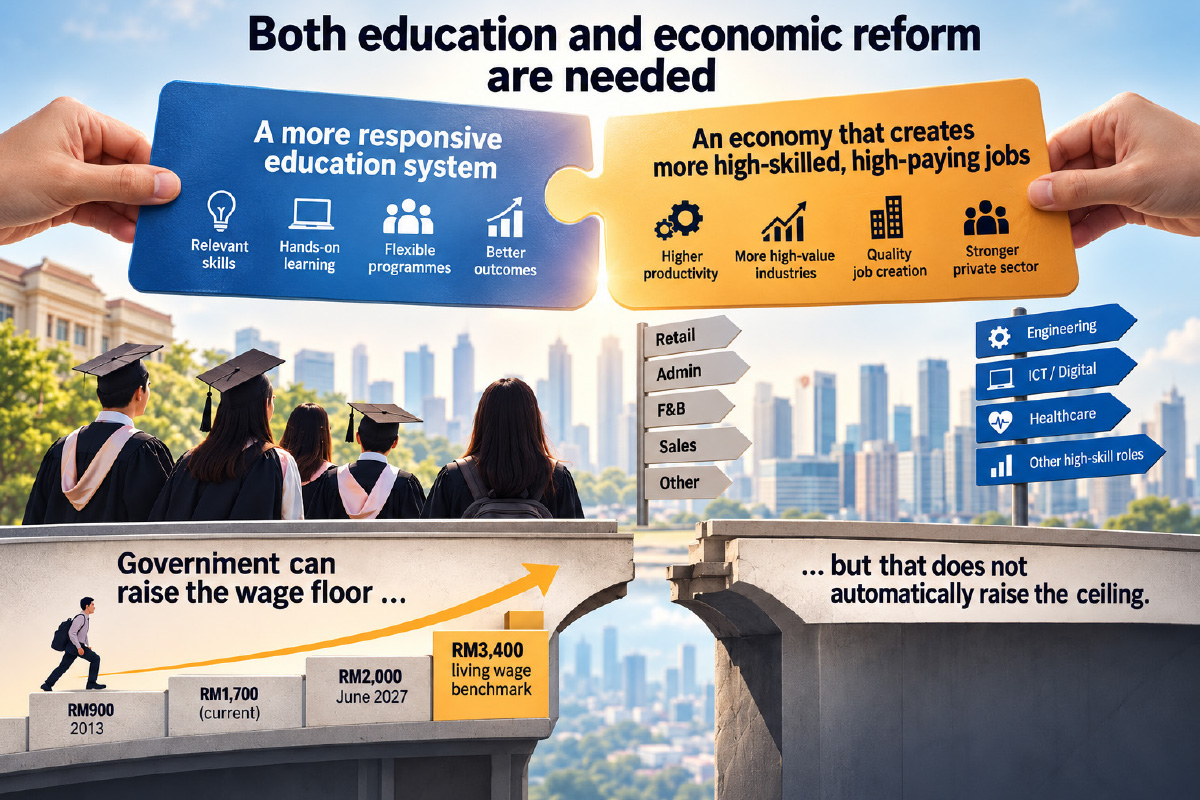
The government has made raising both the floor and the ceiling of Malaysian wages a top policy priority. The rationale is that raising the floor — through higher minimum wages and, to a lesser extent, the Progressive Wage Policy — will also push overall incomes higher to maintain the wage premiums between different skill levels. Similarly, the benchmark for government-linked investment companies (GLICs) and government-linked companies (GLCs) to pay a minimum living wage of RM3,100 to their permanent employees is meant to be wage-setting by example of sorts for the private sector.
The minimum wage policy was first introduced in 2013 at RM900 per month in Peninsular Malaysia and it has risen to RM1,700 currently. This is set to increase further to RM2,000 by June 2027 under the just-revealed Budget 2027. The living wage benchmark was also raised to RM3,400 a month while a RM2,500 minimum starting wage was announced for semi-skilled workers and graduates. The implementation mechanism for the latter is pending.
Will these measures address the underemployment issue? Or will misdiagnosing the problem — and therefore prescribing the wrong solution — result in worse unintended consequences for the economy?
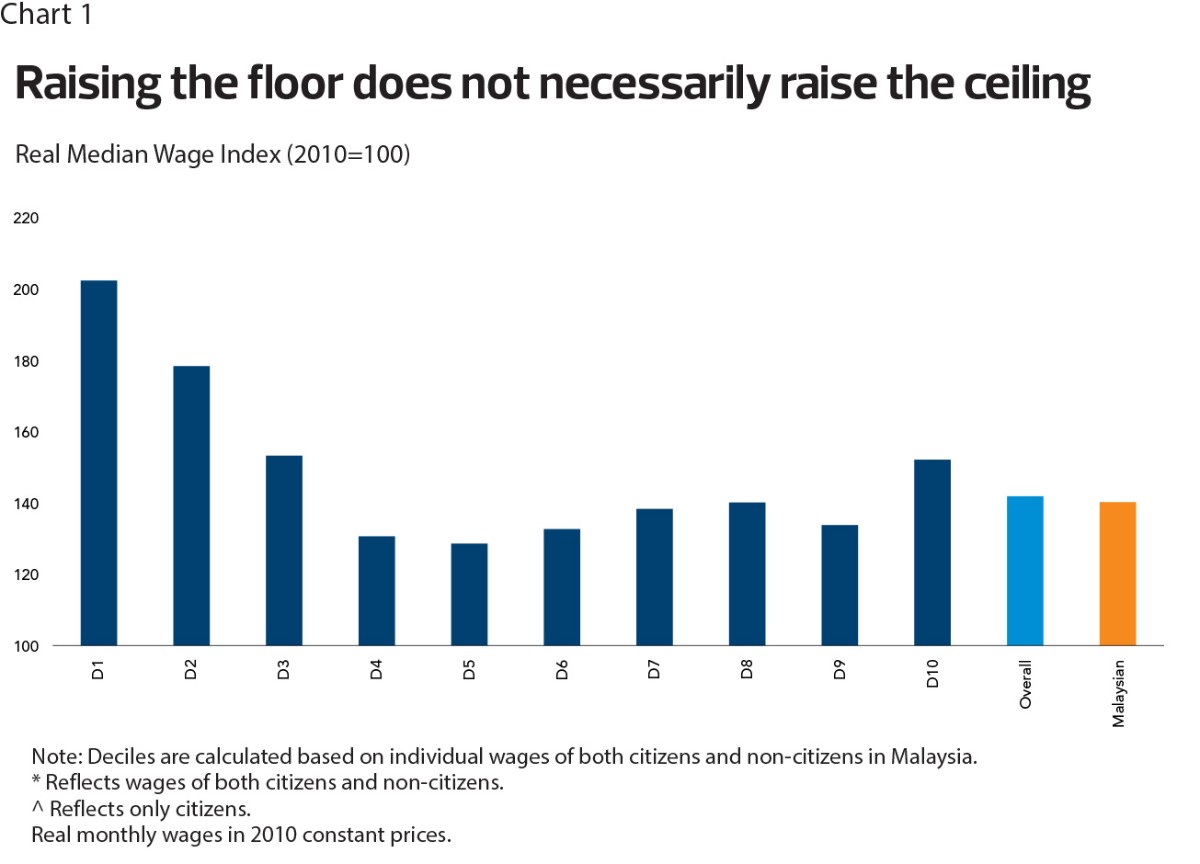
Raising the floor is the relatively “easier” task. Thanks to the aggressive minimum wage policy, real wage growth for low-income earners (the bottom 30%) has been strong over the past 15 years. However, the growth for every other wage group, save for the top 10%, has lagged badly (see Chart 1).
The government’s implicit diagnosis for our high underemployment rate is that employers are not paying wages that are commensurate with worker qualifications. This may well be the case in individual industries or occupations, but there is little evidence to suggest that employers are systematically underpaying their workers.
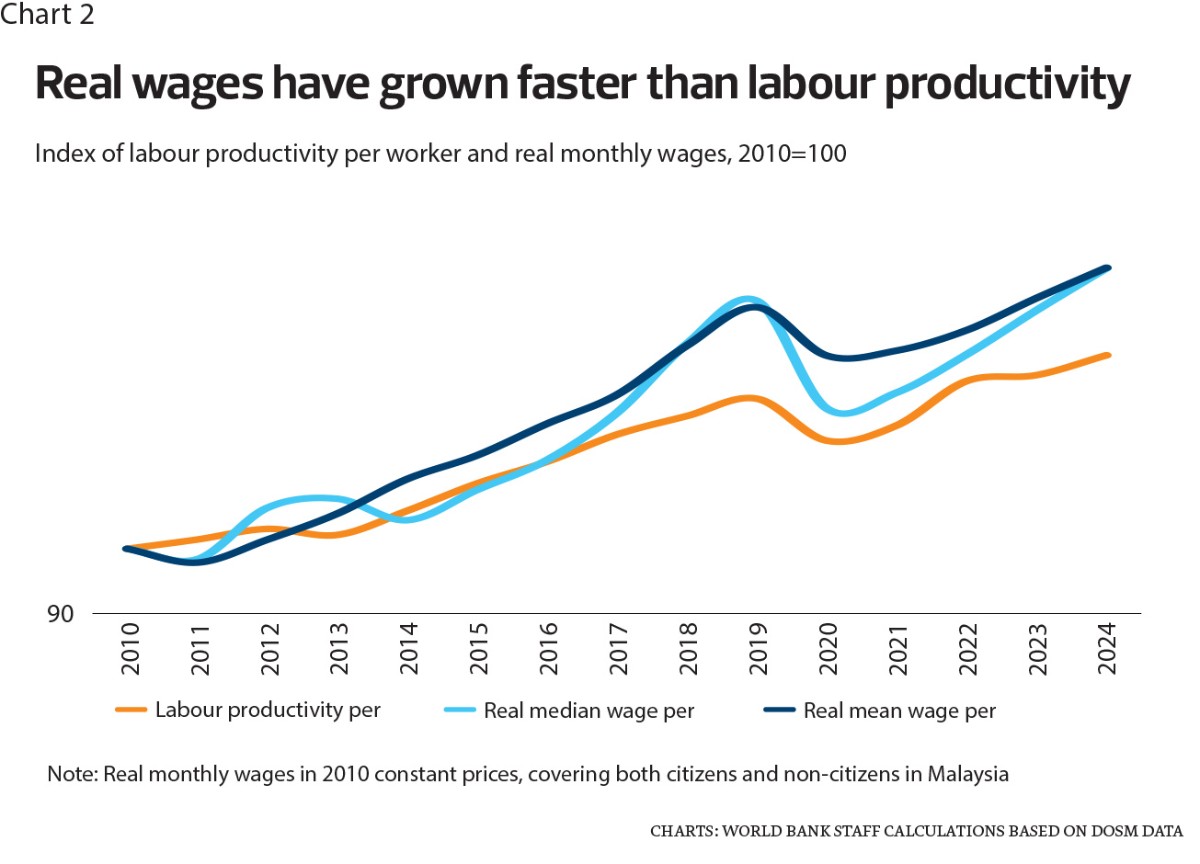
For instance, average wages have risen faster than labour productivity over the past 15 years (Chart 2). It does not necessarily mean workers are overpaid. But businesses competing in the domestic and global markets cannot afford to consistently pay more without corresponding improvements in productivity, margins or prices.
The more fundamental reason for Malaysia’s graduate underemployment, we think, is two-fold. On the labour demand side, our economy is not creating enough high-skilled, high-paying jobs. And on the supply side, the education system is not consistently developing the capabilities those jobs require. These problems can coexist — and reinforce each other.
Let’s start with the data.
What does the graduate wage tell us?
The Department of Statistics Malaysia (DOSM) reported in October 2025 that graduates aged 24 and below earned a median monthly wage of RM2,031. This is well below the RM3,100 living-wage benchmark adopted by GLICs and GLCs.
The gap is troubling. But it does not, by itself, explain why earnings are low. A living-wage benchmark concerns what workers (in this case, privileged ones) need to live reasonably. The median wage describes what workers currently earn. Neither directly measures their capabilities nor establishes whether employers reward them fairly.
The median also combines graduates with different qualifications, fields of study, occupations and experience into one figure.
The salary distributions in Chart 3 reveal substantial differences between fields. More than 85% of ICT (information and communications technology) graduates earn above RM2,000, with the largest group earning between RM3,000 and RM4,000. At the other end, around 60% of education and arts-humanities graduates earn below RM2,000.
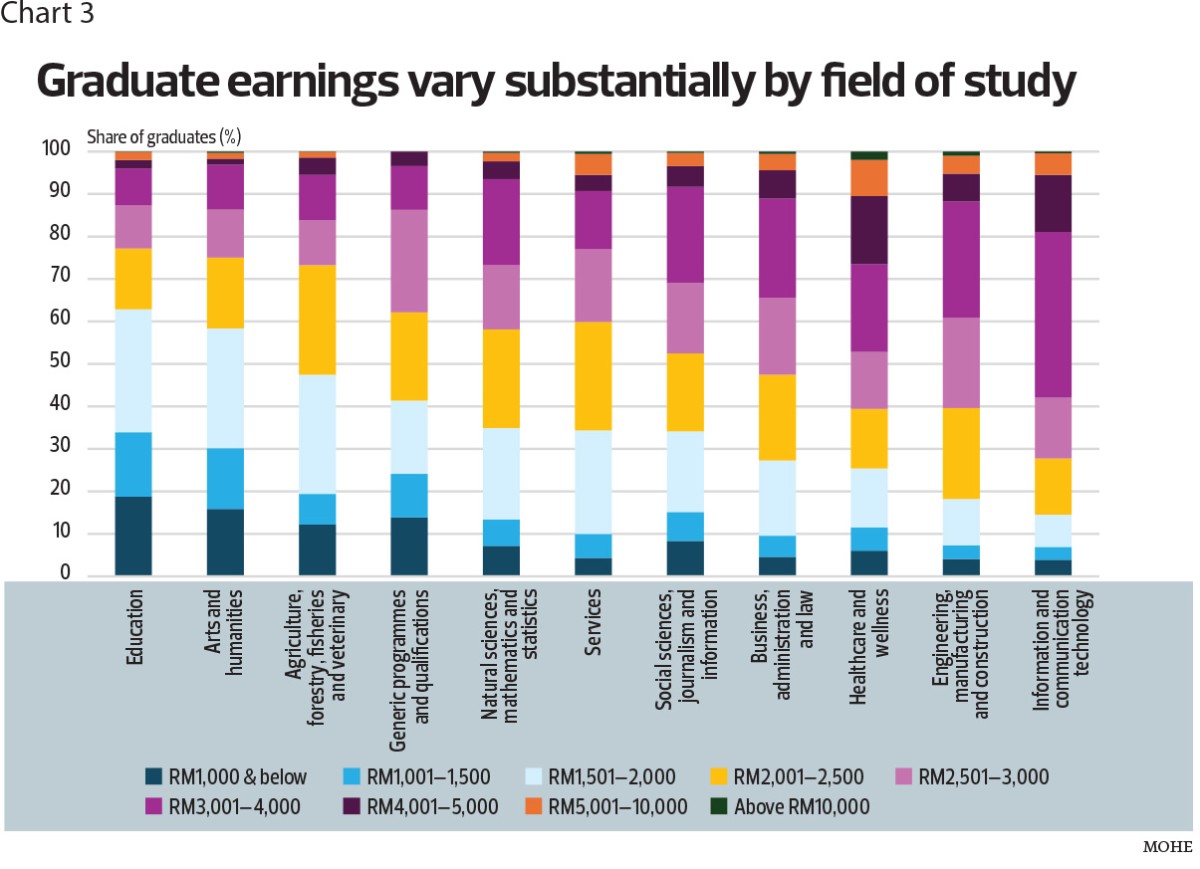
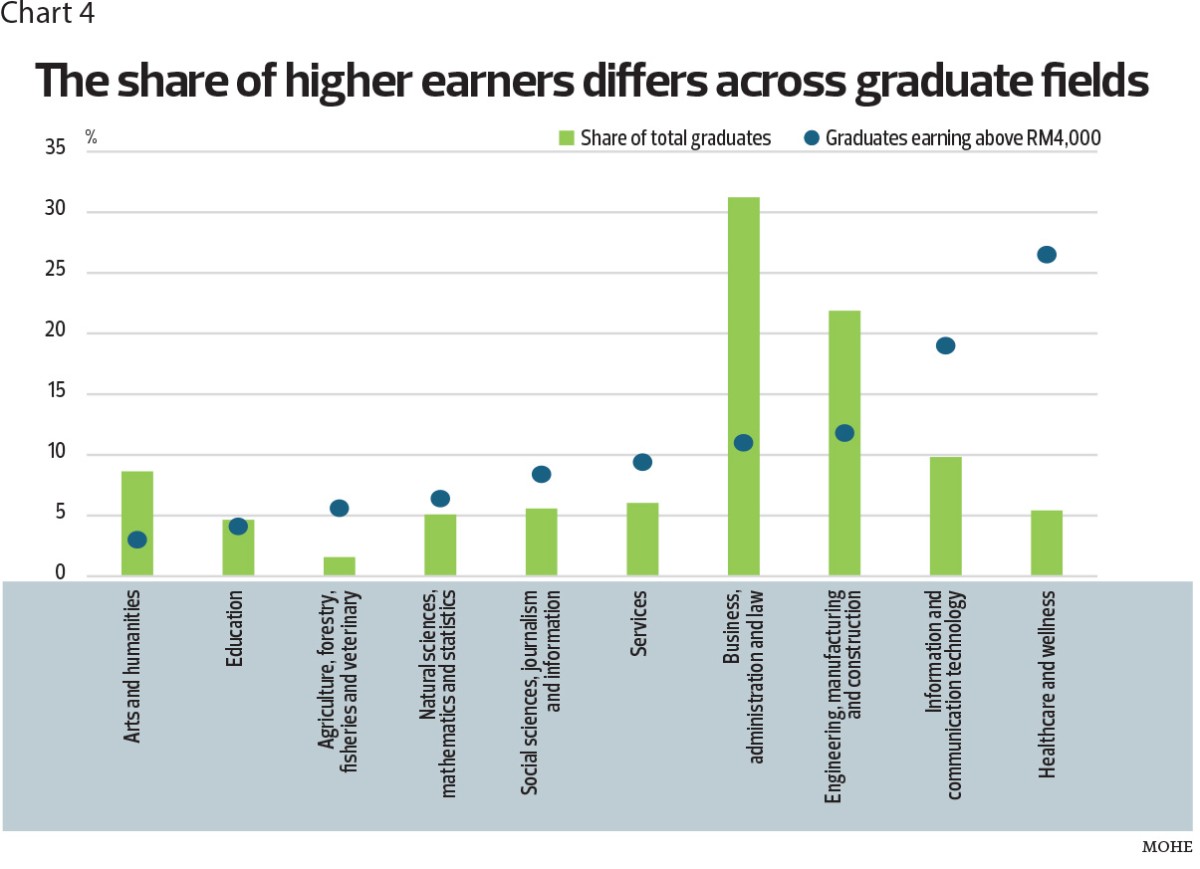
Chart 4 similarly shows considerable differences in the proportion of those earning above RM4,000. Graduates in the fields of engineering, manufacturing, ICT and healthcare and wellness have the highest percentages.
These patterns are consistent with the importance of supply and demand for particular skills. If more graduates enter fields with lower earnings, surely the overall median is pulled down — exactly as reported by DOSM and articulated by some.
But the charts cannot on their own establish either lower-paid graduates lack skills or that employers pay fairly. Wages also reflect industry productivity, employer characteristics, location and the availability of suitable work.
The conclusion is nevertheless important: a graduate’s qualification alone cannot explain what the labour market will pay. We must examine what the person can do and where those capabilities can be applied.
Education: More graduates but not necessarily with the capabilities employers need.
Claudia Goldin and Lawrence Katz provide a useful framework for understanding this tension in their book The Race Between Education and Technology. Technological progress changes demand for skills. Education determines how rapidly their supply expands. The interaction helps shape the wage gap between workers with different educational backgrounds.
Their research traces how the expansion of American education helped narrow educational wage differences during much of the 20th century. When educational expansion subsequently slowed relative to demand for educated workers, those differences widened. Technology did not determine the outcome alone. The pace of educational advance mattered.
Malaysia’s circumstances are different. But their framework raises a pertinent question: are we expanding the supply of capabilities that technology requires, or just the supply of qualifications? In other words, Malaysia may be producing more graduates but are these graduates “learnt” for what the economy needs?
Case in point, employer surveys routinely highlight difficulties in finding workers with managerial and leadership skills, vocational, job-specific and technical skills (other than IT) as well as critical thinking-problem solving skills.
The blame, we believe, lies with both a culture of credentialism among students and the rigidity of our education system that has been too slow to adapt to evolving market demand.
Education must keep pace with evolving skill requirements of the job market
The gradual but sure deterioration in the quality of Malaysia’s education system has been left festering for years, if not decades. And it is now manifesting in rising underemployment rates and slow productivity gains that limit wage increases.
We cannot overemphasise the urgency for change. Not when artificial intelligence (AI) is evolving so rapidly and reshaping global economies. If our education system continues to adapt too slowly, the cascading problems may well grow into crisis proportions.
Unfortunately, there can be no quick fix. It is not about building more schools or even hiring more teachers. Improving our education quality requires the system to rebuild itself from its very foundations.


As we argued in the first two parts of this education series (scan QR codes above), more schooling does not automatically mean more learning. Malaysia has near universal access to basic education with primary and secondary schooling enrolment rates of 94%-95%. Yet, Malaysian kids only demonstrate learning outcomes equivalent to 8.9 years of schooling despite completing 12.5 years in school.
The most serious deficit lies in their inability to apply what they have studied in school to real-world situations. This suggests a weak grasp of fundamental concepts, thereby limiting their ability to reason critically, weigh alternatives and identify appropriate solutions.
Just as years of schooling do not automatically translate into learning, a degree certifies completion of a programme. It does not necessarily mean acquiring the capabilities and/or skills the market demands. Malaysia has a credentialism problem that is rooted, at least partly, in cultural attitudes towards education and social status.
It matters not how many straight-A students we produce, how well our GPN (Gred Purata Nasional) scores are improving, or how many graduates with multiple degrees we churn out each year. These are syok sendiri statistics. They cannot change the underlying reality. Worse, the reluctance to make honest assessments and confront uncomfortable truths, and tendency to mask failures only prevent us from learning from them, and doing better.
Graduates who worked hard to obtain their qualifications should not be left bearing the consequences of these systemic failures.
But even graduates with the right capabilities will struggle if the economy does not create enough jobs that can put those skills to productive uses.
Economic structure: Too few productive firms, too few high-skilled jobs
The World Bank in its April 2026 report, “Raising the Ceiling, Raising the Floor”, concluded that our underemployment is mainly a demand-side problem. Malaysia has become better educated, but the economy is not generating enough high-productivity firms and high-skilled jobs to absorb that talent.
We agree with many of the reasons cited. In fact, we have written extensively about these same issues, including the crowding-out effect of GLCs, cumbersome approval processes and regulatory compliance, protectionist policies, weak competitive pressure and prevalent rent-seeking, in our previous articles. We will not repeat them here.
Suffice to say, when businesses remain in low-value activities and productivity cannot keep pace with cost inflation (including wages), margins and profits suffer. This reduces the capacity and incentive to invest, expand and innovate — and create jobs that demand advanced capabilities, even where those capabilities exist.
In short, Malaysian firms are scaling too slowly and not creating the high-skilled, high-paying jobs needed to retain our talent.
Aside from electrical and electronics (E&E), our export footprint is small and declining. Per World Bank estimates, only 15% of Malaysian firms export at least 10% of sales and even firms exporting as little as 1% of sales are relatively rare.
Our business environment is not creating sufficient incentives for firms to grow. Without scale — the domestic market is too small with the population at only 34 million — many are losing competitiveness, not only in global markets but increasingly, even domestically, against foreign brands.
This is the other side of Malaysia’s graduate mismatch. Improving education alone will not be enough if firms have neither the incentives nor the opportunities to move into more productive, higher-value activities.
Education and economic reform must go hand in hand
Productive firms and capable workers need each other. Preventing Malaysia’s underemployment from turning into a chronic problem requires reforms on both sides.
Keeping pace with technology requires more than producing additional graduates in familiar programmes. As technology changes tasks, the capabilities needed to perform them also change. Education must provide both relevant knowledge and the ability to learn, reason and adapt.
This is particularly important when technological change accelerates, driven by rapid advances in AI. Training for one existing task may become less valuable. Strong foundations allow workers to acquire new skills and use new tools.
The right policy should therefore focus on how to increase the number of graduates where the market is signalling shortage — most notably in core engineering (civil, mechanical, electrical, chemical) and ICT (software developers, data and cybersecurity) as well as in the health and welfare industry. But, here too, increasing the graduate numbers must come hand in hand with improving the quality and relevance of their education.
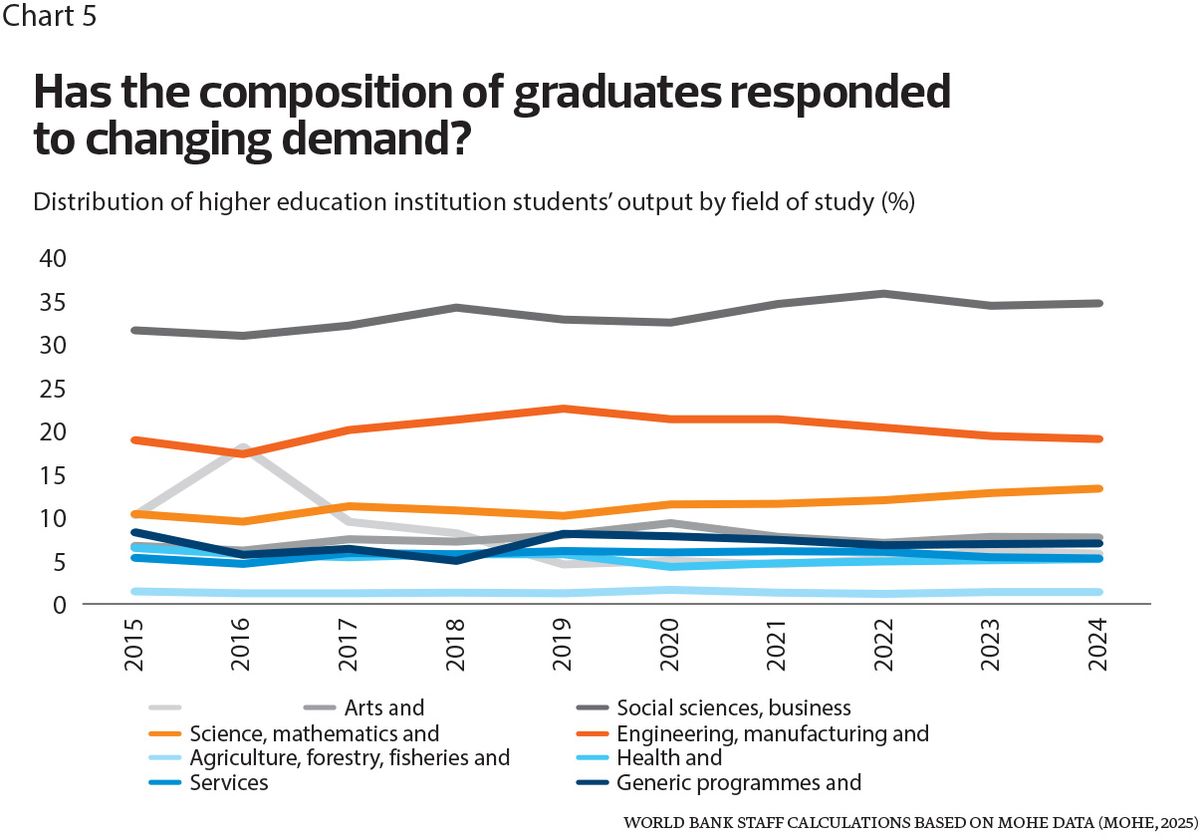
Case in point, the share of science, technology, engineering and mathematics (STEM) graduates has stayed fairly flat over the past decade. Graduates from social sciences, business and law, on the other hand, have risen (see Chart 5). Increasing the percentage of graduates from high-skilled, high-paying fields will be more effective in raising wages than through legislation. Provided, of course, the economy can create the jobs to utilise those skills.
The race can be lost even while graduate numbers rise. It can also be lost inside the workplace. Learning does not end at graduation. Firms develop capability through training, practical experience, demanding assignments and exposure to better methods. Employers therefore have a responsibility beyond asking education institutions to deliver fully prepared workers. They must invest in developing the workforce they need.
At the same time, there must be corresponding structural reform to address the Malaysian economy’s lack of dynamism. Improve the incentives so that productive firms will invest, innovate and expand, which will, in turn, create the new high-skilled, high-paying jobs.
Graduates too require a return on their education, in terms of career progression and income. Otherwise, the nation will continue to lose talent.
As things stand, those who can afford to study abroad do. And when they complete their studies, many tend to remain and work where they graduated. Our best and brightest local graduates migrate and work overseas, where they are rewarded for their skills. What this means is that the economic value generated by Malaysian talent is increasingly captured by foreign firms and foreign nations.
Left unchecked, the worsening brain drain risks creating a vicious feedback loop. One of the most important considerations for foreign direct investors is the availability of a local talent pool. When capable workers leave, the nation will be less attractive for high-value investments. Less investments will then limit opportunities for all those who remain.
We think the need for education and economic structural reforms is well known. Education supplies an essential foundation. Competition, investment and organisational learning help turn that foundation into economic value.
Education reform without economic reform will leave capable graduates underutilised. Economic reform without better education will leave businesses struggling to find the talent they need. Both must advance together.
We believe what must be done too is well understood. The issue is whether there is the political will to address the problems head-on.
The real challenge then is, how can we create the political incentives to carry out the necessary and well-understood reforms?
Portfolio commentary
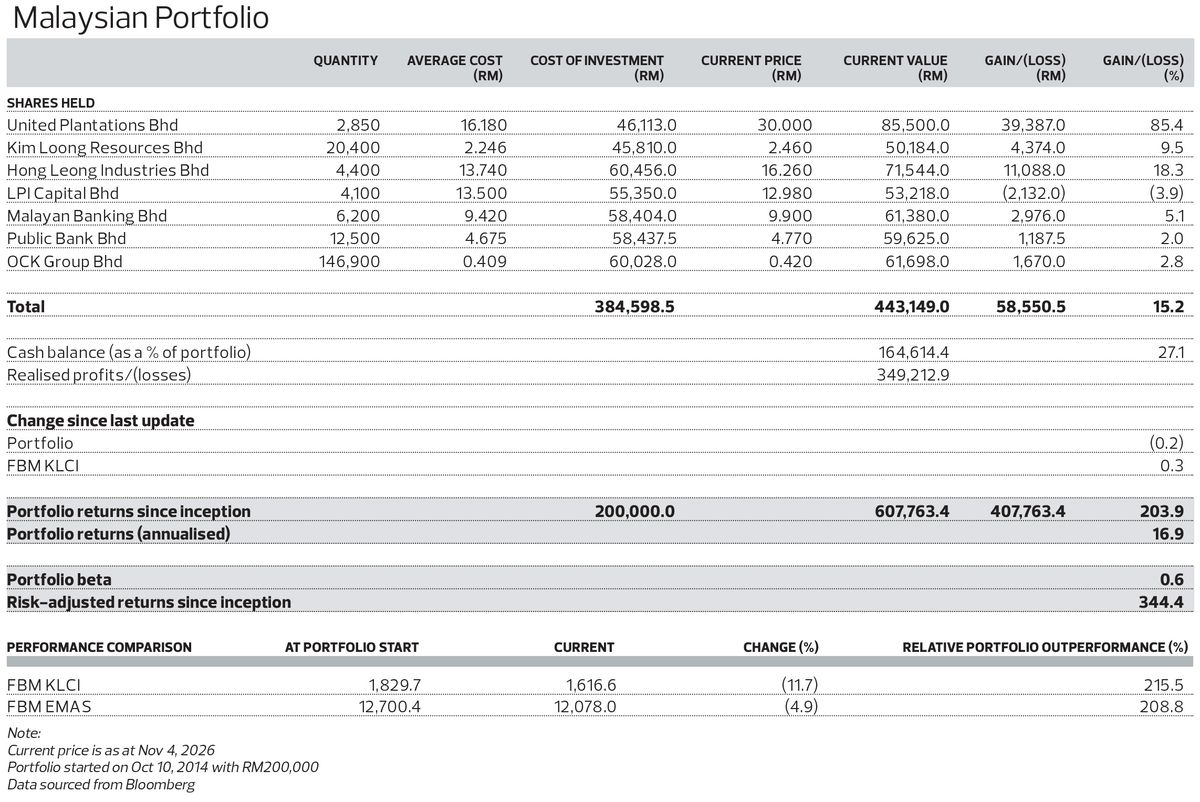
The Malaysian Portfolio fell 0.2% for the week ended Nov 4. The winners for the week were United Plantations (2.3%), Public Bank (1.3%) and Hong Leong Industries (0.2%) while the biggest losers were Kim Loong Resources (-3.1%), OCK Group (-2.3%) and Maybank (-0.9%). Total portfolio returns now stand at 203.9% since inception. This portfolio is outperforming the benchmark FBM KLCI, which is down 11.7% over the same period, by a long, long way.
The Absolute Returns Portfolio, too, ended 1.6% lower for the week, paring total portfolio returns to 28.9% since inception. Shares for Sun Hung Kai Properties (+5.9%), Microsoft Corp (+4.7%) and Alibaba Group Holding (+1.7%) bucked the broader market downtrend while the top losers were Alphabet Inc - CL C (-10.7%), Nvidia Corp (-7.1%) and Talen Energy Corp (-6.0%).
The AI Portfolio was also down last week, losing 11.4% amid a volatile technology earnings season and concerns over the implications of the US midterm election results for AI infrastructure spending. The top gainers were Naura Technology (+4.6%), Amazon.com Inc (+4.5%) and Alibaba (+1.7%) while the top losers were Datadog (-32.2%), Unusual Machines (-26.0%) and Hewlett Packard Enterprise (-17.0%).
Disclaimer: This is a personal portfolio for information purposes only and does not constitute a recommendation or solicitation or expression of views to influence readers to buy/sell stocks. Our shareholders, directors and employees may have positions in or may be materially interested in any of the stocks. We may also have or have had dealings with or may provide or have provided content services to the companies mentioned in the reports.
Save by subscribing to us for your print and/or digital copy.
P/S: The Edge is also available on Apple's App Store and Android's Google Play.