

This article first appeared in The Edge Malaysia Weekly on October 26, 2026 - November 1, 2026

Completing 11 years of schooling from primary (six years) to secondary (five years) is now mandatory for all Malaysian citizens. Parents who fail to comply can be fined up to RM5,000, jailed up to six months, or both. Per the latest United Nations Development Programme (UNDP) data, Malaysians have completed 11.1 years of schooling, on average, well above the global mean of 8.8 years — and just a shade lower than Singapore’s 12 years. A child entering school today has an even higher 12.7 expected years of schooling. By this measure, Malaysia places within the UNDP’s “Very high human development” category. A laudable achievement — but also a false narrative.
Here’s the thing: Schooling is not the same as learning. Yes, students attending school will acquire knowledge. But possessing knowledge versus understanding, using and applying that knowledge in real-world situations are very different things.
The World Bank tracks an essential metric called Learning-Adjusted Years of Schooling (LAYS). The core concept: The number of years in school under different settings can have very different learning outcomes. Put simply, two students can sit through an identical number of years in a classroom and emerge with entirely different levels of actual competency. And this is where the Malaysian education system is failing our young.
Using the World Bank’s methodology, Malaysia’s 12.5 years of schooling only produce learning outcomes equivalent to 8.9 years. In other words, 3.6 years of schooling are effectively “lost” due to educational quality gaps.
Why is this distinction critical? Because in the future world shaped by artificial intelligence (AI), knowledge is abundant and inexpensive. Even a student with photographic memory cannot come remotely close to matching the processing power of AI.
Therefore, the need for our education system to adapt has never been more urgent. We must shift from the current content-centric curriculum to an emphasis on critical thinking, reasoning and problem-solving to keep pace with rapid technological advancement. Knowing an answer is not the same as knowing what to do with it.
The 3.6 years Malaysia is already losing due to educational quality gaps are exactly the kind of reasoning and problem-solving capacity that’s about to matter more.
Persistently poor learning outcomes will deprive Malaysia of the productive capability to turn potential into prosperity. The government tacitly acknowledges this truth. But reform initiatives are falling short. Why?
You may also ask: How is it that our students are scoring excellent results in domestic exams, yet consistently underperforming in international assessments? This is the question we will answer in this Part 1 of our three-part education series.
Over the next two weeks, we will also aim to provide clarity on some of the most important issues and challenges facing Malaysia today.
Are Malaysian graduates truly underemployed and underpaid? For instance, we have Grab drivers who are university graduates. More than one-third of our graduates are working in jobs that do not utilise their qualifications, earning modest salaries and seeing limited progression in their expected careers.
Are our universities producing credentials, not skills? To be able to compete in the global job market, move up the value chain and command higher wages, Malaysian graduates must develop the skills required by the job market.
Finally, the elephant in the room.
Why are productivity growth and wages stalling, and why are our brightest increasingly seeking better opportunities abroad, contributing to other people’s economy?
Why is the brain drain worsening?
Is the Malaysian economy creating the opportunities that reward skills and capability?
We measure grades, not learning
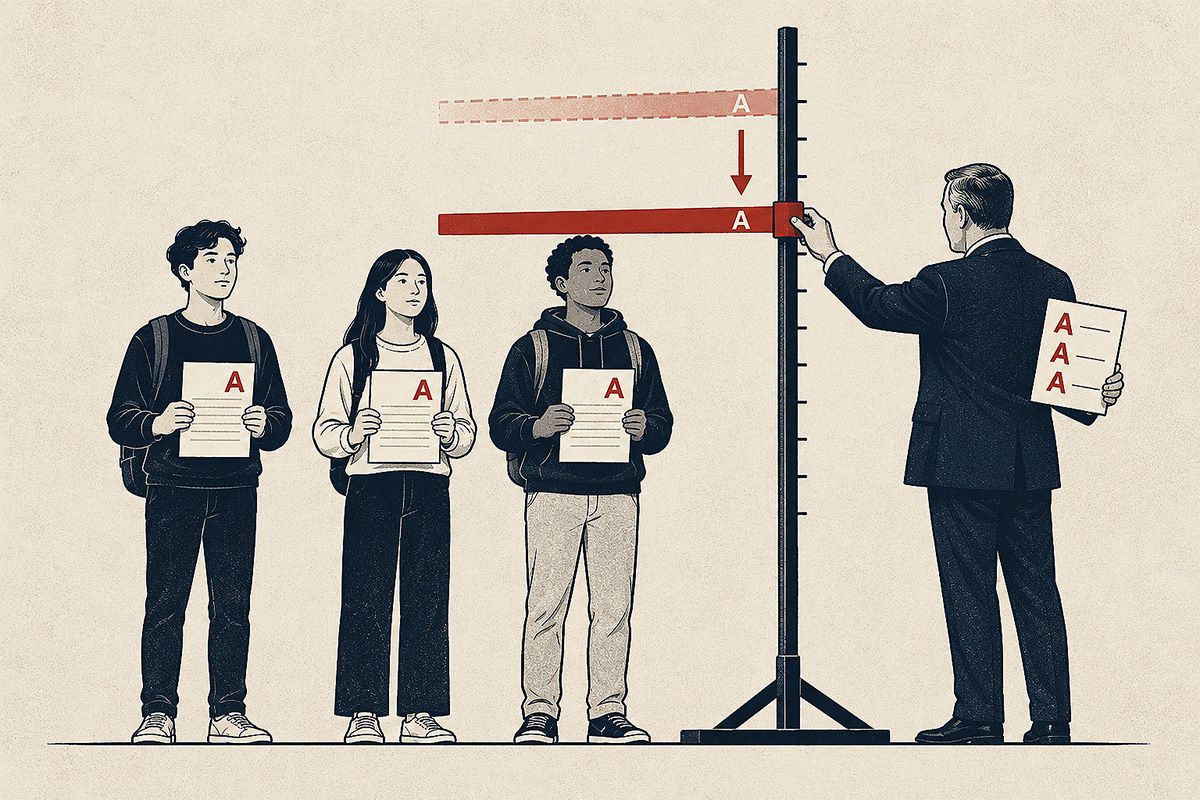
Malaysia produces a record number of straight-A students. Every year, our Ministry of Education (MoE) announces it as proof the system is working — and improving. However, in the one exam that Malaysia does not get to grade itself — the Programme for International Assessment (PISA), an international evaluation for 15-year-olds in more than 80 countries that is coordinated and conducted by the Organisation for Economic Co-operation and Development (OECD) — the scorecard is far less flattering.
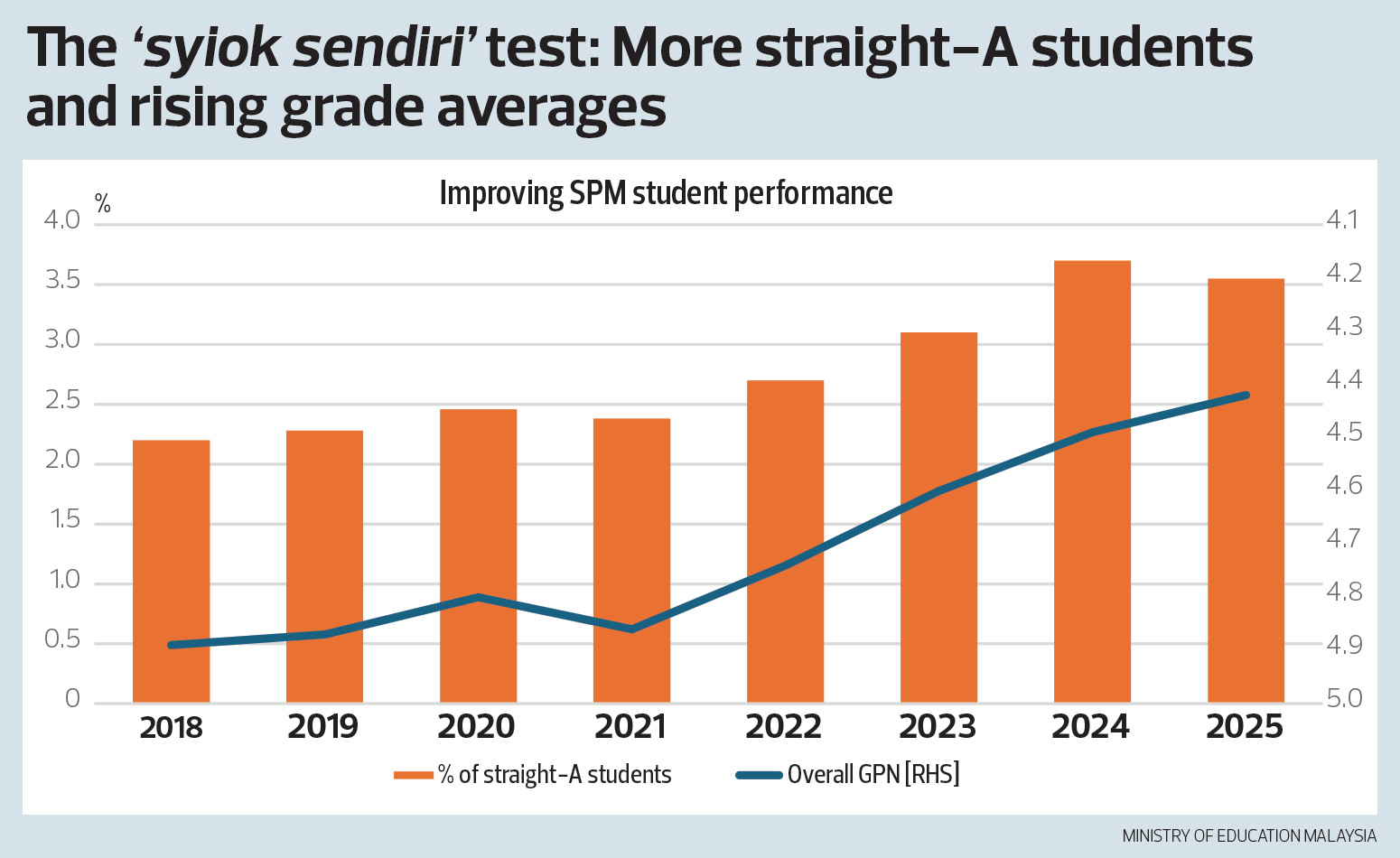
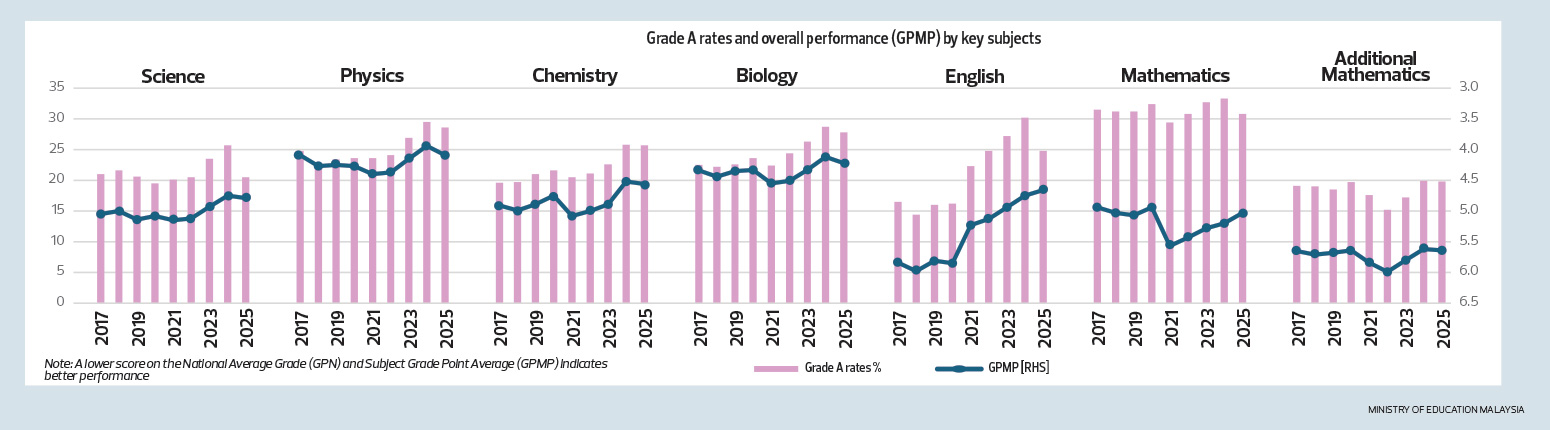
Over the past 15 years, our students’ scores in science and mathematics have fallen slightly while reading saw a sharper decline. In short, deteriorating. Why are test results for essentially the same group of students showing such divergence (see Charts 1 and 2)?
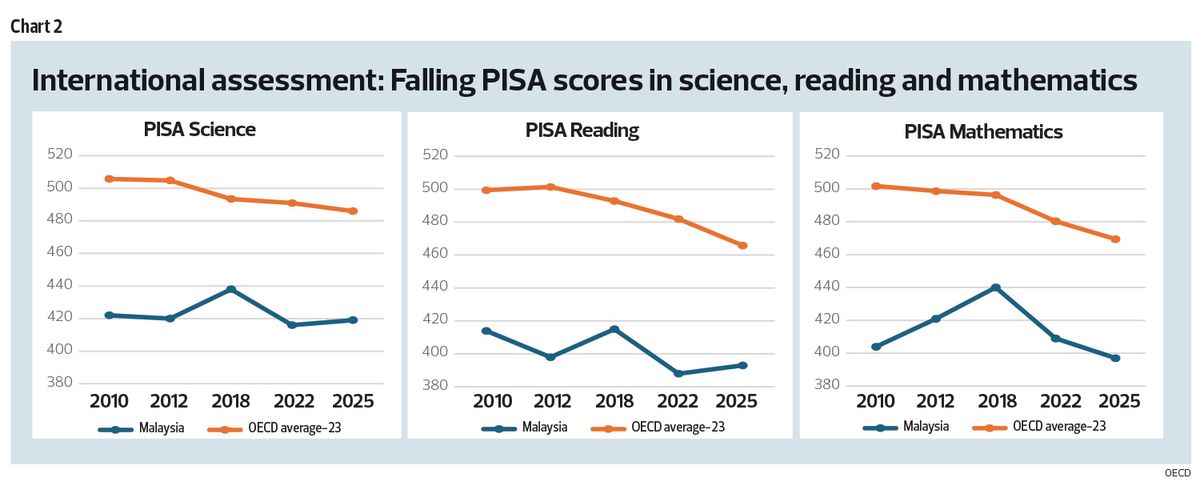
The answer, we believe, lies in what we wrote earlier — the difference between schooling and learning. Case in point: Our PISA scores are far below OECD averages even though we are almost at par with these countries in terms of years of schooling (11.1 years vs 12.3 years). The scores also corroborate the World Bank’s lowly 8.9 LAYS for Malaysia (see Chart 3).
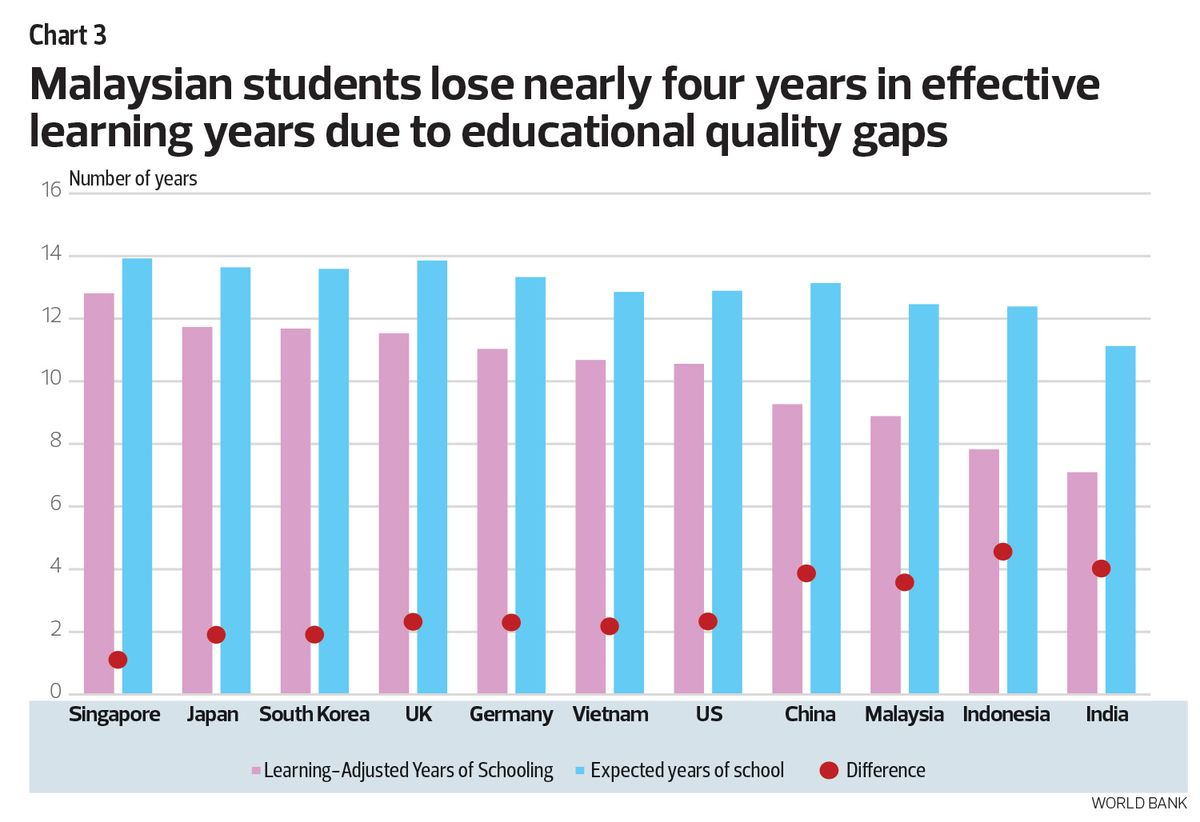
All these statistics point to the deep divide between schooling (the time spent sitting in a classroom) and learning (the critical skills they absorb).
Malaysia’s education system is optimised for memorisation and passing exams. PISA assesses not only the knowledge and theoretical principles, but also how well students can apply them to unfamiliar, real-world situations, think critically and solve complex problems.
What is perhaps more alarming is that less than 1% of Malaysian students rank as top-tier performers — in mathematics (0.6% compared with 8% OECD average), science (0.5% vs 7%) and almost none in reading (6% across OECD countries).
At the top tiers, a student can, for instance, turn a complicated real-world situation into a mathematical model, compare alternative models and judge whether the answer makes sense; or understand a long/abstract article, distinguish facts from opinions and make a judgement on the issues. These are precisely the skills needed in the era of AI, where knowledge is abundant and having basic knowledge alone is no longer sufficient.
A weak foundation in mathematics and science could also narrow student option and choice in university courses — and over time constrain Malaysia’s future pool of science, technology, engineering and mathematics (STEM) graduates, including engineers and scientists. This, at a time when STEM-related skills are among the fastest growing in demand for an AI-shaped global economy.
Widening learning gap
Malaysia’s apparent huge learning gap cannot be easily explained away as a matter of student motivation. PISA 2025’s (published by the OECD on Sept 8, 2026) own findings are explicit. On almost every self-reported measure, Malaysian students look like a population eager to learn: 80% described themselves as curious about many different things and 79% said they put in extra effort when schoolwork gets difficult, both notably higher than the OECD averages of 73% and 60%. Our students also described themselves as self-regulated learners with goal-setting behaviour and know when and where to ask for help.
Notably, though, only 37% of students in Malaysia (OECD average 69%) hold the belief that intelligence can be cultivated through work, effort and feedback. This is the Malaysian education system failing our students.
That gap should prompt a hard question for our schools: Are students being shown how their effort translates into better understanding and stronger skills?
If schoolwork is built around completing tasks rather than visibly building a skill, a student can do everything asked of him/her and still have no evidence that any of it is making them more capable in the real world. Their effort is real; the system simply fails to supply proof that it matters.
The problem is structural. It suggests the need for greater focus on whether every child has genuinely acquired comprehension, critical thinking, independent problem-solving and a healthy learning mindset — instead of numerical results and schooling years.
Without those foundations, a student can attend school, complete homework and pass every internal exam with flying colours — and remain poorly prepared for employment.
A broken feedback system negates the incentives for improvements and reform
Yet, this is not how the story gets told at home. Domestically, the national conversation around education rarely reflects the picture the PISA scores and World Bank’s index paint.
The percentage of SPM candidates obtaining straight As has risen by nearly 70% since 2016. The average grade-point performance nationwide (National Average Grade or GPN) — and across nearly all key subjects — too has shown marked improvement.
In other words, our students are performing splendidly simply by looking at their SPM results over the years. Therefore, there is little internal pressure and urgency for improvements and reform. Why fix what is not broken?
Malaysia’s MoE sets, administers and grades its own domestic exam. There are obvious incentives to make the system look like it is working and little incentive to reveal where it may be falling short. That’s the problem with self-measurement. Making failures visible creates discomfort and perhaps embarrassment, exposes weakness and demands accountability.
An international assessment, by contrast, sits outside that loop entirely. It is designed, administered and scored by an external party with no stake in how any single country’s students perform. There is no reason to be cautious about reporting quality deterioration. Hence, it offers an objective benchmark of performance against global standards.
Without honest measurement, critical feedback is lost. The system can no longer identify what works, what does not and what needs changing.
The world is constantly evolving, technology advances and the job market requirements for workers change, as do the value attached to different skill sets. But our education system is not keeping pace with these changes. It is selling Malaysians short.
Remember, Malaysian graduates will eventually have to compete for jobs and opportunities against students trained abroad. They would have to hold their own against these global standards.
Not about throwing more money at the problem
And no, spending more money does not address the underlying problem. The World Bank’s 2018 World Development Report found little correlation between school spending and learning outcomes across a wide range of countries.
A positive correlation does exist at low levels of spending, where a very poor country can gain a lot by building roads and schools for its people. But the incremental gains will decline as more schools with better access are built and attendance reaches high levels. Beyond a certain threshold, additional funding contributes little to no further payoff.
The amount Malaysia currently spends on education is already well above this threshold. It is the learning outcomes that are below par.
In short, it is not about spending more. It is about converting years of schooling into meaningful years of learning.
Objective, cross-country comparison will help
Let’s compare Malaysia against Vietnam — a country that spends less on education per student yet consistently outperforms us in PISA scores — and Singapore, the regional and global benchmark of quality education. What are their common denominators despite sitting at very different points on the income ladder?
For starters, both nations measure themselves against the world rather than against their own past scores. Singapore treats PISA and Trends in International Mathematics and Science Study (TIMSS) as central inputs into policymaking, while Vietnam openly uses the international results to find weaknesses within its own system.
Vietnam’s competency-based curriculum and Singapore’s emphasis on adaptive thinking focus on helping students apply what they learn, demonstrate their skills and adjust their reasoning when faced with unfamiliar problems.
To be fair, Malaysia does recognise that quality education increasingly goes beyond content knowledge, to an emphasis on critical thinking, reasoning and problem-solving. It has integrated Higher Order Thinking Skills (HOTS) and School-Based Assessment (PBS) into the national curriculum (lessons and exams) progressively since 2011.
Positively, HOTS may have played a role in the rising percentage of students who say they are curious about many different things and will persevere when faced with challenges, as seen in the latest PISA assessment. But there is limited evidence in actual student performance to suggest the reform has succeeded at scale. Why?
Quality of an education system cannot exceed that of its teachers
The primary reason, we think, is Malaysia’s education system has not equipped our teachers for the higher-order thinking curriculum as well as continuous classroom observation and assessment of students. Data from the Trust Schools Programme (TSP) shows that the capacity and capabilities of teachers to implement the PBS method is only at the 25% to 30% level.
This is not a small gap to leave open. McKinsey’s 2007 report on the world’s best-performing school systems concluded that the quality of an education system cannot exceed the quality of its teachers.
Across the top-performing systems studied, three things mattered most:
- Getting the right people to become teachers;
- Developing them into effective instructors; and
- Ensuring the system delivers the best possible instruction for every child.
This is strengthened by a follow-up McKinsey study of the world’s most improved education systems, which found the same pattern from a different angle — the systems that made the most progress focused on building teachers’ instructional skill directly, rather than structural reform or funding increases.
Chart 4 illustrates clear positive correlations between teacher quality and students’ learning outcomes, as measured by the Harmonised Learning Outcomes (HLO).
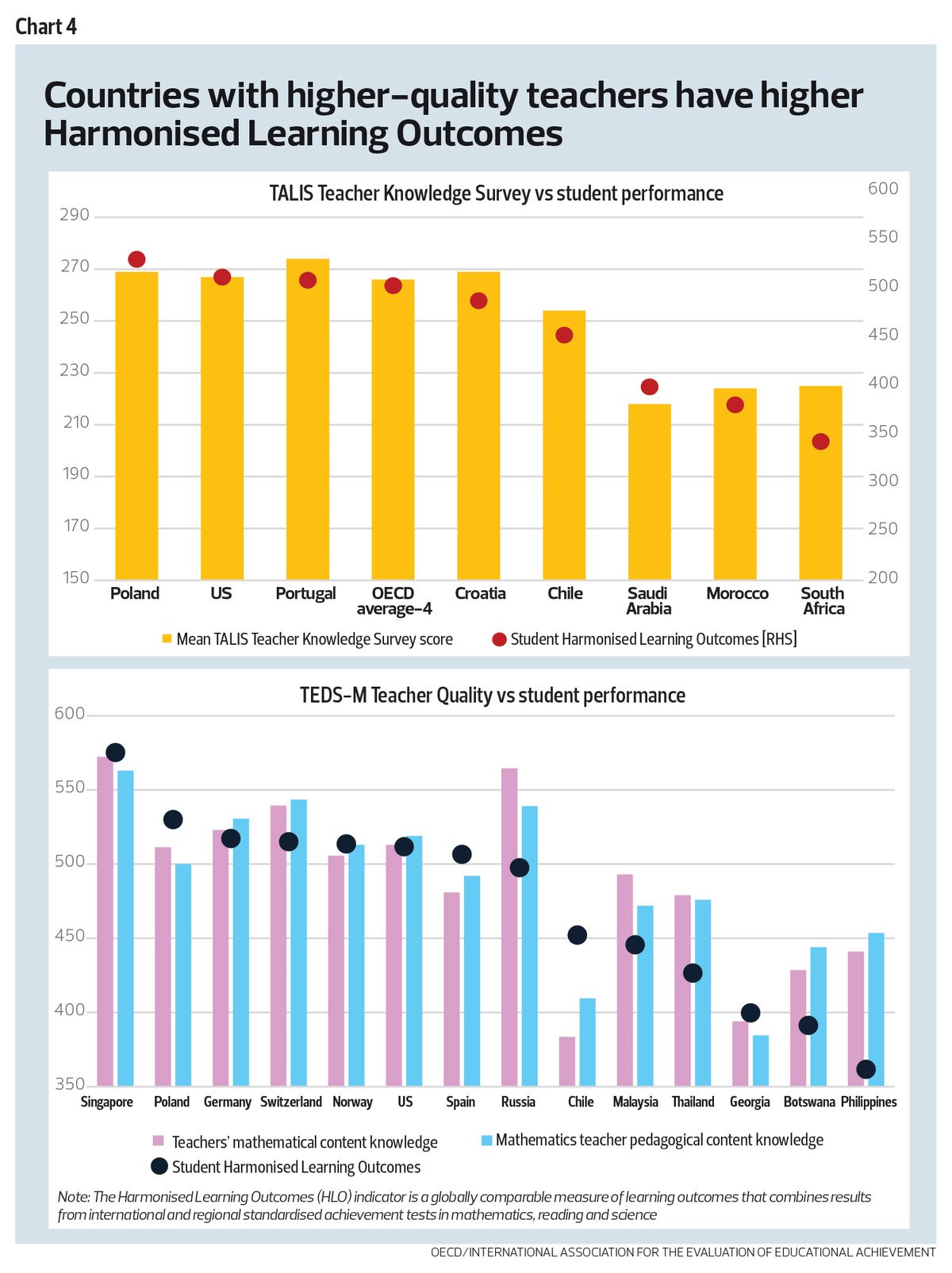
This raises the obvious question: How can Malaysia raise the quality of our teachers?
The intuitive answer to pay teachers more or raise the profession’s social standing to attract top talents turns out to be less decisive than most would expect.
Chart 5 shows no statistically significant relationship between teachers’ perceived social value and student learning outcomes, even after controlling for differences in expenditure per student.
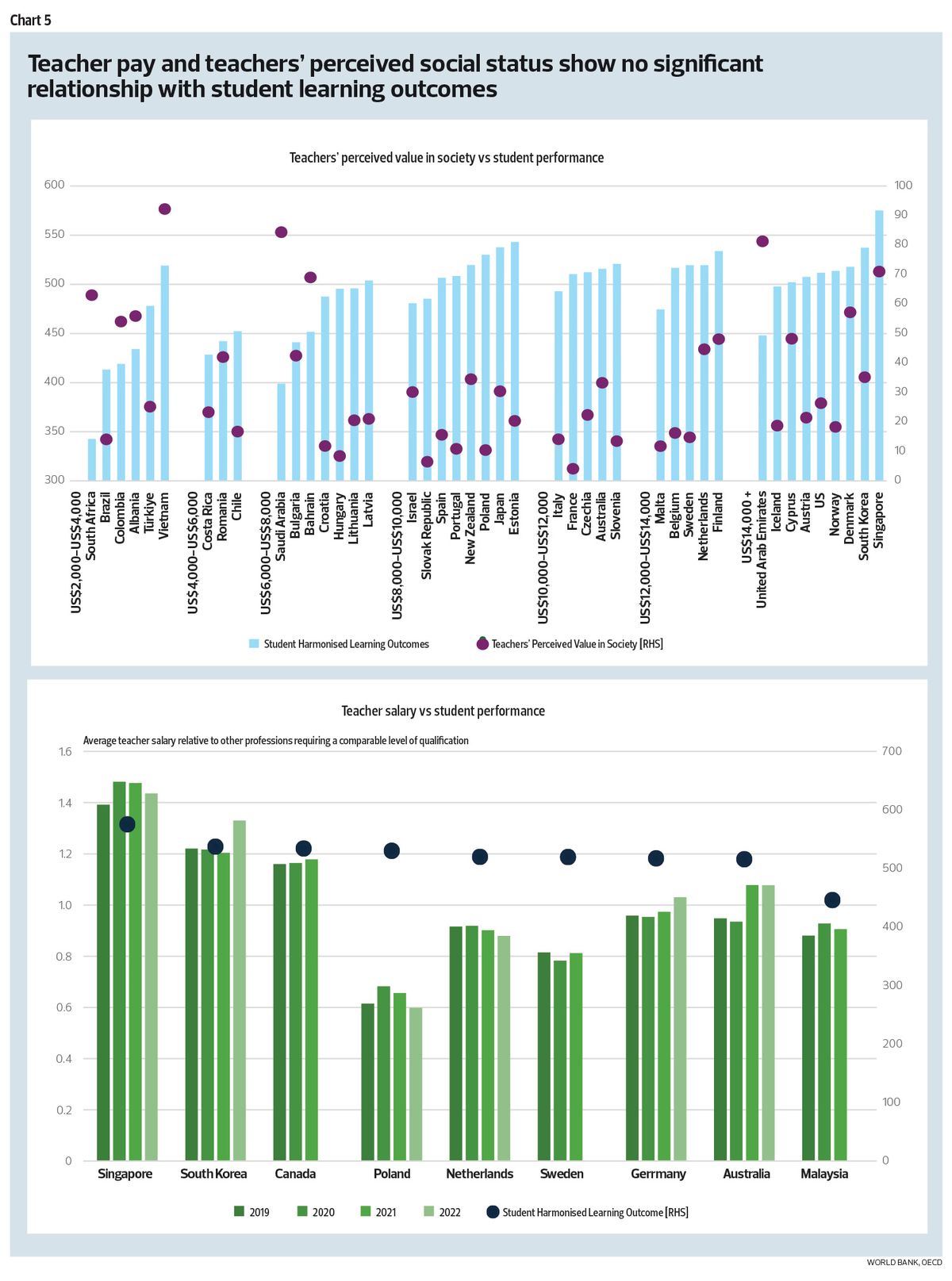
Neither does teachers’ pay provide any consistent correlation. The data shows that teachers in many top-performing countries are not especially well paid compared with other professions.
This result does not mean pay and prestige are irrelevant in every context. But it does mean neither is, on its own, a sufficient lever.
Other than pay and prestige, there is one other strong possibility — how teachers are trained.
Specifically, how well is the education system designed to produce quality, responsible educators? This includes both the initial, off-the-job training before entering the profession as well as continued on-the-job development that compounds over a career.
The most direct way to change teachers’ incentives is to tie career progression to student learning outcomes. And student outcomes must be benchmarked externally, not just domestically.
Interestingly, we circled back to the same self-measurement problem. Currently, Malaysia’s teacher appraisal system leans heavily on the supervisor. This is essentially an internal, largely self-contained assessment process, not unlike our examination system.
Without the robust use of external benchmarks in the appraisal system, there is no objective measure of whether internal judgements track real classroom impact. Here, too, we can learn from policies and practices in other countries.
Vietnam’s Ministry of Education and Training sets national professional standards for teachers and evaluates them through a combination of self-assessment, principal appraisal and periodic external review. Its standards are explicitly benchmarked against frameworks used in other higher-performing systems.
Singapore goes further. Its Enhanced Performance Management System ties appraisal and career progression to a broad set of demonstrated teaching competencies, evaluated annually against concrete performance targets.
Poor learning outcomes = weak human capital development
The problem with Malaysia’s education system goes far beyond the schooling system. What persists in our classrooms is really a symptom of a deeper problem running through the entire process of how Malaysia builds — or fails to build — human capital. Primary and secondary education is simply where that deeper issue is most visible first.
The term “human capital” refers to the skills, knowledge and capability embedded in a country’s people. In the long run, it is a more decisive determinant of a nation’s prosperity than the natural resources it sits on.
What a productive workforce can do has no fixed ceiling, and it compounds as a more capable workforce raises the return on every other investment a country makes. This is exactly why human capital is one of the most crucial multipliers that decides whether Malaysia can break out of the middle-income trap it has been stuck in for the past three decades.
The evidence suggests we’re already falling behind. The World Bank’s Human Capital Index measures how countries build human capital through sustained investment in education, health and employment.
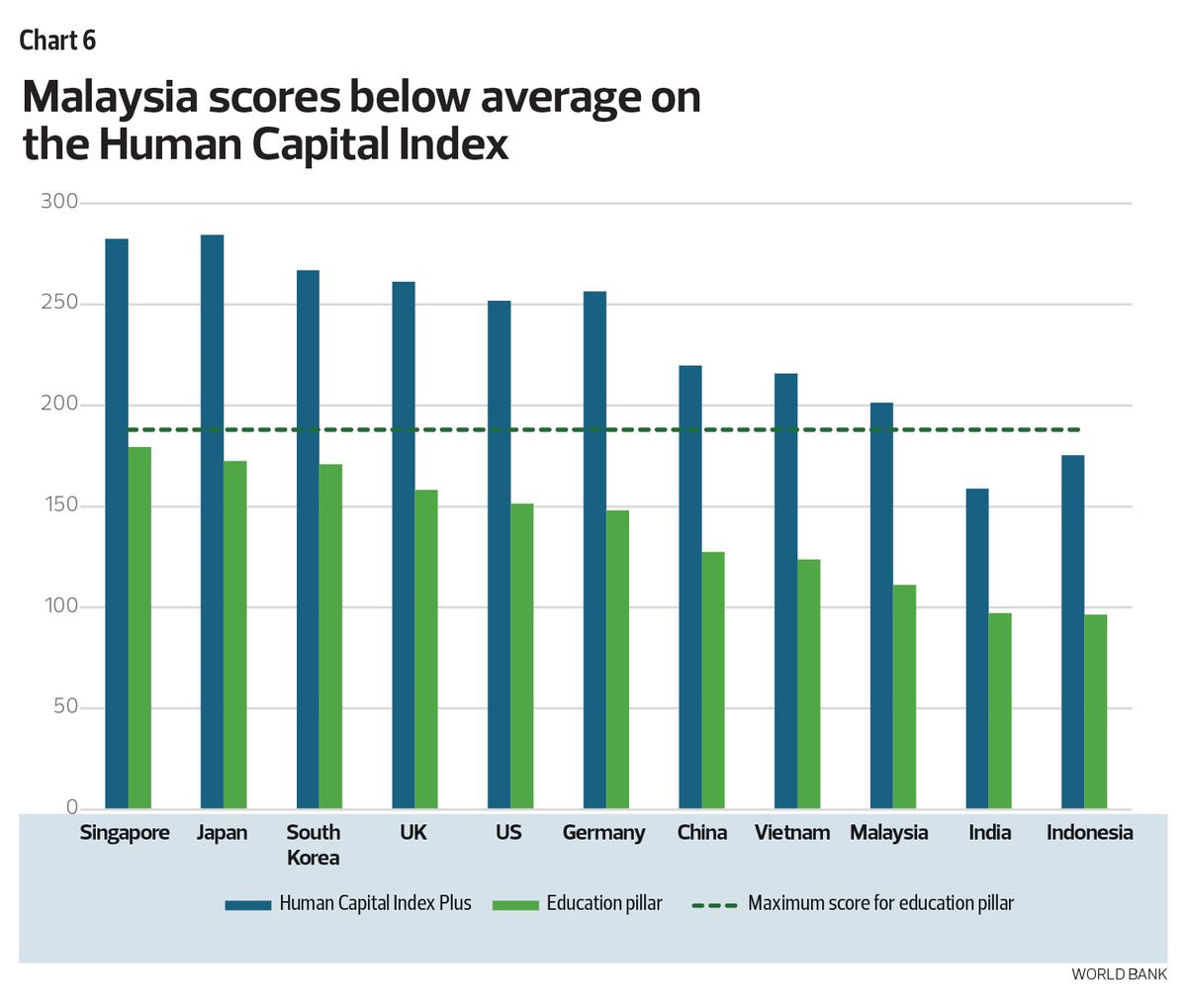
Chart 6 shows that Malaysia scores 201 out of a maximum 325 — lower than the average score for upper-middle-income countries (204) and East Asia & Pacific (215). On the education pillar specifically — measured through expected years of schooling, quality of schooling and tertiary completion — Malaysia scored 111, falling behind the regional average of 124.
Conclusion
We can invest capital in the economy, build world-class infrastructure and access the most advanced technologies. But if we don’t have the people with the capability to apply the knowledge and use it to continuously improve the processes to raise productivity, the nation cannot turn potential into prosperity. Unfortunately, there is no quick fix. Improving our education quality requires the system to rebuild itself from the foundation level.
A new syllabus can be planned, launched and documented within a single term. Teacher quality and effective learning cannot. It takes years to see if a new training pipeline produces better classroom educators. Whether they know how to effectively teach what the curriculum asks for, and whether they have the right incentives to keep getting better at it.
The incentives and any measures of success must be directly tied to student learning outcomes. Outcomes that must be measured honestly, and benchmarked against international standards. There is a need for transparency and public accountability.
It is only with honest feedback — even if they expose flaws and weaknesses — that mistakes can be identified, remedied and policies continuously adapted to the changing environment. Even a well-trained teaching force working inside a system with no external check on its own results would have no reliable way to notice its own decline before the repercussions compound.
A society that masks its own failures forecloses the ability to learn from them.
The inconvenient truth is that investing in teacher quality has a high upfront cost — where the payoff will only be evident in the long term. Politicians prefer visible spending — a big budget for new schools, new computers and laptops, and so on. Honest assessment of teacher quality may also require firing underperformers, which is a tough proposition for political optics.
The schooling system is the first visible crack in a much longer chain — one that runs through tertiary education and eventually into a labour market that signals what it rewards. Parts 2 and 3 of this series follow that chain. From the credential a student learns to chase in place of skills, to an economy that may not even reward the skills once they are built.
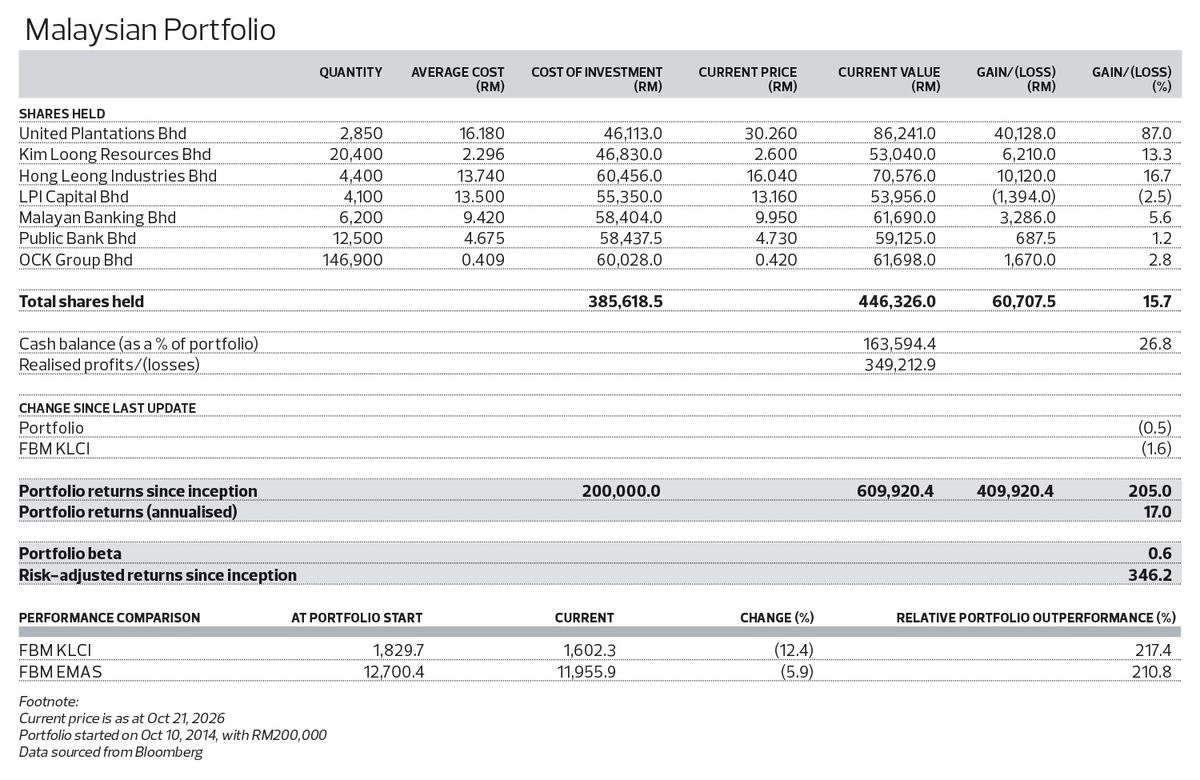
Portfolio commentary
The Malaysian Portfolio fell 0.5% for the week ended Oct 21, faring better than the benchmark FBM KLCI, which fell 1.6%. The only winner for the week was LPI Capital (3.3%). The biggest losers in that same period were OCK Group (-3.4%), United Plantations (-1.4%) and Hong Leong Industries (-1.2%). This portfolio is outperforming the benchmark FBM KLCI, which is down 12.4% over the same period, by a long, long way.
The Absolute Returns Portfolio also ended lower, down 0.8%. Total portfolio returns now stand at 32.6% since inception. The top gainers were Thermo Fisher Scientific (+3.1%), Nvidia Corp (+0.3%) and Talen Energy Corp (+0.3%), while the top losers were Alibaba Group Holding (-6.1%), Schneider Electric (-4.9%) and Alphabet Inc – CL C (-3.7%).
The AI Portfolio, too, fell by 3.3%. The top gainers were Amazon (+3.3%) and Datadog (+1.4%), while the top losers were Hewlett Packard Enterprise (-7.8%), Alibaba (-6.1%) and Unusual Machines Inc (-4.2%). The AI trade has had a rocky October thus far, as investors question whether revenue growth can keep pace with the massive spending on infrastructure. Against this backdrop, we have taken a more cautious view and disposed of our holdings in Akamai Technologies Inc, Broadcom Inc, Marvell Technology Inc and Roundhill Memory ETF. Total portfolio returns now stand at 19.6% since inception.
Disclaimer: This is a personal portfolio for information purposes only and does not constitute a recommendation or solicitation or expression of views to influence readers to buy/sell stocks. Our shareholders, directors and employees may have positions in or may be materially interested in any of the stocks. We may also have or have had dealings with or may provide or have provided content services to the companies mentioned in the reports.
Save by subscribing to us for your print and/or digital copy.
P/S: The Edge is also available on Apple's App Store and Android's Google Play.