


This article first appeared in The Edge Malaysia Weekly on November 2, 2026 - November 8, 2026


More than one-third of Malaysian tertiary graduates are working in jobs that do not fully utilise the qualifications they spent years earning. At the same time, employers are saying they cannot find workers with the skills they need. These two phenomena may appear contradictory. Yet, both are true at once. In Part 2 of our three-part series on education in Malaysia this week, we examine what this skill mismatch reveals about our education system.
For a quick recap, Part 1 of our series — “More Straight-As, less learning: What Malaysia’s exams miss” — explained the difference between schooling and learning. Today, knowledge is abundant and a wide range of data is readily accessible. But having the knowledge and data and making sense of and knowing how to use it are not the same thing. Based on a methodology developed by the World Bank — the Learning Adjusted Years of Schooling (LAYS) — Malaysian students completing 12.5 years of schooling possess only the learning outcomes or capability equivalent to 8.9 years. In other words, 3.6 years of schooling are effectively “lost” because of educational quality gaps.
This educational quality gap is reflected in Malaysian students’ underperformance in international assessments, such as Programme for International Student Assessment (PISA), which tests not only knowledge and theoretical principles but how well students can apply them to unfamiliar, real-world situations, think critically and solve complex problems.
We now trace this gap through tertiary education, and into the job market, and how education links to employment and wages. And by the end of Part 3, we intend to answer the question: Are Malaysians underemployed and underpaid?
Credentialism and the credential trap
Your university certification is something everyone says you have to obtain, if you want to secure a good job with good career progression. Your degree functions as a signal to potential employers — proof that you have learnt the skills and passed all the necessary exams from this university. Vetted. It is the piece of paper that will help you get a foot in the door when you apply for a job.
This is rational. Employers use credentials as a filter, to narrow the pool of applicants to a manageable number. But as Malaysia continues to churn out a high number of tertiary graduates each year, credential as a filtering tool becomes less effective.
When having an undergraduate degree still does not get you that job interview, the instinct is to chase a master’s degree, or even a doctorate. This is the credential trap — where qualifications are seen to be increasingly necessary to compete for jobs, but increasingly insufficient to secure good employment.
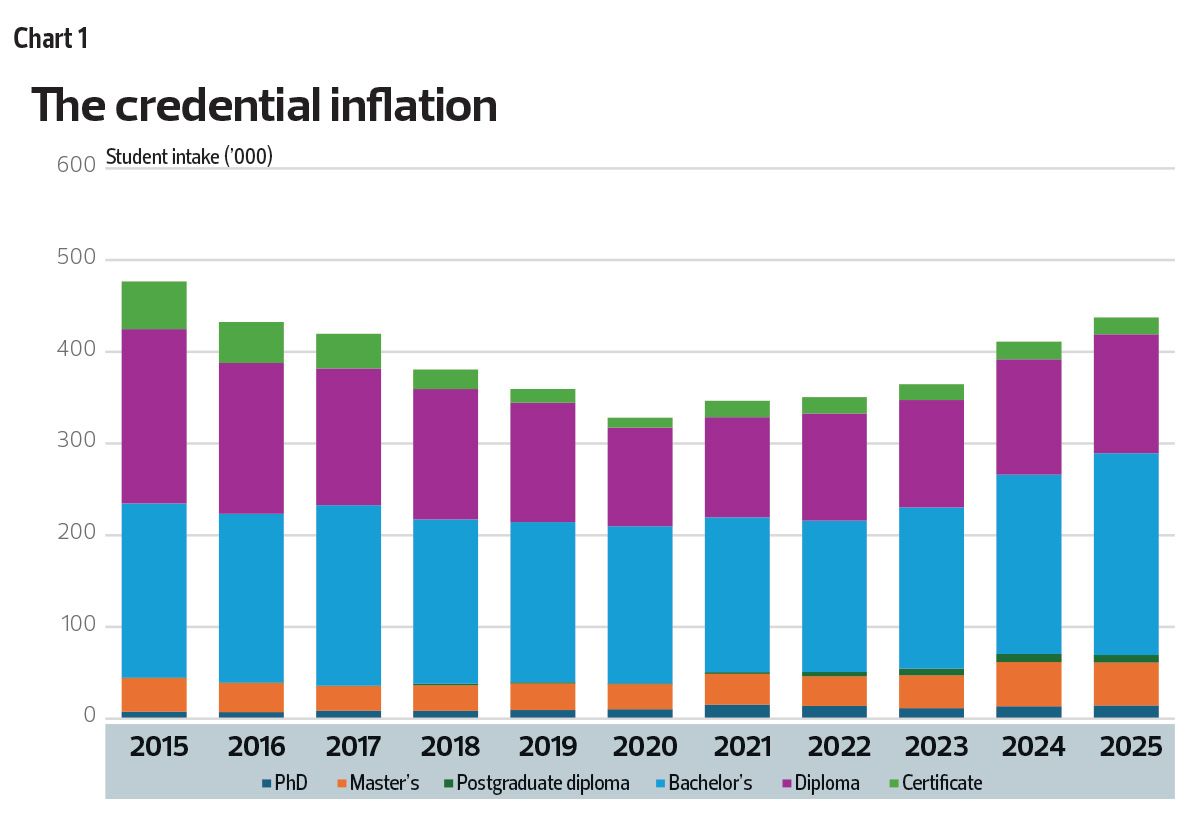
Chart 1 provides suggestive evidence of this happening. Over the past decade, student intake has shifted from diploma- and certificate-level programmes towards degree-level education (bachelor’s, master’s and PhD).
Yet, even as more graduates are armed with higher levels of education, employment prospects and career progression remain highly uncertain for many.
According to the latest Department of Statistics Malaysia survey, 35.2% of employed workers with tertiary education are working in low- or semi-skilled jobs. This suggests they are earning wages below what they have been taught to expect.
Remember the difference between schooling and learning? Similarly, having a paper qualification does not necessarily mean that one has in fact acquired the skills. More importantly, the skills that were acquired may not be the skills employers need.
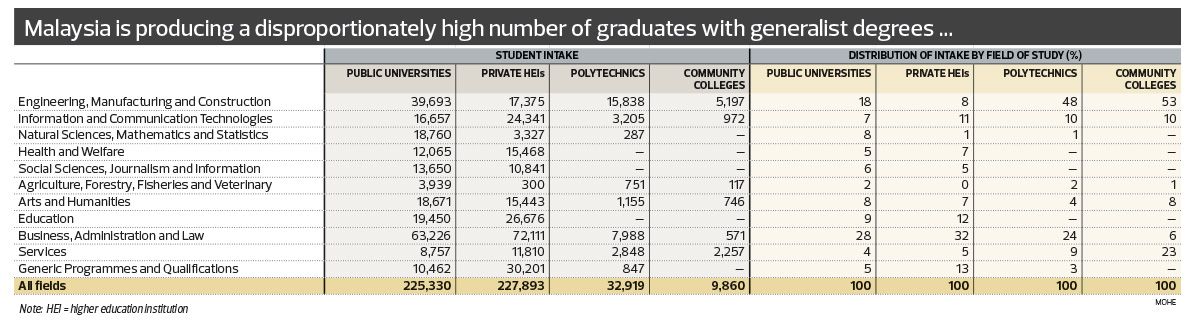
The fact is that too many Malaysian students continue to enrol in generalist fields of study — even though the job market is signalling otherwise. Degrees such as business, administration, marketing and mass communication, while not inherently less valuable, may no longer be sufficient on their own.
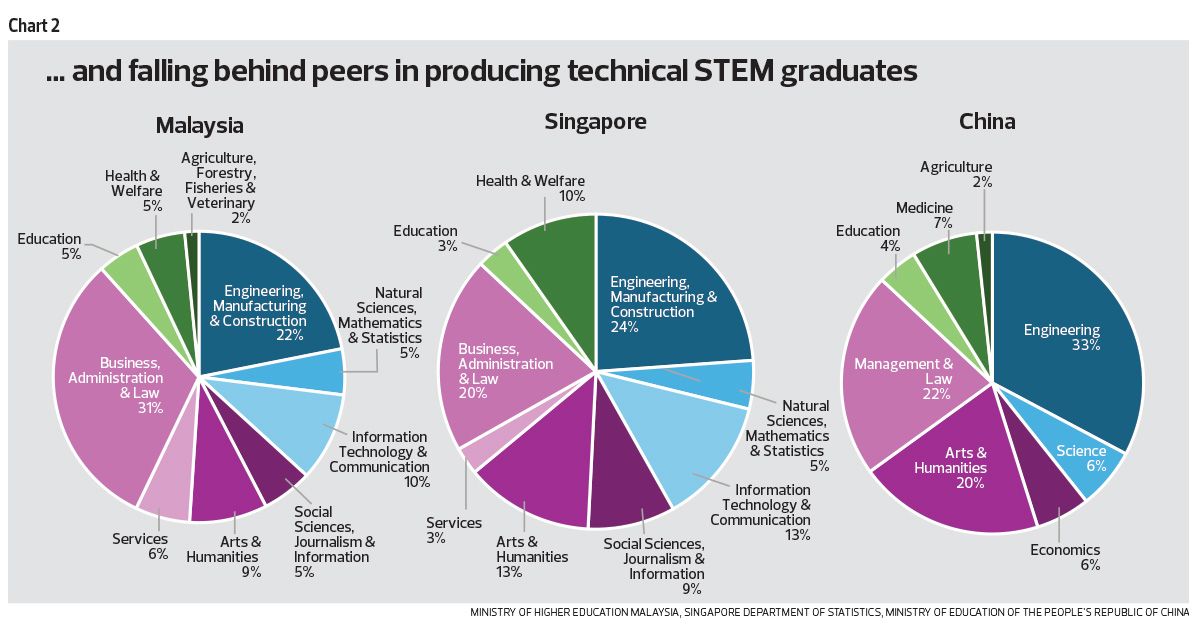
Table 1 shows the breakdown of course enrolments at public and private universities, as well as polytechnics. The most popular courses, by far, are business, administration and law. Chart 2 shows Malaysia falling behind peers such as Singapore and China in producing technical STEM (Science, Technology, Engineering and Mathematics) graduates.
In other words, Malaysian students are skewed towards “safe” generalist degrees with multiple career pathways, rather than the technical fields our economy is actually short on. Why? We think there are several key reasons for this.
Weak foundation in early years of schooling
One reason is the weak foundation built during the early years of primary and secondary schooling. The relatively low 8.9 adjusted years of schooling is a material gap, and a disadvantage, when competing against international peers entering tertiary education.
As reflected in the PISA scores, Malaysian students are comparatively weak when it comes to reasoning, mathematics, science and problem-solving.
Case in point: The percentage of students choosing Chemistry, Physics and Biology as electives in the Malaysian Certificate of Education (SPM) ranged from a low 18.6% to 24% in 2025. The percentage of students taking Additional Mathematics recorded the sharpest drop among all subjects, from 30.5% in 2021 to 27.6% in 2025. The choices these SPM students make must surely also influence their preference of studies in universities.
In other words, learning gaps accumulated during the primary and secondary years of schooling have lasting repercussions that carry through to tertiary education — and affect their future employability.
The chase for credentialism and civil service fallback
Table 1 reveals several interesting facts. As we noted, it shows a disproportionately large percentage of students choosing generalist degrees instead of more technically demanding fields of study.
This trend is particularly evident in private universities, where only one-fifth of students are enrolled in Engineering, Science, Mathematics and ICT (information and communications technologies)-related courses (the first three rows in the table) versus about one-third in public universities.
It would appear that credentialism is more extreme among students from presumably higher-income families who can better afford the higher fees. Some would even argue this is akin to paying to get a degree.
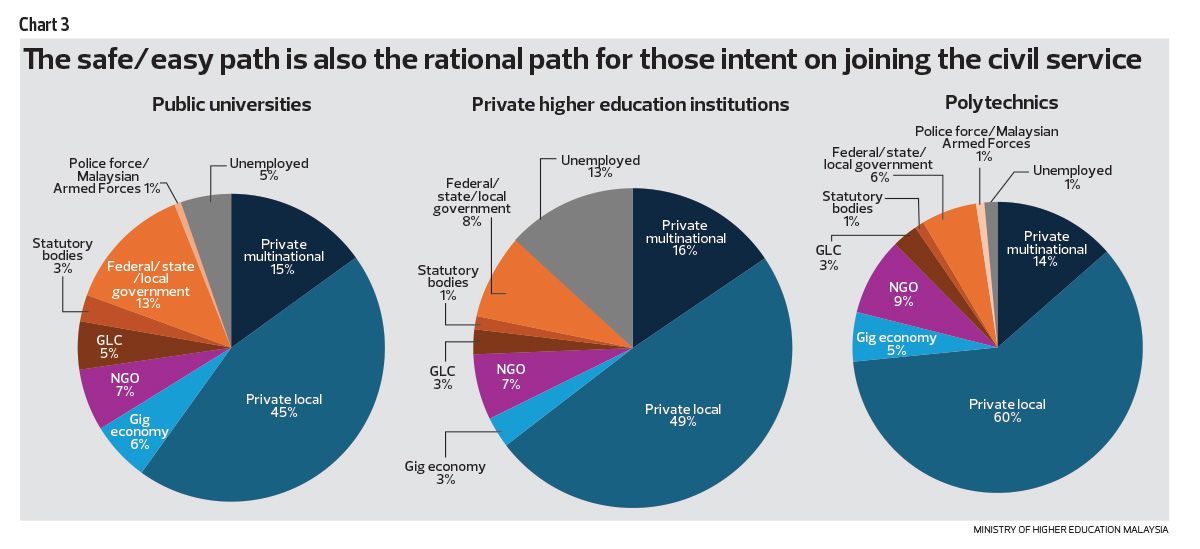
For those studying in public universities, the safe choice is, sometimes, also the rational choice. Malaysia’s civil service workforce as a percentage of total population is far larger than many of our Asian neighbours. It absorbs a relatively high percentage of graduates each year (see Chart 3 on Page 24).
The government is incentivising people into the civil service with overly generous remunerations plus benefits. This is also a rational decision on the government’s part. Keeping the unemployment rate low and raising the floor with higher remuneration is politically popular.
Fresh graduates entering the civil service can earn up to RM3,000 to RM4,000 a month, including allowances, well above typical private-sector starting wages (RM2,500 to RM3,000). Then throw in lifetime job security, predictable annual increments, bonuses and promotions that are more often tied to seniority than merit (less competition) — and, therefore, predictable career progression, regular hours and lifelong pension (before the recent reform proposal).
With the civil service as a high-reward fallback, opting for a generalist degree to keep career options open, rather than specialising in what is perceived to be a more challenging field with uncertain financial returns, makes sense.
There is also a cultural dimension. A position in government service may still carry social prestige in many rural communities, an association that took root during the British colonial era. Back in those days, a kerani, or clerk, was one of the few genuinely respectable, stable paths to social advancement available to the local population.
Chart 3 is also suggestive of an interesting contrast in graduate employability between universities and polytechnics, with the main difference, we think, being the fields of study.
Rather than generalist degrees, 58% of students from polytechnics are graduates in engineering, manufacturing and construction, and ICT — compared with just 19% to 25% in private and public universities.
Universities focus more on academic theories, research and analysis. With weak links between universities and industries, most graduates enter the job market with limited workplace training and real-world experience. Polytechnics, by contrast, focus on practical, hands-on vocational skills, where students graduate with job-ready skills.
The result: The unemployment rate for polytechnic graduates is much lower at 1% compared with 13% and 5% in private and public universities respectively.
The race between technology and education
The labour market is an ongoing, dynamic race between technology and education. Technology changes the work people do and, accordingly, the skills required. Education responds by adapting and supplying the human capital to meet that changing demand.
This relationship is very well articulated in the book The Race between Education and Technology, co-authored by Claudia Goldin, winner of the 2023 Nobel prize in Economic Sciences.
When education keeps pace, more people are able to fill the roles for new and changing jobs. Skills premiums fall, wage inequality lessens, technology can diffuse more quickly and be applied at scale across the economy, all of which lead to broad prosperity.
If, however, technology races ahead and/or education falls behind, scarce skills will command higher wages, driving up inequality. Workers whose capabilities no longer match demand risk being left behind. Ultimately, the development of human capital suffers, and a shortage of skilled workers will cost the economy.
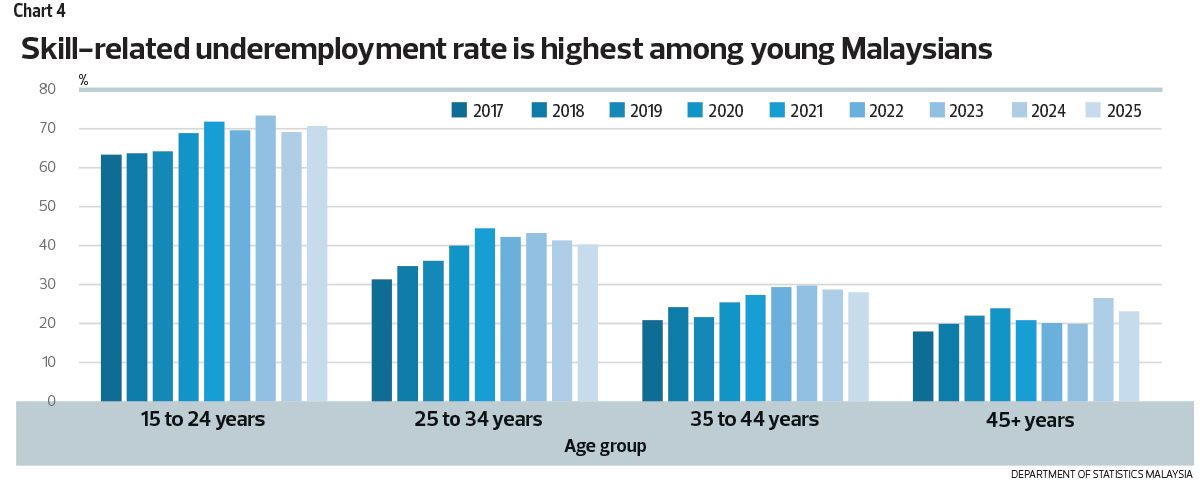
AI is accelerating this race. The learning curve is steepening with skills demand evolving far more rapidly than in the past. One of the biggest challenges for governments today is adequately preparing the people for the imminent disruption through education, reskilling and upskilling. But nowhere is this skills challenge more evident — and more pressing — than among young Malaysians (see Chart 4 next page).
Are universities incentivised to adapt quickly enough?
The modern job market increasingly rewards graduates who can move across disciplines. Sectors such as tech and AI increasingly need graduates who command interdisciplinary skills. For instance, a computer science student with working knowledge of finance and economics, or a social science student with a basic command of data analytics would likely have the competitive advantage.
There is no question technology is evolving very rapidly. The question is whether universities can adapt their programmes quickly enough in a highly regulated environment.
Eight of Malaysia’s leading public universities — out of the 20 local public universities — hold self-accreditation status (except for programmes requiring professional-body accreditation) and therefore have greater autonomy in designing their own programmes. Even then, interdisciplinary programmes still need a single faculty willing to “own” it — after someone has initiated the project — while coordinating across faculties and departments.
For example, the typical process for new programmes in Universiti Malaya involves:
1. A full programme proposal that must first be developed. It must include market need, educational objectives, learning outcomes, curriculum, courses, credits, staffing and financial viability, among others;
2. The proposed programme, drafted to precise Malaysian Qualifications Framework (MQF) standards, then goes through multiple internal committees, including the departmental curriculum committee, the faculty academic board and the university curriculum committee;
3. Initial screening carried out by Mesyuarat Saringan Awal (MSA), Ministry of Higher Education;
4. Approval obtained from University Senate; and
5. Finally, the new academic programme submitted to the Ministry of Higher Education for approval to conduct the course.
Those without self-accreditation status face additional governance constraints. For example, material structural changes (beyond a certain threshold) to core, major, minor or specialisation curriculum require approval from the Malaysian Qualifications Agency (MQA).
In that case, perhaps the more fundamental question is: How do we ensure there are sufficient incentives for academic staff in universities with self-accreditation to exercise their autonomy and for other non-accredited institutions to go through the additional MQA assessment, expend the time and effort — and have the necessary resources — to go through the cumbersome process of changing or creating new programmes?
Public universities rely primarily on government funding, which is tight. Teaching staff is part of the civil service and management has limited freedom to recruit specialists, adjust salaries or allocate resources. And some are quite likely also losing top talent to private education.
Competition for talent from private universities
The Malaysian government has over the years outsourced higher education to the private sector, mainly to relieve the public sector of the growing financial burden. Even leading universities such as Universiti Malaya are reportedly facing severe budget constraints from government allocation.
As more Malaysian students compete for insufficient public university placements — even the highest-grade students are sometimes unable to secure seats in their first-choice courses — and as the quality of public education deteriorated, more middle-income families have struggled to send their children to private schools.
In addition, the escalation in the cost of private education is placing an increasingly heavy burden on middle-income households — eating into their disposable incomes, raising the cost of living and hurting retirement savings — and worsening the income-wealth inequality.
As demand for private university education grows — with public and private higher education institutions now producing roughly the same number of graduates each year — competition for teaching staff is also likely to intensify.
While there is no conclusive evidence that private universities consistently pay better than public ones, they have greater flexibility in structuring remuneration packages to attract top teaching talent. Public universities, by contrast, operate much like civil service departments, with salaries tied to structured government pay grades.
Conclusion
Over the past two weeks, we have focused on the supply side of the labour equation to explain why underemployment among young Malaysian tertiary graduates remains high and continues to rise.
Given that this skill-related underemployment is happening while employers are reporting difficulties in hiring adequately skilled workers for higher-value jobs, there is an obvious mismatch. The question is why?
In Part 1, we explained the difference between schooling and learning. This week, we have extended the discussion further, into higher education. What the statistics show is that Malaysian students are chasing higher credentials, from diplomas and certificates to degree-level education, but they are not responding to market signalling on the skills that are most in demand today. Too many are choosing to study generalist fields instead of what the market demands. We believe this is linked to the declining quality of early-years education, with learning deficits carrying through to tertiary education. You cannot build on a weak foundation.
Our universities are also slower to adapt their programmes to the same market signalling. You cannot study for a degree that does not exist. We believe local public university courses have yet to materially adjust to the future economy that will be dominated and driven by AI.
This is a problem related to incentives. Designing and getting new programmes approved require substantial university and, importantly, individual initiative, time, effort and resources. Where is the incentive?
For some perspective, Chinese universities adapt quickly under the direction of the central government. The Ministry of Education updates and publishes the catalogue for institutions of higher learning annually, aimed at aligning education with technological advances. For instance, its 2026 catalogue introduced a new interdisciplinary category, incorporating 11 existing majors and four new ones. In the nation’s previous 14th Five-Year Plan (2021 to 2025), universities nationwide added 10,200 new undergraduate programmes and either discontinued or suspended 12,200 programmes. In 2026, the adjustment rate of undergraduate programmes exceeded 10% for the first time.
Technology does not wait for the education system to catch up
In the third and final part of this education series, we will move the discussion into the job market, the repercussions of a persistent skills mismatch and feedback loop. And as promised at the start of this article, we will offer our conclusion to the question: Why are so many Malaysians underemployed while employers cannot find workers with the skills they need? What is the right diagnosis and solution to this problem and, critically, how do we create the political incentives to implement the necessary reforms?
Portfolio commentary
The Malaysian Portfolio fell 0.2% for the week ended Oct 28. The winners were OCK Group (+2.4%), Hong Leong Industries (+1.1%) and Malayan Banking (+0.4%) while the biggest losers were United Plantations (-3.1%), LPI Capital (-0.6%) and Public Bank (-0.4%). Total portfolio returns now stand at 204.5% since inception. This portfolio is outperforming the benchmark FBM KLCI, which is down 11.9% over the same period, by a long, long way.
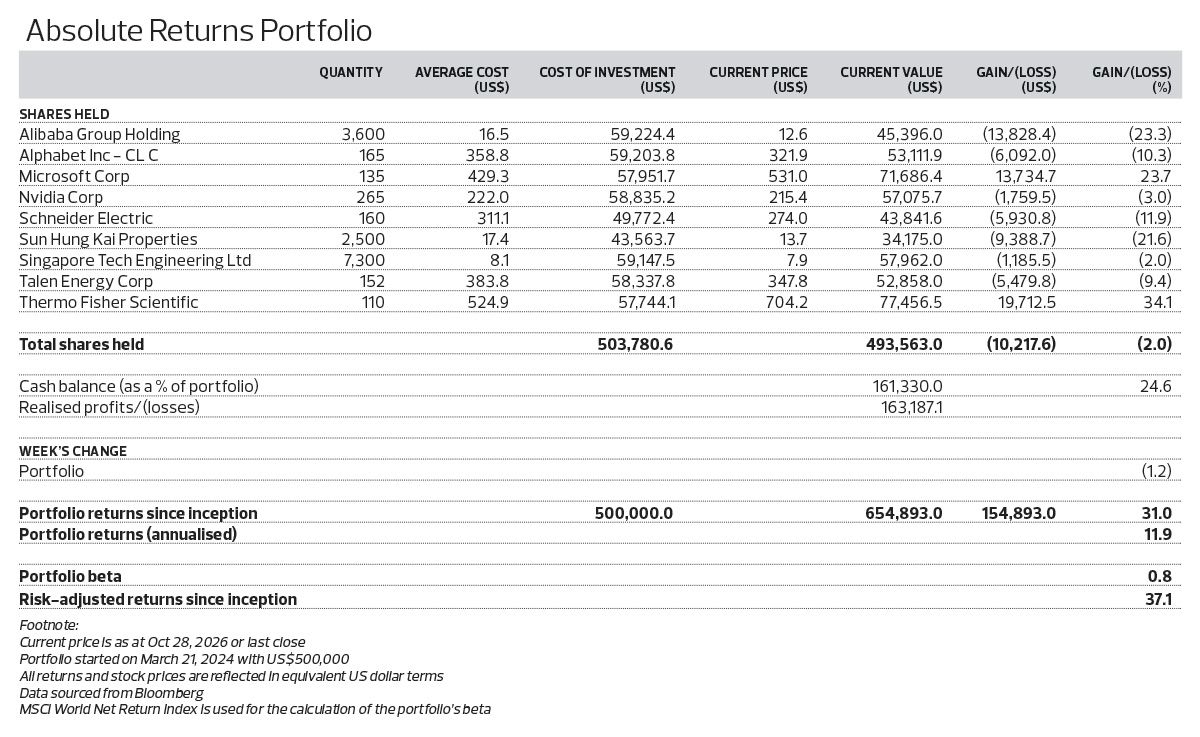
The Absolute Returns Portfolio also ended lower for the week, down 1.2%. Total portfolio returns now stand at 31% since inception. The sole gainer was Thermo Fisher Scientific (+1.5%) while the biggest losers were Alibaba Group Holding (-4.5%), Talen Energy (-3.3%) and Nvidia (-3%).
Meanwhile, the AI Portfolio gained 0.6%. Total portfolio returns now stand at 20.3% since inception. The top gainers were Cadence Design Systems (+5%), Unusual Machines (+3.8%) and Hewlett Packard Enterprise (+3.7%) while the biggest losers were Naura Technology (-8.7%), Alibaba (-4.5%) and Amazon.com (-3%).
Disclaimer: This is a personal portfolio for information purposes only and does not constitute a recommendation or solicitation or expression of views to influence readers to buy/sell stocks. Our shareholders, directors and employees may have positions in or may be materially interested in any of the stocks. We may also have or have had dealings with or may provide or have provided content services to the companies mentioned in the reports.
Save by subscribing to us for your print and/or digital copy.
P/S: The Edge is also available on Apple's App Store and Android's Google Play.