


This article first appeared in The Edge Malaysia Weekly on November 2, 2026 - November 8, 2026
Are Malaysian workers underpaid? It is an important question. But citing a relatively low labour share does not answer it.
Labour share tells us what proportion of value-added is attributed to labour. It does not tell us whether workers are underpaid. The latter is a different question altogether, one that requires looking beyond the division of income to what workers earn, comparable wages and the forces shaping their bargaining power.
Consider Ireland. In 2025, its information and communications sector had a labour share of just 12.8%, yet median weekly earnings were €1,516. By contrast, accommodation and food services had a much higher labour share of 82%, but median weekly earnings were only €409. Median weekly earnings in the sector with the much smaller labour share were about 3.7 times as high.
There are, of course, caveats to this comparison. First, weekly earnings reflect hours worked and employment patterns, rather than hourly pay alone. Second, higher earnings do not necessarily mean fairer pay. Workers in Ireland’s information and communications sector could still be underpaid relative to comparable employment opportunities. Equally, the much higher labour share in accommodation and food services does not establish that workers there are adequately compensated.
The comparison nevertheless illustrates an important distinction: Labour share tells us how value-added is divided, not how much the typical worker earns.
A smaller share of a bigger pie
The reason a smaller labour share can coexist with higher compensation comes down to simple arithmetic. Labour share is a ratio: labour compensation divided by value-added. But average compensation per worker also depends on how much value-added is generated per worker. A smaller percentage of a much larger amount can translate into higher compensation.
Suppose annual value-added per worker is RM50,000 in one business and RM150,000 in another. A labour share of 60% in the first translates into average annual compensation of RM30,000 per worker. In the second business, however, where value-added per worker is three times as high, even a smaller labour share of 40% translates into average compensation of RM60,000 — twice as much.
Different industries, different shares
The same principle applies across industries, where differences in productivity and capital intensity can produce very different labour shares, without necessarily indicating how their wage levels compare. This distinction is particularly relevant to Malaysia, where many politicians, technocrats and even economists often cite the country’s relatively low labour share as evidence that workers are underpaid. Yet, Malaysia’s own statistics illustrate why the relationship is not so straightforward.
According to the Department of Statistics Malaysia’s 2025 figures, employee compensation accounted for just 11.3% of value-added in mining and quarrying, compared with 75.2% in construction. Yet, mean monthly salaries and wages in the former were RM6,175, almost twice the RM3,188 recorded in the latter (see table).
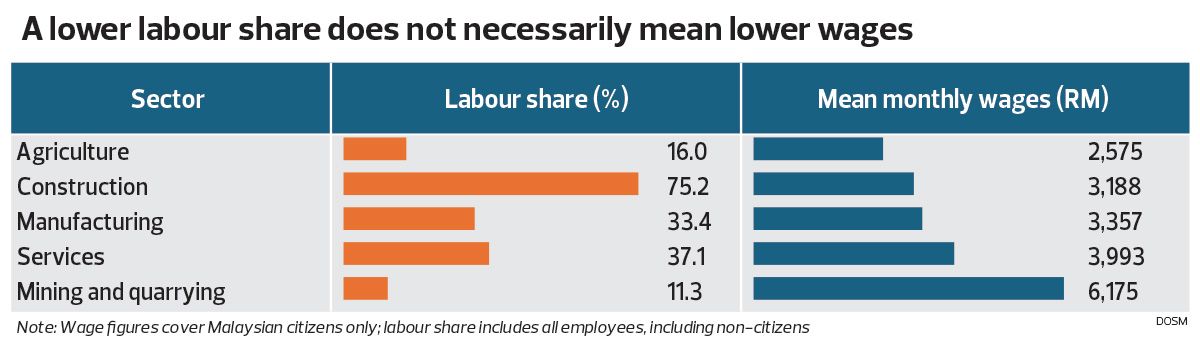
This is not to suggest that lower labour shares are associated with higher wages. As the table also shows, agriculture had a relatively low labour share of 16% but recorded the lowest mean monthly wage, at RM2,575. A smaller labour share can coexist with either high or low wages. The percentage alone establishes neither how much workers earn nor whether they are underpaid.
These differences across sectors also have implications for an economy’s overall labour share. When sectors with low labour shares expand faster than the rest of the economy, the national ratio can decline even without wage cuts in any sector.
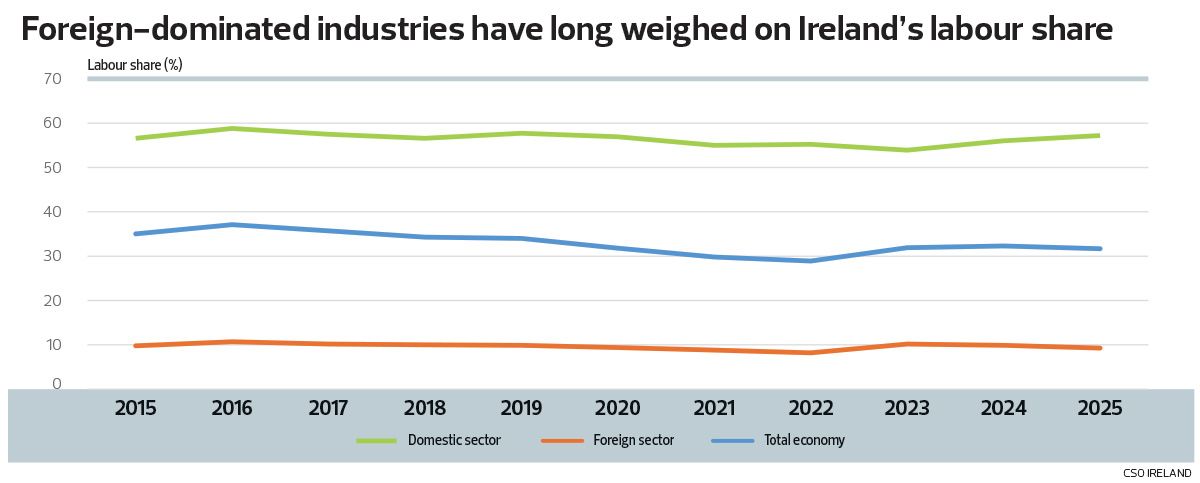
Ireland provides a striking example. In 2025, the labour share in Ireland’s domestic sector stood at 57.2%, compared with just 9.3% in industries dominated by foreign multinationals (see chart). This wide disparity has persisted throughout the past decade. Crucially, foreign-dominated industries account for a substantial share of Ireland’s total value-added. Their much lower labour share, therefore, pulled down the national figure to just 31.7%, despite the considerably higher labour share in the domestic sector.
This point is worth keeping in mind when comparing labour shares across countries. According to the International Labour Organization’s (ILO) estimates for 2025, labour income as a share of GDP ranged from 71.2% in Switzerland and 63.1% in Germany to just 45.9% in Norway — a considerable variation even among wealthy economies.
But as we have explained, differences in economic structure complicate such comparisons. Economies with substantial petroleum production, property income or capital-intensive manufacturing should not be expected to have the same labour share as those dominated by labour-intensive services.
What the numbers actually measure
Interpreting labour share also requires understanding what the measure includes — and what it leaves out.
A common misconception is that a low labour share means the remainder of economic output goes into the pockets of business owners. But GDP is a gross measure that includes depreciation of productive assets, income earned by the self-employed and taxes less subsidies. The portion not accounted for by employee compensation, therefore, cannot simply be equated with corporate profits.
Another limitation concerns what is counted as labour income. The Malaysian labour share figures cited earlier, for example, measure employee compensation as a proportion of value-added. But this excludes the labour income of people working for themselves. A self-employed shopkeeper’s earnings reflect both their own labour and returns from owning the business. The same applies to many small business owners. As a result, relying solely on employee compensation may understate the labour share, particularly in economies where self-employment is widespread.
Some measures, including the ILO’s labour income share estimates, seek to address this omission by estimating the labour component of self-employment income. This provides a more complete picture of labour share, but also complicates comparisons with figures based solely on employee compensation. Failing to account for these methodological differences can, therefore, lead to misleading conclusions.
A larger slice, but of what?
Beyond these measurement issues, labour share also tells us little about how individual workers are faring. As an aggregate ratio, it conceals changes in total employee compensation, how that compensation is distributed and the underlying reasons for movements in the ratio.
Consider Malaysia. In 2025, the country’s labour share barely changed, rising to 33.9%, from 33.6%. Yet, total employee compensation increased by 5.8% to RM686.9 billion, from RM649.3 billion. In other words, a relatively stable labour share does not mean the total amount paid to workers has stagnated. But neither does an increase in total compensation necessarily mean higher wages for individual workers. It could reflect more people being employed, higher compensation per employee or both.
Nor does the aggregate show who benefits from increases in compensation. Both executive remuneration and ordinary workers’ wages count as employee compensation. Labour share can, therefore, remain stable, or even rise, while the gains accrue disproportionately to higher-paid employees.
Even the direction of change can be misleading. Labour share may rise during economic distress if profits fall faster than employee compensation. Workers would then receive a larger proportion of a shrinking economic pie, even as they face wage freezes or job losses.
A rising labour share, therefore, is not necessarily evidence that workers are better off. Much depends on what is driving the change and how the gains, if any, are distributed.
Determining fair pay
These limitations do not diminish the usefulness of labour share as an economic indicator. A persistent decline, after accounting for changes in industrial composition and statistical definitions, deserves investigation. It may signal weakening bargaining power, greater employer market power or workers receiving a smaller share of the gains from productivity. But these are possibilities to investigate, not conclusions that can be drawn from the ratio alone.
Determining whether workers are underpaid requires more direct evidence. This includes examining real median hourly compensation, wage growth relative to productivity in comparable industries, pay for similar work, and workers’ bargaining power or ability to change employers. Living costs provide a further test of whether wages support an adequate standard of living.
For Malaysia, the priority should be to build productive capability while ensuring workers share in the gains. Investment, technology adoption and learning can raise productivity and expand the resources available for higher compensation. But these gains do not automatically translate into better pay. Competition for workers, effective labour protections and stronger bargaining power also matter in determining how the benefits are distributed.
A lower labour share does not, by itself, establish that workers are underpaid. Equally, a higher share does not prove that they are fairly compensated. Ultimately, the test is whether workers receive fair compensation and enjoy improving economic opportunities — not whether a single national percentage looks sufficiently high.
Save by subscribing to us for your print and/or digital copy.
P/S: The Edge is also available on Apple's App Store and Android's Google Play.