

This article first appeared in The Edge Malaysia Weekly on October 26, 2026 - November 1, 2026
MUCH of the pre- and post-Budget 2027 discussions revolved around whether Prime Minister Datuk Seri Anwar Ibrahim’s fifth Madani budget would be a pre-election voter-base-pleaser and how much longer Malaysia could continue to increase cash handouts without the return of the politically demonised Goods and Services Tax (GST), with debt service charges already making up 16% of federal government revenue and 73.5% of development expenditure.
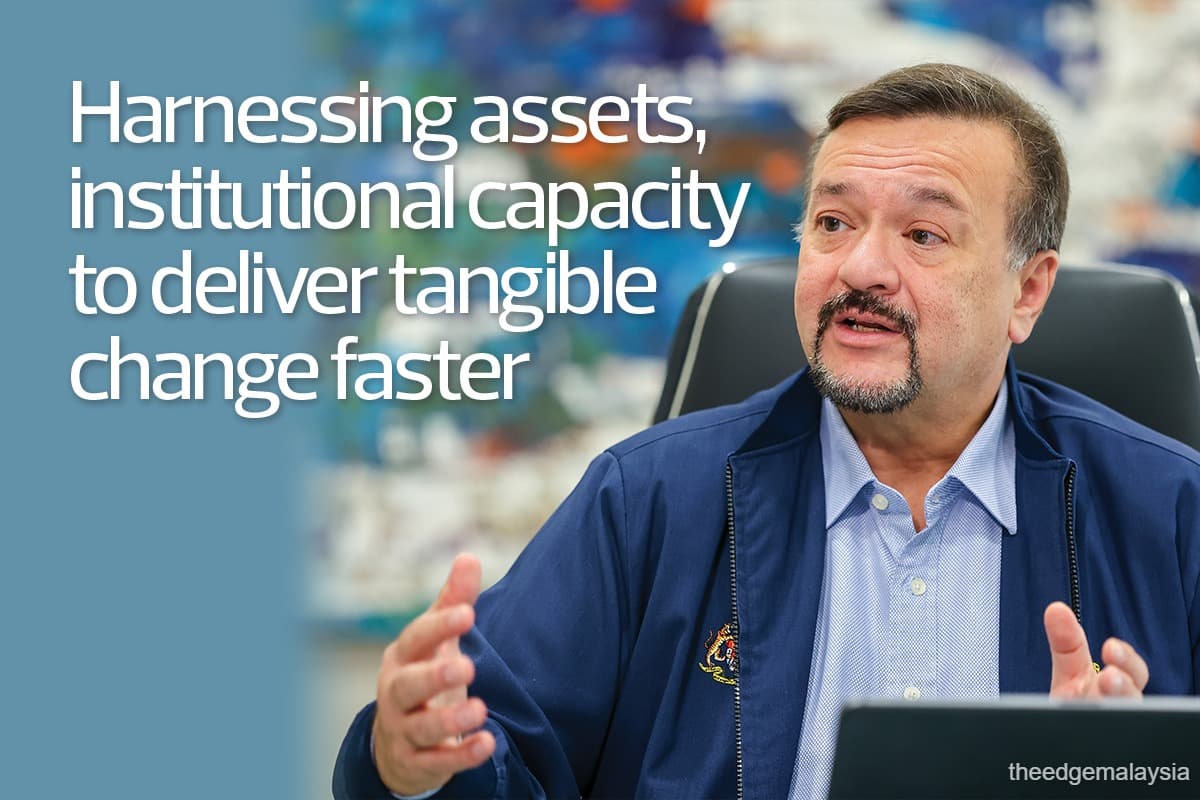
Minister of Finance II Datuk Seri Amir Hamzah Azizan, who worked closely with Anwar on the past three federal budgets, prefers to focus on “institutionalising changes” that would ensure fiscal reforms are not reversed but continue to yield longer-term benefits. His quick comeback on the lack of new revenue measures in Budget 2027 was, “To get the tax numbers up, sometimes you need to give people breathing space. If every year you do some tax measures, after a while people will say they don’t want to do business in this country.” He also explained why Anwar is reluctant to bring back GST despite admitting to the tax system’s efficiency and awareness of larger businesses’ preference to be able to claim input taxes (see “SST makes businesses share the tax burden, says Amir Hamzah”).
Amir also expressed confidence in Malaysia’s economy surpassing 5% growth for a fourth straight year in 2027. That’s higher than projections of 4.5% growth for China.
“This year, we’re tracking at 5.5%, including third-quarter advance estimates. We’re projecting between 4.2% and 5.2% growth for 2027 but generally, we’ll end up on the upper end — the government is always very conservative when it comes to its estimates,” he tells The Edge.
What is important, he says, are the efforts to ensure the people enjoy tangible benefits from higher wages, better jobs, skills training, affordable housing and better healthcare.
Equally important is the need to ensure there is enough capital investing in Malaysia’s strategic capacity to power the next stage of development amid rapid technological disruption, rising geopolitical tensions, trade fragmentation and value-chain recalibration plus climate-related pressures, on top of sustaining economic progress as the country seeks to sustainably break away from the middle-income trap towards high-income status. Part of this is done via the RM120 billion investment commitment over five years by six government-linked investment companies (GLICs) through the Government-linked Enterprise Activation and Reform Programme (GEAR-uP) launched in August 2024. Capital is also deployed without affecting the headline message on fiscal consolidation by harnessing the country’s assets, institutions plus the flexibilities of modified cash-basis accounting.
For the broader economy, Amir says the growth drivers will come from the continued execution of key initiatives under strategic road maps — including the New Industrial Masterplan 2030 (NIMP 2030), National Semiconductor Strategy (NSS) and the National Energy Transition Roadmap (NETR) — which are structured around good governance and the twin strategies of “raising the ceiling and raising the floor” of the Ekonomi Madani framework launched in July 2023.
“When I joined the government nearly three years ago, when we talked about the Ekonomi Madani framework, people would say, ‘I’ll believe it when I see it’. In the second year, people said, ‘These guys are serious because they are prepared to do difficult things that most people are not prepared to do’. This is the third year. When I went around, and even when I did my sukuk roadshow, there was no issue about directionality, capability, execution or point of view because our credibility is there. I think that made the difference,” he says.
Foreign investors seem more interested in, or at least are less sceptical about, Malaysia which has managed to bring down its headline fiscal deficit from 6.4% of gross domestic product (GDP) amid the Covid-19 pandemic in 2021 to 3.7% of GDP in 2025. The Ministry of Finance is projecting a fiscal deficit of 3.6% of GDP for 2026, only a shade higher than the 3.5% of GDP expected when Budget 2026 was tabled in October 2025 — even as higher global oil prices pushed up Putrajaya’s fuel subsidy bill for 2026 to RM40 billion versus the RM15 billion initially budgeted. That still puts Malaysia on track to reducing its fiscal deficit to 3.3% of GDP next year and 3% of GDP in 2028.
“The world is struggling with a lot of things that’re happening today and most governments have reacted by deploying fiscal space. I think concerns coming from the IMF-World Bank meeting is that the fiscal space of governments is getting thinner. But Malaysia bucked the trend, right? We’re effectively showing that it’s important that we address fiscal reform, build a better future and make sure we will always have the capacity to be resilient … I think the economic model Malaysia is playing through very well is because of our diversification, whether you talk about industries, markets … has really allowed us to generate continued growth and are clued into what’s happening in the changes to world trade. So, I think recognition of Malaysia is much better today,” says Amir, who led the country’s delegation to the IMF-World Bank Group annual meeting in Bangkok (Oct 12 to 18), soon after Budget 2027 was tabled on Oct 9.
Petroliam Nasional Bhd’s (PETRONAS) net income for the first half of 2026 rose 4% year on year to RM27.2 billion but “Interest and return on investment from PETRONAS” — which the Ministry of Finance (MoF) generally refers to as PETRONAS dividends in its annual fiscal outlook report, including in the 2027 report — had been revised higher to RM27 billion this year versus RM20 billion when Budget 2026 was tabled in October 2025, even as Putrajaya’s Brent crude oil assumption is adjusted higher to US$85 a barrel for Budget 2027, from about US$65 a barrel in Budget 2026. Budget 2027, which expects fuel subsidies to remain at RM40 billion next year, assumes an average oil price of US$85 a barrel, just below the current year-to-date average of about US$90 a barrel.
While our search confirms that the term “Interest and return on investment from PETRONAS” has been used in the MoF’s annual fiscal outlook report for at least the past seven years to refer to dividends from the national oil behemoth, this year is the first time the media were asked not to use the word “dividend” to refer to the RM27 billion in the revised Budget 2026 and RM32 billion in Budget 2027 because the entire amount is not all cash (see “Institutionalising reforms to build intergenerational wealth and long-term sustainability” for more on the non-cash elements).
With Malaysia’s budget deficit on a steady downward trend since 2022 — and Anwar being the finance minister when Malaysia last had a fiscal surplus 29 years ago in 1997 — did Putrajaya really choose prudence over populism? Or has a clever balance been struck to satisfy the people’s needs as well as investors’ search for good storytelling while Malaysia is on the global radar for being a net exporter of oil and gas products as well as among the beneficiaries of the global artificial intelligence-driven semiconductor boom and geopolitically driven value-chain recalibration?
For now, the strong growth headlines point to Malaysia being buoyed by a rising tide. Amir assures that the Madani government continues to be serious about strategic reforms, which is why time is taken for careful planning to gain buy-in, whether it is fuel subsidies or its attempt to reform civil service pensions and the wider retirement savings adequacy and old-age social safety net. Actual benefits and fiscal space yielded from these reforms may determine how well Malaysia fares when the next crisis hits. As famously captured by Warren Buffett, “Only when the tide goes out do you discover who’s been swimming naked”.
Read also: Save by subscribing to us for
your print and/or
digital copy. P/S: The Edge is also available on
Apple's App Store and
Android's Google Play.
Special Report: Institutionalising reforms to build intergenerational wealth and long-term sustainability
Special Report: SST makes businesses share the tax burden, says Amir Hamzah