

This article first appeared in The Edge Malaysia Weekly on October 12, 2026 - October 18, 2026

US President Donald Trump’s Libe ration Day tariffs, first unveiled in April 2025, triggered a barrage of near-uniform criticisms from economists and trade experts. Many of the arguments against the tariffs — which were imposed on almost every country in the world, friends, allies and enemies alike, and even in places where only penguins live — are valid. We have written extensively on this subject and hence will not repeat our views here (scan the QR codes to revisit the articles). In a nutshell, while we agree with many of the arguments, we also took the contrarian stance that tariffs were a necessary means to an end, an essential pillar of Trump’s larger Make America Great Again (MAGA) strategy.
One of the biggest criticisms back then was that tariffs would raise import costs for US businesses and consumers, leading to lower profit margins and investments, higher inflation and, possibly, economic slowdown — even stagflation — and, at worst, cascading into a global recession.
Obviously, the worst fears did not happen. The US economy is still growing at a solid pace. Its job market remains resilient. Corporate America has never been more profitable, the stock market is booming and major bellwether indices are near all-time highs.
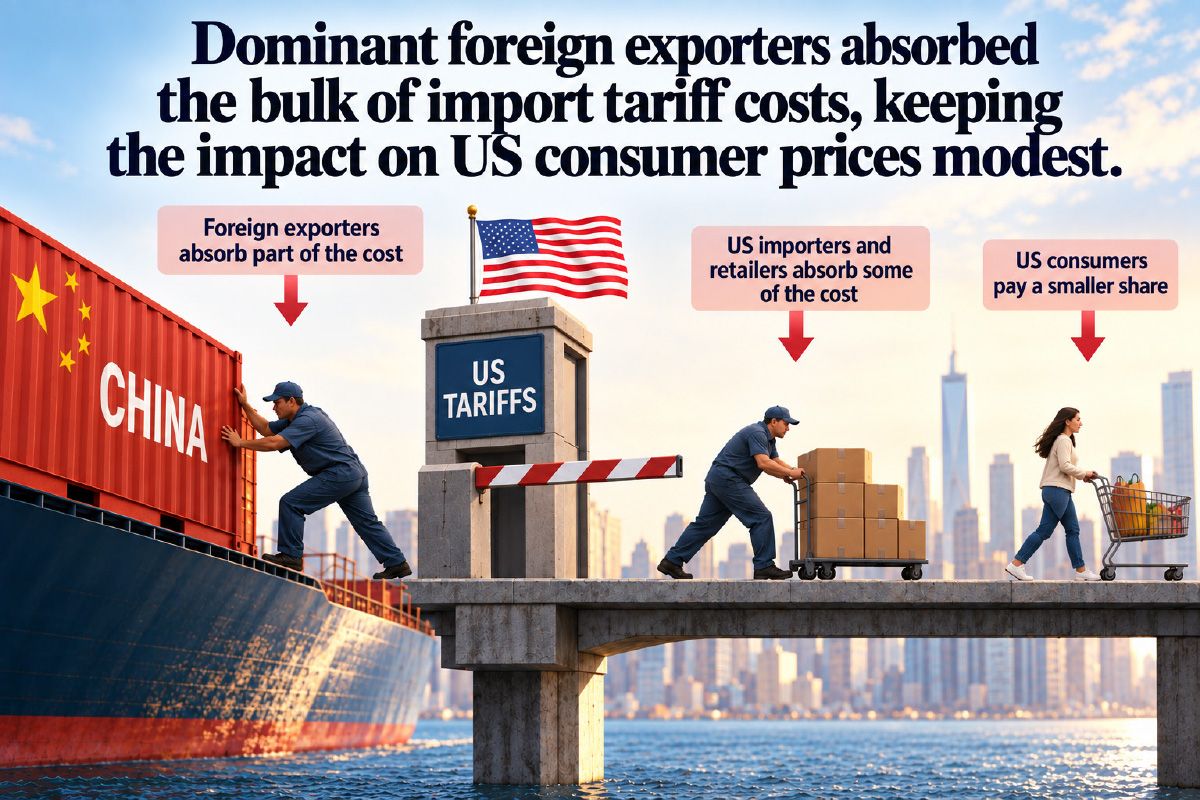
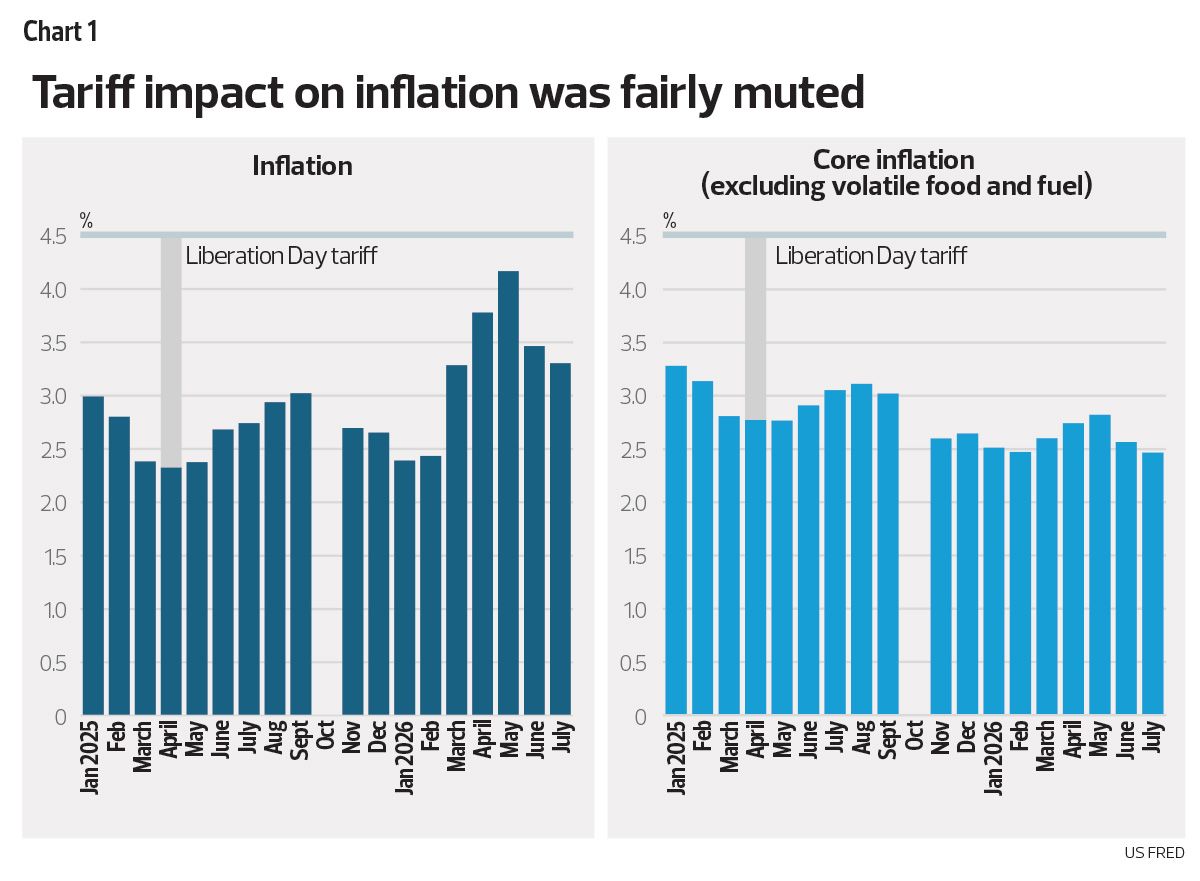
As we said, the Liberation Day tariffs were broad — ranging from a minimum 10% to as high as 50% — affecting almost all countries in the world. At the time, the Yale Budget Lab estimated that the tariffs would raise US prices by 2.3% in the short run — on the assumption that US consumers would end up paying much of the cost. The actual impact was nowhere close to that.
The tariff shock that wasn’t
While the headline Consumer Price Index and core CPI (excluding energy and food) did edge higher in the immediate months after the Liberation Day tariffs went into effect, the tariff-driven surge did not happen. Both measures peaked at 3% to 3.1% in 3Q2025, and then trended lower. Inflation did accelerate again this year, but it was due to higher energy prices resulting from the US-Iran war. Prices of tariff-affected categories of goods have shown meaningful slowdown in inflation or outright price declines in recent months. For perspective, the CPI was 2.3% to 2.4% from March to April 2025 while core CPI stood at 2.8%.
So, why didn’t US consumer prices and inflation surge as predicted by the majority of economists back then?
We were right on the money … based on the Optimal Tariff Theory
The Optimal Tariff Theory states that it is possible for a country with market power (able to influence world prices) to improve its terms of trade by imposing a moderate tariff on imports — by shifting some of the tariff cost onto foreign exporters.
In this case, the US government collects tariff revenue, while foreign exporters absorb part of the cost, preferring to lower their prices and receive less revenue than lose the market altogether. This will, in effect, transfer income from the rest of the world to the US. It increases the national welfare of the US — as long as gains from improved terms of trade outweigh the higher prices to consumers.
We mentioned at the time that the optimal tariff was generally thought to be less than 20%, sufficiently low so that foreign manufacturers are able to absorb part of the cost and countries do not retaliate. According to World Trade Organization (WTO) estimates, US trade-weighted average tariff rose from 2.4% before Trump took office to as high as 21.9% in early May, before declining to just over 13% by end-2025. As we explained previously, Trump takes the maximalist approach as part of his Art of the Deal — extracting concessions from trading partners in exchange for lower tariffs.
Our proposition was further validated by evidence in a recent analysis conducted by the Centre for Economic Policy Research (CEPR). “Data for the 50 largest US trading partners [showed] that foreign exporters absorbed roughly 40% to 50% of the 2025 US tariff increases through lower export prices,” it said. “The absorption was highly unequal: Dominant suppliers bore the bulk, while smaller ones passed the tariff on almost fully.”
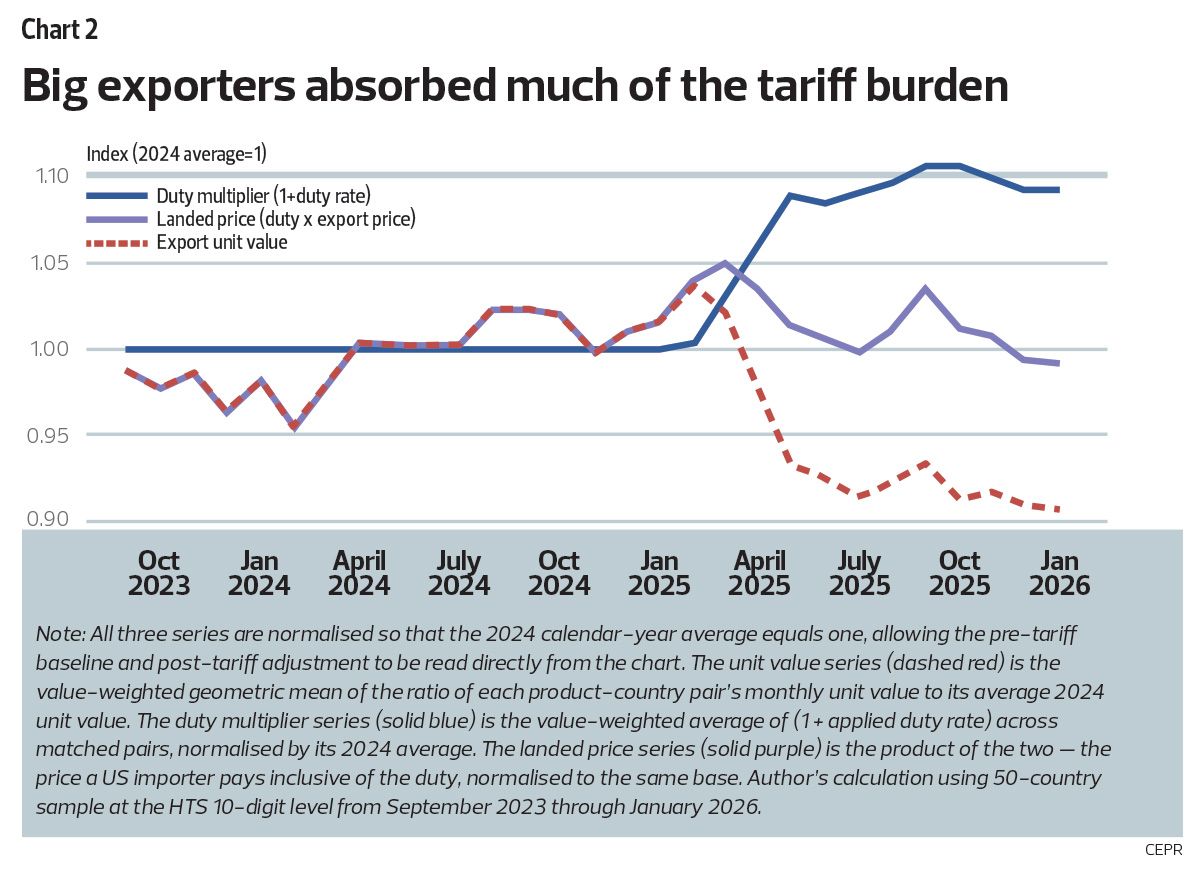
Chart 2 is an extract from the study — exporters, in aggregate, lowered their prices (the dotted red line represents export unit value), absorbing much of the tariff burden, thus keeping the price US importer pays (the tariff-inclusive landed price) broadly stable.
US importers and retailers also absorbed some of the tariff costs, resulting in the gradual and relatively small price increases for end-consumers, hence the muted impact on inflation.
(Scan the QR code to read the discussion paper [titled “DP21798 Tariff Incidence and Market Power: Evidence from the 2025 US Tariff Shock”], published on July 29, 2026.)
Ultra-competitive Chinese producers can afford to absorb the tariff cost …
We know that Chinese manufacturers are, by a wide margin, the world’s most dominant goods exporters, accounting for one-fifth of global manufactured-goods exports. What we have also come to understand over the past months is how the Chinese became such fearsome competitors and how they exert pressure on all others in the global market.
Chinese manufacturers’ ultra competitiveness was honed in their domestic market. China’s huge population of more than 1.4 billion provides manufacturers with the scale to experiment and to innovate. This scale enables new products to iterate rapidly, improving at a speed that is beyond producers in most countries. Technologies are pioneered, deployed, improved and produced at scale. Any marginal improvement is rapidly imitated across the entire industry.
But the Chinese domestic market is also intensely competitive. Survival is often dependent on the enterprise’s ability to come up with better products at ever more affordable prices to attract greater volume sales. Some resort to selling below cost.
Eventually, this cutthroat price competition itself becomes a problem. Consumers benefit. But in such an extremely competitive environment, many manufacturers struggle to turn a profit, even with relentless cost reduction. It is estimated that nearly one-third of China’s larger industrial enterprises are operating at a loss, so much so that the Chinese government has stepped in to curb such vicious, race-to-the-bottom, price wars, the so-called involution.
Manufacturers must earn the minimum necessary returns to continue investing and innovating. For many, the answer lies in exports — where selling prices are, by and large, higher than in the domestic market. Chinese manufacturers can afford to undercut foreign competitors — and still make better margins than they could domestically.
It is also why, we believe, Chinese exporters — especially those that sell predominantly to the US market — were willing to absorb part of the tariff cost. Case in point: The CEPR study showed that Chinese exporters of toys and dolls saw US tariffs rise by 28% while cutting export prices by 22%, absorbing roughly 80% of the shock. As a result, US importers ended up paying only a small portion of the tariff burden, an amount that they can more easily absorb and/or partially passed through to consumers. Whichever the case, the tariff impact on prices of toys and dolls was far less than the headline 28% levy.
… and also exert price pressure on the rest of the world
Chinese manufacturers play the volume game. They are able and willing to lower selling prices — cost competitiveness can be attributed, in part, to the sheer scale of the domestic market — and earn smaller margins to gain market share. This is rational. One can maximise profit through either margins or volume sales.
What this also means is that other producers are forced to lower their own selling prices and similarly absorb part of the US tariff cost — or cede market share. Large dominant players typically have more room to cut, and many would sacrifice some margin to retain market share. Smaller exporters, on the other hand, tend to be price-takers in the global market and have little margin buffer. They either pass on the tariff cost — but where their substantially smaller footprint means less impact on overall US inflation — or sell elsewhere.
Trump’s Liberation Day tariffs may have shocked a world in which globalisation has reigned in past decades. In its aftermath, however, even the most ardent defenders of free trade are now reconsidering protectionist policies. Faced with higher US trade barriers, many Chinese exporters sought alternative markets — diverting their products to the rest of the world. The rationale is the same: Prices in these markets are higher than in the Chinese domestic market. China’s merchandise trade surplus surged nearly 20% from US$992 billion in 2024 to a record-breaking US$1.2 trillion in 2025. As we wrote previously, ultra-competitive China-based e-commerce platforms, brands and enterprises are a growing threat to the domestic economies in the rest of the world.
Portfolio commentary
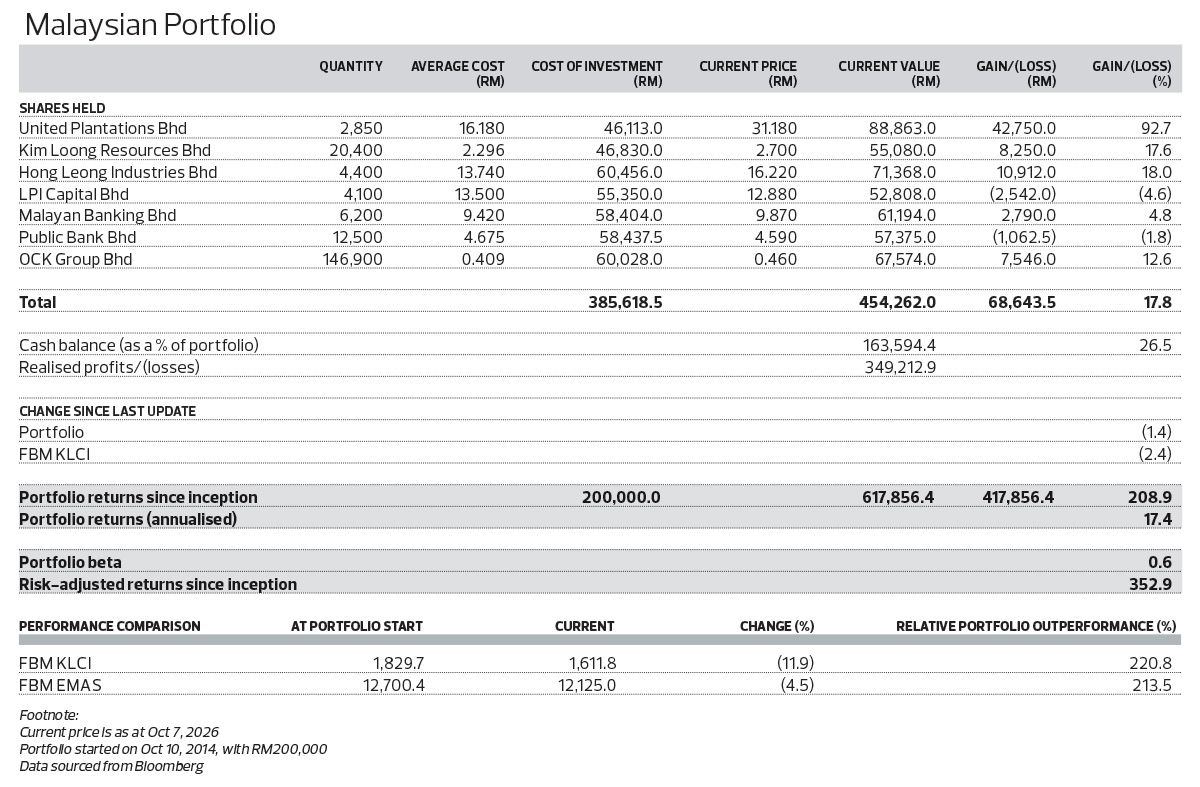
The Malaysian Portfolio fell 1.4% for the week ended Oct 7, holding up relatively better than the broader market where the FBM KLCI was down 2.4%. All stocks in our portfolio ended in the red. The biggest losers were OCK Group (-5.2%), Public Bank (-2.3%) and Hong Leong Industries (-1.5%). Total portfolio returns dropped to 208.9% since inception. Nevertheless, this portfolio is outperforming the benchmark index, which is down 11.9% over the same period, by a long, long way.
The Absolute Returns Portfolio, on the other hand, gained 0.9% for the week. The gains lifted total portfolio returns to 34.9% since inception. The top gainers were Talen Energy Corp (+21.0%), Nvidia Corp (+4.0%) and Microsoft Corp (+3.3%) while the biggest losers were Schneider Electric (-14.0%), Thermo Fisher Scientific (-1.9%) and Sun Hung Kai Properties (-1.7%).
Meanwhile, the AI Portfolio was up 2.2% over the same period, boosting total portfolio returns to 34.5% since inception. Hewlett Packard Enterprise (+12.8%), Cadence Design Systems (+7.9%) and Marvell Technology (+7.7%) led the gainers while Unusual Machines (-10.6%), Akamai Technologies (-1.6%) and Alibaba Group Holding (-1.2%) were the biggest losing stocks.
Disclaimer: This is a personal portfolio for information purposes only and does not constitute a recommendation or solicitation or expression of views to influence readers to buy/sell stocks. Our shareholders, directors and employees may have positions in or may be materially interested in any of the stocks. We may also have or have had dealings with or may provide or have provided content services to the companies mentioned in the reports.
Save by subscribing to us for your print and/or digital copy.
P/S: The Edge is also available on Apple's App Store and Android's Google Play.