

This article first appeared in The Edge Malaysia Weekly on March 31, 2025 - April 6, 2025
We had originally planned on a two-part series to explain the “truths” behind the actions that Donald Trump has undertaken in his short eight-week tenure, thus far, as president of the United States of America. We called his blueprint the “MAGA Pathway”. But we realised that we would miss out a critical third leg of Trumpianomics — no less important than tariffs and currency. That is, the need to deregulate to raise competitiveness and reduce the fiscal deficit for long-term sustainability.
Although implied and touched upon in the first two parts, we feel it needed to be highlighted to complete our narrative, hence Part 3 of Trumpianomics. It will also explain why we think US equities will outperform — and the US dollar will strengthen — and our investment choices of US banks as well as steel and building material stocks. Much of the effects from tariffs and currency on investments and growth will take time to deliver benefits to the US economy. But deregulation is likely to see more positive outcomes in the near term as we will explain in this article. Tariffs on imports are likely also to increase the gross margins for domestic producers, from both higher prices and capacity utilisation on the back of higher volume sales.
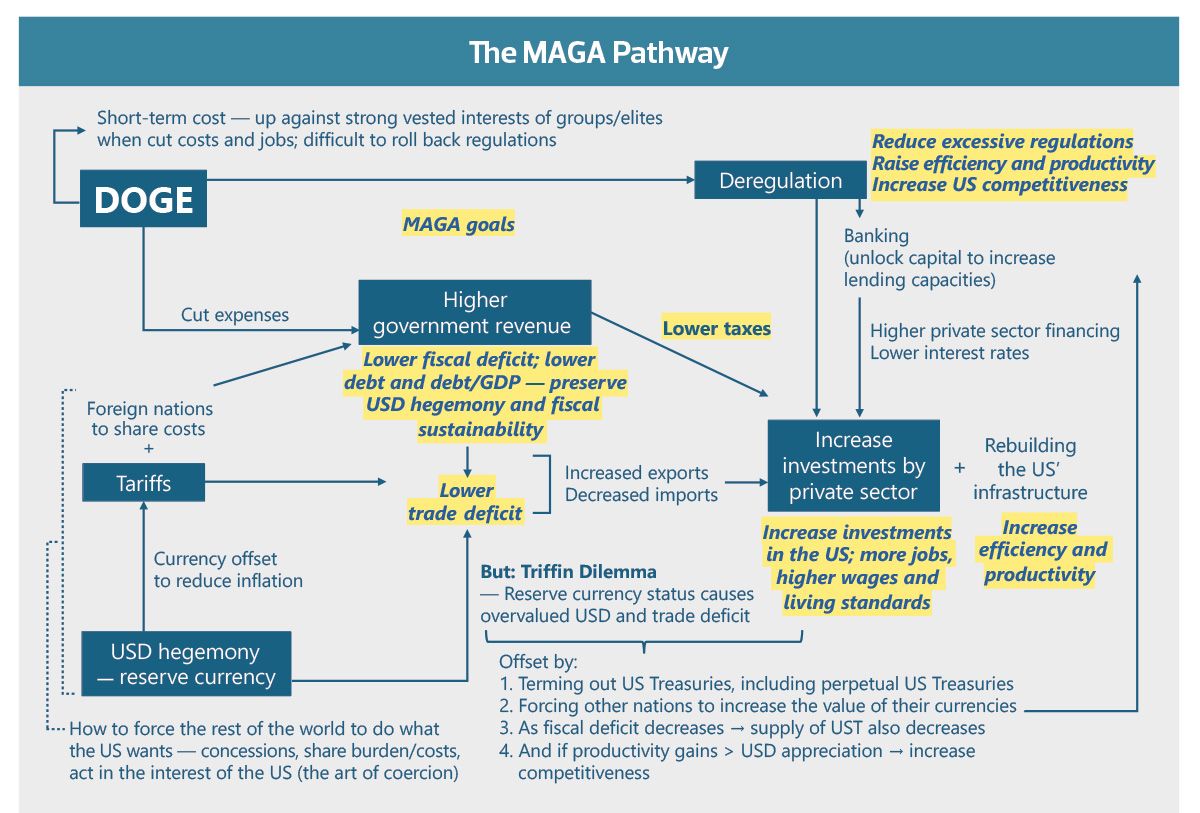
As we wrote previously, contrary to what many economists and analysts see as disruptive, confounding and ill-conceived policies, Trump’s goals to Make America Great Again (MAGA) are well defined (see diagram), which is to:
i) Increase investments in the US, revitalise manufacturing and reindustrialisation;
ii) Increase jobs and real wages and, therefore, standards of living;
iii) Increase exports and reduce trade deficit;
iv) Reduce fiscal deficit to ensure fiscal sustainability;
v) Reduce total debt and debt-to-GDP to preserve US dollar hegemony;
vi) Reduce taxes and excessive regulations to increase investments;
vii) Raise efficiency and productivity; and
viii) Increase US relative competitiveness.
We think few, including conventional economists, will disagree with the virtues of these goals in and of themselves. Indeed, most of what we have listed here are standard prescriptions for how countries should grow their economies and be fiscally responsible at the same time.
Case in point: Many have flagged concerns over the sustainability of mounting US debts at some point or other in the past, and the need for the government to rein in its fiscal deficit. Government spending has exceeded revenue in all but four years in the last 50 years, and every year since 2001 (Chart 1).
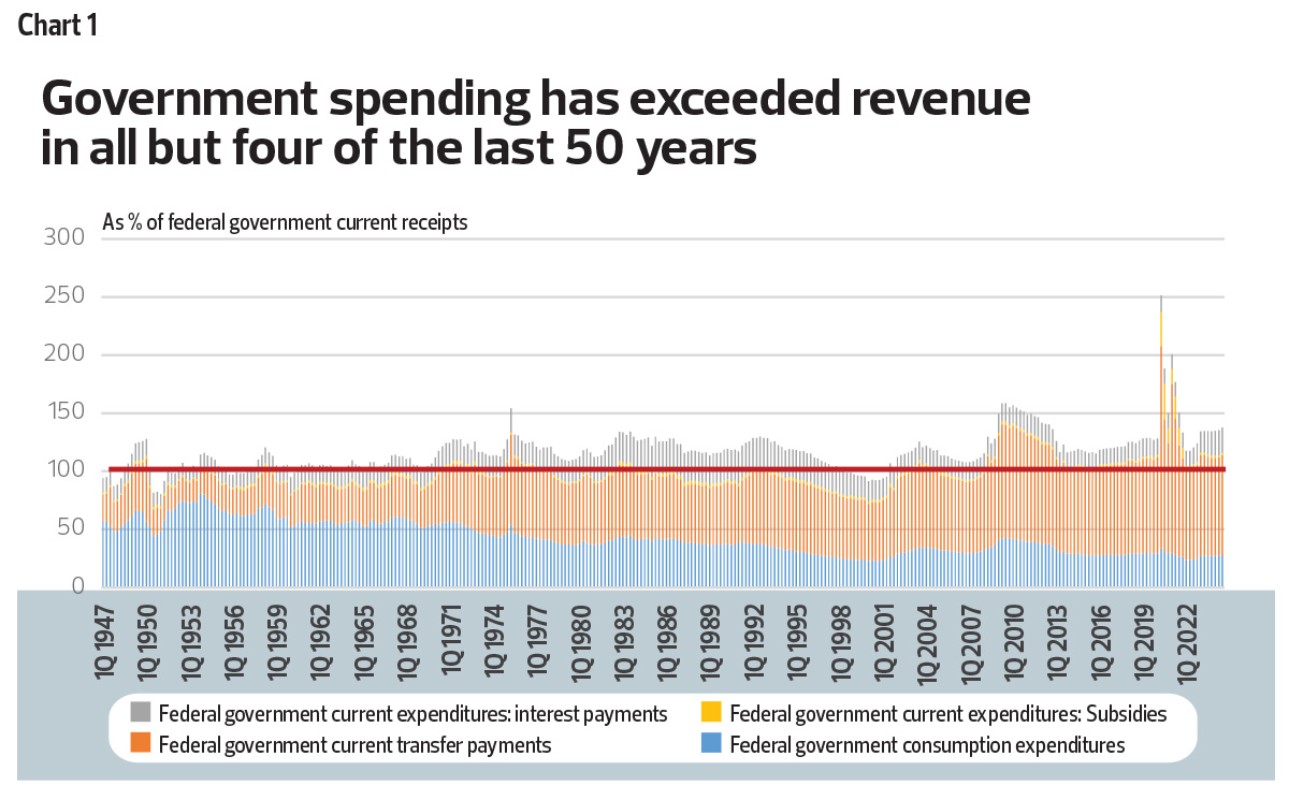
Successive presidents since Bill Clinton (the last time the US ran a budget surplus) have talked about cutting spending but none have made a significant dent in US government outlays. That includes the first Trump administration, during which fiscal deficit increased, owing primarily to tax cuts that were not offset by equivalent spending cuts. The US fiscal deficit has been growing larger in the past 10 years.
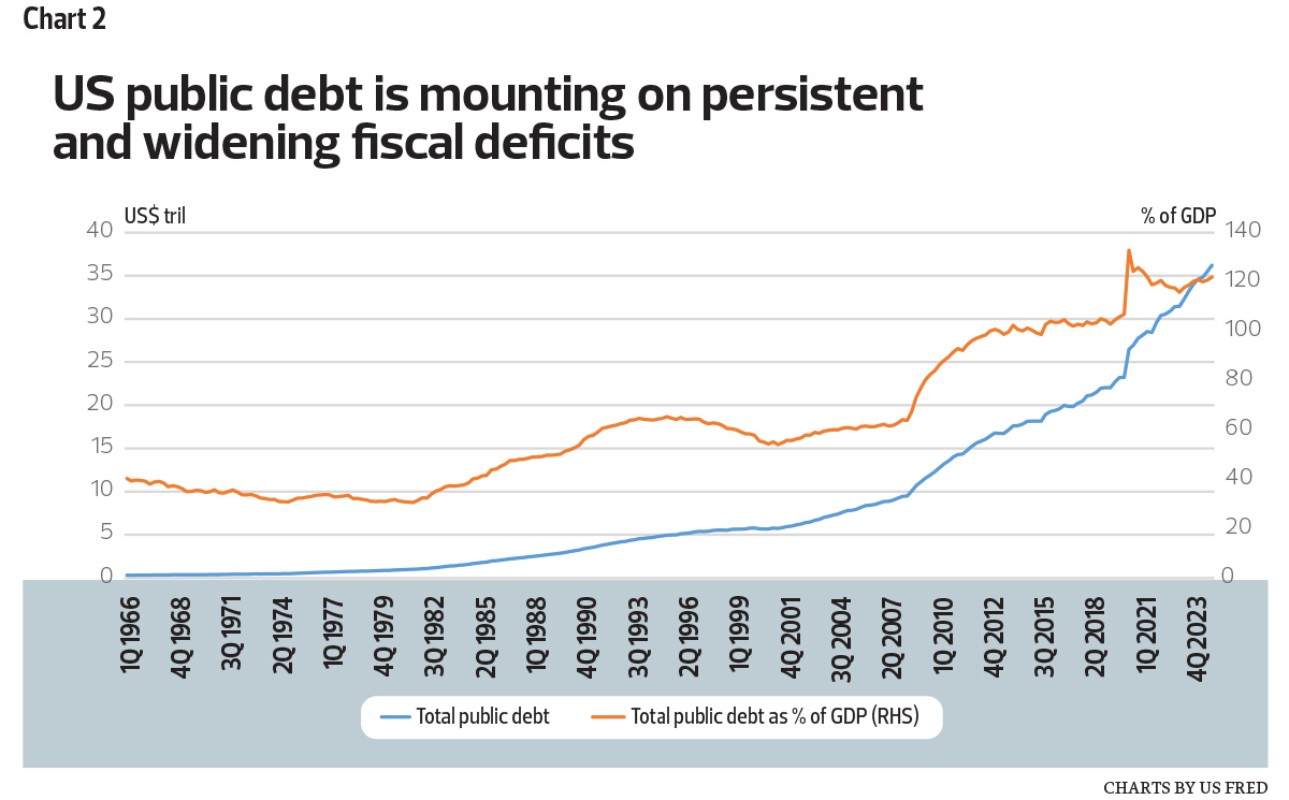
As a result, total US public debt has risen at a very steep pace, especially after the Global Financial Crisis (in 2008) and Covid-19 pandemic (2020), now totalling more than US$36 trillion with a debt-to-GDP ratio of more than 120% (Chart 2). Such a high level of indebtedness, for any country, would have been punished by the markets. The US has got away with it thus far, primarily because the US dollar and US Treasuries are reserve assets held by most of the rest of the world. But there must be a tipping point, beyond which central banks and investors will start to worry about the credit-worthiness of the US and demand a higher risk premium (interest rate). Or worse, the US dollar will lose its reserve currency status and hegemony.
To a certain extent, the urgency to reduce fiscal deficit and debts has been blunted by low and falling interest rates. For the past four decades, US interest rates have been falling — owing to the secular decline in inflation driven by globalisation — to near zero in 2020. As a result, interest expenses have grown at a slower clip relative to the size of total debt, and interest payments as a percentage of government spending have been steadily declining in the three decades prior to 2021 (Chart 3).
But that era of ultra-low and falling interest rates is over. Interest rates have risen since the pandemic and are expected to stay higher for longer. As a result, the government’s annual debt servicing costs have risen sharply, to well over US$1 trillion currently — and growing. Clearly, this is not sustainable. Left unchecked, interest payments will take up an increasing share of government revenue, depriving funding for other more critical programmes and development. And as we said, there will come a tipping point (albeit not in the foreseeable future) when the US dollar will start losing investor confidence and value.

The solutions are obvious. One, the US government must raise revenue and make material cuts in public spending to narrow the fiscal deficit and set the US onto a more fiscally sustainable path. And, two, grow GDP so that debt-to-GDP will begin to fall, as will interest servicing costs to revenue. The MAGA Pathway aims to achieve both goals.
None of what we have written so far is controversial. As we said, successive US presidents have talked about reducing the fiscal deficit — but without material success. The reality is that the democratic system is a popularity contest. All lawmakers (in the House of Representatives and the Senate) as well as the president are elected by the people. Raising taxes is never popular and cutting spending even less so. There is simply too much vested interests (perpetuated by powerful lobbyist groups) and cutting spending causes pain and job losses. Regulations, once implemented, tend to be very difficult to roll back. Therefore, what Trump is now attempting to do is well out of the norm, even for old-school Republicans.

What is controversial is how Trump is going about achieving his MAGA goals: tariffs (targeted primarily at friends and allies no less); the Department of Government Efficiency (DOGE); and his handling of foreign relations. It is his willingness to use tariffs as the blunt tool of trade policy, to use the force of coercion to get what he wants — the concessions and the sharing of burden of US supremacy. Specifically, it is the cost of providing the US dollar as the primary reserve currency to the world and the security shield, militarily, to allies. And he is succeeding! Not just in negotiations with foreign governments — pragmatic China will make a deal, including the possibility of voluntary export restrictions — but domestic institutions such as Columbia University and prominent law firm, Paul Weiss, too, are ceding to his demands.
We think this is largely due to his personality — he is aggressive and he is obnoxious. The course of history has never been changed by a weak personality, out to please others. He says what he means and he does what he says. Also, he is — and makes deals like — a businessman, not the typical politician. And the environment is ripe for his disruptive, wrecking-ball approach. Many middle-class, hard-working Americans believe the US has been going in the wrong direction — economically (hollowing out of manufacturing, expansion of foreign aid and welfare programmes that need to be paid for) and culturally (woke, transgender, cancel culture), on immigration, DEI (diversity, equity and inclusion) and affirmative action and so on — under the influence of the progressive left and the globalist elites. They believe the system is broken. When things are pushed to the extreme, there will be a backlash. Right now, the pendulum is swinging sharply back towards the right, after years of liberal extremism.
Fiscal sustainability through lower fiscal deficits and GDP growth
The three key thrusts in Trump’s MAGA agenda — tariffs and cost-sharing, DOGE and deregulation — are interlinked and self-reinforcing, enabling a positive feedback loop to achieve his goals.
Tariffs will raise revenue for the government, lower the fiscal deficit as well as pay part of the cost of tax cuts. Lower taxes and tariffs will encourage more investments in the US. Companies (foreign and domestic) can avoid tariffs by producing in the country. Higher prices due to tariffs will reduce imports and lower the trade deficit and reduce the supply of US Treasuries. Yes, in the short term, it will lead to domestic producers also raising their selling prices, thereby increasing their own margins and profits. Over time, however, it will lead to higher investments and domestic production, creating jobs and raising productivity and wages — and drive economic growth. Revitalising manufacturing and reindustrialisation as well as infrastructure rebuilding is the basis of our longer-term investment thesis for US steel and building materials sectors (more on this next week).
Aggressive DOGE cost-cutting — including eliminating wastages, fraud and abuse, and downsizing the government — will further lower the fiscal and trade deficits. That will improve efficiency and productivity. It will also free up more revenue for the rebuilding of America’s ageing infrastructure, which will, in turn, raise efficiency and productivity. As long as productivity gains exceed US dollar appreciation, the US will net gain relative competitiveness.
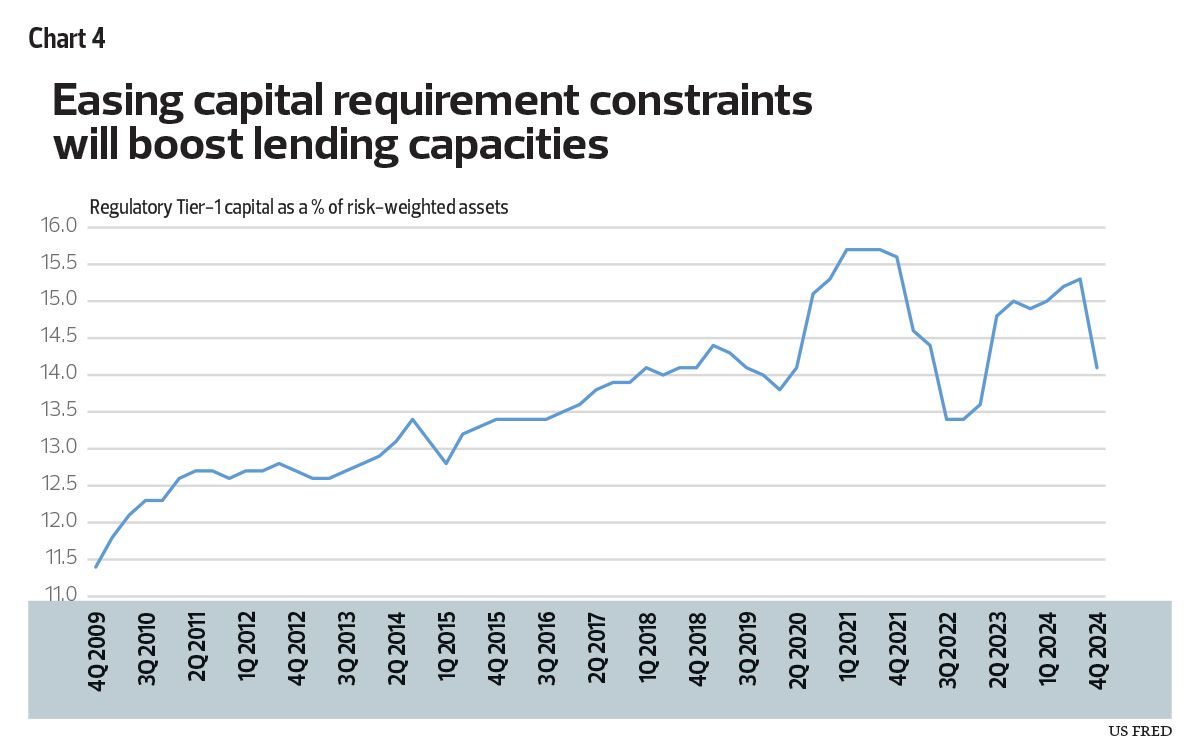
Less restrictive regulations will boost the attractiveness of investing in the US. Over-regulation stifles innovation and discourages investments. Just look at Europe. Deregulation of the financial sector, such as reducing excessive rules and oversight, will lower compliance costs. Lowering capital reserve requirements (as originally mandated under the Basel 3 Endgame) will unlock capital (reduce the banks’ mandatory holdings of US Treasuries) that will go towards expanding lending capacity — at lower interest rates — to the private sector while generating more business and profits for banks. This is one of the reasons we are bullish on US banks, why we bought JPMorgan Chase and Goldman Sachs (see Chart 4). Less stringent environmental rules and regulatory hurdles in the energy sector, especially on federal lands, will boost oil and gas production and bring down prices (costs) for both consumers and businesses.
In short, the combination of Trump’s actions will reduce the cost of doing business in the US, stimulate investments, create more jobs and better wages for Americans, boost productivity and relative US competitive in the world while maintaining US supremacy, sustained GDP growth and US dollar hegemony (see diagram for a summary of all the actions and MAGA goals).
Asian economies are vulnerable to more tariffs
We have explained in our past articles that tariffs are just a means to an end. We will not rehash it, but you can reread them in our last two articles on Trumpianomics (scan the QR codes to read the articles in full). Tariffs are proving to be quite effective in forcing concessions from others, to the benefit of the US. We suspect that the final piece to Trump’s “MAGA Pathway” will include terming out US Treasuries (including perpetual bonds) and forcing countries to increase the value of their currencies. This will resolve the Triffin Dilemma, where being the reserve currency will lead to an overvalued US dollar and ever-increasing trade deficit (to supply the world with its US dollar needs). Of course, there will be consequences, in the short term and in the long run, for the US and the rest of the world.
Already, uncertainties and volatility in global equity markets have worsened in recent weeks, as the full extent of Trump’s tariffs became increasingly clear. Thus far, the US has imposed 25% tariffs on all imports from Canada and Mexico, additional 20% tariffs on China and 25% tariffs on steel and aluminium imports from all countries. He has talked about similar tariffs on products such as copper and lumber, cars, semiconductors and pharmaceuticals. Trump has also threatened a 25% blanket tariff on the European Union.
The Trump administration is set to announce on April 2 much broader “reciprocal tariffs” that will cover all countries. Basically, countries will get a tariff “number” from the US — to match the tariff rates that each country currently levies on US exports. Negotiate or accept the tariffs. The thing is, smaller nations may have little of value to offer — or, using Trump’s analogy, they probably have few, if any, cards to play — even if they are willing to negotiate.
This is why we are more bullish than most on larger economies such as China — even though they are positioned by the US as foes — than smaller nations, even when they are positioned as friends. It is why we think the traditional trichotomy view of friends, foes and neutral nations may no longer be useful. What does this mean for future geopolitical alliances? What does this mean for trade and economic relations between the US and China, the US and Russia, and the US and India? We think President Trump is a political trader, not investor. This is a topic we will return to in a few months, when the time is right.
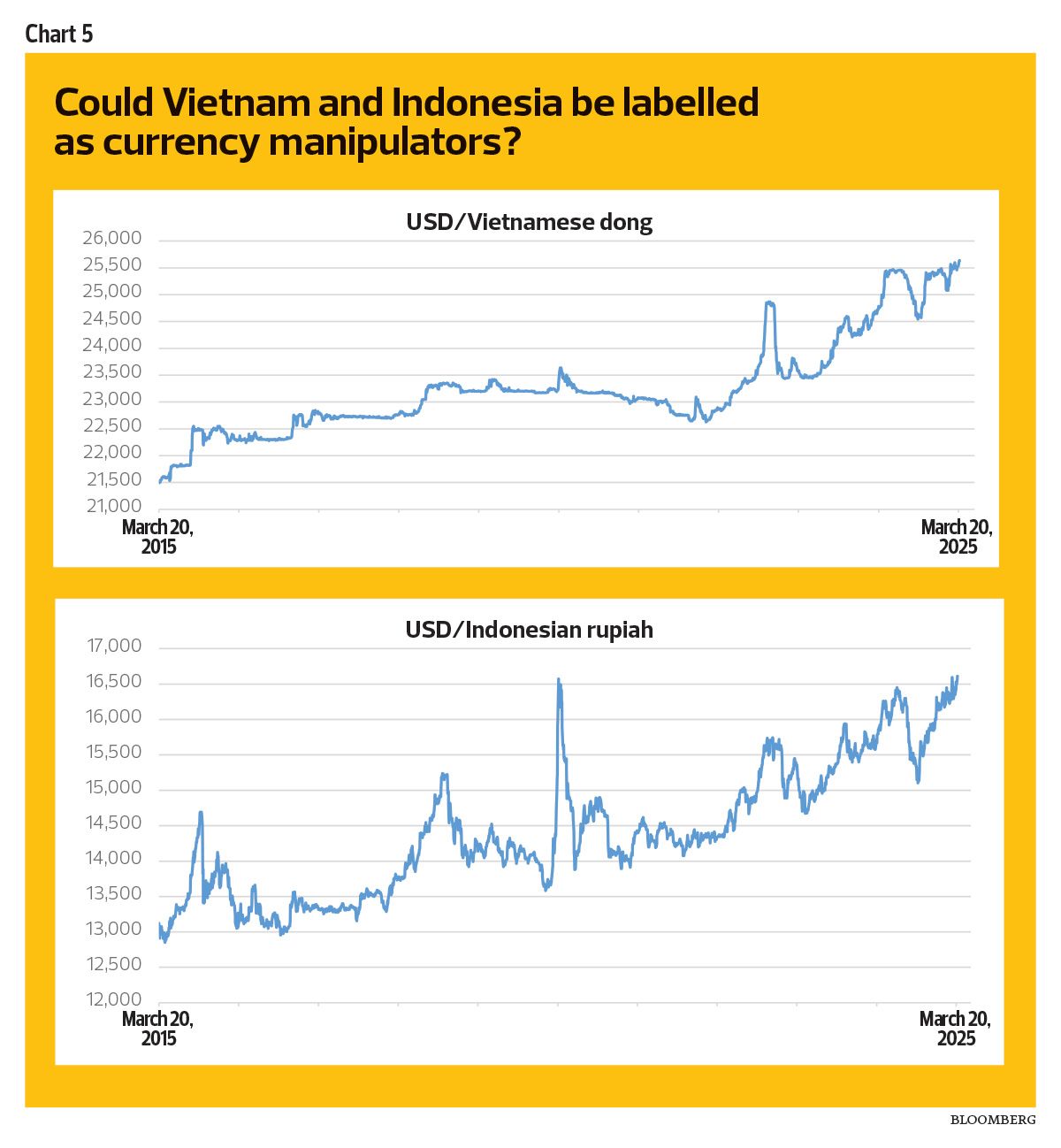
We see more tariffs as imminent and Asian countries are most likely next in the line of fire. Those with large trade surpluses with the US will be particularly vulnerable. China, Canada and Mexico are the top three on the list. The next is Vietnam, with Japan, Germany, South Korea, Italy, India and Taiwan rounding the top 10. Malaysia is on the list at No 13 and Indonesia is at No 14. In addition, India, South Korea and Indonesia have some of the highest protectionist tariff regimes in the world. Trump’s reciprocal tariffs will also take into account non-tariff barriers, value-added taxes, exchange rates and other perceived unfair practices (such as subsidies) that disadvantage the US. Back in 2021, the Trump administration had listed Vietnam as a currency manipulator, essentially charging that the country was depreciating its currency to make exports to the US cheaper. Indonesia, too, has been on the US’ currency monitoring list at different points in time (see Chart 5).
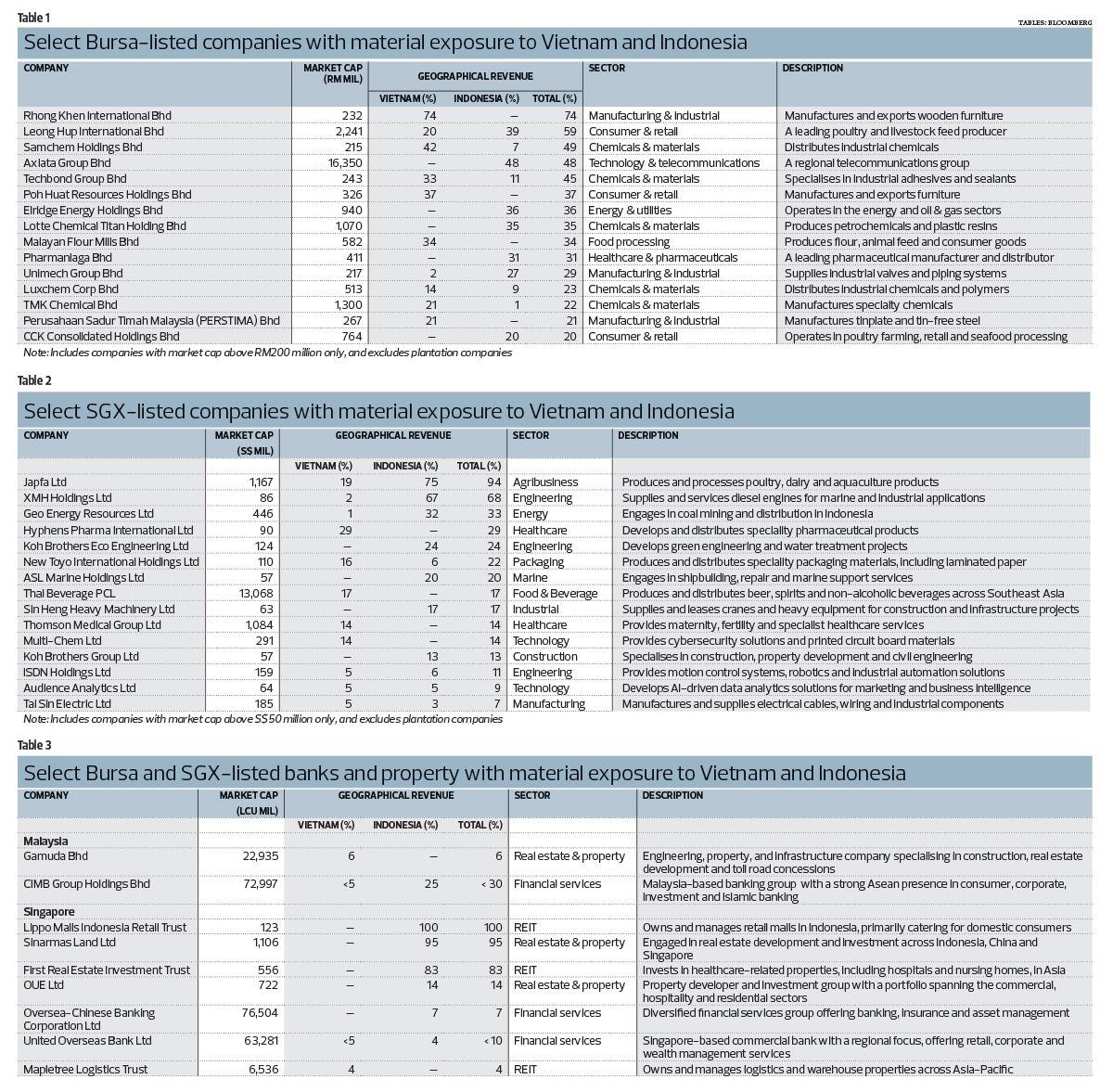
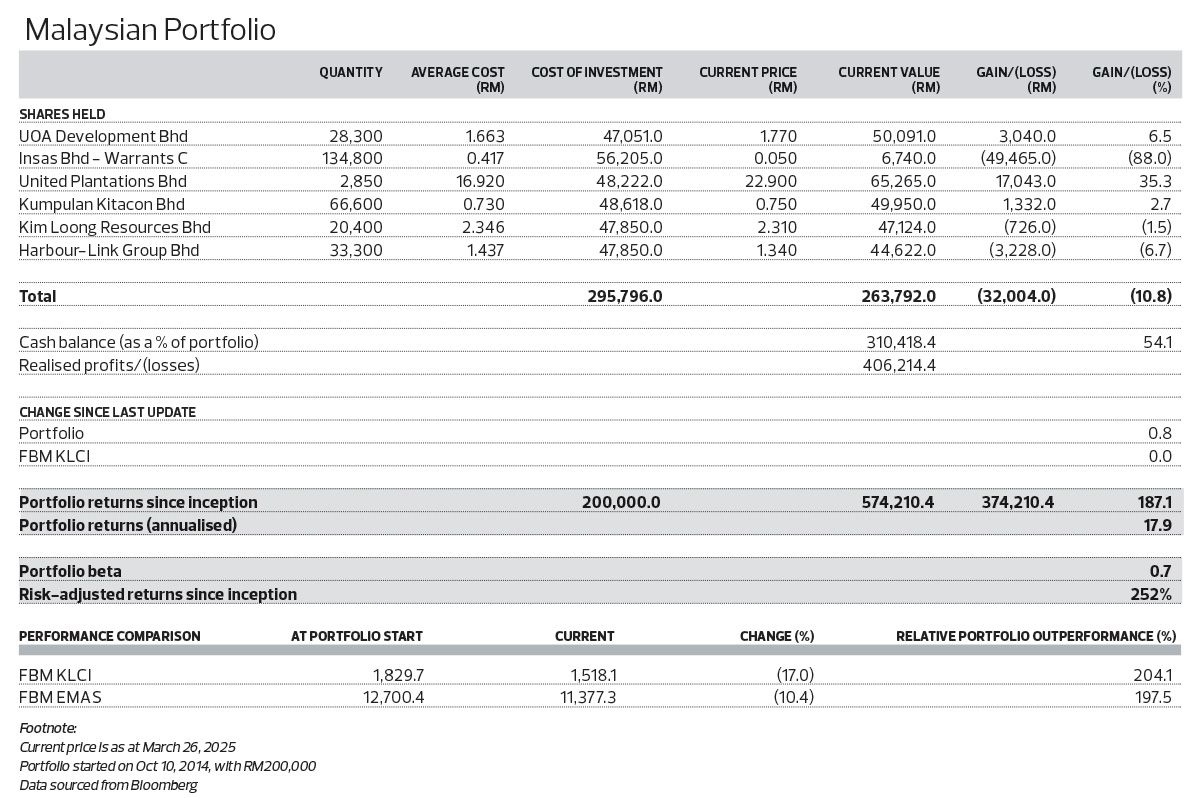
US tariffs on countries will hurt exports and drag on their domestic economy, ultimately hurting consumption and growth. We are particularly worried for Vietnam and Indonesia, especially with over leveraging in the real estate and banking sectors (see Tables 1 to 3 for select listed companies on Bursa Malaysia and the Singapore Exchange that have some exposure to both countries). We think the risks of tariff-inflicted damage on Asean economies are high and this is the main reason we have sold down our Malaysian Portfolio, to about 54% cash. We would adopt a defensive stance for now.
The Malaysian Portfolio was up 0.8% for the week ended March 26, led by gains from United Plantations (+6.4%), Kim Loong Resources (+2.2%) and Kumpulan Kitacon (+1.4%). The only loser was Insas Bhd – Warrants C (-16.7%). Last week’s gains lifted total portfolio returns to 187.1% since inception. This portfolio is outperforming the benchmark FBM KLCI, which is down 17% over the same period, by a long, long way.
The Absolute Returns Portfolio also traded higher last week, gaining 1.5% amid steadier sentiment for the broader market. Total portfolio returns since inception now stand at 25.6%. The top gainers for the week were JPMorgan Chase (+7.3%), Goldman Sachs (+4.1%) and US Steel Corp (+4%). On the other hand, Tencent Holdings (-5.5%), CRH (-2.8%) and Nucor Corp (-1.9%) ended in the red.
Asia Analytica is offering a three-month internship to those interested in learning more about the intricacies of investing with our research team. Please email your resume to [email protected]. Only shortlisted candidates will be notified.
Disclaimer: This is a personal portfolio for information purposes only and does not constitute a recommendation or solicitation or expression of views to influence readers to buy/sell stocks. Our shareholders, directors and employees may have positions in or may be materially interested in any of the stocks. We may also have or have had dealings with or may provide or have provided content services to the companies mentioned in the reports.
Save by subscribing to us for your print and/or digital copy.
P/S: The Edge is also available on Apple's App Store and Android's Google Play.