

This article first appeared in The Edge Malaysia Weekly on October 5, 2026 - October 11, 2026
DATUK Seri Azmir Merican, group managing director and CEO of Sime Darby Property Bhd (SDP), is steering the country’s largest developer by land bank away from the traditional develop-and-sell model to become a diversified real estate group.
SDP is sweating its land bank, maximising returns on every acre it owns, to build a recurring income of RM10 billion in the next five years, from RM5 billion now. In addition, the group is setting up development funds to allow it to leverage capital from other sources to fuel its growth.
The following are excerpts from The Edge’s exclusive interview with Azmir.
The Edge: SHIFT25 was your first major strategy after taking over as group managing director in April 2022. Are you happy with what it has achieved?
Datuk Seri Azmir Merican: We had lofty ambitions. One was to get both our property engines firing. We are known for township development, but not so known for high-rises. We had high-rise projects in the past, which were not executed to the level that we thought we should, and we weren’t able to sustainably launch them.
SHIFT25 was also about moving from a traditional pure-play developer to a real estate company. A real estate company means you have multiple sources of income.
People look at Sime Darby Property and say there is a lot of land, so you don’t have to worry. But over the long term, we exhaust land pretty quickly. There was one year when we did 1,200 acres. If you take that over 10 years, we will be out of land. So we needed to find a way for the company to be in business for a long time. Building long-term recurring income was one of the pillars of SHIFT25.
More importantly, it allowed us to develop new skill sets in fund management and investment capabilities: fundraising, identifying opportunities and understanding what types of funds we can raise.
If you ask me whether I’m pleased, I think we have demonstrated that we’re able to execute. Under SHIFT25, we brought in RM7.6 billion worth of data centre lease deals that will be delivered. We also improved our margins significantly.
What was the hardest part of introducing such a different way of operating? Did the corporate culture have to change?
The biggest thing in any organisation is people and culture. It starts from the top. The first thing we did was to make sure the top team gelled. That cohesion needs to be demonstrated. Once I knew the team could work together, I had a lot of confidence in how far we could push the envelope.
We [are building] Engines 1, 2 and 3. Engine 1 is about making us the best developer in town. Engine 2 is creating a recurring-income business, creating platforms, bringing in new skill sets and educating the team on investment and fund management.
Engine 3 is our experimental engine. That’s the culture we needed to have. We needed to experiment and fail and move on. The team started believing we could do things that previously we thought we couldn’t. Today, it feels like second nature, but it wasn’t always the case.
SHIFT32, which began this year, runs for seven years. Why seven years? Is the recurring-income engine a main part of SHIFT32?
The longer I have been CEO, the more I believe our strategies should be planned over a much longer time horizon. In fact, 10 years would be better. Sometimes, when we compress the time and keep asking for results, that’s where we tend to take shortcuts or find ways to fix things.
For property development, a high-rise takes four to five years to build. Before that, planning takes one to two years. That’s already six or seven years for one high-rise project. Likewise, recurring income takes a long time to build. Companies that embarked on this 10, 15 or 20 years ago are benefiting from it today.
We started with assets under management (AUM) of under RM3 billion. Today, we’re at around RM5 billion and targeting RM10 billion. It’s an aggressive target coming from a small base. We also need to bring in the skill sets — to manage money, investors, exits and funds. So we look into the part of the cycle that we want to go into with the platform used to pool the funds (see also “Driving growth in an unconventional way” on previous page).
SHIFT25 took us from where we were before towards becoming a real estate company. Now, SHIFT32 takes us from where we are now to another level. We want to become a diversified real estate company. That means building capabilities, building size and building returns.
SDP is a GLC (government-linked company). There might be perceptions of it being more conservative. How did you convince your staff of the new strategies that are very different?
That is why culture is one of the things we want to get right. Given the business, the entity, the shareholders, we have to get the culture right. And that’s why we go back to purpose. So if we get it right, then we form the culture.
Although we have a lot of land, if we continue to activate like 1,000 acres per year, in 10, 12 years we will have no more land. We did an experiment [to see], asking ourselves if we could create another township today like what we had done before. It will be very difficult. Not impossible, but much harder. What do we do then?
So when writing the plan, I looked at developers in mature markets. What’s their income, their profile? There are specialised and diversified players, meaning they have to do both property development and recurring income. Then there’s the one that’s flipped more recurring income and less of development. We see … those who do more recurring getting a higher valuation. Specialised players also get a higher valuation, so we knew from that standpoint that we have to change to recurring income.
There’s a gap in the price-to-book [valuation of SDP shares]. And that’s because a lot of capital is stuck in delivering too little profit. So if we keep doing what we’re doing, we will tie down all this capital but we cannot [generate] enough returns. But when we build enough recurring income, use third-party capital, create platforms, that’s when the game will change. And that’s why I think those who do it earlier will benefit. But it needs time.
I think recurring income is an exciting business for us. It’s not a high-risk business and has steady cash flow. We need to grow to a certain size. So from where we are, RM5 billion, we want to grow to RM10 billion. I think when we go above RM10 billion, RM15 billion, then there’s enough throughput to give steady dividends. That’s where our target is.
And I think there’s one other factor — we are no longer that big company anymore. We are standalone today. So we have to earn our keep. We’re not going to get land from a plantation to convert into property. We have to compete with everybody else. So it’s quite a different time and place.
What helped us is that we had really good cohesion — the board, the management and everybody believed this is a really good plan. So I had a lot of factors that kind of helped push it forward.
Fund management is very different from conventional property development, for instance, risk profile. Was it difficult to convince the board?
It depends on what the fund is going to do. I believe real estate funds are relatively low risk because they are asset-backed. You can calculate the return profile from a land fund to a development fund, to a core fund or a real estate investment trust (REIT).
I come from a background in private equity. I used to raise money and invest in private equity, where the return targets could be 18% or 20% because the risks were higher. Here, the risks and return targets are much more manageable.
When we presented the idea of a development fund, the board was very receptive. Permodalan Nasional Bhd (PNB), which is represented on our board, got it and so did most of the other board members.
The board wasn’t the challenge. It was almost like the board was waiting for someone to convert the idea into something that could be executed. The challenge was, how do we conceptualise and execute it?
The first fund was RM1 billion and we have just launched our second fund of over RM1.2 billion. It allows us to earn income from managing funds. As a fund sponsor and general partner, we can also generate fee income from projects. As AUM and funds under management grow, that gives us another income stream and diversifies our earnings. We are quite happy with the progress.
How do you get an organisation that is used to selling property to think differently about its traditional development business?
One of the hardest things internally was getting the team to understand. I can take a piece of land, develop industrial lots, sell them and make RM100 million in three years. Or I can make that money over a much longer period and continue to own the land. Many developers announced that they sold their land to data centre operators and made money. But we went against the grain, retaining our land. In 20 years, we’ll still have that land and it will be worth a different amount then.
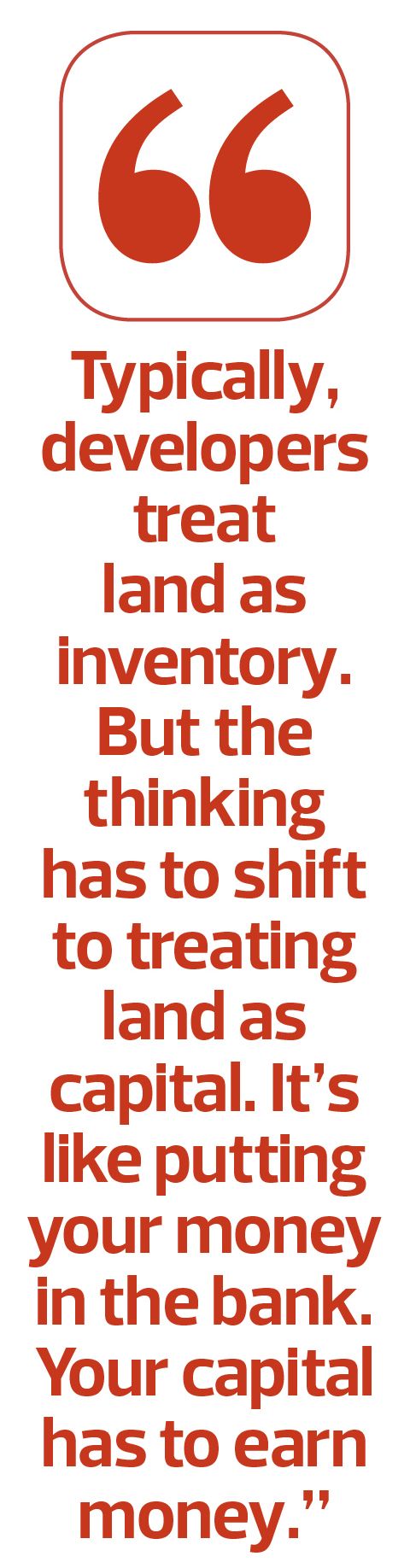
The traditional model is a churn business. You keep churning and churning, but land is finite. Typically, the rule is to treat land as inventory, but the thinking has to shift, that we treat land as capital. It means you need to get returns on it. Under SHIFT32, all this land that’s not earning money needs a plan. Once you find a way for the capital to earn money, I think the equation will change.
With regard to SHIFT32, what kind of earnings trajectory would shareholders expect in the next seven years? Would they expect an even stronger growth momentum compared to that in the last five years?
We want to talk to fund managers about our ability to execute [our plans]. In the last four to five years, we have been doing that, so that gives us confidence that the next three years will see the momentum that has been carrying us.
We can execute, but how strongly? It’s hard to give you a number, but please judge us by our current standing and track record.
Would there be more generous dividends as you grow your recurring income?
We revised our dividend policy to say that there will be a higher payout ratio. That shows our confidence in raising it from where it was before to pay out more. The whole idea is to show that we have more confidence in building recurring income. What that means is that as we get more and more recurring income, we can pay more dividends. It’s a signal so that the investment community understands this is the direction. But we need to hit scale for recurring income.
Tell us more about what you have in mind in terms of capital and leverage strategy as the group is open to higher leverage in SHIFT32.
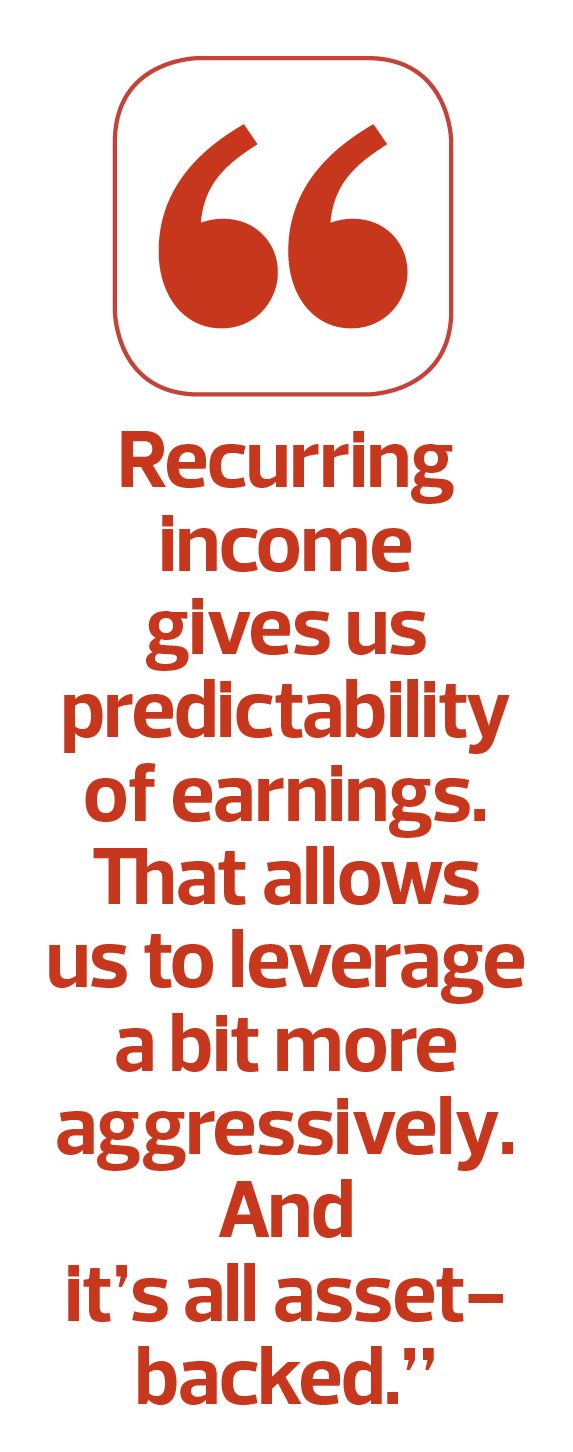
At the moment, as we move away from being a traditional developer and build more recurring income, recurring income gives us predictability of earnings. That allows us to leverage a bit more aggressively. And it’s all asset-backed.
Obviously we’re very sensible, we’re not going to build debt without growing recurring income. As [to] where we are now, I think we’re at 35%, we’re very comfortable. We have room to build recurring income.
What will drive the next phase of growth?
Firstly, we believe that within property development itself, there is a growth element that we have not tapped, and that’s the Engine 3 experimental idea. I think that will give us significant growth for our main business.
Secondly, although we have RM7.6 billion worth of leases from data centres, this can [still] grow over the long term, subject to many other factors. Moreover, we believe the market is ready for specialised assets for build-to-suit lease.
If I can work with you to design an asset, I think we can do a deal with you. A case in point is our deal with Mydin. They have a facility that they relied on for a long time. We were talking to them [about] a modern facility with an automated storage and retrieval system. It made sense so when they got it, we built that facility for them and they leased it from us for [15 years] or longer.
It is exciting because we seek ideas and test them. As an example, we’re building affordable homes in Gurun, Kedah. That’s one of the opportunities that we see, including the energy business, which we’re working on, and solar.
How did you decide that data centres (DC) was an area that you wanted to go into?
We were the first one to announce any DC deal in Malaysia. We’ve been talking to the DC guys, the hyperscalers, ever since I came in. Nothing concrete happened. But I told my board this is going to be the next gold rush. So we have to be in this game. As we worked on it, we’ve got them approaching us, telling us that they’re looking at us, but they’re also looking at others. So that’s when we started working on this particular DC with the hyperscaler.
Hypothetically, if the worst-case scenario happened — when your client, in the seven or eight years, decides to move out — what would be the implications?
There are mechanics to deal with it. Basically, we won’t lose out. We will recover our costs and also enjoy a certain amount of value and compensation. The land and building still belong to us so we can use it for another purpose. I don’t see that scenario happening, obviously. But if you’re saying that happens, that’s the benefit because we’ve not sold them the land.
What we build is a powered shell. That means we build the building, there’s power and water connected. What goes inside the building is not ours. All the money, the chips and all that, is the client’s.
You have a large land bank along the west coast of Malaysia. What are your plans or strategies moving forward?
Under SHIFT32, we are looking at how to intensify returns. I spoke about the discount to RNAV (revalued net asset value). This is because companies like us have got a lot of capital tied up in land and inventory.
So one of the things that we’re looking at is how much land should we hold. We have to hold the right amount of land. Some cases are clear-cut. There is land that we know we will hold because of recurring income.
As a portfolio, it also begs the question of how many years of development land do you want to hold. For example, for our high-rise business, we don’t need to hold hundreds of acres.
So what is the amount of land we should hold and how fast can we monetise? This is about generating returns. It is an ongoing exercise for us because traditionally, we’ve always had land. But let’s also be balanced because for SDP to survive long term, our forte is that we are a good master developer. We master plan the entire, say, 3,000 acres and then we can develop townships. We need to hold enough land to do that. There is that exercise being undertaken now because the end game is to maximise returns. As I mentioned, treat land as capital, not as inventory.
What’s your assessment of the industrial park business?
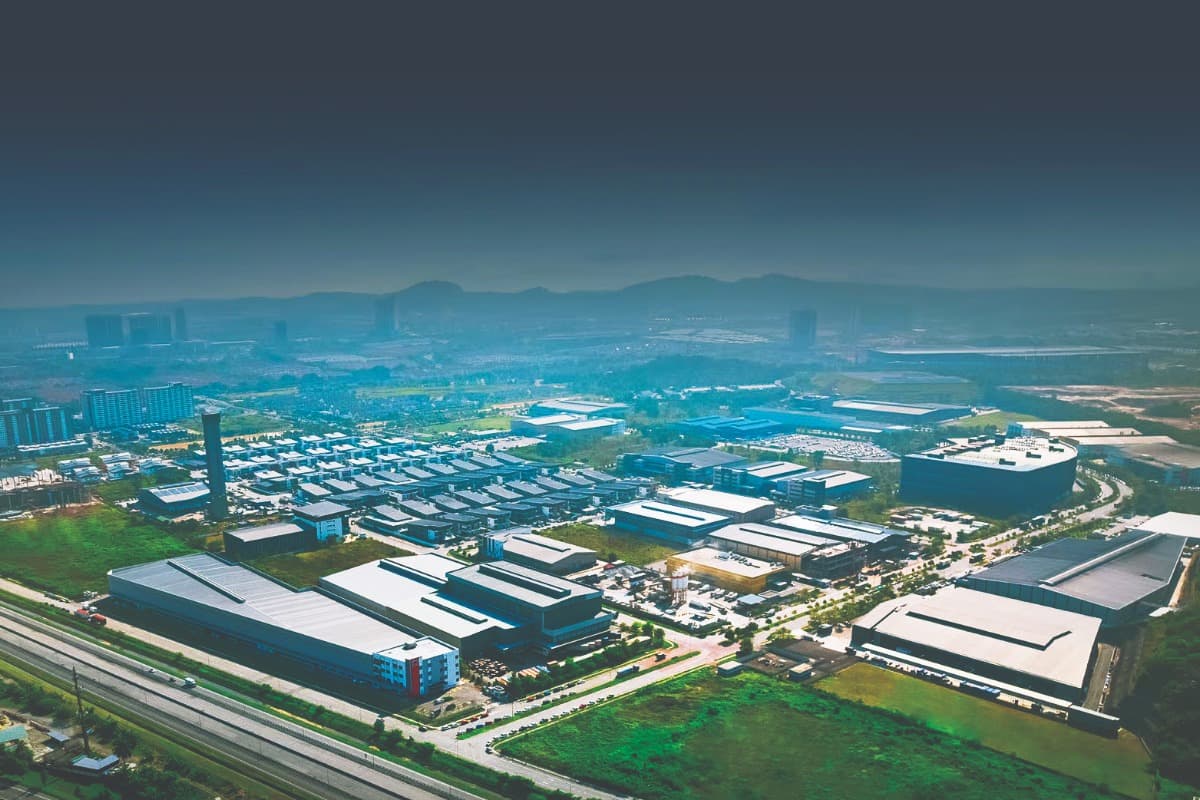
Our industrial product today is number one. During Covid, we shifted to industrial. We were known for landed homes. So we shifted into two things — high-rises and industrial. Industrial is [now] our number one component followed by landed homes and then high-rises. We see there’s a natural demand for this. Planning and managing industrial parks is quite unique, for example, our master plan in Bandar Bukit Raja.
We want to set a benchmark for being environmentally friendly, sustainable, the kind of industries that we bring in, the kind of buildings that we will build. And then we launched Vision Business Park in Negeri Sembilan.
For the investment and asset management division. What are the top three criteria for asset selection? Are REITs also part of your plan?
Yeah, eventually we will have it. Talking about funds, to me, REITs are the boring part. Everybody wants to have a REIT. It’s not complex to set up. Everybody can do one. Nothing sexy about it. It just allows you to recycle capital. Funds are more interesting. I can just do it with investors and I don’t have to disclose too much to anybody. I think we earn more money from doing this type of funds. But I think to complete the value chain, we will do a REIT as well. It will allow us to recycle capital.
Is a REIT listing expected in the next five years?
Sooner than that.
Why enter purpose-built student accommodation in Australia? Isn’t overseas expansion risky, given the experience in the UK?
Today, if you look at SDP’s revenue profile, almost all of it is from Malaysia. Australia is a market that we have studied. We’ve seen many property developers do well there, and the size and scale we’re taking on is manageable.
The site is less than one acre and we have two products. One is something we understand very well, which is build-then-sell apartments. The other is purpose-built student accommodation (PBSA), which we’ve wanted to enter for a long time and felt the time was right.
We like the PBSA market. Melbourne is a market where the economy is very dependent on education. We can understand how the student population will grow and we understand the gap in student housing today. We’ve spoken to developers and people all along the value chain, and we understand the costing, so it gives us confidence.
The PBSA economics is attractive. Depending on the rent, you know whether you’re offering a single bed, two beds or a suite. The fit-out is fairly standard. You can calculate the number of units, the type of beds, the build cost and whether you’re going to make money.
Ultimately, this is an opportunity to do it with third-party capital and build recurring income. We are exploring bringing in a capital partner for the asset. We will build one tower with 64 storeys, half of which will be sold as apartments while the remaining half (PBSA) will be kept for rental income.
We’re exploring bringing in a financial partner, with us retaining the majority [of the asset].
How’s your investment in Battersea?
Battersea is progressing. We’ve got the approval for the next phase. We’ve launched Phase 3C and we’re quite bullish about it. The thing about Phase 3C is that you launch it today, you deliver in four to five years later and the sale is only recognised when you have completed. So for us, there’s a bit of a revenue gap. But we’re confident. In fact, our sales have been quite encouraging. We’re quite happy about the fact that we’ve got the product right and the price right. So far, we’ve got a more than 40% take-up rate and it was only launched like two months ago.
Do you think it will be easier to implement SHIFT32 since you already have SHIFT25?
No, it won’t be easier. SHIFT32 is more complex. We need to bring in more skill sets. We need organisational discipline. We need different people. We are going to go deeper in operations because of the assets that we own and operate.
We did a transformation from the inside out. Looking at our purpose, working on our culture, a strategy. Working on execution. The next challenge of SHIFT32 is very interesting because it will allow us to take this organisation to a different level of discipline. And we are hungry for growth.
We also want to expand beyond Malaysia. Australia is one, but we have one or two other countries that we like. It will give us that challenge. A more complex organisation means we’ve got more to handle and manage. Culture is the glue. It’s the stickiness that makes everybody want to work together.
Read also:
Cover Story: Reworking the developer model
Cover Story: Driving growth in an unconventional way
Save by subscribing to us for your print and/or digital copy.
P/S: The Edge is also available on Apple's App Store and Android's Google Play.