

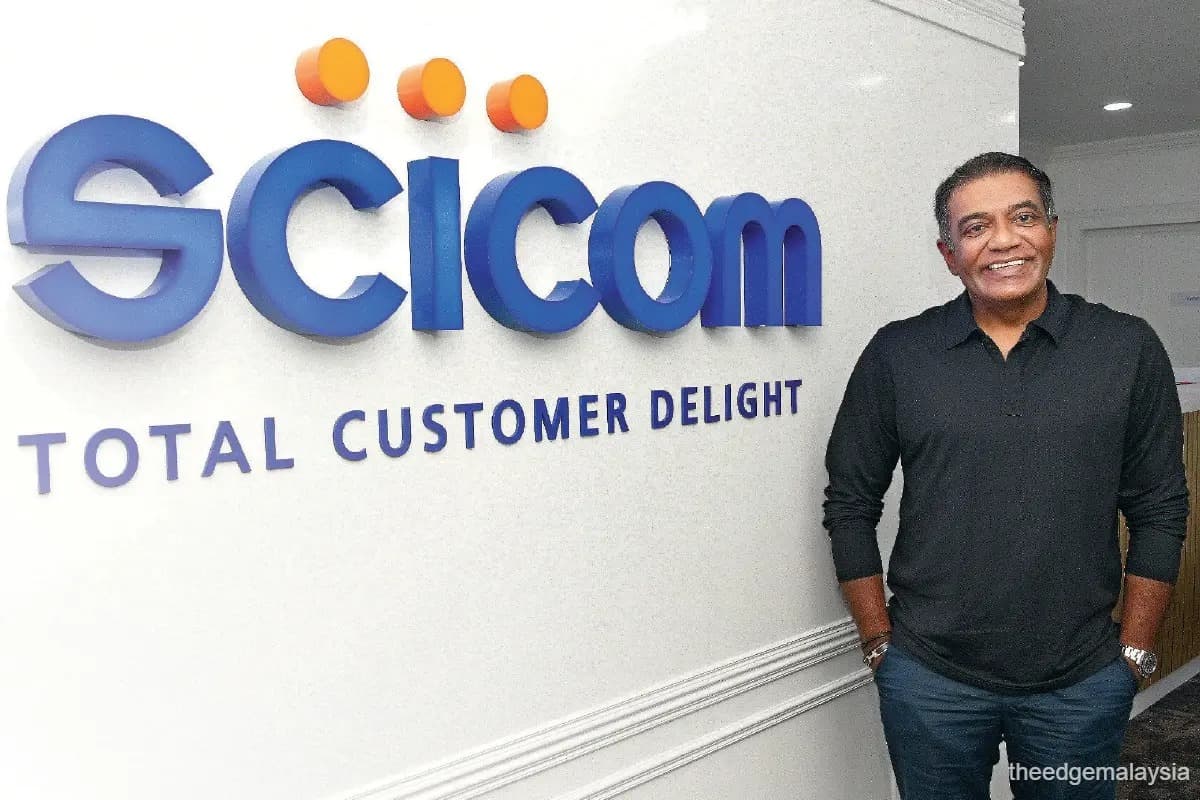
KUALA LUMPUR (Aug 11): Shares of Scicom (MSC) Bhd (KL:SCICOM) rose to a nine-year high on Tuesday, extending their year-to-date gains to 60%, as investors continued to price in the group's earnings recovery and potential for higher shareholder payouts.
At the start of Tuesday's trading session, the counter opened at RM2.20, which was its highest level since August 2017. At market close, its shares closed 0.9% lower to RM2.17 with about 862,100 shares changing hands, valuing the company at about RM771.3 million.
The rally comes as Scicom, known for its business process outsourcing (BPO) and contact centre operations, moves further into government technology (Gov-Tech), digital services and artificial intelligence (AI)-adoption.
In response to a query by The Edge, Scicom executive director and group CEO Datuk Seri Leo Ariyanayakam said the share price largely reflected interest from investors in the company's business progressing towards "highly bespoke offering, tackling the AI game in a big way and also Gov-Tech."

He also highlighted that their contract win from Telekom Malaysia Bhd (KL:TM) to jointly develop AI-enabled customer engagement solutions and digital service delivery platforms further cemented the company's position in the technology sector.
Speaking in a recent BFM Radio interview titled “Scicom’s Turnaround: A Call Centre Or Concession Play?”, Leo Ariyanayakam said the company was comfortable returning capital to shareholders because its business was relatively asset-light.
He said Scicom did not need to keep large amounts of cash on its balance sheet and could instead invest its funds in businesses that generate returns. The group could also take on debt if larger investment opportunities arose.
“We are asset light, our whole proposition is that if we have the money, we are very efficient in how we deploy our money and return on capital deployed is sensational, if we put it all together, why keep it?” Leo said, adding that the group had no debt and could fund potential government ventures or contracts internally.
Scicom's latest results provide some support for the stronger market sentiment. For the nine months ended March 31, 2026 (9MFY2026), revenue rose 46.5% year-on-year to RM222.83 million. Net profit more than doubled to RM34.62 million from RM16.16 million previously.
In the latest quarter, revenue reached a record RM79.21 million, up 74.5% from RM45.40 million a year earlier, while net profit nearly tripled to RM11.09 million from RM3.77 million. BPO revenue alone increased by RM33.81 million during the quarter.
Scicom's latest balance sheet shows it had RM14.36 million in cash and bank balances as well as RM28.17 million in money market funds as at March 31, 2026. The group reported no borrowings or debt securities at the end of the quarter.
This may provide room for dividends, with Scicom having already declared three interim dividends of three sen each for FY2026, taking its dividend declared for the year so far to nine sen per share. It paid a total of RM31.99 million in dividends to shareholders during the first nine months of FY2026.
For comparison, Scicom paid a total of 5.5 sen per share for FY2025. If it were to declare another three-sen interim dividend for the fourth quarter, its FY2026 payout would rise to 12 sen per share, more than double the previous year's total.
The company's distributable retained earnings attributable to owners stood at RM97.76 million as at March 31, according to financial data, while its issued share capital was RM35.55 million.
AskEdge data trading puts Scicom’s shares trading at a price-to-earnings ratio of 20.1 times earnings and price-to-net asset value ratio of 6.2 times, both at its highest compared to historical levels and peers.
Scicom is also gaining exposure to Malaysia’s growing foreign student intake through its government technology business.
The group develops and operates digital systems for foreign student visa applications and processing, including technology infrastructure, application processing and contact-centre services. Its Gov-Tech business also includes an international student management system that handles application vetting, tracking and integration with other systems.
This means higher numbers of international students coming to Malaysia could increase demand for Scicom’s systems and related processing services.
In February 2025, Scicom was awarded a 15-year contract by the Government-Industry TVET Coordination Body (GITC) to develop and implement its TVET Digital Platform Placement Centre. The platform, now known as the GITC TVET Placement Centre, was launched in June as a national platform connecting TVET students and graduates with institutions and employers for training, apprenticeships and jobs.
According to Leo, Scicom sees potential to use the platform to match students’ skills and qualifications with companies’ manpower needs. For example, a company looking for mechanics could use the platform to identify students with the relevant training and qualifications.
Meanwhile, Scicom's Gov-Tech pipeline is expected to become more visible from the current financial year. In a previous exchange filing, the group said newly secured Gov-Tech projects were at various stages of implementation and onboarding, with some expected to begin contributing revenue from the fourth quarter of FY2026.
It also said it remained in discussions on several shortlisted Gov-Tech opportunities, which, if awarded and subsequently implemented, could contribute to earnings in FY2027.