

This article first appeared in The Edge Malaysia Weekly on May 19, 2025 - May 25, 2025
THE once-bustling call centres, also known as business process outsourcing (BPO) centres, are on the cusp of a seismic shift, triggered by artificial intelligence (AI).
Industry observers see a major transformation of the BPO landscape in the next three to five years, with some predicting a near-complete disruption of traditional models — where machine-led interactions could largely replace human involvement.
Already, the industry has gone through multiple changes over the decades that include digitalising its operations, a geographical shift of operations and some larger companies opting for in-house operations.
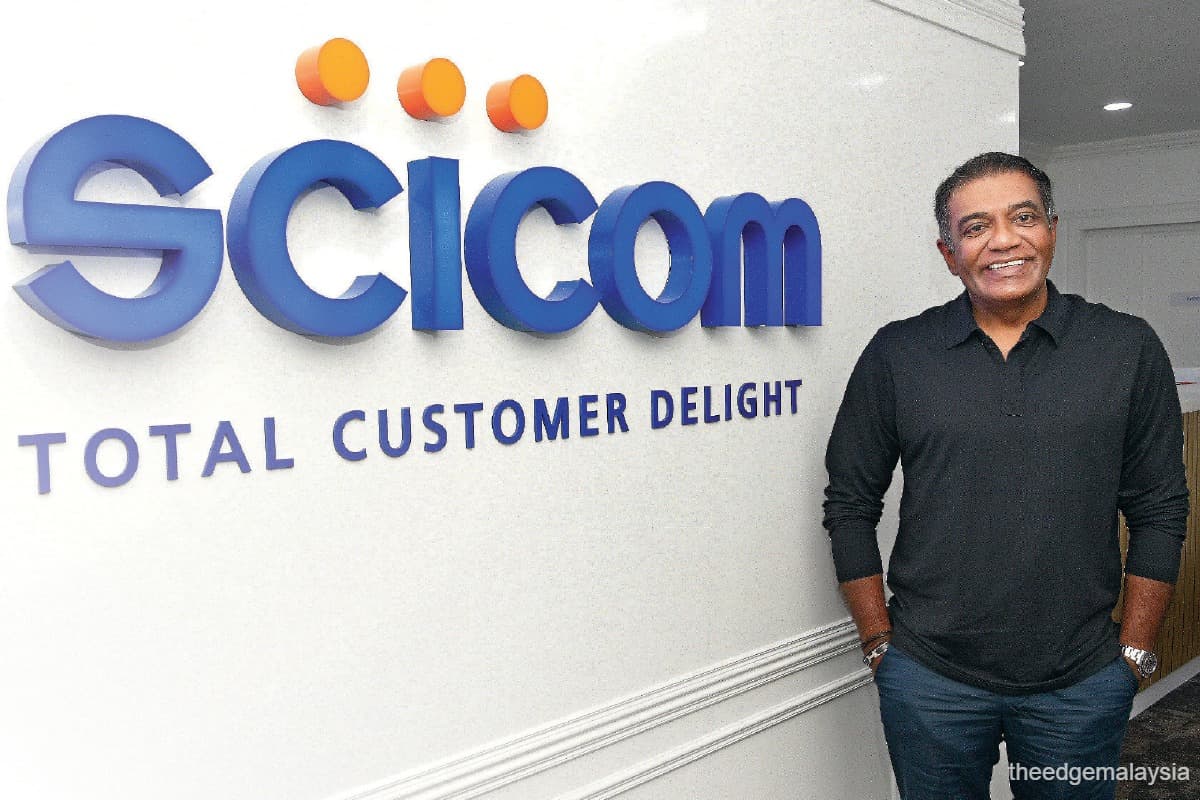
Scicom (MSC) Bhd (KL:SCICOM) executive director and CEO Datuk Seri Leo Ariyanayakam says that in the last 18 months, the company has been developing its own AI-driven technology, upping the ante of its current BPO business.
“I think we are the first local company that has built its proprietary AI-generated solution for BPO. As a matter of fact, all our existing clients have shifted to this platform,” he tells The Edge.
With 28 years of experience in the BPO industry, Ariyanayakam believes Scicom has the necessary data to allow its AI-driven solution to be trained on live operational data.

“It will not just be a generic dataset. The AI-driven solution will allow our BPO solution to be tailor-made for different industries. These include autonomous customer service agents, intelligent workflow bots, compliance monitoring tools and predictive analytics dashboards — all trained on real operational data rather than relying on generic, pre-built models,” he explains.
Scicom has already migrated all its BPO clients to its AI solution and the group is currently bidding for more jobs.
It has a long-term agreement with 20 companies for its BPO business, including multinational corporations, of which about 50% come from overseas.
Ariyanayakam is the single largest shareholder of Scicom with a 26.15% stake. Filings with Bursa Malaysia show that he has bought 272,600 shares in the company since March this year.
Scicom’s share price had been under pressure over the past 12 months before the recent rebound. The stock fell 34% from its peak of RM1.045 in May last year to a low of 69 sen in April.
Better margins
According to Ariyanayakam, Malaysia was once a leader in the BPO sector, but scalability was always an issue due to a shortage of workers.
“Malaysia was once recognised as a BPO hub, thanks to its multilingual capabilities, but unlike India or the Philippines, it struggled to scale up due to limitations in the size of its workforce.
“But with AI, I believe we can scale up without worrying about manpower issues,” he says, adding that on Scicom’s part, it has been training its people to be data scientists and process engineers in order to retain its talent.
The group also owns Scicom Academy and Scicom International College Sdn Bhd — both of which offer a comprehensive suite of fully accredited certification programmes as well as services-oriented courses.
Ariyanayakam acknowledges that embracing the AI revolution has been a challenging but necessary wake-up call for the company.
“It took us a while, but that’s the only way that you can compete with everybody else on price. Scicom has been around in this business for almost 30 years, so we have a clear understanding of how everything works,” he says.
He adds that in the past, the BPO segment struggled with a price war, resulting in margins of only around 10%. Moving forward, he expects margin improvement in its business as the company can operate its business with a lower headcount.
“By leveraging AI, not only do we see margin improvement in our business, but we could also empower our customers to be more cost efficient. In addition, we can offer our services to small and medium enterprises (SMEs), such as enhancing their customers’ experience through intelligent virtual agents that offer 24/7 support.”
While declining to disclose the exact figure, Ariyanayakam revealed that Scicom’s investment in AI amounts to “millions of ringgit”.
According to the AT Kearney Global Services Location Index (GSLI), Malaysia was ranked third in 2023 after India and China as a BPO and IT outsourcing destination.
The GSLI estimated that the global market for business services grew from US$624 billion in 2022 to US$681 billion in 2023, and is expected to rise at a compound annual growth rate of 8% through 2027.
More than just a call centre

It is worth noting that Scicom has also diversified into the government technology (gov-tech) sector in the past 15 years — from having a presence solely in the BPO segment.
It made its major breakthrough back in 2013 when it won a contract from the Ministry of Education to process foreign student visa applications.
Under the contract, the group puts up all the investment expenditure and, in return, it is entitled to a percentage of the fees collected by the ministry for every new visa application and renewal.
Moving forward, Ariyanayakam says the company continues to look for more such gov-tech contracts both locally and overseas.
He declined to comment on how big the contribution of the gov-tech segment was to the company’s revenue.
“We have two focus areas. First is the conversion of our traditional BPO into being AI-driven and second is securing more projects for our gov-tech business,” he says.
He explains that for the gov-tech segment, the company usually puts up all the investment expenditure and in return gets a percentage of the fees collected from the transactions. This model was applied to the student visa project.
With its strong balance sheet, Scicom has ample room to bid for more jobs. As at Dec 31, 2024, the company’s cash and bank balance stood at RM24.6 million and its retained earnings at RM88.95 million. It had no borrowings.
For the six-month period ended Dec 31, 2024 (1HFY2025), Scicom’s net profit fell 15.7% to RM12.39 million from RM14.7 million in the previous year on the back of lower revenue of RM106.75 million compared with RM125.22 million previously.
It attributed the weaker performance to its BPO business due to the non-renewal of contracts by certain long-term BPO clients who opted to take their business in-house.
Scicom has long been regarded as a dividend stock, consistently delivering steady payouts to its shareholders. At last Thursday’s closing of 78.5 sen, Scicom’s dividend yield was about 7.23%, making it one of the top dividend counters among companies with a market capitalisation of below RM500 million.
In FY2024, the group paid out a total of 6.5 sen per share in dividends, lower than the eight sen in FY2023, reflecting the challenging environment of the BPO segment and the group’s investment in AI technology.
Besides the high dividend yield, the company’s dividend payout ratio isn’t low either. Scicom paid out 94.9% of its net profit as dividends in FY2024, compared with 87.9% in FY2023 and 79.1% in FY2022, according to AskEdge.
It is known that Scicom has been trying to secure gov-tech contracts over the years. Shareholders are certainly hoping that the in-house AI-driven technology will help increase its chances of getting new contracts locally and abroad.
Save by subscribing to us for your print and/or digital copy.
P/S: The Edge is also available on Apple's App Store and Android's Google Play.