

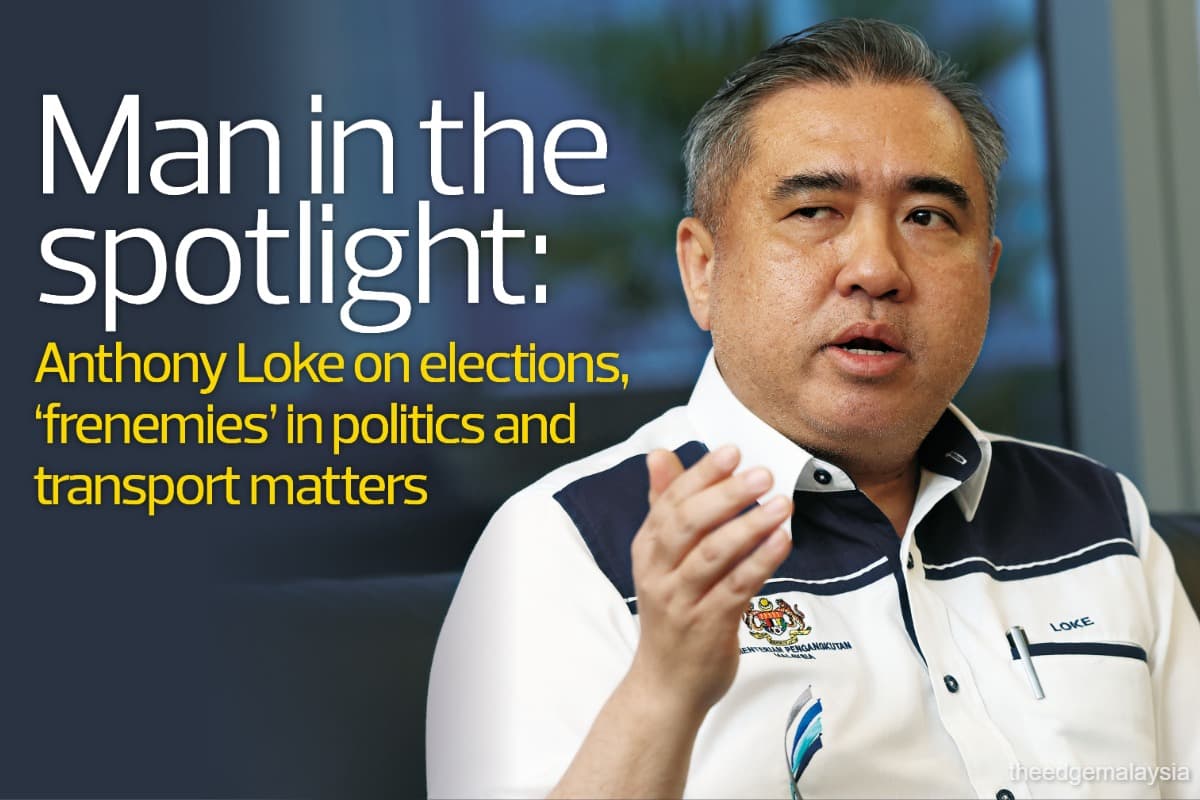
This article first appeared in The Edge Malaysia Weekly on July 27, 2026 - August 2, 2026
WITH the campaigning for the Negeri Sembilan elections to be held on Aug 1, in full drive, the leader of the Democratic Action Party (DAP), secretary-general Anthony Loke Siew Fook, must be under tremendous pressure to deliver solid results for the party and Pakatan Harapan (PH).
Loke is in the spotlight not only because he is DAP leader but also for two other reasons:
• Negeri Sembilan is his home state and he is contesting to retain his Chennah state seat, which he has held since 2013. Some analysts say Loke will face a tough challenge this time because the seat has 47.8% Malay votes and Umno and PAS are now working as one.
• DAP, which has 11 of the 17 seats held by PH, needs to win all of them if the coalition is to have any chance of retaining power, which it shared with now election rival Barisan Nasional (BN), which has aligned itself with Perikatan Nasional (PN) for Aug 1. In short, PH needs DAP to win every seat in order to get the 19 to win by a simple majority in the 36-seat state assembly.
In the last state elections in August 2023, DAP and PH had an alliance with BN in which they did not contest against each other. That helped them convincingly win 31 of the 36 seats, with PH taking 17 and BN 14.
However, ties between PH and BN have frayed and the latter performed strongly in the Johor elections held on July 11. BN, comprising Umno, the MCA and the MIC, thrashed PH by winning 48 of the total 56 seats.
With momentum on its side, BN is confident of wresting control of Negeri Sembilan with PN’s help. They have split the seats they will contest among themselves to avoid any three-cornered fights with PH — a move that analysts say makes it very tough for PH.
But despite the heavy load on his shoulders, Loke, who is also member of parliament for Seremban and Minister of Transport, was quite relaxed as he sat down for an interview with The Edge to talk about not only the elections but also other issues related to the Madani government.
The following are excerpts from the interview.
Politics and elections
The Edge: Did you expect the Johor results to turn out the way they did?
Anthony Loke: Of course, we expected [to do] better. We expected BN to form the (state) government ... [but] not [win by] a landslide.
Was the swing in votes more from PN to BN than from PH to BN?
It was a PN to BN vote transfer. Our vote share did not decrease. Our vote share is still the same. But many of the seats [we won in 2022] were won [with] less than 50% (margin). So when there is a vote transfer from PN to BN, then they (BN) will have more than 50%.
How do you see Negeri Sembilan then?
They want to repeat that. (For Negeri) they have an actual seat collaboration. But let’s see how. Negeri, we are not sure yet. Different dynamics.
You don’t sound very confident.
Well, I mean it’s the reality because it all boils down to the racial narrative.
Some people say even you are quite shaky in Chennah.
I know, I know because it’s a demographic issue.
You see a close fight then?
Yeah, it’s a very tight race.
Do you think the vote transfer will be around the same as in Johor?
Well, I think it’s different dynamics altogether. Firstly, there are other factors in Negeri Sembilan too … We are in the state government, we have a track record to show.
The sitting MB (menteri besar) is from PH. He is quite well accepted by the people of Negeri Sembilan and there are some achievements to be shown in terms of our financial management, our welfare policies, more investment coming in over the past few years, and there are some tangible projects ongoing, tangible projects being implemented and so forth.
So, these are all different factors for PH in Negeri Sembilan compared to Johor, where we were not in the state government. So they (BN) successfully painted [the picture] that all the achievements in Johor were due to the state government, which to our mind, I mean, is a bit unfair because it’s a combination of contributions from both the federal and state. Because a lot of the initiatives are federal-initiated, and so a lot of major catalysts in Johor were due to the federal [initiatives].
Johor Bahru, for example, the major project is the RTS Link (Rapid Transit System Link) — it’s a federal project. The Johor-Singapore Special Economic Zone is a federal initiative. There are a lot of other investments. It’s not just due to the state government but also because of the federal push in terms of our policies for attracting foreign investment.
Anyhow, this is politics. They (BN) were able to portray that [the projects were] the achievements of the state government [alone].
In Negeri Sembilan, of course, this is probably a bit different. We are in the state government. So the people can see that the achievements, some of the welfare policies, they are due to the (PH) leadership of the current state government. So, we hope that can convince people to keep the current government.
What is the message you’re getting on the ground? We ask because there’s a lot of negativity now when it comes to the PH government.
Well, I think, yes, there are concerns, there is negativity but as I see it, as far as Negeri Sembilan is concerned, I think the negativity (now) is due to the racial narrative being played out (during campaigning). And trying to pin the blame for everything on the DAP. You know, I forewarned and I know that they are trying to even attribute the (palace) constitutional crisis to me. [It is] ridiculous to say that I tried to interfere in the adat and so forth, and that is the, you know, the DAP’s agenda, DAP’s fault and DAP is trying to interfere.
That kind of narrative is very, very negative and racially charged and [they] are trying to incite hatred for the DAP and by extension, for PH.
How do you combat something like this?
Well, it’s very hard. I mean, we just have to show that, you know, we are not like that [and that] it’s a complete lie. And we campaign based on our track record, based on the positivity, the positive side of the government. But, you know, sometimes the positive is not as easy to find as the negative. Negativity can let people fear and threaten people. But we are still trying to campaign based on a positive message.
YB, there is speculation that if BN does well in Negeri Sembilan, it could lead to a vote of no confidence at the federal level. Are you prepared for something like that?
Well, I mean, we cannot predict what will happen, right? But we are focusing on winning the election. We are hopeful that we can still perform well in Negeri Sembilan. I mean, to ensure that there’s continuity, there’s stability. And, you know, politics is evolving; we know that politicians when they see — especially certain politicians — when they see opportunities, of course they will strike, so this is something which of course we know. The implications of PH not making it in Negeri Sembilan will be quite big to the federal, to the survival of the federal government, even though the BN leadership has time and again assured us that they will stay in the (unity) government until the end of the term (full term is until early 2028).
But as I said, it’s evolving. Nobody knows what will happen. And our focus is to at least keep our strength in Negeri Sembilan. Politicians will only speak the language of strength. If you do not have electoral strength and political strength, then we are, of course, on the chopping board.
One of the criticisms against the federal government is lack of reforms or the slow pace of reforms. What do you say to that?
Well, of course, I mean, at the same time, people also don’t look at the reforms being done. You say there’s a lack of reforms. What about the reforms that are being [put] in place?
If you talk about institutional reform, the government has initiated the separation of the attorney general and public prosecutor [roles], which is a huge, huge reform being implemented. Why is it still not in parliament yet? Because there’s a lot of refinement to the bill.
And the government is listening to the backbenchers, to the opposition, to try to get a consensus. But then again, you see, reforms must get the support of everyone. If everyone is sincere about reform, then there should not be any politicking as far as the reform agenda is concerned.
When we tabled the amendment to limit the term of the prime minister, which is a major reform as far as the institution is concerned, some MPs did not turn up, even [MPs] on the backbench did not turn up [in order] to kill the bill, to kill the reform.
So these are the things that I think the public also has to be fair about to the prime minister and the current government, that we are dealing with a lot of different actors who are not necessarily aligned with the government, even among the backbenchers. There are forces who try to kill the reform and to replace the government, within the ranks of the backbenchers.
So I hope that the public can be a bit more objective. I know that there are criticisms. Sometimes, it’s of course fair criticism but at the same time, it’s not that the current government is not doing anything. We are trying our level best to bring about change, to bring about reform. But there are constraints. There are people — forces, not only people — there are different forces and different actors coming together to try to kill the reform and the government.
The DAP has been very strong against the “corporate mafia”. But that is one thing people always talk about on the ground, the involvement of an anti-graft body, the MACC (Malaysian Anti-Corruption Commission). The general complaint is there is inaction, ‘tak buat apa’. And also, the name of the PM’s former aide keeps popping up ... These are a few things that always crop up against the government.
As far as we are concerned, as [far as] DAP is concerned, we have made our position very clear. I have openly called for the RCI (Royal Commission of Inquiry) to investigate the corporate mafia allegation together with Gobind (Singh Deo, Minister of Digital and DAP national chairman). Both of us cabinet ministers, we issued a joint statement. Of course, it was not to the liking of a lot of people, but we stated our position. It is our position and we maintain that position.
Yes, we tried in the cabinet, we have not been able to convince the cabinet to form an RCI until now. That is a fact, but as far as our position is concerned, we are clear. We tried and we maintain that position.
Allegations like these, and whether there’s the involvement of top people within the government or certain segments within the government, [we] should have a royal inquiry to clear the name … the good name of the government and the institution that we are trying to protect. So as far as we are concerned, we maintain that position and hopefully, you know … we can convince our colleagues in the cabinet, the prime minister, to proceed one day.
Coming back to Negeri Sembilan. You have said that the target for PH is 23 seats. Which six seats specifically are you looking to add? (In 2023, PH won 17 seats.)
No, we are not mentioning any specific seat. That’s the target. We put our target higher. Everyone, of course, hopes to win by a larger margin. You know, the simple majority is 19, but of course any coalition, any party wants to win more than the simple majority to form a stable government. So I think the 23 seats, it’s a target. Well, it’s not an unreasonable target because I think we have won ourselves 20 seats before, so we just put a higher target of 23.
You believe it’s achievable?
Well, I think it’s not an unreasonable target. Whether it’s achieved or not, that’s a different story. But you must aim higher.
If PH is not able to get the seats, would you rule out PH working with another coalition to form the government?
I think it’s premature to say anything like that now because no coalition and no party will ever rule out anything in the current Malaysian political situation. I would not comment on a post-election scenario because our focus right now is to win. Every party wants to win on their own. But if you cannot have enough seats, then post-election, you have to sit down and negotiate. So I think this is a permanent feature after the last general election.
Some are calling this election a sort of rehearsal for the BN-PN alliance for GE16 to woo the Malay voters. So how does PH, the DAP in particular, see yourselves attracting Malay voters?
Well, for the DAP, of course, it’s tough to attract Malay voters. We are in a coalition. PH has always been a multiracial coalition. We did not get a chunk of Malay support (in previous elections). But in mixed constituencies and mixed states, you know, more multiracial states, like Selangor, Penang, Negeri Sembilan, we have been able to form the government on our own. That is the strength of PH as we have our support across the races, even though among the Malay voters, we have never been able to cross 50% of Malay support. But in a multiracial state, cross-community support is more important to form a government.
Some analysts have said that certain DAP leaders made certain remarks in the Johor election that further hurt Malay support for the DAP.
Well, I think when the election results are known, a lot of people would pinpoint … give all kinds of reasons and so forth. I would not blame anyone, any particular leader. It’s a collective responsibility and … well, we have to accept the results. When things go wrong, people will be blamed; when things are right, everyone will not say anything. As far as we are concerned, our leadership does not pursue any blame game. It is a collective responsibility.
Is the DAP weaker now compared with previous years?
In terms of results, of course we had weaker results in Johor and in Sabah. But, you know, politics has its ups and downs.
You cannot judge a party just based on one or two elections. We have been strong for the last four general elections, since 2008. Every party has ups and downs, and the DAP is no exception. We have had ups and downs throughout our 60-year history.
Before 2008, the best results we had was in 1986 but in 1995, we were down to nine (parliamentary) seats. But after three elections, we came back again (in 2008). So in politics, there are always ups and downs.
Political parties should not be evaluated on one or two election cycles. (After 2022) Umno was left with 26 (parliamentary seats), right?
They just won by a landslide in Johor. But they also won by a landslide in Johor in 2022, but they lost badly at the parliamentary level. In 2022, they won handsomely in Melaka at state level but they lost all the three parliamentary seats in the general election.
So politics is dynamic. We have to put up a fight, we have to soldier on and convince the public and our supporters to back us.
Your seat Chennah has nearly 48% Malay voters. How do you try to win the Malay votes?
To tackle the Malay votes is not [something we start] today, right? As far as I’m concerned, I’ve been helping my constituents, contributing to the constituents, whatever their needs, attending to their requests and so forth over the years. So, hopefully, this will translate into support in the elections. I have been engaging the community even though as minister I wouldn’t be able to be there physically all the time, but my office, my service centre has always been servicing the constituents, allocating resources to ensure that things run well, the local community is well taken care of, especially the schools, the associations, the local NGOs and so forth can run their activities smoothly. Individuals who need aid for their medical [problems], for their studies, are all taken care of.
Do you think this will translate into votes?
Yes.
How do you see Bersatu playing a role in some of the seats the DAP is contesting? Do you see them splitting any of the votes for the Malays?
I think, of course, Bersatu in Negeri Sembilan … does have certain strengths of its own. Perhaps in other places, they depend a lot on the PAS machinery ... But PAS in Negeri Sembilan has not been strong before.
So I think in the last election when PN did quite well, it was due, of course, to a wave of Malay voters moving towards PN under (Tan Sri) Muhyiddin (Yasin) then.
And Bersatu, of course, has certain strengths. They are ex-Umno leaders and so forth. So I would not rule that out completely. I think they are, you know, they can be a force in a few constituencies. And they have an incumbent assemblyman.
So I’m sure that the incumbent assemblymen do have a certain influence in their respective constituencies … Bersatu does have a certain influence, probably in Negeri Sembilan, at the local level.
Were you surprised when they splintered off from Perikatan?
That is to be expected, right? Because I think that is something to be expected because they were completely ignored [by PAS]. What choice did they have?
So it was anticipated already.
Not to say anticipated, but I mean, if we put ourselves in their shoes, what choice did they have? You are being sidelined in the coalition. But, you know, political parties can still contest on their own logo without a coalition. That is something that everybody is quite aware of. So if the coalition is sidelining a party, then you do not have a choice but to contest on your own. I think that is something to be expected.
There are some DAP leaders who are considered arrogant.
Well, I think that’s very subjective. What do you mean by arrogance, right? How do you define that? And do they represent the entire DAP? So it’s individual style.
Sometimes being firm, you are seen as arrogant. And if you are being soft, you are seen as weak.
Where do you draw the line? As transport minister, yes, sometimes I give a very firm and stern statement against traffic offenders. That can be translated as arrogance.
People say I’m arrogant, right? To lorry drivers and to commercial vehicle drivers. But can we compromise safety? Can we be soft on traffic offenders? Can we be soft on people who endanger others? So where do you draw the line?
That’s you, YB.
Yeah, I’m the secretary-general. I’m the face of the party. Maybe one or two of our ministers have a different style. A bit gaya and all that. But then you say, oh, this is arrogance. And then you paint the entire party. But you don’t look at the guys who are humble.
Why don’t you use me as an example?
How do you manage your relationship with BN and Umno now? You know, being in the same cabinet.
On Wednesdays, we are cordial.
It must be quite challenging also … like having a partner who’s not really a partner.
I think it’s not easy to answer that question, but as I said at the cabinet level, we still have to keep things cordial. I think all of us have to be very conscious that we are running the (federal) government; we hold the responsibility of managing the country. So in cabinet, of course, we have to put aside our differences and discuss national matters objectively. That’s what I can say.
So tomorrow, for example, there’s a cabinet meeting, so I have to go in as a minister. So I have to put my emotions and my cap as a candidate behind me; I can only wear back the cap of the candidate after the meeting. So during that meeting, we have to focus on matters at stake, the agenda of the government, and have discussions based on national interests. That is, of course, not easy, and it is an odd situation.
But that is the norm in Malaysian politics now.
See also our 8-page special pullout on the Negeri Sembilan state polls
Transport Ministry affairs
The Edge: We reported that former MACC chief Tan Sri Azam Baki’s brother got a RM178.29 million contract on border controls. Can you comment on this and is the contract under MOT (Ministry of Transport) or MOF (Ministry of Finance)?
It’s an MOT project. It is the maintenance of the VEP (Vehicle Entry Permit) system in Johor Bahru. You see, firstly, the principle is that the minister is not involved in any of the tender process.
Any tender process is an open tender, it’s an RFP (request for proposal) open tender. Any company with direct expertise, with direct technical know-how and with the financial capability can put in a proposal, can put in a bid.
The tender process runs according to the process. And any tender process will be validated by Lembaga Perolehan, the Procurement Committee within the Ministry of Transport. After they evaluate, they will shortlist the companies that meet all the requirements — not only technical requirements, but also in terms of the pricing.
After the technical requirements are all passed, then they will look at the price, which is the best price being offered. It will then be given to the MOF for a final decision. So that is the process. So as far as this company is concerned, yes, it passed the (MOT) technical evaluation.
There was a bid then?
Yes, of course there was a bid. It’s not a direct tender. Many companies bid for that project. A few companies were then short-listed after technical evaluation. And we looked at the price.
If there are short-listed companies that already won another tender under the MOT, usually the MOF will not give two tenders to one company. The final decision has to be decided by the MOF.
Can we penalise that company just because one of the directors is related to Azam Baki? Of course, there is a perception ... a perception thing. We know that it’s a negative perception.
You have to go (through) the process. So if anything [is] wrong, then the investigation authority can go through it. But as I’ve said, I don’t interfere in the tender. The process takes place, the procurement committees do their work, and in the end, it will be decided by the MOF as the final authority.
When we talk to people, they often mention a logistics company that is supposedly very close to the DAP. It seems they’ve gotten contracts, direct negotiations for ECRL (East Coast Rail Link)…
You go and check what contracts we have given them. Firstly, it’s not contracts. They lease the land to run the freight station. But these are all lease and they go through RFP (request for proposal).
Is it true that they’re close to the DAP?
Yes, I know him (the owner/controlling shareholder). Yes.
But everything is above board?
Well, if anything, you can just go and investigate it. What is under board?
This is what people are talking about.
I know, I know, I know. I know where you’re coming from.
People have commented that the company is linked to the DAP and not just from your time.
It’s not linked to the DAP, it is just that the owner knows us.
We had to ask you.
Yeah, but you have to be fair in terms of the report as well. It cannot be based on some passing comments.

There was also Tanco Holdings Bhd’s (KL:TANCO) groundbreaking for a port recently. Your good self and the PM went for the groundbreaking the other day. How did that come about? They invited you?
Yeah, of course, it’s an investment. There’s no injection of capital from the government. It’s by the landowner to build a private port in that area, so they’ve gone through the process. The application was (made) two, three years ago. They’ve gone through the process, then they got the kebenaran merancang (planning permission), they got the approval to build and they wanted to do a groundbreaking. They invited the prime minister. It’s a normal ceremony, it’s an open and transparent ceremony.
Tanco has been in the news lately.
Well, I mean, it’s ... How do you penalise people? I mean, it’s just based on share price. So from your point of view, it’s not good. It’s a perception thing. I think media also have to be fair to companies. They are putting [in] an investment, there’s no risk to the government.
So should we penalise them just because they have, you know, some ups and downs in their share price?
As far as we are concerned, there is no wrongdoing [that] has been passed by the Securities Commission. [But] if they manipulate the shares, it’s a different story. If they manipulate the shares, then definitely there will be an investigation and enforcement by the relevant authorities. But so far, as far as we know, there is none.
So there are ups and downs in terms of the share price, which I think is quite normal on the share market. Our (MOT’s) concern is whether or not they comply with the conditions (to build a port). As long as they comply with the conditions, then we give the approval.
As far as the government is concerned, why should we block people from investing? If they want to take the risk of investment, it’s their call. Should the government block it just because there are some negative media reports against that particular company? I think that would be unfair to that company. As far as the PD Midport is concerned, there is not a single sen invested by the government. It’s purely a private investment.
A question on MMC Port Holdings. There’s a new executive chairman. There is no plan to have a new shareholder come in?
No, as far as we are concerned, the government only governs in terms of the shareholding. If there are new shareholders, if there are changes to the structure of shareholding, then definitely the concession company must inform the government, must inform the MOT as well as, I think, UKAS (Unit Kerjasama Awam Swasta), because the concession is under UKAS. As far as we are concerned, we have not been notified [of] any change in terms of shareholding. It is just an appointment within their management. So as I have mentioned before, the government does not regulate in terms of management. The company is free to decide on their management. And a foreigner heading the management is not something new.
PTP (Port of Tanjung Pelepas) has always been headed by a (foreigner). So, it’s nothing new. So, it’s not against the law. Our concern is that if there are any shareholding changes, then definitely they have to notify us. Then our policy is very clear. It cannot exceed 49% of foreign ownership. It has to be 51%-owned by Malaysians.
Does the government have a golden share?
Yes, at port level, operating level. At PTP, Penang Port and so forth. We have government representatives inside the port. But not [a golden share] at the holding level.
What do you think your achievements are as transport minister?
Well, I think I [will] let the public judge what my achievements are. I have tried my level best to improve things in all divisions, whether it’s land transport, public transport, aviation, maritime.
It’s multi-pronged work. It’s not just focusing on one particular area, whether it’s public transport or land transport, JPJ (Road Transport Department), port development, airports, aviation, leasing [things for] the public in terms of facilities and also in terms of public transport. So I would leave it to the public to judge. I do not want to blow my own trumpet saying that I have done this, I’ve done that.
It’s a big portfolio.
Yeah, it’s a big portfolio. It’s multiple divisions, there are aviation related, there are maritime related. Land transport is a big chunk of the entire portfolio, so we are trying our level best to firstly build connectivity, making sure that our connectivity can be a strategic asset to Malaysia, and we always want to look at the MOT and make it an enabler for economic development.
So the MOT must be looked at from a point of strategic consideration. So whatever we do, in terms of building our infrastructure, we have this strategic interest of the country in mind. Whether it’s aviation, whether it’s ports, whether it’s railway, all that is within the strategic consideration for Malaysia.
The problems with the KLIA Aerotrain, the LRT3 — these are legacies that got passed on to you, but do you think they were handled well?
Well, we just, I mean … every subsequent government will have to inherit whatever has been done by the previous government, right?
So we just have to improve on things. Good or bad we have to inherit it and we have to continue. It cannot be a point that, you know, we disown it. It is a government asset so you have to remember this.
Governments can be formed by different parties. Ministers come and go but government assets are there to stay. So you cannot undo infrastructure projects just by the changing of government or changing of ministers. So the asset will stay. Every subsequent administration, the ministers involved, the ministers in charge, have to build on it. If there are weaknesses, you have to rectify the weaknesses; if there are strengths, you have to build on the strengths.
So, we have to be fair. I mean when we launch certain projects, sometimes people say, ‘Oh this is the (work) of the former government, right?’ But then, if there are problems, they blame the current government. So, I think that’s why I say, sometimes comments and evaluation are not based on objectivity. Whoever is the government of the day inherits all this, good or bad.
It must be frustrating then?
Well, this comes with the job, especially in this portfolio. You mentioned Aerotrain. When the Aerotrain was having problems, everybody pointed fingers at the transport minister, asking for his head to roll. But when things are running very well, nobody will say a word. Nobody will say that you have done a good job, right?
Some of the rail players that we speak to say that the government is too cost-oriented. We buy assets from China simply because they are cheaper, which could lead to problems later.
I think that’s a very unfair comment. What makes them think that China’s products are of lower quality? China has the largest network of high-speed rail today. In China, in terms of railway systems, they carry the most passengers compared to any other country. They have a 1.4 billion population. They carry billions of passengers every year.
Of course, if their companies are not selected, they will criticise the products of others. The fact is that they cannot compete, they are less competitive.
We don’t have our own companies to do similar projects.
We are trying our own companies but the point is, you know this kind of industry, you need the scale. It’s not that we don’t have local companies. We do have local companies and we give opportunities to local companies too. Say, for example, the locomotive. We selected SMH Rail as our partner, it’s a local company. Yes, we try to build up our local expertise, but as far as our EMU (electric multiple unit) is concerned, who can build the EMU?
We don’t have the capability yet?
No. Tell me which local company? We used to have one local company building the monorail: Scomi. But what happened to Scomi? We couldn’t even get spare parts for a monorail. So that is the reality.
Sometimes when people pass comments, they don’t take into consideration the reality on the ground. And sometimes I think when you pass a general statement to just say that you depend too much on China, I think that is a bit unfair because firstly it’s a competitive (tender). If you think we should not be buying anything from the Chinese companies, then … we should not be having a tender.
So when you have that technical requirement being met apple to apple but the price is a 20% difference, who do you choose? So I think that is a point that you have to accept.
And [the] Chinese, especially on rail and rolling stock and so forth, they are much more competitive than the European companies, price-wise. So, a government also has to save money, right? So we cannot be buying the same thing at a much higher price.
To those critics who say that the quality from China is bad, the problem with the Aerotrain was not because of a Chinese company. The system is from Europe.
Read also:
A test of Malaysia’s new political equation as BN teams up with PN against PH with Bersatu likely a spoiler
A brief history of the PAS-Umno love-hate relationship
Stage set for rehearsal to GE16
Key seats to watch as ‘frenemies’ battle for control
Save by subscribing to us for your print and/or digital copy.
P/S: The Edge is also available on Apple's App Store and Android's Google Play.