

This article first appeared in The Edge Malaysia Weekly on July 27, 2026 - August 2, 2026

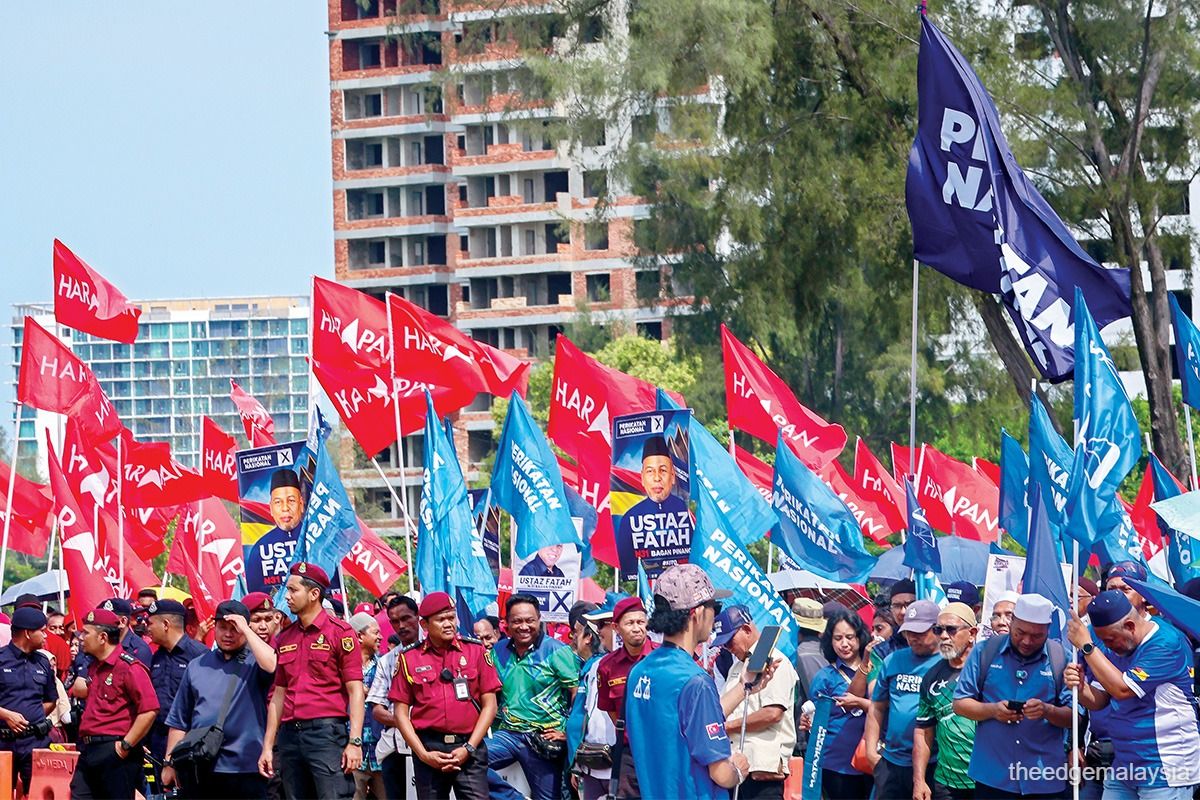
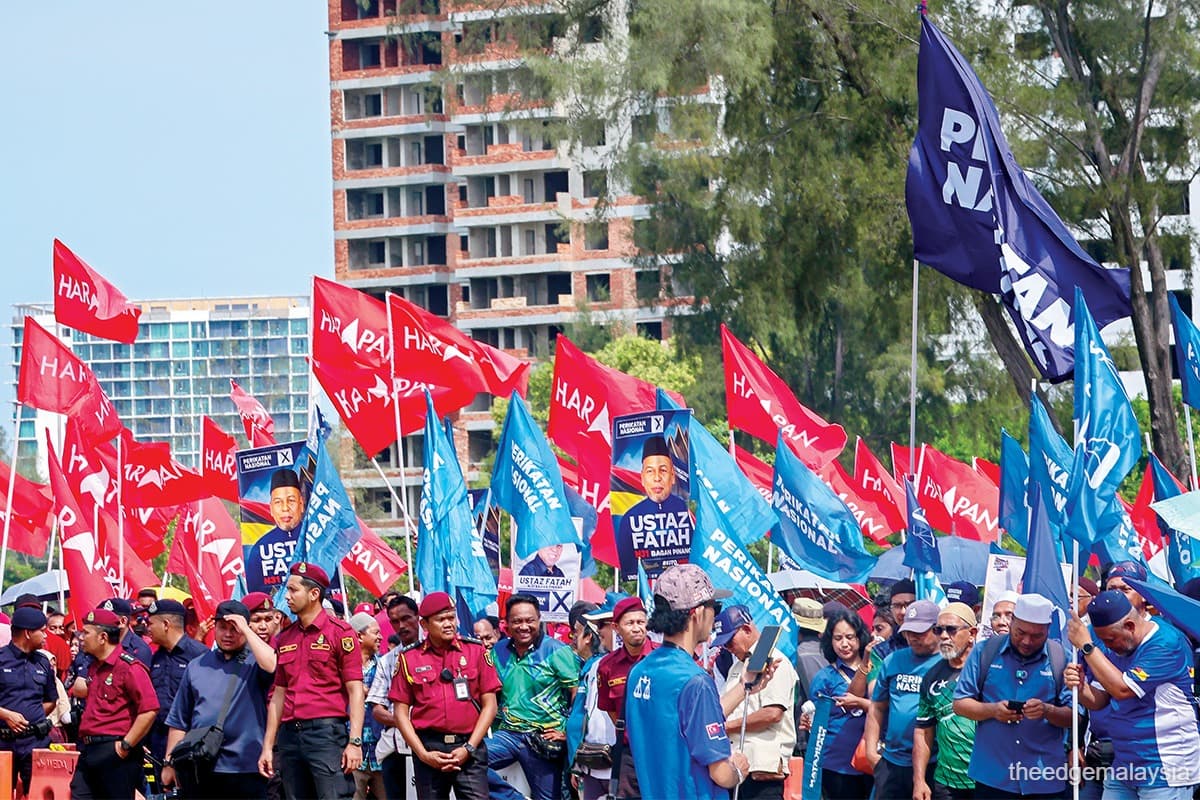
THE quiet town of Kuala Klawang stirred unusually early on the morning of July 18, a Saturday. The sleepy district capital of Jelebu had been transformed into a sea of party colours as more than 1,000 supporters gathered outside the nomination centre ahead of the Aug 1 state election.
On one side of the road stood supporters dressed in red, waving Pakatan Harapan (PH) flags and chanting the name of DAP secretary-general Anthony Loke Siew Fook, who is seeking a fourth consecutive term as the Chennah assemblyman.
Facing them across the police barricades was another group also in red, but under a different banner. They were supporters of Bersatu, which is entering the Negeri Sembilan election under its own party logo for the first time since its formation nearly a decade ago.
Elsewhere around the nomination centre stood two groups in blue, though they did not belong to the same political party. One represented Barisan Nasional (BN), PH’s partner in the federal government. The other backed Perikatan Nasional (PN), BN’s long-time national rival but its electoral ally in this state election.
The contrasting colours — and the unusual alliances they represent — encapsulate the political realignment that has reshaped Malaysia over the past few years.


“Politics nowadays is becoming harder and harder to understand. Friends become rivals, and rivals become friends,” said an elderly Chinese voter from Pekan Titi, a Hakka-majority town about 10km from Kuala Klawang, as he watched supporters cheer outside the nomination centre.
His remark may have sounded like the casual observation of a passer-by. Yet it also captures why the Negeri Sembilan election matters beyond its 36 state seats.
More than deciding who governs Negeri Sembilan, the state polls will offer the clearest indication yet of whether Malaysia’s shifting political alliances can withstand electoral reality.
A post-Johor test
The Negeri Sembilan state election comes at a politically significant moment.
Just recently, PH suffered a disappointing defeat in the July 11 Johor state election, securing only eight of the state’s 56 seats. BN, meanwhile, stormed to victory with 48 seats, retaining the southern state with a commanding majority and reinforcing its belief that opposition cooperation against PH remains an effective electoral formula.
Buoyed by that result, BN has adopted a markedly different strategy in Negeri Sembilan. Rather than contesting every seat itself, the coalition is fielding candidates in only 25 constituencies, leaving the remaining 11 to its electoral partner, PN.
PH, by contrast, is contesting all 36 seats in its bid to retain control of the Minangkabau state.
Bersatu, while remaining a component party of PN, is contesting 24 seats under its own logo, marking another departure from previous elections.
To many observers, the arrangement represents an attempt by BN and PN to consolidate Malay support while avoiding unnecessary three-cornered contests that could split votes.
Whether that strategy will deliver the desired results for the coalition partners, however, remains uncertain.
“I agree Johor provides BN with psychological momentum, but it does not guarantee the same outcome in Negeri Sembilan,” says Mohammad Tawfik Yaakub, senior lecturer in the Department of Political Science, Public Administration and Development Studies, Faculty of Business and Economics, University Malaya.
“Nearly one-third of Negeri Sembilan’s seats were decided by fewer than 1,000 votes in the last state election.”
Indeed, 11 constituencies were won by fewer than 1,000 votes in the 2023 state election, including eight by BN, two by PH and one by PN. Those narrow margins highlight how even a modest swing in support could reshape the electoral map.
This election will therefore serve as the first major test of whether the BN-PN cooperation at the leadership level can translate into effective vote coordination on the ground.
Will voters follow party leaders?
Perhaps the biggest unknown is whether supporters will follow the political realignments engineered by party leaders.
Political observers caution that electoral cooperation does not automatically result in vote transfers.
While BN and PN may have reached an understanding at the leadership level, voters on the ground may not necessarily follow the same script.
“Turnout will also be decisive, particularly among Malay fence-sitters, non-Malay voters and younger voters,” Tawfik says.
Wong Chin Huat, political scientist and a professor at Sunway University, says many of PN’s supporters during the last general election were not necessarily committed party loyalists.
“Some PN voters in the last general election could have been middle-ground or fence-sitting voters who supported the coalition without developing long-term party loyalty,” he says.
That could make vote pooling considerably more complicated than political leaders expect.
A uniquely Negeri factor
Unlike Johor, Negeri Sembilan is also entering the election carrying political baggage unique to the state.
The election was originally not due until 2028. However, a constitutional impasse involving Negeri Sembilan’s royal institution triggered an early dissolution of the state assembly.
The crisis began after four Undangs — the state’s traditional chieftains who play a constitutional role under Negeri Sembilan’s adat perpatih system — sought to remove Yang di-Pertuan Besar Tuanku Muhriz Tuanku Munawir, despite questions over the legality of the move.

The PH-led state government rejected the attempt, arguing that it lacked constitutional validity.
The episode ultimately led Umno to withdraw its support for the unity state government, setting the stage for the current election.
Although political parties have largely avoided making the royal dispute a central campaign issue, analysts believe it remains an undercurrent among Malay voters.
“I don’t think there was any need to hold the election now. The matter should have been left to the royal institution to resolve,” said Zahir, a voter in Klawang who declined to give his full name.
Wong says the royal factor may not necessarily work in favour of BN and PN, amid perceptions that the two coalitions are leaning towards the Undangs.
Pivotal non-Malay vote
If BN and PN are banking on consolidating the Malay vote, PH’s chances of retaining Negeri Sembilan hinge largely on preserving its traditional support among non-Malay voters, who make up about 40.2% of the state’s electorate.
Among them, the Indian community stands out. Negeri Sembilan has the highest proportion of Indian voters in the country, accounting for about 15% of the electorate. Their influence is particularly pronounced in 11 constituencies where Indians make up more than one-fifth of voters.

Nine of those seats are currently held by PH — seven by DAP and two by PKR. The remaining two, Jeram Padang, where Indians account for the highest share of voters at 33.1%, and Rantau, are held by Umno.
That demographic profile makes the Indian vote one of the most consequential battlegrounds in the election, with the potential to tip the balance in several closely fought constituencies.
Yet PH cannot take that support for granted. The Johor election exposed signs of discontent among Indian voters, with analysts and political parties pointing to frustrations over what some perceive as a lack of representation and attention to community issues.
Whether that sentiment spills over into Negeri Sembilan could prove decisive in whether PH retain the state.
The Chinese vote remains equally important, particularly for DAP.
Seremban has long been regarded as one of the party’s traditional strongholds. It was here that DAP’s founding chairman, the late Dr Chen Man Hin, secured a historic victory in Rahang in 1965, laying the groundwork for the party’s eventual formation the following year.
Today, the state’s 59 Chinese new villages continue to form the backbone of DAP’s support.
While the outcome of the Johor election has boosted the confidence of BN and PN supporters, analysts say the result may also serve as a wake-up call for PH’s traditional support base.
“There is a heightened awareness that the Johor result was poor overall for the Chinese community, and that they should come out in greater numbers to support PH,” says James Chin, professor of Asian studies at the University of Tasmania.
Bersatu’s wild card role
While much of the focus in the Negeri Sembilan election has been on the three major blocs — PH, BN and PN — Bersatu is positioning itself as the race’s biggest wild card.
Led by former prime minister Tan Sri Muhyiddin Yassin, the party is fielding candidates in 24 state seats, but notably under its own logo despite remaining a component party of PN.
The move comes amid widening cracks within PN after PAS formally announced that it had ended its political cooperation with Bersatu. The breakdown has resulted in Bersatu and PN going head-to-head in at least eight constituencies — Klawang, Serting, Sikamat, Ampangan, Mambau, Paroi, Bagan Pinang and Gemas.
The contests are particularly significant as Bersatu will also take on all four candidates fielded by Parti Wawasan Negara, the party founded by former Bersatu deputy president Datuk Seri Hamzah Zainudin, who is contesting under the PN banner.
Political observers, however, expect Bersatu’s electoral impact to be limited, with the party unlikely to win any seats. However, its presence could still play a spoiler role by splitting the Malay vote in closely fought constituencies.
“I expect Bersatu to lose all their contests, and perhaps move closer to PH after the election,” says Ahmad Fauzi Abdul Hamid, professor of political science, School of Distance Education at Universiti Sains Malaysia.
Tok Min factor
Beyond demographics and shifting political alliances, PH may also have another card to play — the popularity of caretaker Menteri Besar Datuk Seri Aminuddin Harun, better known as “Tok Min”.

In one of the boldest moves of the election, Aminuddin left the relative safety of Sikamat to contest Linggi, an Umno stronghold that has remained under BN’s control for more than half a century.
The constituency falls within the Port Dickson parliamentary seat, which Aminuddin has represented since the 2022 general election.


His decision is widely seen as a high-risk, high-reward gamble. A victory would not only strengthen PH’s claim to retain control of the state government, but also demonstrate the coalition’s ability to make inroads into traditional BN territory.
On the campaign trail, Aminuddin’s approachable and down-to-earth image appears to resonate with many voters. Residents interviewed by The Edge frequently described him as a leader who is accessible and close to the people — qualities they believe distinguish him from many of his political rivals.
In contrast, BN has yet to name its menteri besar candidate, although PN has indicated it would support BN to lead the state government if the opposition secures a majority.
As the campaign enters its final stretch, the political temperature is expected to rise further.
The Negeri Sembilan election may not dramatically reshape Malaysia’s political landscape overnight, but its significance lies in the signals it sends.
The result will not only determine who governs Negeri Sembilan, but also shape campaign strategies, influence coalition calculations and provide perhaps the clearest indication yet of where Malaysia’s political winds are blowing ahead of the next general election.

Read also: Save by subscribing to us for
your print and/or
digital copy. P/S: The Edge is also available on
Apple's App Store and
Android's Google Play.
A brief history of the PAS-Umno love-hate relationship
Stage set for rehearsal to GE16
Key seats to watch as ‘frenemies’ battle for control
Special Report: Man in the spotlight: Anthony Loke on elections, ‘frenemies’ in politics and transport matters