

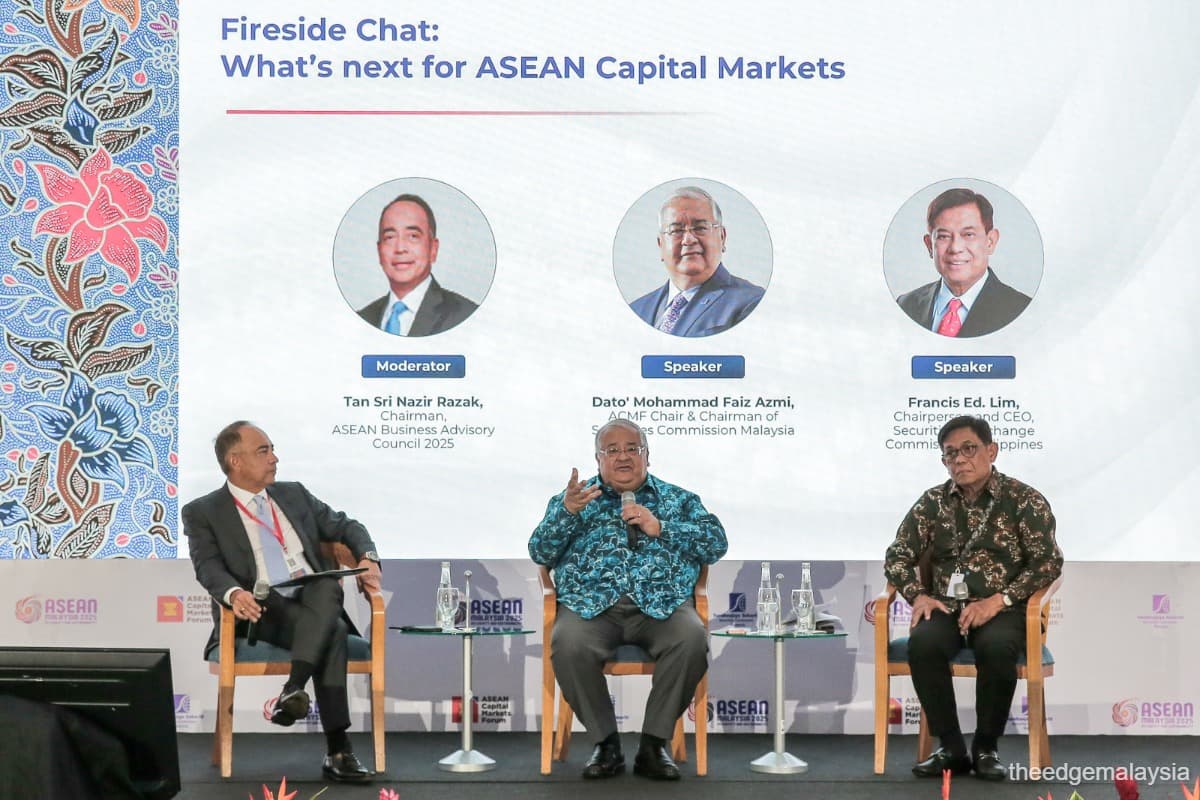
KUALA LUMPUR (Nov 6): The Securities Commission Malaysia (SC) has mooted the creation of Asean bonds, a regional financing mechanism aimed at pooling funds for cross-border infrastructure projects and strengthening capital market integration, said its chairman Datuk Mohammad Faiz Azmi.
Speaking at the Asean Capital Markets Forum International Conference on Thursday, Faiz said Asean should focus on developing shared financial products, such as regional bonds, that would enable markets to collaborate and attract investors, without the need to merge institutions or create a single Asean stock exchange or regulator.
“We already have very large projects within Asean including the Asean Power Grid, which I don’t think any individual country can handle alone. I hope one day we’ll be able to finance these big-ticket projects together,” he said.
Beyond creating new financing facilities, strong governance frameworks are essential to build trust and accountability in managing cross-border funds, he said.
"We also need to establish strong governance standards to go with it. This money carries trust, so how do we ensure a much higher level of governance for any of these projects? Yes, there are already Asian infrastructure funds and other similar initiatives. They’re all good, but they’re not enough. We have to get the private sector involved.”
The SC chairman shared his views during a fireside chat titled “What’s Next for Asean Capital Markets”, moderated by Asean Business Advisory Council chairman Tan Sri Nazir Razak.
Faiz also observed that some Malaysian public-listed companies have explored delisting or relocating abroad to tap deeper funding pools, as the domestic market alone may not support large-scale fundraising.
He suggested that Malaysia needs to rethink its approach to infrastructure financing by empowering states, municipalities, and communities to raise funds directly from private capital markets.
“How do we get companies within the state, for example, to come to the private markets to raise money? How do we get municipalities to raise funds? How can communities that have a need raise or crowdfund money?
“Some of that thinking, we already have an answer to, for example, through our Social Exchange. The first phase is focused on charity, but eventually, it will move towards social impact projects, and the third phase will be about empowering communities.
“Imagine a community hit by a severe flood; the federal and state governments will help, of course, but it will never be enough. So, can they appeal directly to the public through the Social Exchange to raise money? That’s the kind of community funding we envision.
“We are also talking to some of the larger states about how to develop a framework that allows them to come to the market and raise funds. States don’t go bankrupt, but the question is whether their balance sheets are strong enough to support such funding,” he added.