

This article first appeared in Capital, The Edge Malaysia Weekly on November 16, 2026 - November 22, 2026
THE sharp correction in global technology stocks has put Malaysian semiconductor counters under renewed pressure, with the Bursa Malaysia Technology Index falling 17.1% to an intraday low of 66.57 points on Nov 6, from a high of 80.32 points in early October.
While the longer-term artificial intelligence (AI) investment theme remains intact, the sell-off has raised a more immediate question for Bursa Malaysia: how much of the anticipated growth has already been priced into local technology stocks, and which companies can translate the global spending boom into sustainable earnings?
Malaysia’s close links to the global semiconductor supply chain position local players to benefit from continued hyperscaler investments in AI infrastructure, particularly front-end semiconductor equipment makers and related suppliers, as well as packaging players. However, the sector’s elevated valuations leave little room for disappointment, especially after the technology index surged nearly 45% from the start of the year to its October peak.
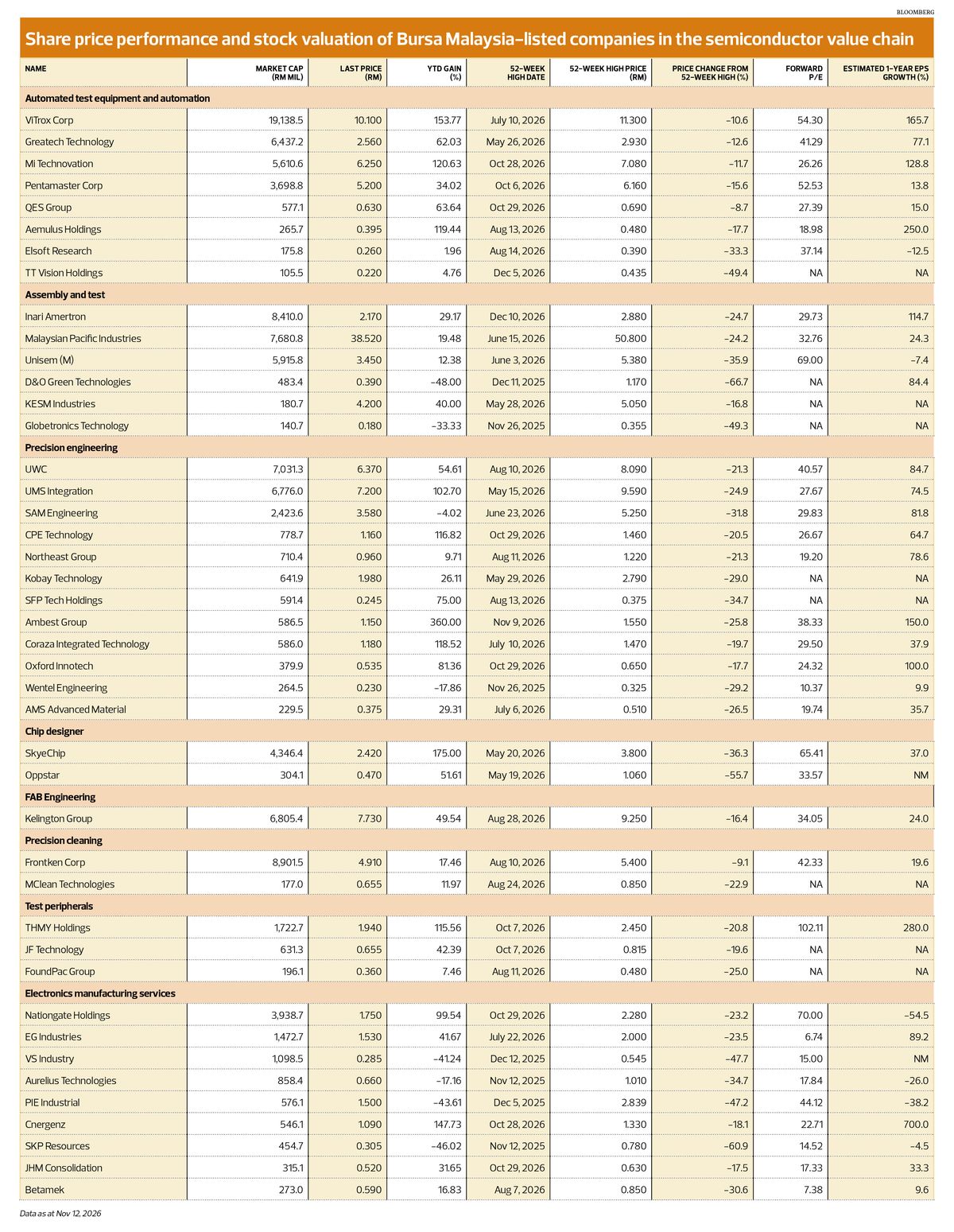
Despite the pullback, the Bursa Malaysia Technology Index is still trading at a trailing price-earnings ratio (PER) of about 50 times and a forward PER of nearly 29 times. These multiples suggest that investors are continuing to pay a substantial premium for future earnings growth, leaving technology counters vulnerable to even modest earnings misses.
Tony Chan Mun Chun, research manager at TA Securities Holdings Bhd, estimates that the market is pricing in earnings growth of at least 20% to 30% for the technology sector. Although the recent sell-off has made valuations slightly more reasonable, he says they remain far from cheap.
The concern is that even companies meeting earnings expectations may struggle to deliver further share price gains. “Even if earnings meet expectations, their share prices may not necessarily rise significantly, as much of the anticipated growth has already been priced in,” Chan says.
Should earnings growth fall materially short of expectations — for instance, below 10% — investors could begin questioning whether the sector’s premium valuations remain justified, he adds.
Tradeview Capital chief investment officer Nixon Wong similarly warns that a meaningful shortfall against the market’s roughly 30% earnings growth expectation for FY2027 could trigger earnings downgrades and valuation compression.
If growth moderates towards 15% to 20%, a more conservative forward PER range of 20 to 25 times would be appropriate for the broader sector, he says. This could translate into significant downside for counters whose valuations have run ahead of their underlying business performance.
Danny Wong, CEO of Areca Capital Sdn Bhd, puts it simply: At 50 times earnings, investors are paying a substantial amount today for profits they expect companies to generate in the future, so a weak corporate update could send a stock sharply lower.
Trident Analytics chief research officer Peter Lim, however, believes the earnings outlook for Malaysian semiconductor companies remains relatively strong.
“At 50 times trailing PER, the only justification would be expecting very strong results on the horizon. I would not say all Malaysian companies that are in the semicon space will have bumper years, but safe to say the majority of them will,” Lim says.
Based on results released at the time of writing, Lim considers 30% earnings growth a conservative estimate. “Personally, I would value the companies on 30 to 35 times forward PER as fair,” he adds.
Not all tech firms are equally positioned
The valuation debate also brings into focus the different positions Malaysian companies occupy along the semiconductor value chain.
TA Securities’ Chan favours front-end semiconductor players, which have earlier and more direct exposure to the AI investment cycle. These are followed by semiconductor testing and automation equipment manufacturers, as well as precision engineering companies serving both front-end and back-end customers.
Outsourced semiconductor assembly and test (OSAT) players are Chan’s least-preferred segment, as many remain significantly exposed to traditional end markets such as smartphones, personal computers and consumer electronics. This could make it more challenging for them to meet the high earnings expectations embedded in their share prices.
Differentiating between the two is important because the current semiconductor up cycle is being driven disproportionately by AI infrastructure spending, rather than a broad-based recovery across all electronics markets.
Tradeview’s Nixon, meanwhile, sees opportunities among selected second- and third-tier suppliers, particularly those benefiting from semiconductor equipment spending, advanced packaging and supply chain diversification. However, he stresses that investors should focus on companies with genuine earnings exposure to these trends, rather than those benefiting mainly from AI-related sentiment.
This means examining order books, customer relationships and, crucially, the extent to which new business can translate into revenue and profits.
TA Securities believes the recent sell-off has also made established players such as Dagang NeXchange Bhd (KL:DNEX), Pentamaster Corp Bhd (KL:PENTA), Malaysian Pacific Industries Bhd (KL:MPI) and Coraza Integrated Technology Bhd (KL:CORAZA) more attractive from a risk-reward perspective, supported by their fundamentals and exposure to the AI investment cycle.
Malaysia could benefit from a shift in data centre investment
Malaysia could also benefit from changes in the geographical distribution of AI infrastructure investment.
Concerns over electricity availability, grid connections, land use and local opposition to data centre development in the US could encourage hyperscalers and infrastructure developers to consider alternative markets.
Hisham Hamzah, CEO of Maybank Asset Management Sdn Bhd, argues that restrictions on data centre development in individual US states are more likely to influence where and when capacity is built, rather than eliminate demand for computing infrastructure.
He points to Google’s commitment to invest US$15 billion in data centres in Malaysia over 2027 and 2028, with the company pledging to pay for all the electricity it uses.
For Malaysia, the opportunity extends beyond hosting data centres. AI infrastructure requires a broader ecosystem encompassing semiconductor components, networking equipment, power management, cooling systems and engineering services.
Areca Capital’s Danny says construction companies with substantial data centre and infrastructure jobs remain interesting, but cautions that a large order book alone does not guarantee attractive returns. “Strong order books mean little if the company carries too much debt,” he says.
Investors must therefore assess not only the size of a company’s contract pipeline, but also its execution capabilities, funding requirements and ability to convert projects into cash flow, he adds.
Interest rates strengthen case for defensive sectors
The prospect of higher interest rates adds another layer of uncertainty to the Malaysian equity outlook, particularly if global bond yields remain elevated.
Although the US Federal Reserve’s policy direction does not automatically determine Bank Negara Malaysia’s decisions, changes in global interest rates can influence currency movements, capital flows and equity valuations.
Trident Analytics’ Lim argues that individual countries are increasingly making monetary policy decisions based on their own economic conditions and currencies, rather than simply following the US.
Nevertheless, a higher-for-longer interest rate environment could weigh on Malaysian companies with substantial borrowings and those whose valuations depend heavily on future earnings.
Property developers and real estate investment trusts (REITs) are potentially vulnerable if Bank Negara raises rates, given the impact of higher financing costs and less attractive yields, notes Tradeview’s Nixon.
Construction companies with elevated borrowings could also come under pressure, while consumer discretionary stocks may face weaker spending, though companies with strong pricing power and resilient domestic demand should fare better.
Areca Capital’s Danny similarly favours companies with relatively low debt and steady income, which are better positioned to withstand higher financing costs and weaker market sentiment.
Against this backdrop, institutional investors are becoming more selective in their equity exposure.
Tradeview prefers companies with resilient cash flows, strong balance sheets and reasonable valuations, rather than making broad sector allocation changes.
Areca Capital, which raised its cash holdings in the third quarter, is prepared to deploy the funds gradually into fundamentally strong companies as buying opportunities emerge.
Banks, utilities, telecommunications and selected consumer companies could attract greater interest, given their relatively predictable earnings and, in some cases, dividend yields.
Tradeview sees domestically oriented businesses, particularly banks and utilities, as relatively attractive because of their recurring earnings and resilient demand. Areca Capital identifies telecommunications companies as potential alternatives to highly valued technology counters.
For income-seeking investors, REITs remain an option, although their sensitivity to interest rates and financing costs makes stock selection particularly important.
Lim, however, cautions against assuming there is a perfect defensive sector. Technology continues to offer the strongest growth visibility, in his view, while REITs may appeal to investors who are more sceptical about the technology rally.
Read also: Save by subscribing to us for
your print and/or
digital copy. P/S: The Edge is also available on
Apple's App Store and
Android's Google Play.
Cover Story 1: AI boom or bubble? Investors confront risks versus rewards
Tech: ‘Mata Hari’ and the future of Nvidia without Jensen Huang