

This article first appeared in Capital, The Edge Malaysia Weekly on November 16, 2026 - November 22, 2026
CAPITAL is rotating out of crowded positions in artificial intelligence (AI) and into healthcare, banking and cyclical stocks. Meanwhile, in the AI ecosystem, investors are favouring companies with strong balance sheets and the ability to fund expansion through internal cash generation.
The sharp sell-off in global technology stocks following the recent US midterm elections has reignited concerns about the sustainability of the AI investment boom, raising questions about whether the market is undergoing a temporary, sentiment-driven correction or a more fundamental reassessment of valuations.
On Nov 5, the Nasdaq-100 Index plunged 6.3%, while the Philadelphia Semiconductor Index (SOX) tumbled more than 12%, as investors grew increasingly concerned that a Democrat-controlled US Congress could introduce tighter regulations and slow the pace of AI infrastructure development.
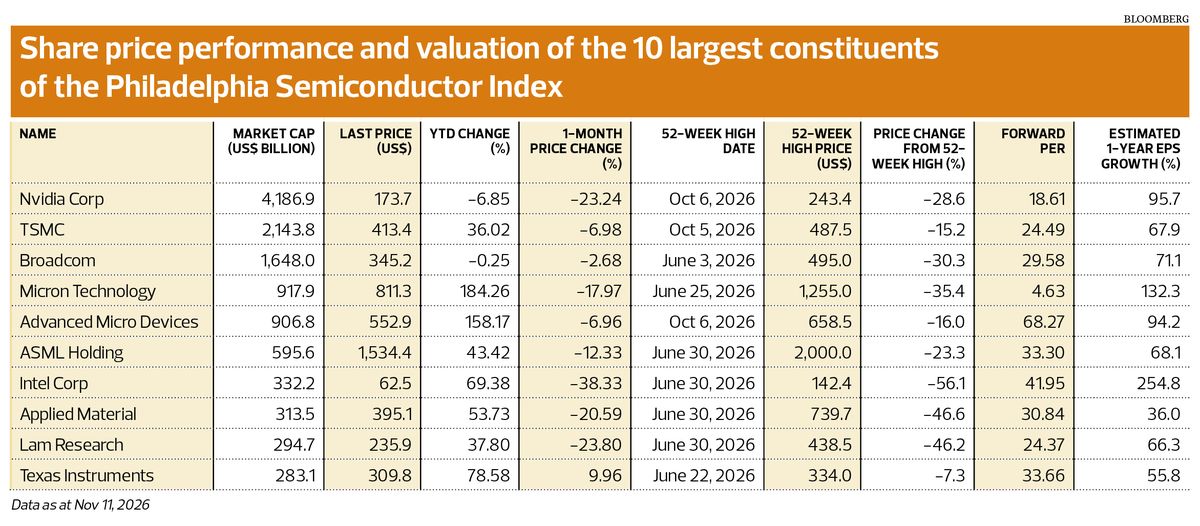
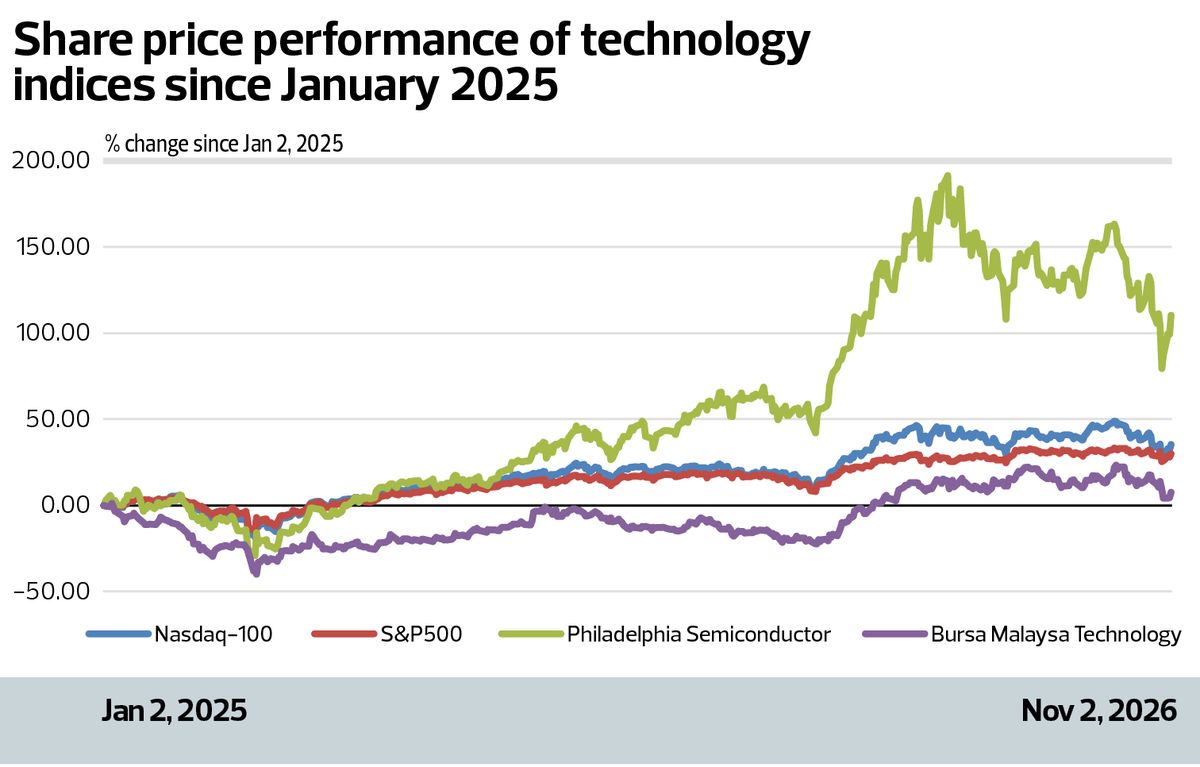
Semiconductor stocks bore the brunt of the sell-off, reflecting their significant gains over the past year as one of the biggest beneficiaries of the AI investment boom. The SOX has fallen 37% from its June peak, while the Nasdaq-100 has retreated 14.7% from an October peak. Despite the correction, both indices remain firmly in positive territory for the year, with the SOX still up 49.2% and the Nasdaq-100 having gained 12.4% year to date.
While global tech stocks have recovered some of their losses, investor confidence has faced another test following developments surrounding Nvidia Corp, the world’s leading AI chipmaker. Co-founder Jensen Huang has admitted to an extramarital affair with a business executive reportedly linked to a Chinese intelligence operation, prompting Nvidia’s board of directors to launch an in dependent investigation into whether he had been targeted by foreign intelligence efforts. In the fallout — and amid reports of further infidelity with a co-worker — Huang resigned as CEO last Thursday, while China rejected the espionage allegations, dismissing them as groundless and an attempt to smear Beijing. In the interim, chief financial officer Colette Kress takes the helm at Nvidia as the group searches for a permanent successor.
Against this backdrop, market participants remain divided over whether the correction marks the beginning of a prolonged downturn or merely a shakeout of investors who had increasingly crowded into AI-related stocks.
Maybank Asset Management Sdn Bhd CEO Hisham Hamzah, whose firm manages about RM41.9 billion in assets — more than double from a year earlier — attributes much of the recent weakness to forced selling rather than a deterioration in corporate fundamentals.
“Technology makes up 28% of the global stock market. But because its share prices swing more sharply, it accounts for about 40% of the market’s overall risk. Chipmakers alone make up 13% of the market but about 21% of the risk,” he explains.
The concentration matters because many large funds are subject to risk limits. When markets are relatively calm, they can increase their exposure. However, when volatility rises, they are forced to reduce positions to remain within those limits, potentially amplifying market movements.
“When prices start swinging, they have to sell to stay within their limits. That selling makes prices swing even more, which forces yet more selling,” says Hisham.
He points to hedge funds as a key source of the selling pressure. From late September, hedge fund returns moved almost in tandem with semiconductor stocks, suggesting that funds were hitting risk limits and liquidating similar positions.
Multi-strategy funds suffered their heaviest losses since March 2020, while quantitative funds rotated out of AI-related stocks into the healthcare, banking and cyclical sectors. Trend-following funds also unwound their long positions in semiconductor stocks.
A similar pattern was evident in South Korea, where the end of corporate share buybacks coincided with increased selling by foreign and systematic investors. Stocks outside the memory segment fell almost as sharply as memory-related counters, suggesting that the sell-off was driven more by broad-based portfolio de-risking than company-specific concerns.
The Nov 5 sell-off further intensified the pressure. Retail investors had poured record sums into leveraged exchange-traded funds (ETFs) in late October, creating another source of mechanical selling as prices declined.
“The semiconductor index fell 12.25%, its second-worst day on record. Options were not the accelerant this time; retail call buying had not recovered since the summer,” says Hisham.
The indiscriminate nature of the selling was another indication that market positioning, rather than deteriorating fundamentals, was driving the correction. Every constituent of the iShares Semiconductor ETF fell more than 6% that day, while trading in the main Nasdaq-100 ETF reached a record of about US$80 billion (RM326.3 billion).
Even companies announcing positive developments were not spared. Bloom Energy Corp fell 17% on the day it announced a 900MW fuel-cell deal, while semiconductor equipment makers that had recently raised their earnings guidance were sold alongside those that had not.
“Forced sellers sell what they own, not what has deteriorated,” Hisham observes.
The subsequent rebound reinforces his assessment. Advanced Micro Devices Inc (AMD) and Lam Research Corp each gained about 11% in the following days, while short interest in the main Nasdaq-100 ETF had climbed to its highest level since 2023, leaving room for further short covering.
Fundamental selling, he argues, would typically be accompanied by earnings downgrades, rising inventories across the supply chain and order cancellations. None of these developments has become evident so far.
Instead, earnings forecasts continued to rise through the sell-off. When share prices fall while earnings expectations improve, Hisham believes positioning rather than fundamentals is likely to be the dominant driver.
Trident Analytics chief research officer Peter Lim shares the view that the correction should be seen in the context of elevated expectations and crowded positioning.
“AI stocks have done extremely well in the past two years, which resulted in the market finding reasons to sell the sector. Thus, any news, no matter how insignificant or uncorrelated, will provide the doomsayers a window to scream ‘sell!’” he says.
Lim also challenges the argument that the AI industry is approaching a speculative bubble, pointing to the increasing adoption of AI tools in everyday life and business operations.
“Whenever someone tells me that this is a tech bubble, I’ll ask them if they are using more and more AI, be it Claude, ChatGPT or Perplexity, in their daily lives. When the time comes when humans use less AI assistance in their daily lives, then I will say yes, we are in a bubble. We are in an AI supercycle, which will sustain for the next three to five years,” he says.
Other fund managers, including Tradeview Capital chief investment officer Nixon Wong and Areca Capital Sdn Bhd CEO Danny Wong, similarly view the recent sell-off as largely driven by valuation concerns and profit-taking rather than a fundamental deterioration in the AI investment theme.
Big technology companies continue to commit substantial capital to AI infrastructure, while semiconductor manufacturers are still receiving orders. The correction, in their view, reflects the unwinding of crowded positions after too many investors piled into the same stocks.
US political risks emerge as AI market wildcard
Beyond market positioning, political uncertainty in the US has emerged as another concern for investors, particularly given the strategic importance of semiconductors and AI infrastructure to the country’s economic and technological ambitions.
Nevertheless, fund managers generally believe the US commitment to maintaining its leadership in AI is unlikely to change fundamentally, regardless of which political party controls Congress.
Hisham argues that the more immediate regulatory risks are not necessarily at the federal level but at the state and local levels, where resistance to data centre developments is becoming increasingly apparent.
While a Democrat-controlled Congress could lead to greater scrutiny of the tech industry, he does not expect federal legislation to halt the AI infrastructure buildout before the next presidential election in 2028.
“Democrats now control both chambers of Congress, but without veto-proof majorities. Expect hearings and oversight, not federal legislation that halts the AI buildout before the next presidential election,” he explains.
Instead, Hisham identifies local moratoriums on data centre approvals and proposals requiring developers to bear a larger share of electricity and grid connection costs as more immediate obstacles.
“But demand is strong enough that permission changes where, how and when capacity gets built, not whether AI revenue is real. OpenAI and Anthropic’s combined annualised revenue has risen from less than US$20 billion a year ago to more than US$100 billion. That spending is turning into contracted demand for computing capacity. Backlogs at the four largest cloud providers have roughly doubled in a year to nearly US$2.5 trillion,” he points out.
Hyperscalers are already looking beyond the US to secure the necessary infrastructure. The day after the US midterm elections, Google committed US$15 billion to data centres in Malaysia over 2027 and 2028, pledging to pay for all the electricity it uses. Meanwhile, the first 200MW of the Stargate UAE campus in Abu Dhabi are scheduled to come online this year.
In the US, developers are increasingly building their own on-site power facilities to circumvent grid connection queues and electricity supply constraints.
“Chips don’t care where they are plugged in. The winners are the suppliers of chips, memory, networking and power equipment, wherever the capacity lands. The losers are assets tied to a location, such as developers in moratorium states,” says Hisham.
Lim believes the broader direction of US technology policy is unlikely to change significantly under a different political administration. “If you understand the political landscape of the US, you will find that whether it is the Republicans or the Democrats that run the country, the major policies and direction remain. Of course, a caveat is needed for the Trump administration,” he says.
“AI investment is not a Republican theme. It is a US theme — one that ensures that the US remains the leader of the world. Will the Democrats make an Armageddon-like decision to reverse their investments in AI at a time when China is just right behind them? I guess not.”
TA Securities Holdings Bhd senior technology analyst Tony Chan Mun Chun cautions that a Democrat-led Congress could introduce additional regulatory hurdles, potentially slowing the Trump administration’s AI agenda and infrastructure investments.
“We believe the key risk is not the introduction of new AI proposals, but rather potential delays in AI investments, which could affect the strong earnings growth expectations already priced into tech stocks,” he says.
Delays in approving infrastructure projects or implementing investment incentives could affect the timing of orders and earnings recognition across the semiconductor supply chain.
For Malaysia, tighter US restrictions on semiconductor exports remain a particular concern, given the local industry’s integration into the global technology supply chain.
“The main worry for Malaysia is tighter US limits on selling chips and chip technology abroad, because many of our companies are part of that supply chain. But new laws take time, and Malaysia has often gained when companies move production out of China,” says Areca Capital’s Danny.
Apart from export controls, changes to incentives under the CHIPS and Science Act and potential restrictions on AI development are other risks that investors should monitor.
The developments surrounding Nvidia have also introduced another source of uncertainty to the market, given its dominant position in the AI chip industry, accounting for roughly 80% of global data centre AI accelerator sales and commanding more than 90% of the market share for chips used in frontier AI model training.
Nvidia’s significant weighting in major market indices, as the second-largest company in the US by market capitalisation, also means that any prolonged weakness in its share price could have broader implications for tech stocks and investor sentiment.
Danny says the leadership changes at Nvidia, coupled with the possibility of tighter US export controls on advanced chips, could prolong volatility and weigh on sentiment towards Malaysian semiconductor and data centre-related stocks, even if underlying AI demand remains healthy.
“Investors are worried about losing leadership, not orders drying up. In the immediate term, investors are looking for alternatives or rivals to Nvidia, even though the ‘spy’ allegations are yet to be confirmed,” he adds.
Lim believes Huang’s importance to Nvidia should not be underestimated, given his central role in building the company into a global AI powerhouse.
“There are views that no single person is indispensable in an organisation. But I do beg to differ in Nvidia’s case, considering he is the co-founder and the main brain behind growing the company to where it is today. The implication of replacing him will be more on Nvidia itself rather than derailing the whole AI growth trajectory and ecosystem,” he says.
TA Securities’ Chan is of the view that Nvidia’s competitive advantages extend beyond its chief executive.
“Nvidia’s competitive advantages are built on decades of R&D, its CUDA software ecosystem, engineering capabilities and strong customer relationships. These advantages would not disappear simply because of a change in leadership,” he says.
“As such, we do not expect any significant impact on Malaysia unless the allegations are proven to be true. In that case, US regulators could tighten scrutiny of chip exports to Malaysia, particularly given Megaspeed’s business presence in the country.”
Nevertheless, he acknowledges that the leadership transition could temporarily slow decision-making and technology development while new management settles in, potentially creating opportunities for competitors such as AMD, Broadcom Inc and Google to catch up and gain market share.
Interestingly, recent share price movements appear to reflect this possibility, with several chipmakers seeing their stocks gain ground as Nvidia’s share price came under pressure amid the controversy.
AI fundamentals remain intact
Despite the market volatility, corporate earnings expectations in US tech companies have continued to improve, supported by accelerating cloud revenue growth, strong demand for computing capacity and persistent supply constraints.
For Hisham, the divergence between share prices and earnings forecasts is an important indication that the underlying AI investment thesis remains intact.
“Third-quarter 2026 US corporate earnings grew about 33% year on year (y-o-y), while forecasts for 2027 earnings continued to rise throughout the reporting season. That matters, because if the fundamental thesis were breaking, the earnings estimates would be falling, not climbing,” he stresses.
He identifies four factors that could fundamentally undermine the AI investment cycle: demand, supply, funding and permission. While demand and supply remain supportive, concerns are increasingly centred on the ability to finance the massive infrastructure buildout and secure the necessary regulatory and local approvals.
On the demand front, the September quarter results of major US hyperscalers point to accelerating adoption of AI-related services.
Amazon Web Services (AWS) recorded revenue growth of 39% y-o-y, its fastest pace in almost five years, while Microsoft Azure grew 48%, from 40% a year earlier. Google Cloud’s revenue more than doubled, having risen 103%.
The growth is also increasingly translating into enterprise spending. Fortune 500 companies’ spending on Amazon’s Bedrock AI platform rose almost sevenfold from a year earlier, while rental rates for Nvidia’s H100 graphics processing units (GPUs), a chip that is now two generations old, increased from just under US$2 an hour at the beginning of the year to close to US$3.
These developments suggest that demand for computing capacity remains robust, rather than showing the characteristics of an industry that has overinvested in infrastructure. “These are not the conditions of an overbuilt market,” says Hisham.
Meanwhile, supply remains a bottleneck. Microsoft has indicated that customer demand continues to exceed available supply, while Alphabet has started renting third-party computing capacity to meet demand. Lead times for key server components are also lengthening.
Even Microsoft’s decision to trim its 2026 capital expenditure (capex) was attributed to delays in the arrival of externally contracted computing capacity rather than weaker demand. “That is a delivery problem, not a demand problem,” says Hisham.
The distinction is important for investors trying to determine whether the AI infrastructure investment cycle is sustainable. If demand remains strong while the industry continues to struggle to deliver sufficient computing capacity, the current investment boom could have further room to run.
Hisham expects the next four to eight weeks to provide further evidence through hyperscalers’ initial guidance for 2027 capex, cloud growth, order backlog and return on infrastructure investment. With Alphabet and Amazon having already indicated plans to spend significantly more next year, he expects cloud growth and order backlogs to continue accelerating.
Lim shares this optimism, arguing that the continued adoption of AI and spending by major tech companies provide stronger indicators of the industry’s prospects than short-term share price movements.
“From a more quantitative perspective, not only am I looking at the numbers of OpenAI and Anthropic, I am also looking closely at the revenue growth of the hyperscalers such as Amazon, Meta, Alphabet, Microsoft and Oracle. Their usage of AI to grow their core businesses has been remarkable,” he says.
Danny also believes the correction could present opportunities for investors, provided that spending plans remain intact.
“If spending plans stay on track over the next few months, this dip may turn out to be a buying opportunity. I would monitor AI capex, semiconductor orders, earnings revisions and corporate guidance,” he suggests.
Cash flow emerges as key vulnerability
While the demand for AI infrastructure remains robust, the sheer scale of capex required to build data centres, procure advanced chips and expand computing capacity is increasingly putting pressure on the cash flows of some of the world’s largest tech companies.
Hisham identifies funding, rather than demand, as the most compelling risk to the AI infrastructure investment cycle. Hyperscaler capex is projected to rise from about US$914 billion in 2026 to US$1.7 trillion in 2027, based on JPMorgan estimates cited by him.
More importantly, all six of the largest spenders are expected to generate negative free operating cash flow in both years.
This does not necessarily mean the industry is overbuilding, as much of the capacity is being developed against contracted demand. However, the mismatch between upfront infrastructure expenditure and revenue generated over the life of customer contracts creates financing risks.
Part of the demand also depends on AI laboratories that are still growing into their commitments to purchase computing capacity.
“The bear case we take most seriously is funding rather than demand. Spending has outgrown the cash flow of the companies doing it,” says Hisham.
The market has already started differentiating between companies with stronger balance sheets and those more dependent on external financing.
He cites Alphabet’s 12.6% share price decline on Oct 29, its worst single-day performance since listing, despite its cloud revenue more than doubling. Investors were concerned that its capex was running ahead of cash flow.
In October, bonds issued by the most heavily indebted AI cloud provider also fell to distressed levels, highlighting the financing pressure faced by parts of the industry.
For Hisham, the main risk would be if funding stress spread from highly leveraged AI cloud providers to the investment-grade bond markets used by major hyperscalers. He would also reduce exposure if AI laboratories fail to generate sufficient revenue growth to meet their contracted computing commitments, potentially leaving cloud providers with excess capacity.
Rate hikes add another test
The prospect of another US Federal Reserve key policy rate increase in December adds another dimension to funding concerns surrounding the AI infrastructure buildout.
Hisham argues that the biggest vulnerability may not lie with the largest tech companies but with highly leveraged businesses that rely more heavily on external financing. With the futures markets pricing in a December rate hike as “close to certain” following October’s hotter-than-expected inflation print, he believes heavily indebted AI cloud providers, data centre developers, unprofitable growth companies and smaller businesses with floating-rate loans face the greatest risks.
The major hyperscalers, by comparison, have substantial financial resources to absorb higher borrowing costs. Microsoft, Alphabet, Amazon, Meta and Oracle collectively hold nearly US$600 billion in cash and short-term investments, while most of their debt is long-dated and carries investment-grade fixed rates.
Nevertheless, their infrastructure spending is beginning to affect cash generation. Their combined capex reached US$557 billion in the first nine months of 2026, turning what was previously a free cash flow surplus into a deficit, according to Hisham.
Higher interest rates would therefore increase the cost of financing the next phase of the infrastructure buildout, potentially affecting investment returns rather than the companies’ ability to meet their obligations.
Microsoft, which continues to finance its infrastructure expansion from its own cash flow, is particularly well positioned, he notes.
Lim believes that even if the Fed raises interest rates in December, the move should not necessarily be interpreted as the beginning of a prolonged tightening cycle.
“Historically, a hike in interest rates will result in an exit from tech stocks. Even assuming the Fed does raise rates in December, I don’t see this as the US entering a rate-hiking trajectory. I expect inflationary pressures to cool, which would eliminate the need for further hikes,” he says.
“Unlike in the past, when the world looked to the US for interest rate direction, we are now at a stage where each country’s interest rate decisions are increasingly based on its own economic conditions.”
Interestingly, Hisham argues that the valuation sensitivity of leading tech stocks to higher interest rates may be lower than in previous tightening cycles.
“The AI leaders now trade at forward earnings of 13 to 16 times. Those are not long-duration valuations. Their prices rest on earnings growth today, not on distant cash flows,” he says.
He also challenges the assumption that technology stocks are the most expensive segment of the global equity market.
The MSCI All-Country World Index trades at 15 times forward 12-month earnings, below its long-term average of about 17 times and down from 19 times at the beginning of the year. The Nasdaq-100 trades at 19 times forward earnings, its lowest multiple in five years, according to Hisham.
By comparison, some consumer staples stocks are trading at significantly higher valuations despite having slower earnings growth.
Costco trades at about 43 times forward earnings for expected growth of 10%, while Coca-Cola trades at about 27 times for growth of about 6%. Procter & Gamble trades at about 23 times forward earnings for earnings per share growth of 6% in the financial year ending June 2028.
“The stretched corner of the market is not AI. It is the safe haven,” says Hisham.
Nevertheless, he cautions that the central question is whether current earnings among AI infrastructure companies represent a cyclical peak that may not be sustainable. Semiconductors are inherently cyclical, and the current up cycle has already recorded more than three years of y-o-y revenue growth, making it the longest on record, he says.
However, traditional warning signs of an approaching industry downturn have yet to emerge. Supply chain checks show no meaningful accumulation of GPU or custom AI chip inventories, while lead times continue to lengthen and capacity additions for 2027 and 2028 remain disciplined.
The cycle would begin to turn when supply catches up with demand, as reflected in shorter lead times, order cancellations, falling computing rental rates and chips being installed but unable to operate because data centres lack grid connections or regulatory approvals.
For now, Hisham does not believe the industry has reached that point.
Global funds reposition amid AI market volatility
The recent market correction has nevertheless prompted institutional investors to reassess their portfolio exposure, although Hisham believes capital is being redistributed rather than withdrawn from equity markets altogether. “The money is not leaving equities. It is unwinding its most crowded positions.”
Foreign investors withdrew about US$50 billion from Asian equities in October, largely from Taiwan and South Korea, two markets with significant exposure to the semiconductor industry.
Hedge funds that reduced their AI positions subsequently rotated into healthcare, banking and traditional cyclical stocks, while US Treasuries and high-grade credit also attracted investor interest.
In the AI ecosystem, capital is increasingly moving towards companies that can finance their expansion through internal cash generation, suppliers whose products can be deployed regardless of where data centres are built, and markets capable of providing reliable electricity and securing the necessary approvals.
Hisham also observes a rotation away from AI-heavy Asian markets towards those with relatively limited AI exposure, such as India. However, he stresses that this should not be interpreted as a rejection of AI or US equities.
There is little indication of capital leaving the US market, supported by continued buying from retail investors and record corporate share buybacks. JPMorgan also expects hedge funds to begin rebuilding their AI exposure from late November once markets stabilise, he says.
Other fund managers are similarly adopting a more selective approach.
Areca Capital raised cash in the third quarter and is now prepared to deploy it when attractive opportunities emerge.
“We were selling and raising cash in 3Q. We hold higher cash than usual, but I don’t think we will sell more now. Instead, we are ready to deploy the cash for any buying opportunity in the near term, especially those fundamentally strong companies,” says Danny.
Tradeview Capital is also maintaining adequate liquidity, focusing on companies with resilient cash flows, strong balance sheets and reasonable valuations rather than making broad sector allocation changes.
Read also: Save by subscribing to us for
your print and/or
digital copy. P/S: The Edge is also available on
Apple's App Store and
Android's Google Play.
Cover Story 1: Can Malaysian tech companies live up to AI-driven growth expectations?
Tech: ‘Mata Hari’ and the future of Nvidia without Jensen Huang