

This article first appeared in The Edge Malaysia Weekly on November 9, 2026 - November 15, 2026
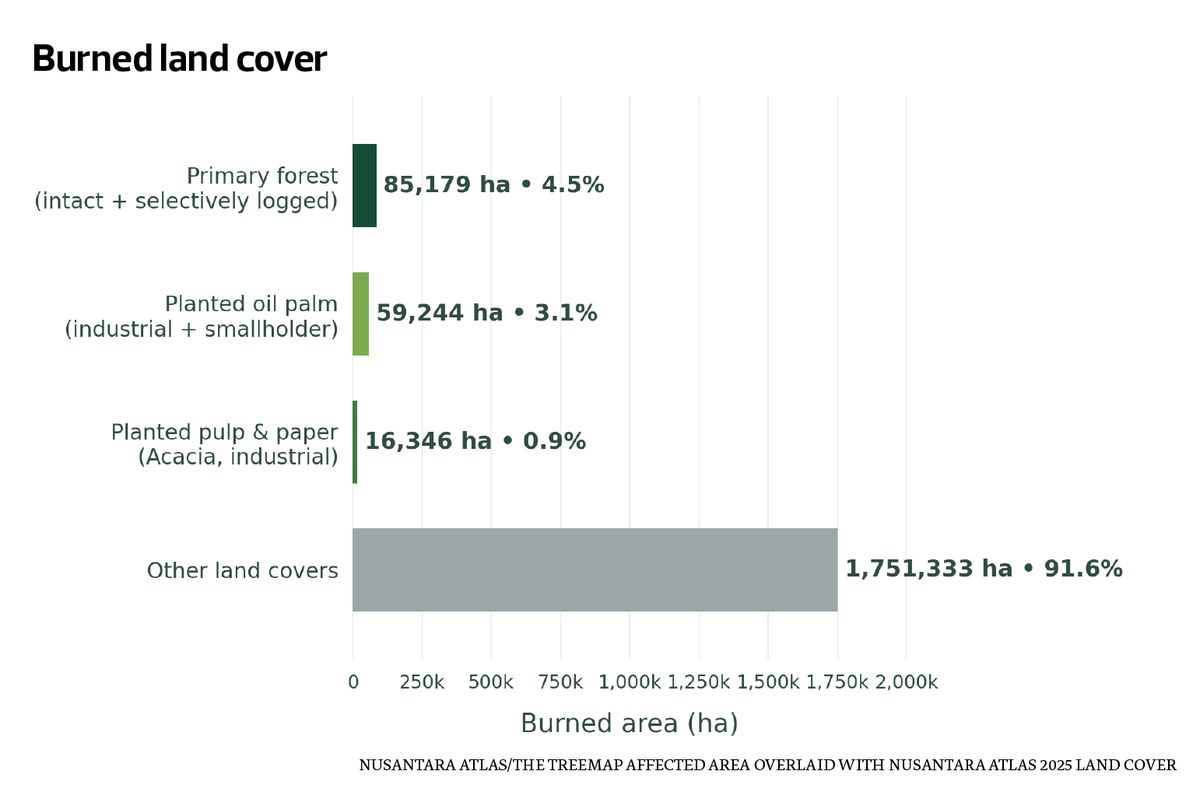
INDONESIA’s forest fires this year have affected close to two million hectares, but only 3.1%, or 59,244ha, were on planted oil palm area, according to Nusantara Atlas and The Tree Map. Another 85,179ha, or 4.5%, of burned land cover were in primary forests; and 16,346ha (0.9%) in planted pulp and paper estates.
Most fires occurred on other land covers, which accounted for 91.6%, or 1.75 million ha, of the affected area.
Even so, much of public attention has fallen on palm oil and forestry companies that operate in the country.
Nusantara Atlas is an independent, open-access geo-platform tracking deforestation, wildfires, peatland degradation and forest regeneration in Equatorial Asia and Colombia. The Tree Map is a geospatial company.
The fires, coupled with strong El Niño weather conditions, caused a prolonged transboundary haze that triggered demonstrations in Indonesia, even leading to tensions between neighbouring countries in the region.
Singapore responded by investigating companies that have business interests in the country, issuing information notices to 10 palm oil and forestry companies registered there, seeking details of their Indonesian operations and links to land concessions. The companies either hold concessions in Indonesia or are associated with entities that do.
Five of the 10 companies are linked to three Bursa Malaysia-listed groups — IOI Corp Bhd (KL:IOICORP), TSH Resources Bhd (KL:TSH) and PPB Group Bhd (KL:PPB).
The five are Bumitama Agri Ltd, in which IOI Corp holds a 32.1% stake; TSH Global Plantation Pte Ltd and TSH Oversea Pte Ltd, both wholly-owned subsidiaries of TSH Resources; and Wilmar International Ltd and Kencana Agri Ltd, which are linked to PPB Group. PPB owns an 18.78% stake in Wilmar, which holds an indirect 20% interest in Kencana through its wholly-owned unit Newbloom Pte Ltd.
The remaining five companies comprise three linked to Indonesia’s Sinar Mas group — Asia Pulp & Paper (APP) Co, Asia Pulp & Paper Co (China) and Golden Agri International. The other two are Indofood Agri Resources Ltd, which is linked to Indofood Sukses Makmur Tbk PT, and First Resources Ltd, controlled by Eight Capital, a British Virgin Islands-based entity.
In a statement, Bumitama said it had submitted the information and documents compiled so far to Singapore’s National Environment Agency (NEA).
At a press conference after IOI Corp’s annual general meeting on Nov 4, group managing director and CEO Datuk Lee Yeow Chor played down concerns that the investigation into Bumitama could affect IOI’s environmental, social and governance (ESG) credentials.
Meanwhile, TSH Resources said in a Bursa filing on Nov 4 that its two subsidiaries had submitted the documents and information compiled so far to NEA. They have until Nov 16 to furnish the remaining materials, although the group did not disclose what was still outstanding.
PPB has not made an announcement on Bursa regarding the notices. Wilmar said in a Nov 2 filing with the Singapore Exchange, however, that it had submitted the first tranche of requested documents and information to NEA. Wilmar added that it was still gathering the remaining materials, citing the volume of information sought and the period covered, which dates back to June 1, 2015.
The investigation comes ahead of Singapore’s move to strengthen its legal framework against transboundary haze. On Nov 4, parliament passed major amendments to the Transboundary Haze Pollution Act, raising the maximum criminal fine for entities causing or contributing to haze tenfold to S$20 million (RM63.4 million), with daily fines of up to S$1 million until the offence is resolved. A separate civil penalty framework, with a maximum penalty of S$10 million, was also introduced.
Read also: Save by subscribing to us for
your print and/or
digital copy. P/S: The Edge is also available on
Apple's App Store and
Android's Google Play.
Cover Story 1: Can Malaysian planters avert another migrant worker crunch?