


This article first appeared in Capital, The Edge Malaysia Weekly on November 9, 2026 - November 15, 2026
INVESTING in gold mining stocks may offer more lucrative returns than holding the precious metal itself, as miners can benefit not only from rising bullion prices but also from expanding profit margins, dividends and business expansion.
Franklin Equity’s head of Asia-Pacific client portfolio management William Chang tells The Edge that even after gold’s sharp correction from record highs in January, opportunities remain — particularly among companies whose equity valuations have yet to fully reflect their earnings potential.
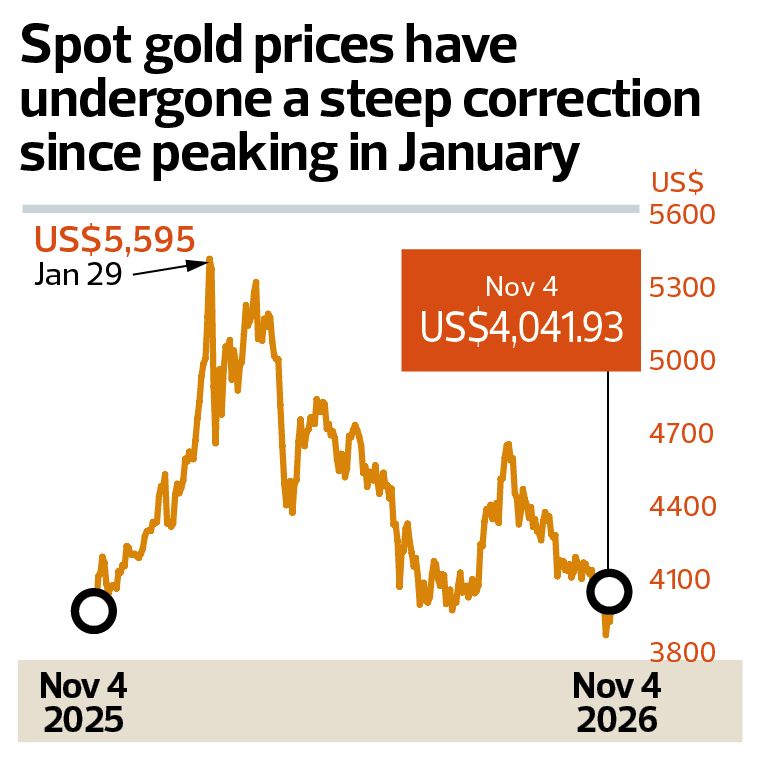
After surging to a record intraday high of about US$5,595 an ounce on Jan 29, gold suffered a steep correction, plunging nearly 30% to the US$3,926 level last Tuesday as concerns over inflation, higher US interest rates and forced selling weighed on the market.
“We think there’s still an opportunity for gold miners. I think it’s important to realise that fundamentally, what you’re getting is an exposure to gold. But the way you do so is by gaining exposure to these businesses that can still profit even if gold prices remain at current levels,” Chang says.
He notes that gold mining stocks historically deliver two to three times the percentage performance of gold prices, though this varies across companies and market conditions. For example, a 10% rise in bullion prices could translate into gains of 20% to 30% in mining stocks, compared to a direct 10% gain from holding the physical metal.
“When gold prices go up, gold miners’ share prices typically go up. We think there is still room to go. Miners are an interesting case and way of gaining exposure to gold because it’s important to realise that, at the end of the day, you’re still buying businesses.
“Miners have the ability to participate in extraction growth. They can continue to deliver shareholder returns in the form of share buybacks and mergers and acquisitions. With [physical] gold, you [only] get your returns through increased price appreciation,” explains Chang.
Consider a miner with total cash-sustaining costs of US$2,000 an ounce. At a gold price of US$5,000, the operating margin is US$3,000.
“So with gold prices at (around US$3,926 today), it means these miners can derive almost US$2,000 in pure profit per ounce of gold. Concerns around inflation and fuel costs might erode that margin, yes, but less so than people expect. We think miners actually represent a pretty good way of capturing returns on gold,” Chang says, noting that miners have also been exercising share buybacks and raised dividend payouts.
However, he acknowledges that mining stocks tend to underperform physical bullion during gold price corrections, as investors reassess corporate profitability.
Nevertheless, he remains constructive on the sector, favouring companies with strong balance sheets, disciplined management and the ability to translate elevated gold prices into sustainable earnings growth.
Where the opportunities lie
While gold mining equities have been part of the equity market for decades, Chang believes select opportunities remain underappreciated, especially among smaller exploration and development companies.
“We look for two different kinds of company profiles. For one, we look for companies that have strong reserves that are executing well, with strong balance sheets and a history of paying consistent dividends,” Chang says, pointing also to smaller exploration and development companies that are still in the early stages of production.
Identifying these opportunities, however, requires considerable research into the companies’ operations, management capabilities and financial strength, he says.
When asked where investors can find these opportunities, Chang points to “gold miners in Canada, Australia and China, which have established mining industries and a sizeable selection of listed gold producers and exploration companies”, without naming anyone in particular.
Major global counters include Canada’s Agnico Eagle Mines Ltd (listed on the New York Stock Exchange); Australia’s Northern Star Resources Ltd (on the Australian Securities Exchange), which operates large-scale underground and open-pit mines across Western Australia and Alaska; and dual-listed Barrick Mining Corp (on NYSE and Toronto Stock Exchange) headquartered in Ontario, Canada, with operations spanning 17 countries across five continents.
Chinese gold miners include Zijin Mining Group Co Ltd, Shandong Gold Mining Co Ltd and Chifeng Jilong Gold Mining Group Co Ltd (all dual-listed on the Hong Kong Stock Exchange and Shanghai Stock Exchange), as well as China Gold International Resources Corp Ltd (on HKSE and TSX).
While opportunities exist in China, Chang notes that valuation remains key, and that his team has generally found broader value in Canada and Australia.
The team also approaches mining operations in conflict-affected regions with caution, due to heightened geopolitical, environmental, social and governance risks.
On Bursa Malaysia, listed miners with gold exposure include Aumas Resources Bhd (KL:AUMAS) and Niche Capital Emas Holdings Bhd (KL:NICE), which operate in Sabah and Kelantan respectively. Borneo Oil Bhd (KL:BORNOIL), which is also in food and beverage and property investment besides resource exploration, announced in February that its gold mining project at Bukit Ibam, Pahang, had secured government approvals to operate.
Several other Malaysian-linked gold miners trade on overseas exchanges, such as Besra Gold Inc, which was listed on the ASX in 2021; and CNMC Goldmine Holdings Ltd, which was listed on the Singapore Exchange in October 2011.
According to Bloomberg data, there is zero analyst coverage for Bursa-listed gold mining stocks.
“We look for operators that have strong management teams with a history of strong financial discipline and strong execution, [those which] have the ability to transform mining operations into profits and ultimately shareholder value,” says Chang.
Gold’s bull case still intact
While gold prices have not picked up much since the correction earlier this year, Franklin Templeton remains constructive on mining equities as well as the underlying metal.
While some attribute the initial sell-off to profit-taking and the unwinding of leveraged positions, OCBC FX strategist Christopher Wong believes broader macroeconomic dynamics were at play.
“The more significant development has been the repricing of US interest-rate expectations, with higher real yields and a firmer US dollar creating a less favourable environment for gold,” Wong says.
Geopolitical tensions has also created an unusual situation, he notes. While such uncertainty typically support safe-haven demand, rising crude oil prices have stoked inflation fears and expectations of tighter monetary policy, making non-yielding assets such as gold relatively less attractive, he says.
BIMB Securities Sdn Bhd director of research Mohd Redza Abdul Rahman views the recent sell-off as a consolidation following an exceptional rally rather than the start of a sustained downtrend.
“Importantly, the key drivers underpinning the longer-term bullish outlook remain largely intact,” Redza says, citing geopolitical uncertainty, central bank reserve diversification, fiscal sustainability concerns and demand for protection against macroeconomic volatility.
All three experts remain positive on gold, though price targets vary.
Franklin Equity’s Chang projects US$4,000 to US$4,500 an ounce by end-2026, which he considers sufficient to support miners’ profitability.
OCBC’s Wong expects gold to recover towards US$4,600 an ounce by end-2026 and US$4,960 by the third quarter of 2027.
Meanwhile, Goldman Sachs forecasts the metal to end 2027 at US$5,400, while HSBC predicts US$5,025, and JP Morgan expects US$6,300.
Wong says the next leg higher will likely require some relief in US real yields and the dollar, likely triggered by softer economic data or cooling inflation.
Redza is similarly positive on the precious metal over the next six to 12 months. Although he does not provide a specific price target, he believes lower interest rates, a weaker dollar and continued central bank purchases could support prices and potentially propel gold towards new record highs over the medium term.
Nevertheless, the experts caution against chasing sharp rallies, favouring gradual accumulation during corrections and periodic portfolio rebalancing.
Gold ETFs still attractive
Globally, gold-backed exchange-traded funds (ETFs) continue to attract strong interest despite the recent correction in bullion prices.
According to the World Gold Council (WGC), physically backed gold ETFs attracted US$10 billion in September, bringing third-quarter inflows to a record US$31 billion. Total holdings rose 67 tonnes in September to reach an all-time high of 4,256 tonnes, even as total assets under management declined 7% month on month to US$574 billion.
The continued buying follows a record 2025, when global gold ETFs attracted US$89 billion in net inflows, the largest annual amount on record, according to the WGC.
In Malaysia, there is one gold ETF, TradePlus Shariah Gold Tracker (GOLDETF), which was listed on Bursa Malaysia in December 2017 and managed by AHAM Asset Management Bhd.
“Our preference is for physically backed gold ETFs as the core allocation. Mining ETFs are more appropriate for investors with higher risk tolerance who want to capture potentially larger gains from rising gold prices,” advises BIMB Securities Sdn Bhd director of research Mohd Redza Abdul Rahman.
OCBC’s Wong points out that not all gold ETFs offer the same exposure. “Physically backed ETFs provide relatively direct exposure to bullion prices. Gold-mining ETFs, on the other hand, invest in companies whose profitability depends not only on gold prices but also on production costs, operational efficiency and capital expenditure.”
When asked whether investors should take profit or add to their holdings now, Wong points to data from OCBC research showing that adding a 10% gold allocation to a conventional 60/40 global investment portfolio historically reduced volatility and moderated losses during market downturns, without compromising long-term returns.
“This is not to suggest that 10% is necessarily the optimal allocation, but it illustrates gold’s potential diversification benefits. Owning gold because its price is expected to rise is a market call. Holding gold because it changes the behaviour of the broader portfolio is an asset-allocation decision,” Wong says.
Currency risk is another factor to watch. Both Wong and Redza expect the ringgit to remain relatively stable to modestly stronger over the medium term, supported by Malaysia’s economic fundamentals, investment inflows and fiscal consolidation.
“For Malaysian investors, currency movements are an important consideration when investing in gold. Gold may appreciate in US dollar terms but deliver smaller gains in ringgit terms if the ringgit strengthens. For illustration, a 10% rise in gold (in US dollar terms) accompanied by a 5% decline in US dollar/ringgit would translate into approximately 4.5% gains in ringgit terms, before costs,” says Wong.
“This applies to physical bullion and unhedged gold ETFs, including those traded locally in ringgit. Investors should distinguish between the currency in which a product is traded and its underlying currency exposure. For overseas gold-mining shares, investors would additionally face equity-market and company-specific risks,” he adds.
Read also: Save by subscribing to us for
your print and/or
digital copy. P/S: The Edge is also available on
Apple's App Store and
Android's Google Play.
The next AI play: Applications and biotech