

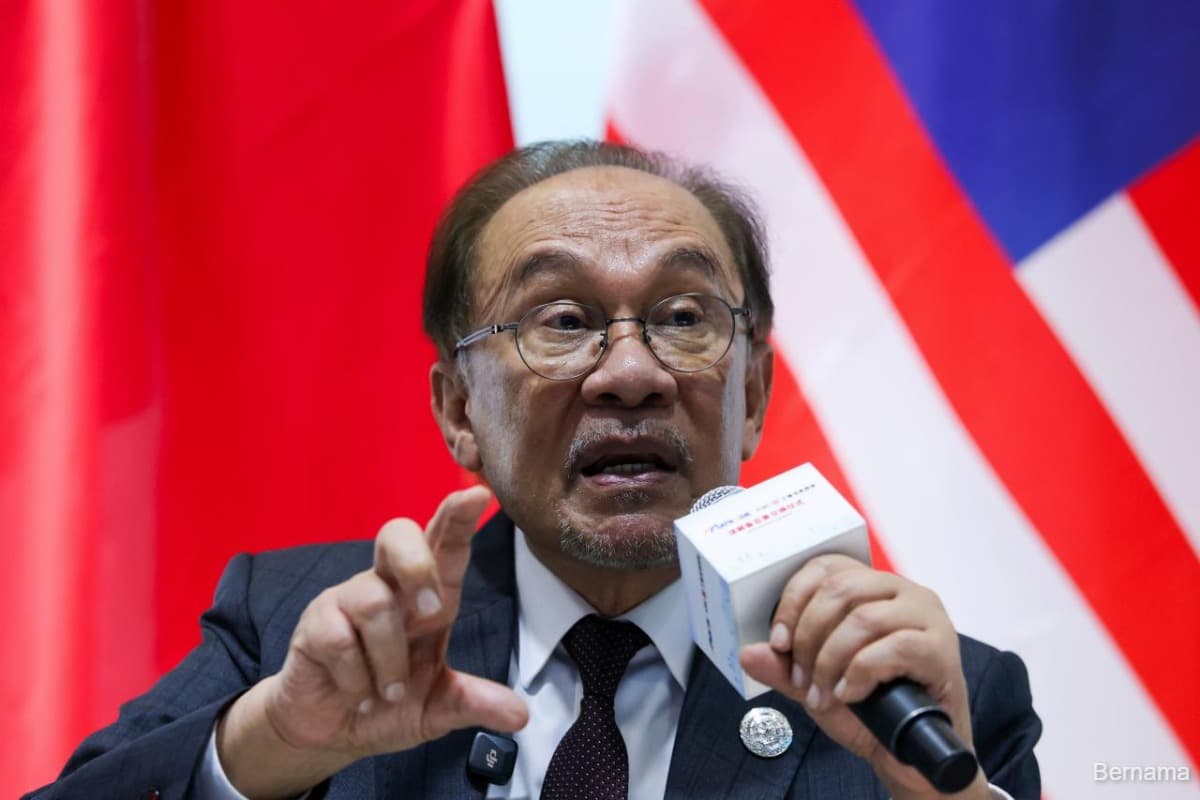
KUALA LUMPUR (Nov 6): The government is examining the short and- medium-term impact across various aspects following political developments in the US, where the Republican Party suffered a defeat in the midterm elections on Tuesday.
Prime Minister Datuk Seri Anwar Ibrahim said the matter was discussed in depth during Friday’s Cabinet meeting and Malaysia will continue to monitor the situation, including potential implications regarding the implementation of reciprocal tariffs.
“However, our relations with the current administration, the existing government, as well as both incumbent and newly elected members of Congress including the House of Representatives will continue,” he told reporters after performing Friday prayers at Taman Kosas Mosque near here.
The Republican Party, led by US President Donald Trump, was reportedly defeated by the Democratic Party, which secured control of both the House of Representatives and the Senate in the midterm elections on Tuesday.
Offering a personal perspective on these developments, Anwar welcomed the shift, viewing it as a rejection by the electorate of politics rooted in racial and religious hatred including anti-Islamic sentiment and hostility toward minority groups.
“From a global standpoint, I see this as a positive signal, many [of those elected] oppose attacks and hostility towards Islam, as well as hostility towards Iran. Hopefully, this will help ease international geopolitical tensions,” he said.
The prime minister said these developments serve as a lesson for Malaysia to avoid the politics of hatred, and instead focus on building a mature society and eradicating corruption.
“What is important for us to learn here in Malaysia? We must strive to cultivate integrity and to cleanse the nation of greed and corruption,” he said.
In a related development, Anwar mentioned that he received a call from US Secretary of State Marco Rubio yesterday to discuss preparations for a possible meeting between the Prime Minister and US President Donald Trump in either Manila, Philippines, or Shanghai, China.
Anwar noted that the US side expressed the hope that investment opportunities for American companies particularly in the artificial intelligence (AI) and semiconductor sectors would not be compromised in other countries, including Malaysia.
However, he emphasised that Malaysia would not restrict investments from any nation, including China, provided that the companies in question comply with national regulations and respect the country’s interests.
He cited the example of Google’s US$15 billion (RM60.9 billion) investment in Malaysia, which will be accelerated over the next two years and the company is required to independently cover costs related to water supply, training, and university facilities.
“The same applies to matters like rare earths, we welcome investment from any country, but on the condition that processing takes place domestically, that national regulations are followed, and that the materials are not used for equipment classified as weaponry,” he said.
Uploaded by Tham Yek Lee