

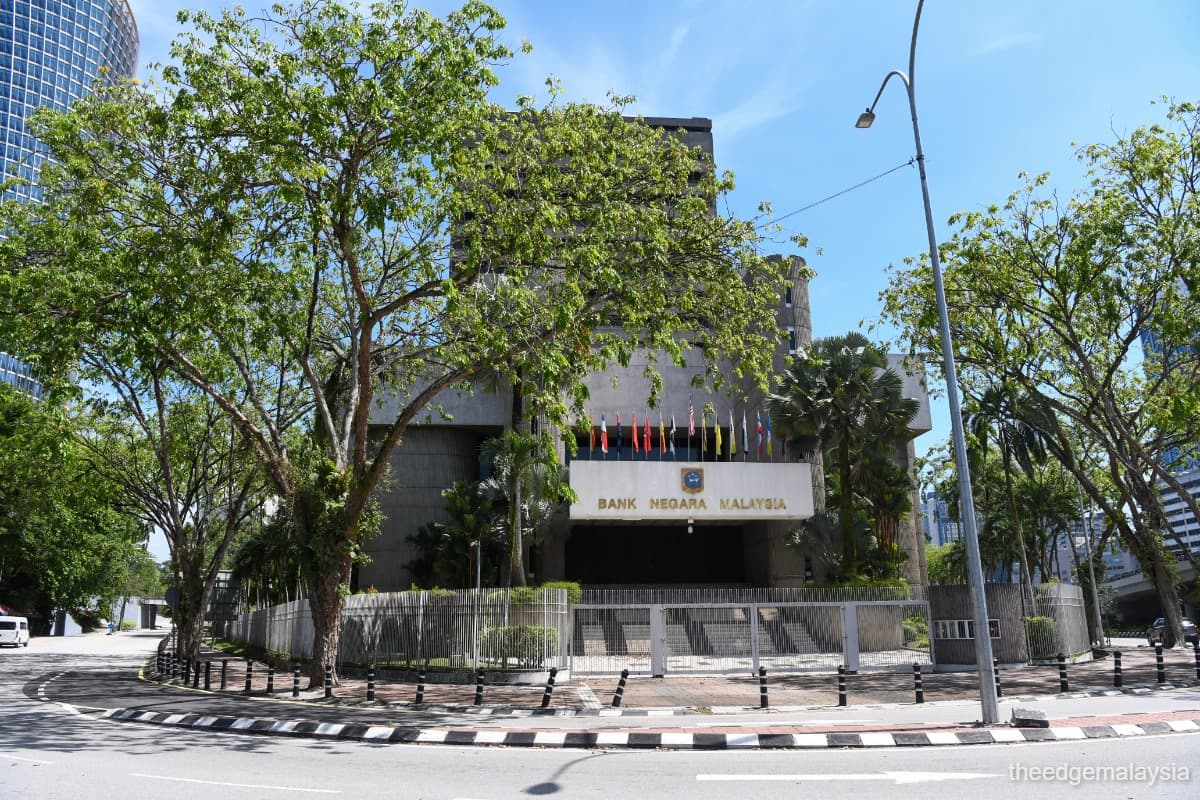
KUALA LUMPUR (Nov 5): Economists broadly expect Bank Negara Malaysia (BNM) to raise the overnight policy rate (OPR) next year, as resilient economic growth and the prospect of higher inflation in 2027 could pave the way for monetary policy normalisation.
The central bank kept the benchmark interest rate unchanged at 2.75% at the year's final Monetary Policy Committee (MPC) meeting of 2026 on Thursday. This met the expectations of 15 ouit of 21 economists surveyed by Bloomberg.
The OPR has been held at 2.75% since a 25-basis-point (bps) cut in July 2025.
OCBC Group Research, ANZ Research and HSBC Global Investment Research expect a 25bps hike in the first quarter of 2027, while BIMB Securities Research anticipates a change in the second half of the year.
However, Pantheon Macroeconomics holds a more dovish view, expecting BNM to keep the OPR unchanged throughout 2027.
OCBC Group Research senior Asean and India economist Lavanya Venkateswaran said BNM kept the door open for normalisation.
“The main risk to our call is that BNM opts for a longer runway to assess the need for normalisation,” Lavanya added.
She said resilient economic growth and a modest pick-up in inflation would give BNM room to normalise the policy rate to 3%, reducing the need to keep monetary policy slightly accommodative.
OCBC expects Bank Negara to increase the OPR at the Jan 21 MPC meeting. The research house forecasts headline inflation to average 2.1% in 2027, compared with 1.9% in 2026, in line with BNM's assessment that both headline and core inflation would edge higher but remain contained next year.
NZ Research has pushed back its forecast for a 25bps OPR hike to March 4 next year, after previously expecting BNM to raise rates at Thursday's meeting.
Chief economist for Southeast Asia and India Sanjay Mathur said the central bank's latest policy statement struck a more hawkish tone, flagging higher inflation in 2027 but expecting resilient economic growth.
However, geopolitical developments, elevated global commodity prices and adverse weather conditions are expected to push up inflation next year.
ANZ Research said BNM was likely to assesses the extent of these inflationary pressures before adjusting its policy rate.
BIMB Securities Research pointed out that moderate wage growth and benign inflation would limit the urgency for near-term monetary tightening.
“Assuming inflation remains near 2%, Malaysia's growth profile, strengthening labour market and sustained investment cycle could justify a modest recalibration toward a more neutral policy stance,” said BIMB Securities.
The research house forecasts Malaysia’s economy to grow above 5% in 2027, supported by resilient domestic demand, improving real gross national income growth and continued strength in the artificial intelligence and semiconductor investment cycle.
It also said Malaysia continues to benefit from the global AI, data centre and semiconductor investment cycle, providing a powerful boost to exports, manufacturing activity and industrial production.
“Combined with firm commodity prices and strengthening domestic demand, these trends point to an economy that could sustain above-trend growth into 2027,” it added.
BNM expects the economy to expand by more than 5% in 2026 and remain robust in 2027, supported by the global technology cycle, stable labour market conditions and fiscal support for household consumption.