

(Nov 5): Malaysia’s central bank is expected to keep interest rates unchanged at its final policy meeting of the year on Thursday while signaling scope for a hike early in 2027 as economic growth remains strong.
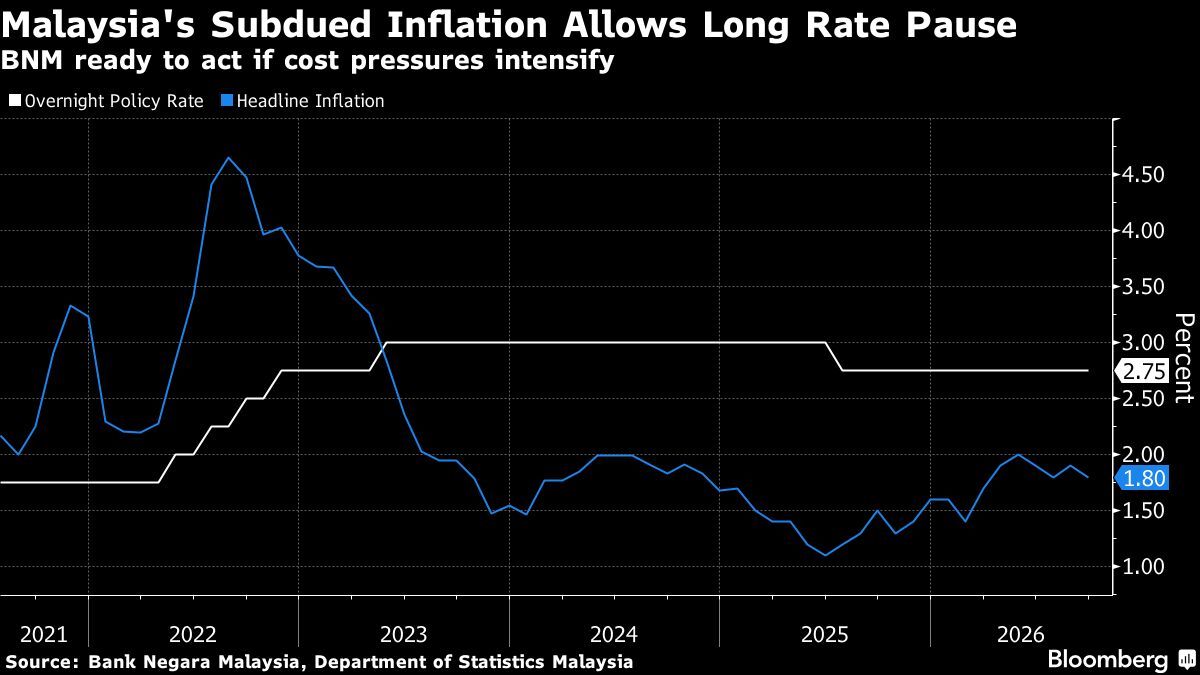
Bank Negara Malaysia (BNM) will maintain its overnight policy rate at 2.75%, according to 17 of 23 economists surveyed by Bloomberg. Six analysts forecast a 25-basis point hike. Policymakers have kept borrowing costs unchanged since a preemptive quarter-point cut in July 2025 to cushion the economy from higher US tariffs.
Low inflation and strong growth, underpinned by private consumption, sustained investment and surging electronics exports, give BNM room to hold rates steady for now, according to HSBC Holdings plc economists Yun Liu and Madhurima Nag.
“BNM is likely to revert to policy normalisation not as a response to inflation but as a preemptive move,” they said in a report, adding that markets will be watching for hawkish signals from the central bank that could pave the way for a rate hike next year. HSBC expects a 25-basis-point hike in the first quarter of 2027.
Inflation risks
Despite a surge in global oil prices fuelled by the Middle East war, inflation in Malaysia has remained moderate, helped in part by government subsidies that keep fuel prices among the lowest in the world. The nation’s position as a net energy exporter, supported by its oil and natural gas reserves, has also helped shield the economy from the higher import costs confronting energy-dependent neighbours such as Thailand and the Philippines.
The ringgit is little changed against the dollar this year, while the Thai, Indonesian and Philippine currencies are all down more than 6%, adding pressure for higher rates.
“If the oil shock extends and the scope to subsidise lessens, second-round inflation effects become a growing risk,” Bloomberg Economics’ Tamara Mast Henderson wrote in a report.
BNM governor Datuk Seri Abdul Rasheed Ghaffour last month said the central bank has greater room to adjust interest rates after changing its policy guidance in September, and stands ready to act if inflation pressures intensify as the Middle East conflict keeps energy prices elevated.
Consumer prices rose 1.8% in September from a year earlier, within the government’s forecast range of 1.5%-2.5% this year. Inflation is expected to pick up in early 2027 as higher energy, food and other input costs feed through to prices, before easing later in the year, according to the government, which forecasts inflation of 1.8%-2.8% in 2027.
Growth momentum
Malaysia’s economy has remained strong, supported by steady consumption and investment and a surge in electronics exports fuelled by demand for AI-related components.
Gross domestic product rose 5.3% in the three months through September from a year earlier, according to advance estimates from the statistics department. The economy expanded 5.5% during the first three quarters of 2026.
The government last month raised its 2026 growth forecast to 4.8%-5.3% from 4%-5%, as resilient domestic demand and surging exports help offset a challenging global environment. It expects the economy to expand 4.2%-5.2% next year, supported by sustained domestic demand and investment.
“We now expect BNM to raise the OPR by 25 basis points to 3% in March 2027,” CIMB Bank Bhd economists Chew Khai Yen and Michelle Chia said in a report. “The projected rise in core inflation towards 2.5% in 3Q2027 strengthens the case for reversing the July 2025 insurance cut before underlying price pressures become more pronounced.”
Uploaded by Liza Shireen Koshy