

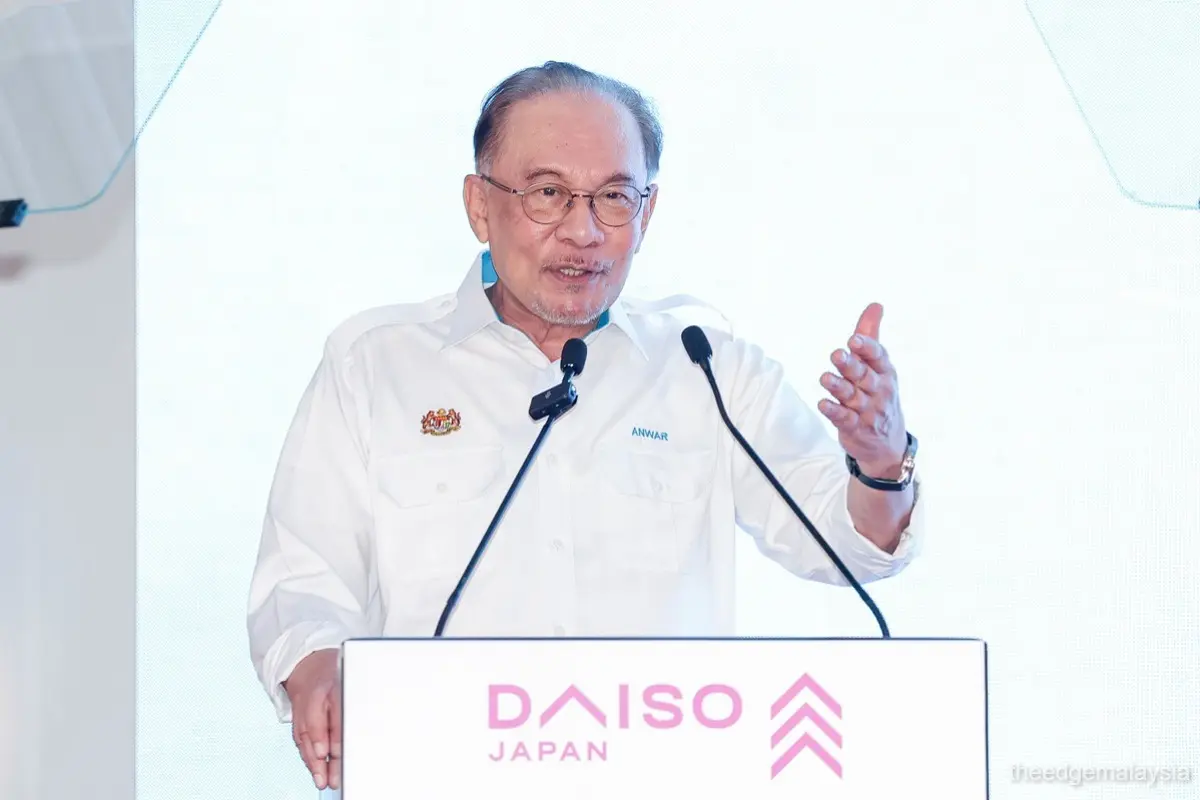
KLANG (Nov 5): Malaysia is rapidly expanding its transport infrastructure across land, sea and air as it seeks to establish itself as a world-class logistics hub, Prime Minister Datuk Seri Anwar Ibrahim said.
The prime minister said Malaysia had prospered throughout its history not merely because of its strategic geographical location, but also because of its ability to connect economies around the world.
"The Straits of Malacca has steered commercial flows for centuries. Our ambition is to expand it across land, sea and air to make Malaysia a world-class logistics hub.
"Port Klang handled a record 15.1 million twenty-foot equivalent units (TEUs) last year and ranks among the world’s ten busiest container ports," he said at the opening of Daiso's New Global Distribution Centre (GDC) in Pulau Indah on Thursday.
Also present were Transport Minister Anthony Loke, Japanese Ambassador to Malaysia Noriyuki Shikata, and Daiso Industries Co Ltd president and chief executive officer Seiji Yano.
Anwar said the GDC reflected Malaysia's broader trade ambitions, with goods arriving from around the world, gaining value on Malaysian shores before being distributed to markets across the globe.
He said the facility demonstrated the country's strategic shift from simply handling greater cargo volumes to capturing higher-value activities. Goods will be sorted, stored and repacked at the Pulau Indah centre for distribution to various international markets, creating skilled jobs for Malaysians in the process.
"That is why we are investing across every mode of transport. At sea, Westports 2 will nearly double Westports’ capacity, and we are planning a future mega-port at Pulau Carey.
“On land, the East Coast Rail Link (ECRL) and our rail freight network will carry more cargo to our ports and off our highways. In the air, we are expanding airport and air cargo capacity. Through a refreshed National Transport Policy, these will work as one system,” he said.
Anwar said Daiso's decision to establish its largest global distribution centre in Pulau Indah was a strong vote of confidence in Malaysia's economic stability, infrastructure readiness and long-term potential.
He said the investment was aligned with the government's vision under the Madani Economy framework, which aims to raise the ceiling of the national economy while raising the floor for all Malaysians.
"So, we do not measure ourselves only by the headline dollar figure of the investment we attract. We also ask whether it creates better-paying jobs, builds more capabilities, links with Malaysian suppliers and supports sustainable development," he said.
Anwar added that, through the New Industrial Master Plan 2030 and targeted investment incentives, the government was increasingly rewarding holistic outcomes that bring higher-value activities, skilled jobs and local partnerships.
Uploaded by Liza Shireen Koshy