

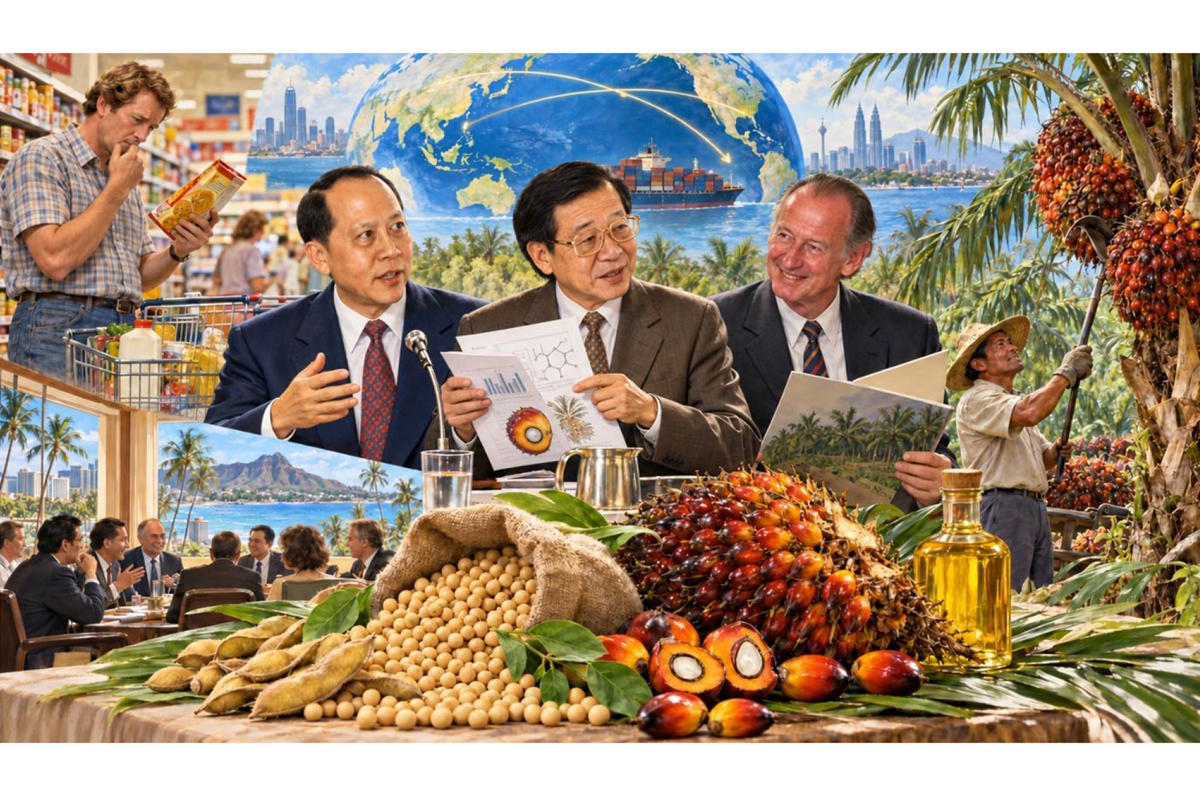
I have always enjoyed history, especially stories of wars and conflicts: how they begin, how people defend what matters to them and how the consequences can outlast the fighting. Reflecting about tensions around the Strait of Hormuz, I found myself thinking of a different war over oil.
For years, I have wanted to tell the story of palm oil’s clash with the American soybean lobby. In presentations, I have usually given it a slide or two. A few minutes explain who fought whom but do little justice to the advertisements, the science, the personalities or the livelihoods caught up in the dispute.
I would leave the room feeling I had told my audience how the story ended before properly telling them how it began. PowerPoint is useful for many things. Giving history room to breathe is not always one of them.
What began as a dispute between competing oils became a story about science, commerce and Malaysia learning to defend an industry on which many livelihoods depended. It also brought a formidable minister to the microphone. I wanted to revisit both the battle and the man, because the famous punchlines have sometimes travelled further than the work behind them.
This war had no tanks, missiles or drones. Its oils were edible, its opposing crops were palm and soybean, and one battleground was the American supermarket shelf.
An oil palm can survive a difficult season. Reputational damage is harder to measure.
When the supermarket became a battlefield
Picture an American shopper in the late 1980s, turning over a packet of biscuits to inspect its ingredients. The choice of oil, once mainly a concern for the people making the biscuit, was becoming a public argument.
The American Soybean Association (Asa) helped drive that argument. It campaigned for the identification of what it called “tropical fats” and drew attention to their saturated fat content.
The Asa’s own account makes the commercial purpose plain. Its “Tropical Facts” campaign sought to displace tropical oils in American food service and food processing. Health concerns and competition for market share had arrived at the same shelf.
There is no need to guess whether commercial interests were involved. The Asa has told us so. The harder question is how a reasonable demand for clearer food labels became a weapon in a contest between crops. A shopper wanted to know what was in the packet. A grower wanted to know whose oil would stay there.
Historian Masaaki Okamoto examines the episode as another “oil war”. His study points to a shift that matters today: the first major international campaign against palm oil focused on health. Environmental criticism, more familiar to the industry now, gathered force later. The issues changed; the contest over how palm oil was understood continued.
Its weapons were pamphlets, lobbying, full-page advertisements and carefully chosen words. For those selling food, the consequences could be quite tangible.
The participants had different reasons for joining the fight. One of the most effective campaigners was not a soybean grower at all.
Phil Sokolof was an Omaha businessman who survived a heart attack in 1966. It left him determined to press the case for lowering cholesterol and changing diets. He founded the National Heart Savers Association and spent his own money urging food companies to reformulate their products.
In 1988, Sokolof sent approximately 11,000 letters to food industry officials urging them to remove palm and coconut oils, along with lard and beef tallow. When the response disappointed him, he bought full-page advertisements under the headline “The Poisoning of America!” They named familiar products and urged consumers to avoid foods containing palm or coconut oil.
One can imagine the discomfort in a food company’s boardroom. Months have gone into getting a biscuit to taste right, hold together and survive distribution. Then a newspaper advertisement arrives and the immediate concern becomes whether the brand will appear in the next one.
Sokolof understood that a manufacturer did not have to lose an argument in a scientific journal to feel pressure. It only had to worry about what shoppers might think at the shelf. His was a largely personal, self-funded campaign confronting major food businesses.
The Asa wanted to defend and expand a market for soybean oil. Sokolof believed he was protecting people’s hearts. Their motives were different, although their campaigns could push manufacturers in the same direction. This was never simply a quarrel between two industry associations.
A consumer has every right to know what is in food. Identifying an oil on a label is sensible. If we in the palm oil industry ask others to be transparent, we ought to be comfortable with the same scrutiny ourselves.
The difficulty lay in what the label was being asked to imply. “Tropical oils” grouped palm, palm kernel and coconut oils under one geographical description, although their fatty acid profiles differ. Nobody can judge a food’s nutritional quality from the climate in which one ingredient was grown.
Yet “tropical” was simple and memorable. Geography was doing a surprising amount of nutritional work.
Palm oil’s price and versatility made it useful to manufacturers. Those same advantages made it a commercial threat. The Malaysian Palm Oil Board (MPOB) records Malaysian palm oil exports to the US falling from approximately 288,000 tonnes in 1986 to 185,000 in 1987 and 142,000 in 1988. The figures show a sharp decline, although they cannot assign it to any single campaign or market force.
For Malaysia, the larger danger was the precedent. Palm oil supported estates, smallholders, mills, refiners and export earnings. An argument that took hold in one influential market could travel to others. A small share of American sales did not mean a small reputational risk.
I began my oil palm career in Sabah in 1991, after the fiercest exchanges had ended. I did not watch the campaign unfold from a negotiating table. But its legacy was there for my generation.
We learned that growing a good crop was only part of the job. Beyond the estate gate, people who had never seen a fruit bunch were forming opinions that could affect our future.
Malaysia answers with science, resolve and resources
Malaysia’s response needed political leadership, scientific credibility and an industry prepared to support the work. Tun Dr Lim Keng Yaik supplied the ministerial resolve and a voice few could ignore. Alongside him stood two men whose contributions deserve their place in the telling: Tan Sri Dr Augustine Ong and the late Tan Sri Børge Bek-Nielsen.
In my earlier recollection, I described the combination as the three Bs: brawn, brains and budget. The shorthand was playful; the responsibilities were serious. A speech could rally the industry. Sustained advocacy required research, organisation and money.
Augustine Ong, then director-general of the Palm Oil Research Institute of Malaysia (Porim), led the scientific response. The challenge was to bring research into an argument increasingly conducted through advertising headlines.
According to the Malaysian Oil Scientists’ and Technologists’ Association’s (Mosta) historical account, Ong assembled American and European scientists for a month-long programme of seminars across six US cities in October 1987. Malaysia’s case was being carried into professional discussions abroad, beyond the reassuring company of its own industry.
Ong later recalled expanding nutrition research and collaborating with researchers in Europe, the US, Australia and Asia. Passion could explain why Malaysia cared. Evidence had to explain why others should reconsider.
Bek-Nielsen brought the industry’s organising capacity and a willingness to speak up. A corporate biographical record identifies his appointment as chairman of the Palm Oil Promotion Fund Committee in July 1988 to coordinate countermeasures to the Asa campaign. It also records his accompanying Malaysian teams to the US in October 1987 and again in late February and early March 1989.
He helped connect the defence of palm oil with the resources needed to sustain it. Research, travel, seminars and public communication could not run indefinitely on indignation. Even a righteous cause eventually receives an invoice.
In an earlier article, My Say: Remembering Lim Keng Yaik, the relentless champion of palm oil I recalled Bek’s readiness to challenge attacks on palm oil at a press conference. It captured the spirit of a man unlikely to remain quietly in his seat while the industry’s case went unanswered. Ong brought scientific authority; Bek helped mobilise industry support. Both were active advocates, rather than supporting names beneath a ministerial photograph.
Their roles overlapped. Scientists had to communicate, industry leaders needed to understand the evidence and the minister needed both. Around them were officials, researchers and businesses doing less visible work.
Remembering that the wider team does not diminish Lim. It helps explain what made his leadership effective.
For him, the campaign concerned an industry woven into Malaysia’s economy. Defending palm oil meant answering for more than the contents of a bottle. Growers needed buyers, mills needed fruit and producing communities depended on the work connecting them.
Malaysia also needed a question of its own: if manufacturers took palm oil out, what would they put in?
A label announcing what a food no longer contained could be rather less forthcoming about the substitute.
Some liquid oils were partially hydrogenated to make them firmer for processed foods. Manufacturers exposed oil to hydrogen under controlled conditions, using a catalyst to help change its fatty acids. This could give a liquid oil the firmness needed for a spread or biscuit filling. Partial hydrogenation could also produce harmful industrial trans-fat.
Ordinary liquid soybean oil is different from partially hydrogenated soybean oil. The concern was a particular process, not the crop itself. The US Food and Drug Administration later identified partially hydrogenated oils as the main historical source of artificial trans-fat in processed foods.
Lim gave that technical argument a name no conference delegate was likely to forget: his “hydrogen bomb”.
A medical doctor with a formidable command of the microphone, he could make chemistry sound like an imminent diplomatic incident. The phrase turned attention towards the replacement fat, a question the campaign against palm oil had made all the more important.
Palm oil had a practical advantage. Separating it into more liquid palm olein and firmer palm stearin offered manufacturers options without partial hydrogenation in suitable applications. That challenged the assumption that removing palm oil automatically improved a food.
The joke could open the room; evidence still had to do the work.
The Mosta account places Lim at a convention in Tucson, Arizona, in March 1989, hinting at his “hydrogen bomb”. It records the warning but does not establish that one dramatic remark ended the dispute. Diplomacy rarely fits quite so neatly into a punchline.
Looking back in 2019, former Malaysian Palm Oil Council (MPOC) chief executive Datuk Dr Kalyana Sundram acknowledged that the industry had initially been short of facts and figures. It responded by investing in health and nutrition studies. Feeling wronged can bring an industry together. It cannot do the work of evidence.
Tun Lim’s humour made the contest memorable. His teammates helped give Malaysia the research, resources and staying power to remain in it.
A truce and its limits
Even before Tucson, the opposing sides had begun talking. While tracing the war through the Asa’s own history, I found a quieter scene in Honolulu in August 1988.
A handful of Asa leaders met Malaysian oil representatives to see whether both sides could ease their attacks. Former Asa president James Lee Adams recalled travelling from Georgia, spending Saturday in talks and heading home almost immediately. His recollection was that the campaigns had become damaging to both markets.
Nothing was signed; he said: “We just shook hands on it.” Oils grown on opposite sides of the Pacific had generated enough heat for their representatives to meet halfway across it to cool things down.
The Asa retrospective dates that private understanding to August 1988. Tucson came the following March; public reporting of an agreement followed later still. These were separate moments in a dispute whose temperature did not fall simply because someone had shaken hands.
Then in August 1989, Reuters reported that the Malaysian Oil Palm Growers Council (MOPGC) and the Asa had agreed to stop portraying each other’s oils negatively. Traders welcomed the halt, although some believed palm oil’s reputation had already been damaged.
An advertisement can be withdrawn on an agreed date. An impression left with shoppers has no expiry date.
Nor could an agreement between two industry bodies end Phil Sokolof’s separate campaign or settle wider American concerns about diet and heart disease. The negotiators could speak for their organisations. They could not instruct every campaigner, manufacturer or shopper to turn the page.
Time also changed the scientific discussion. In 2015, the US Food and Drug Administration determined that partially hydrogenated oils were no longer generally recognised as safe for use in food.
The concern about industrial trans-fat was real. But ordinary soybean oil is not partially hydrogenated soybean oil; neither does the evidence on trans-fat make questions about saturated fat disappear.
History deserves that distinction. Otherwise, we risk replacing one sweeping claim with another and calling the exchange a victory.
What remained after the truce
There is a temptation, looking back, to give the story a winner, a loser and a closing slide. But the truce settled neither the science of nutrition nor the question of how an industry should defend itself.
For palm oil, it demonstrated how quickly a useful commodity could become a public controversy and how slowly a reputation might recover. It also showed why research, communication and market development needed to be treated as continuing work.
The questions facing palm oil now reach beyond nutrition. They concern land, forests, labour and credible supply chains. They also concern growers, including smallholders across producing countries, and the employment, export earnings and rural livelihoods tied to the crop.
These interests belong in the discussion together. For developing economies, palm oil can connect a rural harvest to processing, manufacturing and international trade. For a smallholder, those connections have a more immediate meaning: a buyer, an income and some confidence about the next season.
A sweeping allegation can make those people disappear behind a slogan. Equally, invoking their livelihoods should strengthen our determination to address genuine problems. The strongest defence of a crop is one its growers can stand behind: productive farms, decent work and claims that withstand examination.
In the estate, palms teach patience. A fruit bunch develops over months. In the marketplace, a phrase can cross an ocean overnight and remain in people’s minds for years. Its consequences eventually arrive somewhere less abstract than a conference hall: a farm account, a household budget, a child’s schooling.
The soybean and palm oil industries both had farmers behind them. Remembering that helps keep this history in proportion. We can question a campaign without turning another grower’s crop into an enemy. We can defend palm oil firmly while accepting that its reputation must rest on evidence as well as advocacy.
At last, I have given the War on Oils more than two slides. What stays with me is how a few words on a packet could reach all the way back to a grower’s field.
Malaysia’s response drew on scientists, officials and an industry learning to defend itself. Augustine Ong and Børge Bek-Nielsen helped give it substance and staying power. Its most memorable voice belonged to a doctor who threatened a “hydrogen bomb” without emptying the conference hall.
I remembered the performance. To understand the preparation, I turned to his son.
Joseph Tek Choon Yee is a former president of the Malaysian Estate Owners’ Association and past chief executive of the Malaysian Palm Oil Association