

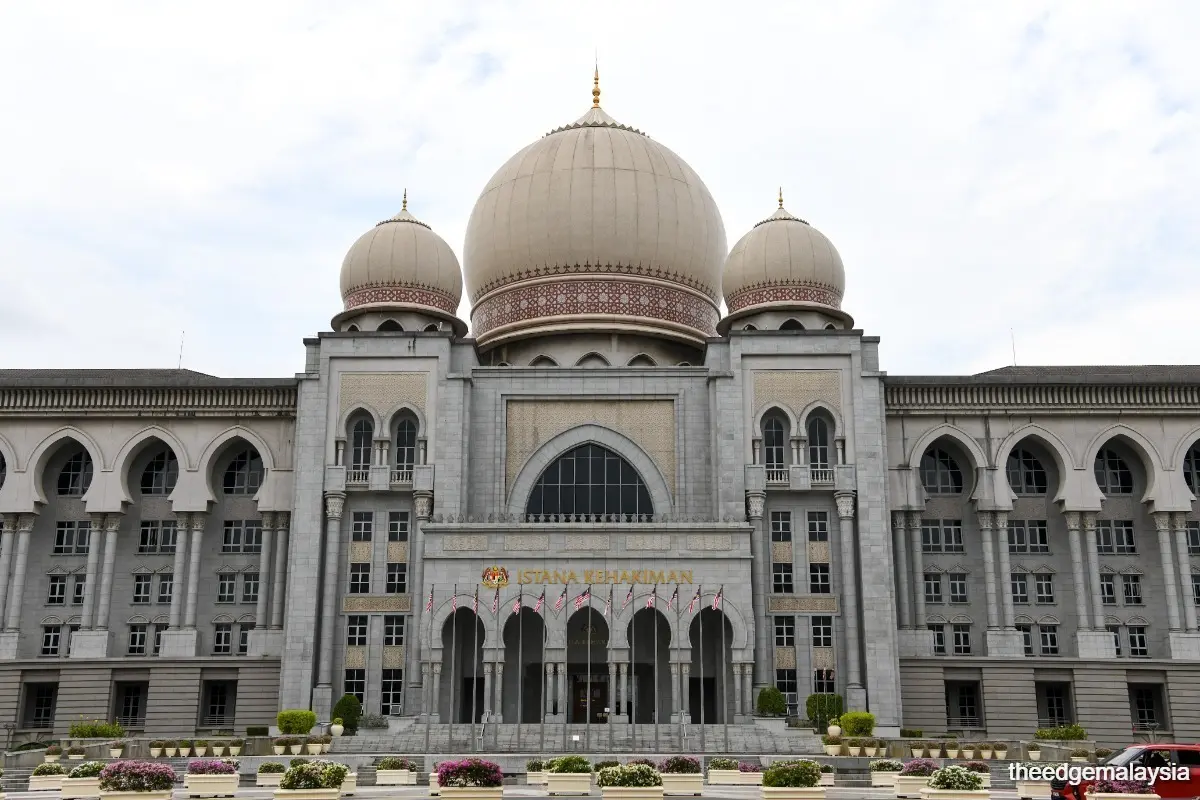
PUTRAJAYA (Oct 29): One of the three Court of Appeal (COA) judges hearing the federal government’s appeal over the Sabah revenue issue on Thursday quizzed parties as to what had transpired between the federal and Sabah governments between 1969 to 2021 that had resulted in them not agreeing to a review between them to increase the state’s revenue.
Judge Datuk Amarjeet Singh Serjit Singh questioned what had happened between those years, that had caused a review of the revenue, which was supposed to take place once every five years, not being done. A second review was done in 2021 during then prime minister Datuk Seri Ismail Sabri Yaakob’s tenure, but not in 1974 as originally scheduled.
“This has taken 48 years [from 1974 to 2021]. What have you been doing, giving us [the judiciary] these problems to sort out? What were they [the federal and Sabah government] doing?” Singh said.
Between 1974 and 2021, the federal government had been paying the Sabah government RM26.7 million annually. Following the 2021 review, bigger grants were allocated for 2022 (RM125.6 million), 2023 (RM129.7 million), 2024 (RM133.8 million) and 2025 (RM138.1 million).
For 2026, Prime Minister Datuk Seri Anwar Ibrahim has agreed to an interim special grant of RM1.5 billion. During the recent tabling of the 2027 budget, Anwar (as Finance Minister) had announced that Sabah will receive RM18.7 billion for 2027.
Amarjeet raised his query towards the end of the hearing of the appeal by the federal government, over certain portions of High Court judge Datuk Celestina Stuel Galid’s judgment in October last year, who had ordered the federal and Sabah governments to hold a mandatory review of Sabah’s special grant.
The hearing was held in Kota Kinabalu, with live-streaming available to the press at Putrajaya.
Fed govt not appealing 40% formula, only other portions
The federal government, led by senior federal counsel Ahmad Hanir Hambaly @ Arwi, had told the COA bench led by Datuk Azhahari Kamal Ramli and also consisting of Datuk Ahmad Kamal Md Shahid and Amarjeet, that the federal government is not appealing the 40% formula in the return of Sabah’s revenue, but on certain findings with Galid’s decision.
The SFC said they were appealing Galid declaring that the second review done in 2021 was illegal, irrational, procedurally improper, and/or disproportionate.
Furthermore, Ahmad Hanir pointed out that although there had been on-going negotiations between the federal government and Sabah government since 1974, there had been no agreement reached to conduct the second review until it was done in 2021.
He admitted there is a special provision for the appointment of a special independent assessor that is agreeable to both parties, but it had not reached this point.
The SFC also said that they are appealing the judge’s finding that the first review in 1969 shall continue to be in force after 1973 (when the term of the first review was supposed to end) until it is superseded by the second review which was done in 2021 and took effect in 2022.
Ahmad Hanir further said that Galid had also failed to take into consideration that the federal government had continue to pay the Sabah special grant from 1974 to 2021, and that the Sabah government had accepted the payment. He said the High Court judge was wrong in her interpretation of Article 112(D) of the Federal Constitution, as from 1974 to 2021 there was ongoing review between the federal and Sabah governments.
The SFC further said that it was also wrong for the High Court to order the federal government or the parties to make an account of the review and reveal it to the Sabah Law Society, as this is tantamount to rewriting the Constitution.
“Whatever discussion should be between the federal and Sabah governments. There is no duty for the federal government to provide the account to the Sabah Law Society,” he said, adding that the High Court cannot prescribe such a mandamus (to compel) the government to do so.
For these reasons, Ahmad Hanir asked the three-member appellate bench to overturn the High Court’s ruling for Sabah’s 40% special grant entitlement for 1974 — 2021 (which Sabahans call “the lost years”).
In April, the federal government had obtained a stay from the Court of Appeal to stop the revenue calculation and further payments to Sabah pending this appeal.
Galid claimed federal govt breached Constitution
In October last year, Galid had ruled that the Federation had breached its constitutional duty by not completing a second review in 1974 and that the original 40% formula remained payable for the “Lost Years” (1974-2021). The judge ordered for a new review, payment, or constitutional damages, and an accounting for the sums to be given to the Sabah Law Society (SLS).
The federal government is appealing those findings. Its central position is that the 1970 First Review Order replaced the 40% formula with grants ending at RM26.7 million paid to the Sabah government from 1974 to 2021.
Galid’s decision stems from the court allowing Sabah Law Society’s judicial review to compel the federal government to hold a review with the Sabah government so as to make good the constitutional promise made at the formation of Malaysia in 1963, that grants Sabah a 40% share of the net federal revenue collected in the state above the 1963 baseline amount, for each consecutive year from 1974 to 2021.
The Sabah Law Society is further seeking an order for the federal government to pay the entitlement as determined.
Article 112(D) of the Constitution stipulates a periodic review of the special grants and assignments of revenue to the states of Sabah and Sarawak, as outlined in Article 112C, which the Sabah Law Society claims has not been done since 1974.
SLS says judgment correct and are entitled to JR
Sabah Law Society counsel David Fung Yin Kee defended Galid’s decision and the judicial review, when the bench asked why the society was acting on something which would benefit the Sabah government.
Fung said they are acting in the interest of the Sabah people, who had been deprived of the review and funds for the state’s development.
He added that the society has the right to file the review, as it views the Sabah government as having failed to exercise its duty.
“Our complaint is who should protect the people, and the state government has the fiduciary duty to do so, as with the federal government,” Fung said.
He added that the Sabah people have contributed in terms of taxes collected and given to the federal government, but only a small sum of it is returned to the state, and the constitutionally mandated review was not done.
“How can the public benefit from the collection of the tax money (which should be returned to the state)? There has been a gap of 48 years,” he added.
For this reason, Fung said the judicial review had been filed to seek the rightful orders to compel the federal government to comply with what was mandated in the Constitution and the Malaysia Agreement 1963
Sabah attorney general Datuk Brenndon Keith Soh had intervened in the society’s judicial review for the right to be heard.
Soh had added that Article 112(C) and Article 112(D) should be read harmoniously and that the lower court may have erred in looking at the five-year review period as being mandated.
He added that an agreement was only reached in 2021 for the second review as announced by the joint statement by the then prime minister (Ismail) and Sabah chief minister (Datuk Seri Hajiji Noor).
Judge Azhahari said the bench needed time to deliberate on the matter before giving a decision, and fixed Nov 12 for case management.