

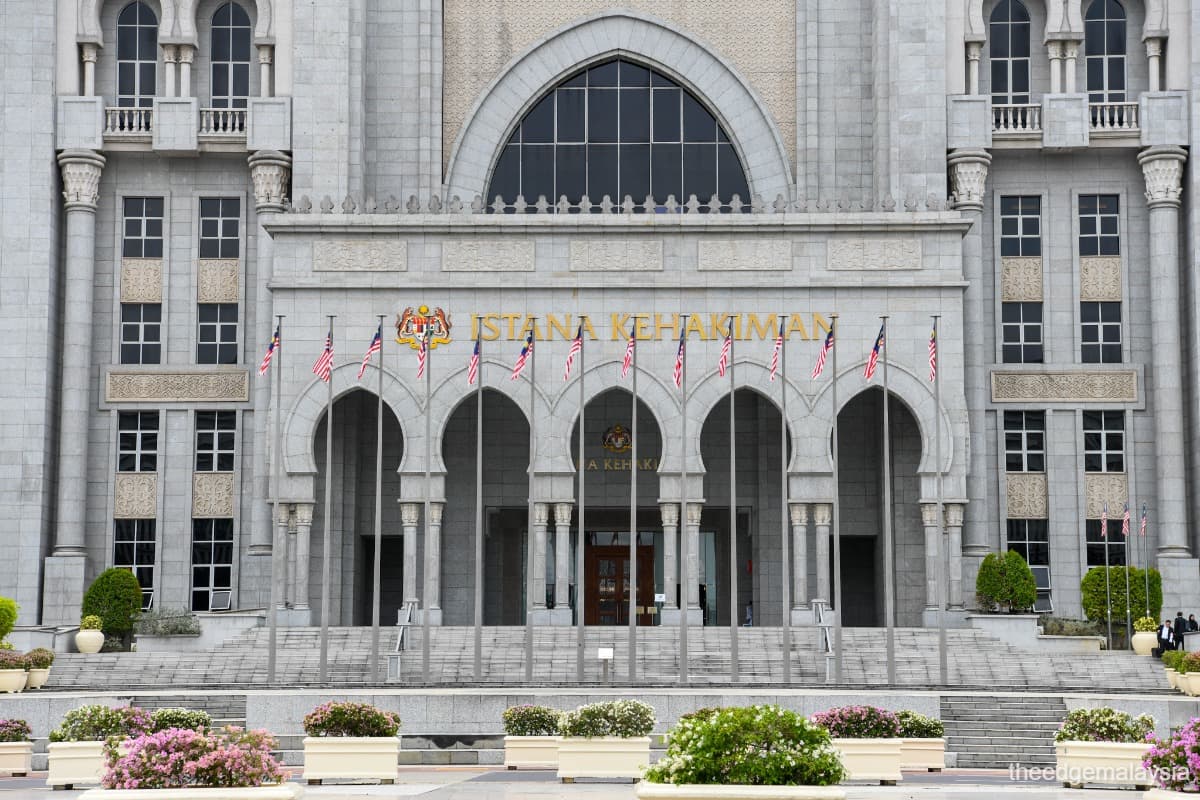
PUTRAJAYA (April 6): The Court of Appeal on Monday allowed the federal government’s bid to pause the review for the calculation and payment of Sabah’s constitutionally-promised revenue entitlement.
A three-member bench led by Datuk Mohamed Zaini Mazlan ruled that the federal government is entitled to obtain a stay under Section 44 of the Courts of Judicature Act 1964 (CJA) and that there are special circumstances to grant a stay on the High Court’s decision.
“There is a need to verify data and see the voluminous document (with regard) to the financial revenue of the federal government during the period,” Zaini said. “A rigid timeline requiring the Malaysian government to pay does not provide a recourse.”
The case centres on a 2025 landmark ruling that Sabah is entitled to 40% of net federal revenue collected from the state, a right under Article 112C of the Federal Constitution.
The Kota Kinabalu High Court sided with the Sabah Law Society, which initiated the judicial review, and ruled the entitlement has not been properly reviewed between 1974 and 2021. The federal government is not contesting the entitlement but it is disputing parts of the ruling.
Further, if a disagreement between the federal government and the Sabah government exists, there is a requirement for an independent assessor to assess the sum but there is no such order in the earlier High Court decision, he noted.
The bench, for the same reason, also allowed a stay of execution for the federal government to calculate and reach an agreement with the Sabah government within the April 15 deadline pending the appeal hearing.
The bench, which also consists of judges Datuk Ismail Brahim and K Muniandy, made no order as to costs.
The federal government is challenging the Kota Kinabalu High Court’s Oct 17 ruling, which ordered it to review Sabah’s 40% entitlement from 1974-2021 within 90 days and an agreement reached within 180 days.
“This is the federal government’s concern, as the 90 days expired on Jan 14, 2026. Although the parties have engaged in a series of negotiations since the High Court’s order, the 180 days will soon expire, on April 15, 2026. The federal government’s appeal has not yet been fixed for hearing,” Zaini said regarding the federal government’s concern.
The bench noted that the federal government accepts Sabah’s 40% entitlement but disagrees on the calculation, and is seeking to pause the High Court’s order while its appeal is heard.
Two considerations for stay
Zaini said the bench must consider two issues: first, whether the federal government’s application under Section 44 of the CJA is procedurally flawed, as argued by the Sabah Law Society and Sabah government.
“If we find favour of Sabah, the federal government’s application would be dismissed. If we decide otherwise, the second issue will be whether there are special circumstances to justify a stay,” he added.
Muniandy, reading the broad grounds on the first issue, said that the Sabah Law Society and Sabah government’s claim — that the federal government should have first applied to the High Court for a stay under Section 43 of the CJA — is not valid, because the federal government has already filed its notice of appeal with the Court of Appeal.
Once it is filed, Muniandy added, the Court of Appeal becomes the dominus litis (master of the suit). Section 44 of the CJA provides a standalone original power to the appellate court to issue interim orders to prevent prejudice.
“Under Section 44(2) of the CJA, these applications are considered proceedings in the Court of Appeal. It is a well-established principle of statutory interpretation that a power exercisable by a single judge is inherently held by a full three-judge panel, particularly in matters of high constitutional and fiscal importance.
“The High Court may be familiar with the facts; Section 44 remains an essential safeguard. It enables this court to conduct an objective, higher-level review to prevent its own appellate jurisdiction from becoming academic due to a timeline set by the High Court,” the judge added, noting that this rests on preserving the subject matter.
Muniandy said it is designed to ensure the fruits of litigation remain intact until the merits are heard.
“To make payment now is mere execution; it is effectively a pre-judgement execution. To decline jurisdiction based on a narrow reading of Section 43 [of the] CJA 1964 would be an abdication of this court’s duty to protect the integrity of the appellate process.
“A purposive interpretation of Section 44 [of the] CJA 1964 is necessary to ensure that substantive justice is not outpaced by procedural technicalities, especially where the survival of the appeal’s substratum is at stake,” Muniandy said.
Special circumstances were met
Zaini said the bench ruled that the federal government meets the special circumstances consideration because it is ordered to pay Sabah its entitlement.
“The 90-day period had already expired on Jan 14, 2026. The bench noted that the federal government has already commenced the review and has had four meetings with the Sabah government.
“The 180-day period will end on April 15, 2026. It is clear that the federal government is under time constraints. The applicant contended that the review would involve a comprehensive evaluation of their financial position and the Sabah government’s net revenue for the period from 1974 to 2021.
“This would require identifying, verifying, and reconciling financial data, voluminous documents, and historical records spanning 47 years, from 1974 to 2021. The applicant also argued that the High Court erred in directing the review in a manner inconsistent with the scheme mandated by Article 112D of the Constitution, in particular by imposing rigid timelines and failing to provide for recourse to an independent assessor in the event of disagreement.”
The bench held that the federal government would be prejudiced if a stay is not granted.
Zaini said there are two concerns. The first is that there is a real risk the federal government cannot meet the High Court’s tight timelines, given the complexity of the review. The second is that the orders may conflict with Article 112D of the Constitution, especially regarding how disputes should be resolved.
“To enforce compliance in such circumstances, before the appeal is heard, would deprive the federal government of an opportunity to ventilate its challenge. It also appears that the High Court’s order was not consistent with the provisions of Article 112D.
“For example, the applicant is obliged to make a payment when Article 112D stipulates that, in case of disagreement, the matter should be referred to an independent assessor. The applicant (federal government) would clearly be prejudiced if forced to comply with the court’s order without the opportunity to present its case on appeal,” the judge said.
The bench, Zaini said, noted the court’s order not only directs negotiations but also requires the applicant to make payment from the Federal Consolidated Fund within 180 days of the High Court’s order.
“This could have serious financial consequences, especially given the current challenging global economic climate. The payments ordered are of such magnitude that their execution, prior to the determination of the appeal, would create a fait accompli.
“The federal government has confirmed that it does not intend to delay proceedings and has taken measures to speed up the hearing of its appeal. The bench is therefore satisfied that special circumstances have been established. The applicant would suffer prejudice if a stay is refused, and the appeal may be rendered nugatory,” Zaini said in reading the broad grounds.
Senior federal counsel Ahmad Hanir Hambaly @ Arwi along with federal counsels Mohd Sallehin Mohd Zaki and Nur Athirah Aiman appeared for the federal government. Dr David Fung Yin Kee of Messrs Alex Pang & Co — from the Sabah Law Society — appeared with Jeyan TM Marimuttu, Janice Junie Lim, and Grace Liew Yung Enn.
Sabah Attorney General Datuk Brenndon Keith Soh appeared with Sabah senior counsel Mohd Saifurrazee Mohamed and Calvin Joy Ensui for the Sabah government.
Sabah court decision
Last October, Kota Kinabalu High Court judge Datuk Celestina Stuel Galid ordered Putrajaya and the Sabah government to hold a mandatory review of the special grant of 40% return on state revenue that Sabah is entitled to, which has been pending since 1974.
Galid also ruled that the federal government’s issuance of a special grant to the Sabah government, and its method of deriving the sum to be granted, was unlawful.
This came about after she allowed the judicial review by the Sabah Law Society, which was seeking to compel the federal government to hold a review with the Sabah government so as to make good the constitutional promise made at the formation of Malaysia in 1963 that grants Sabah a 40% share of the net federal revenue collected in the state above the 1963 baseline amount, for each consecutive year from 1974 to 2021.
The Sabah Law Society is further seeking an order for the federal government to pay the entitlement as determined.
Article 112D of the Constitution stipulates a periodic review of the special grants and assignments of revenue to the states of Sabah and Sarawak, as outlined in Article 112C, which the Sabah Law Society claims has not been done since 1974.
Read also:
AGC: Federal govt’s appeal does not affect Sabah’s 40% entitlement or its formula
Former SLS president and assemblyman reiterates KK High Court’s decision matters
Appellate court defers decision on federal govt’s stay application to calculate review for Sabah revenue
Court orders Putrajaya to review Sabah's constitutionally-promised revenue entitlement, which hasn't been done since 1974