

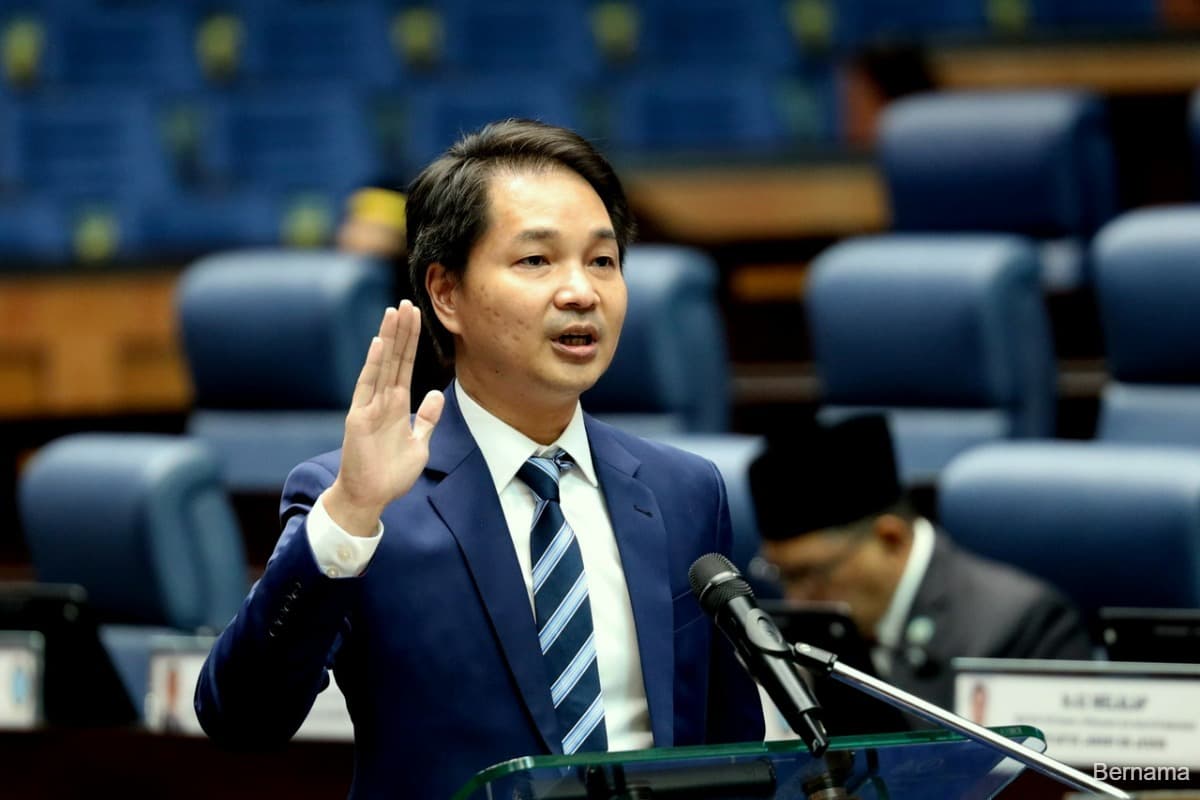
KUALA LUMPUR (April 6): Former Sabah Law Society president and nominated assemblyman Roger Chin on Monday has reiterated that the right of Sabah’s entitlement to 40% of federal revenue is not in dispute and the Kota Kinabalu High Court’s decision on this matters.
The KK court has imposed a structure on what has long been an open-ended process.
“It (the court) requires the constitutional review to be conducted within a defined period, and that an agreement be reached within a fixed timeframe. That was not incidental. It was a direct response to a history in which the obligation existed, discussions took place, but nothing was ever brought to conclusion,” Chin said in a statement.
Describing the Court of Appeal’s decision to grant a stay of the High Court’s order on Sabah’s 40% entitlement as deeply disappointing, Chin said it was not because the decision determines Sabah’s rights, but because it removes the one element that had finally forced this matter forward after decades of inaction — a binding timeline.
Chin said the Court of Appeal had granted the stay on the basis that it had jurisdiction under Section 44 of the Courts of Judicature Act, and that “special circumstances” had been established, including the scale and complexity of the exercise, the potential financial consequences, and concerns that the High Court’s order did not fully reflect the constitutional mechanics of the review.
This, the appellate bench said, included the absence of reference to an independent assessor.
Chin claimed the stay removed the structure.
“We are told that the exercise is complex, that it involves decades of financial records, and that it carries significant fiscal implications. That may be so, but none of this is new.
“These are the same conditions that have existed for decades. If they are accepted as justification for slowing down now, they will continue to justify delay indefinitely, and complexity will cease to be an explanation and become a permanent excuse,” he added.
Chin, who was appointed as one of six nominated assemblymen in December last year by Sabah Governor Tun Musa Aman, said that what had been lost is not the right itself, but the urgency to honour it.
“The obligation remains in principle; but it is no longer tied to a deadline or backed by immediate consequence. It returns to a position where progress depends, once again, on negotiation, discretion, and ultimately, political will — a position Sabah is all too familiar with.
“It must also be emphasised that the stay does not prevent the review from proceeding, particularly for the current financial years. There is no dispute as to the existence of the constitutional formula, nor is there any dispute that a review under Article 112D is required,” he said.
Affects timelines, test of sincerity on federal government
The stay, Chin added, affects the timelines imposed by the High Court; it does not suspend the underlying constitutional duty.
“There is therefore no legal impediment to continuing the review process and working towards implementation, including on a prospective basis."
He further described the decision on Monday as a test of whether the federal government is sincere in saying that more time is required and not that it is slowing its effort.
“Negotiations must continue, and they must intensify rather than pause pending the appeal. The fact that only four meetings have taken place, in the context of a constitutional obligation that has remained unresolved for decades, is, to put it plainly, inadequate.
“Time cannot now be relied upon both as justification and as refuge. This is why the decision matters beyond the legal process. A constitutional right that is acknowledged but not implemented is, in practical terms, no right at all, and a duty that is accepted but not performed offers no protection to the people it was meant to serve.
“Sabah is not asking for something new, nor is this a matter of policy or discretion; it is a matter of compliance with what has long formed part of the constitutional framework,” he added.
Chin said what will happen now is the appeal by the federal government will proceed, and the courts will determine the proper framework for the review.
“But the more immediate question is whether this will now move forward with seriousness, or whether it will once again be allowed to drift under the cover of process. If it does drift, then the issue cannot honestly be said to be legal. It will be, quite simply, the continued acceptance of delay in place of compliance,” he noted.
SLS says decision procedural in nature
Meanwhile, SLS present president Datuk Mohamed Nazim Maduarin noted that the appellate court had granted the stay after considering the timelines imposed by the High Court — requiring a review within 90 days and an agreement within 180 days — but this may not afford sufficient opportunity for the proper determination of the quantum payable, particularly having regard to the scope of the review exercise spanning multiple financial years from 1974 to 2021.
“The effect of the order is to preserve the position pending the disposal of the appeal. It does not displace the findings of the Kota Kinabalu High Court, including its determination that there had been a failure to conduct the periodic review required under Article 112D of the Federal Constitution (FC).
“SLS emphasises that this decision is procedural in nature. The substantive constitutional issues, including the interpretation and proper implementation of Article 112D of the FC, remain to be determined in the appeal,” he said, adding that SLS will continue to participate in the proceedings and act in accordance with the law.
On Monday, a three-member appellate bench led by Datuk Mohamed Zaini Mazlan allowed the federal government’s stay of having to calculate and make payment of the constitutionally-promised revenue entitlement by April 15, ruling that it has jurisdiction to grant a stay and that there are special circumstances to grant it.