


This article first appeared in The Edge Malaysia Weekly on October 12, 2026 - October 18, 2026

BUDGET 2027 has left investors weighing the boost to household purchasing power against the risk of higher operating costs for listed companies, with the increase in the minimum wage dividing opinion among fund managers and analysts.
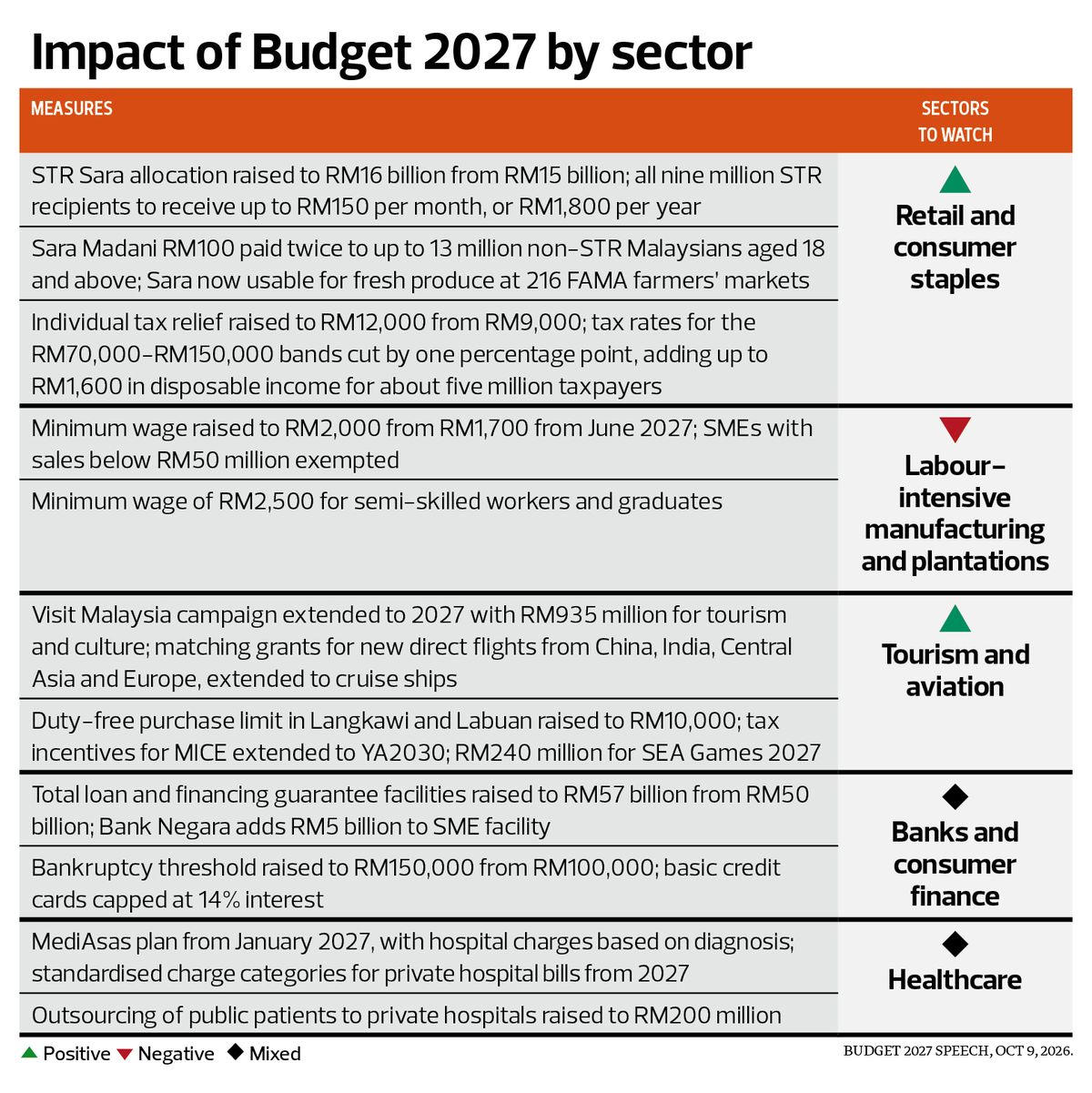
The increase in the minimum wage from RM1,700 to RM2,000, effective June 2027, alongside higher allocations under the Sumbangan Asas Rahmah (Sara) programme and individual tax reliefs, is expected to support disposable income and domestic consumption. However, stronger household spending may not necessarily translate into higher earnings for consumer companies, particularly those facing rising labour costs.
Contrary to the prevailing view that stronger purchasing power would benefit consumer stocks, Tradeview Capital Sdn Bhd portfolio manager Neoh Jia Man sees the wage increase as a net negative for consumer staples and consumer discretionary companies, particularly retailers, arguing that higher cash handouts are unlikely to fully offset the increase in operating costs.
“We deem Budget 2027 more populist than previous budgets. It benefits the rakyat, but partly at the expense of listed companies through higher costs,” he says.
Malacca Securities head of research Loui Low Ley Yee, however, expects the impact on larger listed companies to be limited, as many already pay wages above the new minimum. “The greater pressure could fall on smaller and mid-sized companies with annual revenue exceeding RM50 million, particularly labour-intensive businesses with limited pricing power,” he says.
BIMB Securities Sdn Bhd director of research Mohd Redza Abdul Rahman says the decision to implement the minimum wage increase in June 2027, rather than the widely anticipated January 2027, gives businesses more time to prepare. The temporary exemption for small and medium enterprises (SMEs) with annual revenue below RM50 million should also help cushion the impact on smaller businesses.
The additional lead time could allow affected companies to optimise operations and accelerate automation, helping to mitigate the pressure on profit margins when the higher wage floor takes effect.
“While labour-heavy sectors, such as plantations, gloves and lower-tier manufacturing, will face incremental operating expenditure increases, the aggregate macro impact is overwhelmingly consumption-positive,” says Redza.
He also notes that the increase will raise the wage floor for more than four million workers, potentially supporting spending on consumer staples and mass-market retail. But the extent to which listed companies capture that additional demand will depend on whether consumers spend the extra income on their products and whether businesses can absorb higher costs without raising prices.
For Neoh, the June 2027 implementation date also gives companies a longer window to adjust their cost structures and pricing. He notes that it may coincide with the next general election, putting the benefits of the wage increase closer to the election period.
No easy winners in consumer
The competing effects of stronger purchasing power and higher operating costs make the consumer sector one of the more difficult areas in which to identify clear winners from the budget.
Retailers and consumer staple companies could benefit from increased household spending, particularly those serving lower-income groups. However, labour-intensive operators may find it difficult to translate stronger sales into higher earnings if wage increases outpace revenue growth.
Malacca Securities’ Low says he remains cautious on labour-intensive businesses, particularly selected plantation, manufacturing and food and beverage companies, where higher wages could pressure margins.
Plantation companies face a more direct cost challenge because of their large workforces and reliance on foreign workers, many of whom are paid at or near the minimum wage. The higher wage floor could increase operating expenditure unless companies can offset the impact through higher productivity or mechanisation.
Redza sees the wage increase as a potential catalyst for this transition, noting that affected companies have already begun mechanisation and automation initiatives to improve productivity and reduce their reliance on foreign workers.
However, the pace of adoption will vary according to companies’ financial resources and operational requirements. Mechanisation may offer a longer-term solution to labour constraints, but the upfront investment could prove challenging for operators with limited financial flexibility.
Healthcare is another sector facing potential pressure, although from a different set of policy measures.
Neoh flags the standardisation of hospital billing requirements and the introduction of the MediAsas medical insurance plan as potential headwinds for hospital operators. Their effects will depend on how the new arrangements influence pricing, patient volumes and operating margins.
The implications for individual operators remain uncertain until the measures are implemented and their effects on hospital revenue and costs become clearer.
Selective opportunities for construction
The absence of major new rail projects, including the Mass Rapid Transit 3 (MRT3) and Penang Light Rail Transit (LRT), means construction companies are unlikely to receive a broad-based boost from fresh government contracts. Nevertheless, the budget’s allocations for roads, water infrastructure, school repairs and other public works should provide opportunities, particularly for contractors with exposure to smaller infrastructure packages.
AmInvestment Bank head of equity research Paul Yap says the omission of MRT3 was not unexpected. “We did not expect an MRT3 announcement in Budget 2027, so its omission has no material impact on our outlook. Any announcement would have represented additional upside,” he says.
For the Penang LRT, awarded packages are expected to proceed as planned. However, Yap notes that the absence of an update on the remaining cross-strait package is a slight negative for prospective bidders, including YTL Corp Bhd (KL:YTL), WCT Holdings Bhd (KL:WCT), Malaysian Resources Corp Bhd (KL:MRCB) and Kerjaya Prospek Group Bhd (KL:KERJAYA).
The reinstatement of the variation of price (VOP) mechanism for selected inputs, including diesel and bitumen, should help contractors manage fluctuations in construction costs.
Neoh says the mechanism is particularly beneficial to construction companies with large outstanding civil engineering order books, as it reduces the risk of unexpected input-cost increases eroding project margins. The pause in the carbon tax also removes a potential source of higher cement and steel prices.
“The absence of mega projects is disappointing. However, we deem the budget to be positive for construction players overall. The VOP mechanism eases cost pressure,” he says.
The shift towards smaller-scale infrastructure spending could favour mid-tier and regional contractors, which are better positioned to compete for geographically distributed projects involving roads, water supply, maintenance and public facilities.
BIMB Securities’ Redza identifies water pipe replacement programmes worth RM2.5 billion, rural connectivity allocations of RM3.3 billion and road maintenance programmes exceeding RM8 billion as potential sources of work.
“Mid-tier and regional contractors are the clear winners,” he says, pointing to smaller project packages and more frequent maintenance awards that could offer faster cash flow turnaround and lower execution risks.
Affin Pheim Asset Management fund manager Khoo Zing Sheng highlights that continued data centre development and potential semiconductor-related investments should support demand for industrial infrastructure, including electricity transmission, water supply and other supporting facilities.
“Contractors and engineering companies exposed to these areas could therefore benefit from private-sector investment even in the absence of a new wave of government megaprojects,” he says.
AmInvestment Bank’s Yap also identifies property, real estate investment trusts (REITs) and transport as potential beneficiaries. Housing incentives and infrastructure spillovers could support property developers, while tourism-related measures may benefit retail and hospitality-focused REITs. Tax incentives and upgrades to ports and airports could create opportunities for transport and logistics operators.
However, the eventual earnings impact will depend on the scale and timing of implementation. Budget allocations and policy incentives do not automatically translate into contracts or revenue, making project execution and companies’ ability to secure work important considerations for investors.
Policy execution remains key
Beyond individual sector allocations, investors must also consider how subsidy rationalisation and changes to corporate tax incentives could affect earnings, valuations and market sentiment.
Redza says subsidy rationalisation could strengthen fiscal sustainability and free up resources for productive investment in infrastructure, education and industrial development. The transition, however, could temporarily raise fuel and operating costs, putting pressure on corporate margins and consumer spending.
The challenge for the government will be to balance fiscal consolidation with the need to maintain domestic demand and support economic growth.
Malaysia must also remain competitive in attracting investment, particularly in semiconductors, data centres and advanced manufacturing. Redza says concerns over corporate tax incentives would become more pronounced if Malaysia’s offerings became less attractive relative to those of regional peers.
He expects the government to maintain targeted incentives for strategic industries rather than pursue broad-based reductions.
Ultimately, the market’s response will depend less on the announcement of individual measures than on how consistently they are implemented. Transparent and gradual reforms would give businesses greater certainty to plan capital expenditure, manage costs and make investment decisions.
Beyond the budget, investors will also have to contend with broader market risks. Khoo identifies persistently high inflation, elevated oil prices and rising US bond yields as key concerns. Higher yields could keep borrowing costs elevated and weigh on the profitability and investment appetite of artificial intelligence (AI)-related companies, which have been an important driver of global market performance.
Any slowdown in AI spending or weaker-than-expected global semiconductor demand could also affect sentiment towards Malaysian technology stocks, whose valuations may already reflect expectations of strong growth over the next one to two years.
Read also: Save by subscribing to us for
your print and/or
digital copy. P/S: The Edge is also available on
Apple's App Store and
Android's Google Play.
Cover Story: Translating reforms into more tangible benefits
Cover Story: A spending boost in store for consumer stocks
Cover Story: Regulators and industry leaders’ take on the budget
Cover Story: Continuing the journey of fiscal consolidation and prudence
Cover Story: Budget 2027 Highlights