

This article first appeared in The Edge Malaysia Weekly on September 28, 2026 - October 4, 2026
PRIME Minister Datuk Seri Anwar Ibrahim heads into the Budget 2027 announcement facing an unusual combination of pressures — the broader economy continues to grow and the fiscal deficit is steadily narrowing, but the government’s balance sheet has less room to absorb another shock given the increased spending on fuel subsidies, a result of the war in the Middle East.
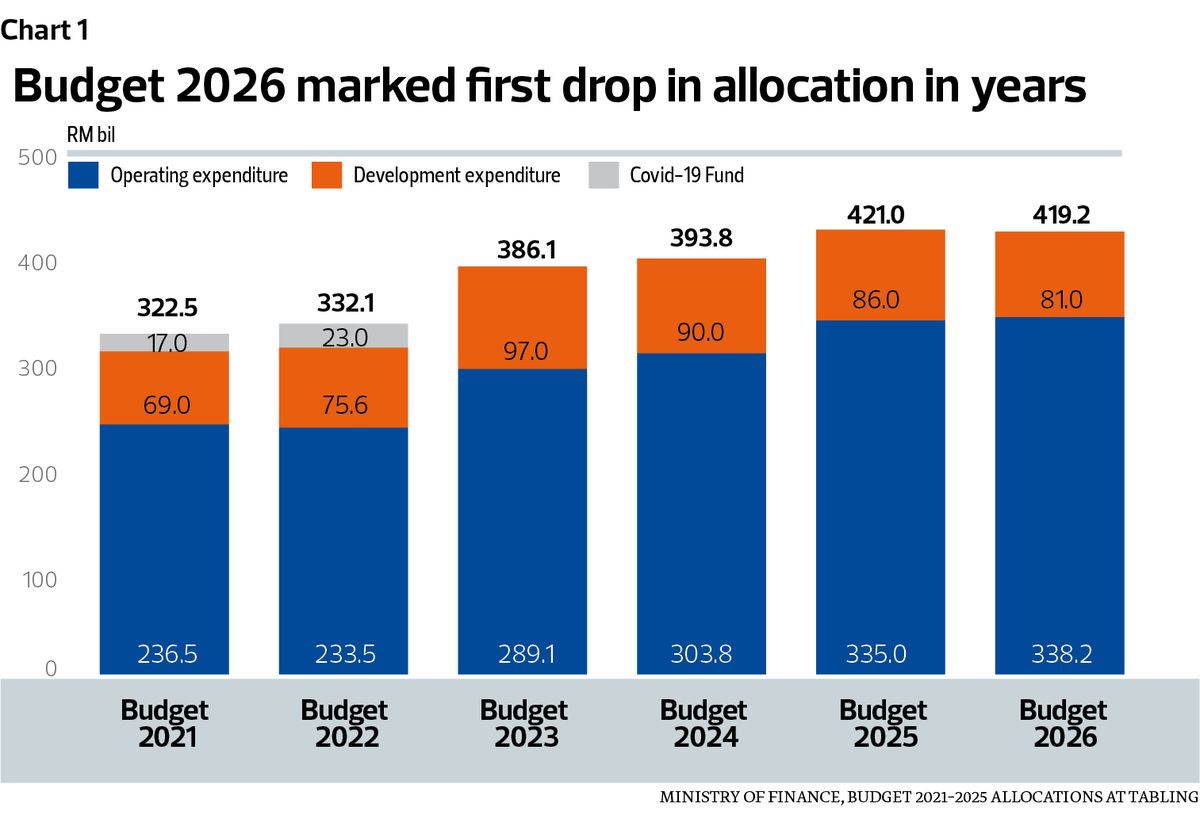
Anwar’s administration has used its four federal budgets to pursue fiscal consolidation following the Covid-19 pandemic, progressively targeting subsidies and tightening expenditure. Budget 2026 marked the first reduction in the overall federal allocation since Budget 2020.
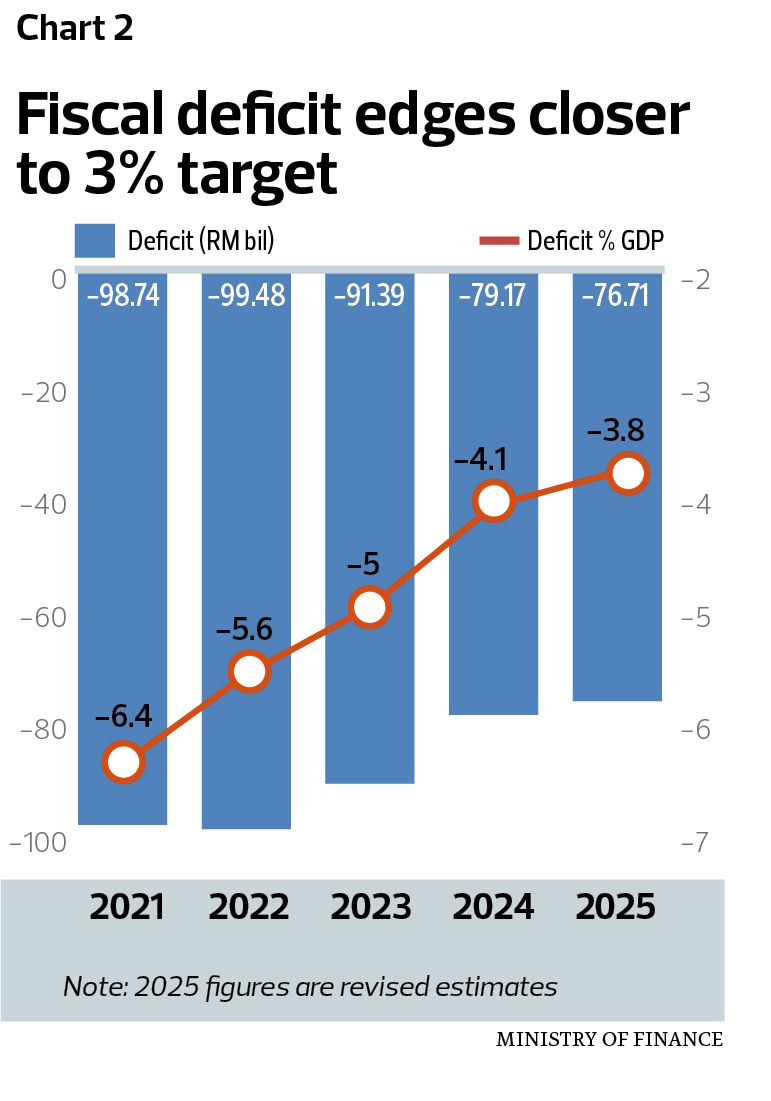
The fiscal deficit has fallen from 6.4% of gross domestic product (GDP) in 2021 to 3.7% in 2025, bringing it closer to the government’s medium-term ceiling of 3%.
But Budget 2027 is being drawn up against a markedly more difficult external environment, as the war in West Asia has pushed up energy prices and turned fuel subsidies, which the government has spent years trying to rationalise, into a fresh fiscal burden.
Due to the oil crisis, the Ministry of Finance (MoF) now estimates that the fuel subsidy bill could reach RM40 billion this year, approaching the initial total of RM49 billion allocated under Budget 2026 for all subsidies and social assistance, even after earlier subsidy reforms generated annual savings of about RM15.5 billion.
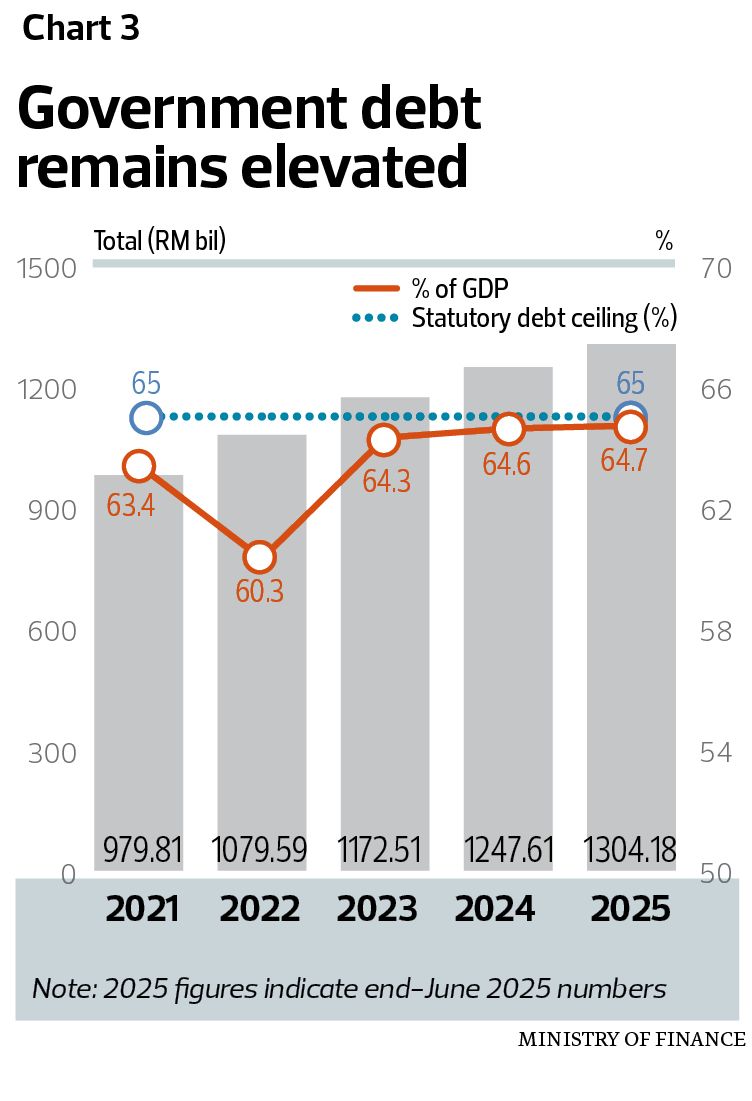
At the same time, the legacy of earlier deficits has not disappeared. Federal government debt stood at RM1.3 trillion, or 64.7% of GDP, as at June 2025, according to MoF data, compared with 52.5% in 2019.
Another consideration looming over Budget 2027 is the possibility that it could be the last budget for the unity government before the next general election.
Economists interviewed by The Edge point to four interlocking issues that will shape Budget 2027: the pace of fiscal consolidation, the growing cost of servicing accumulated debt, the double-edged impact of high global oil prices and the political pressure to protect households from the rising cost of living.
How important is the 3% deficit target?
The government has brought the fiscal deficit down substantially from its pandemic peak, but the final stretch towards its medium-term target could prove harder.
The deficit surged to 6.2% of GDP in 2020 and 6.4% in 2021 as the government responded to Covid-19, before narrowing in each subsequent year to 3.7% in 2025. Budget 2026 had originally envisaged a further reduction to 3.5%.
Under the Public Finance and Fiscal Responsibility Act 2023 (FRA), the government is seeking a deficit of no more than 3% of GDP by 2028, alongside federal government debt of no more than 60% of GDP.
Budget 2027 therefore faces a tension between an external shock that has increased the government’s expenditure commitments and a fiscal consolidation path that is nearing its target.
RAM Rating Services Bhd economist Nadia Mazlan says maintaining progress matters for Malaysia’s fiscal credibility, but a temporary deviation need not have the same implications as a structural deterioration.
“Meeting the medium-term fiscal deficit target of 3% is important as it would strengthen the government’s policy credibility and show that fiscal reforms, including subsidy rationalisation and revenue mobilisation, are producing tangible results. However, slower progress in reducing the fiscal deficit should not automatically result in a sovereign rating downgrade,” she says.
Rating agencies would consider why progress had slowed, the subsequent fiscal trajectory and whether there was a credible adjustment plan, she adds. A sustained widening of the deficit, rising debt-servicing costs or repeated delays to reforms would be more problematic than a temporary deviation caused by an external shock.
Professor Dr Yeah Kim Leng, director of economic studies at the Jeffrey Cheah Institute on Southeast Asia, similarly argues that a temporary widening of the deficit during a severe external shock would not necessarily undermine the government’s medium-term consolidation path, provided the increase in spending is temporary.
“During an external economic shock, the government should engage in countercyclical spending. [The government] needs to spend more, and then importantly, when the economy recovers, it has to cut back on its spending in order to reach the fiscal consolidation path,” he points out.
Dr Cassey Lee, principal fellow and coordinator of the Regional Economic Studies Programme at the ISEAS-Yusof Ishak Institute in Singapore, goes further, arguing that the FRA’s medium-term framework gives the government more flexibility than treating 3% as an immovable deadline would suggest. “The way the fiscal target is set, it’s a medium-term plan, which means it’s a rolling plan.”
The arithmetic nevertheless leaves little room for complacency. UOB Malaysia senior economist Julia Goh expects the absolute deficit to remain broadly flat in 2027, but stronger nominal GDP growth to lower the deficit ratio. UOB forecasts a deficit of RM74.5 billion, or 3.3% of GDP, in 2027 against an estimated RM74.6 billion, or 3.5%, this year.
In other words, further consolidation need not necessarily mean spending less. Some of the work could instead be done by a larger denominator, provided the economy keeps growing.
This will shape the choices in Budget 2027, particularly how much additional spending the government can accommodate without significantly slowing its fiscal consolidation.
The bill from yesterday’s deficits
If the fiscal deficit measures the government’s annual shortfall, public debt is the accumulated bill. And servicing that bill increasingly competes with today’s spending priorities.
Malaysia’s federal government debt rose sharply during the pandemic, from RM793 billion, or 52.5% of GDP, in 2019 to RM979.8 billion, or 62.1%, in 2020. By June 2025, it had reached RM1.3 trillion, equivalent to 64.7% of GDP.
This puts the ratio above the FRA’s medium-term target of no more than 60%, even as the annual deficit has moved much closer to its 3% target.
The distinction matters because reducing the deficit does not reduce the stock of debt overnight. A government running a deficit is still adding debt. It is merely doing so more slowly.
“The still-wide fiscal deficit can lead to faster debt accumulation and a greater debt-servicing burden, which will increasingly constrain fiscal flexibility and limit the productive usage of government revenue,” Nadia observes.
RAM estimates government debt to rise to 65.8% of GDP in 2026, while debt-servicing charges are projected to consume nearly 17% of government revenue, up from around 10% in the early 2010s.
“At around 17% of revenue, this implies that for every RM6 of revenue collected, RM1 is spent on interest and profit payments,” Nadia illustrates. “A further increase would leave less room for other important operating expenditure such as healthcare and education, as well as development expenditure, which supports continued economic growth.”
ISEAS-Yusof Ishak Institute’s Lee regards reducing the debt-to-GDP ratio as the more difficult of the government’s fiscal targets. Keeping debt under control is nevertheless important because it preserves the fiscal space needed to respond to future crises, he says.
“The trade-off is, I think, the inability to trim the national debt down, which is kind of important because in the longer term, you want some fiscal space in case there is a bigger shock — a Covid-type of shock,” he points out.
The Covid-19 shock left a lasting increase in government debt and therefore debt-servicing charges, Lee notes. According to MoF data, debt-servicing charges rose about 41% from RM38.07 billion in 2021 to RM53.71 billion in 2025, accounting for 16.2% of operating expenditure that year.
Economic growth may provide some relief, but how much it eases the government’s fiscal constraints depends on how effectively that growth translates into higher tax collections.
“Economists talk about the term ‘tax elasticity’ — how much your tax revenue increases when your GDP grows by 1%. In Malaysia, our tax-to-GDP ratio has declined over time, so even if you increase growth from 5% to 6% to 7%, that doesn’t necessarily mean that you get enough tax revenue to service your debt,” says Lee.
As such, the choices in Budget 2027 are constrained by expenditure that is difficult to cut, leaving spending that is easier to postpone, particularly development expenditure, more exposed to reductions.
About half of total government expenditure comprises emoluments, pensions and debt-servicing charges — core operating expenses with limited short-term flexibility.
Smaller discretionary items such as travel and events can be trimmed, but Nadia cautions that the savings may not be sufficient to accommodate a substantial increase in spending.
As a result, development expenditure can come under pressure in Budget 2027 even when policymakers regard it as productive. Malaysia’s development allocation rose from RM69 billion in Budget 2021 to RM99 billion in Budget 2023, before falling to RM90 billion in 2024 and RM86 billion in 2025.
“Something has to give”, as Institute for Democracy and Economic Affairs (IDEAS) director of research Dr Stewart Nixon puts it. “New development expenditure is a relatively easy target for cuts as the economic and electoral benefits are not felt immediately,” he says.
Evidently, the growing debt-servicing bill has a direct bearing on the choices in Budget 2027. With more revenue tied up in servicing debt and other relatively fixed operating expenses, the government has less room to spend, leaving development expenditure most exposed to cuts.
Two sides of higher oil prices
Malaysia’s position as an oil and gas producer means higher crude oil prices have long had two competing effects on government finances — lifting petroleum-related revenue while increasing the cost of keeping domestic fuel prices subsidised.
What matters for Budget 2027 is which side of the government’s ledger rises faster following the latest surge in global energy prices.
MoF had budgeted RM15 billion for fuel subsidies in 2026. Following the surge in global oil prices, the bill is now estimated at as much as RM40 billion — an additional RM25 billion.
Higher petroleum income tax, royalties and other petroleum-related revenue provide some offset. But for 2026, the increase has not been enough to cover the additional subsidy expenditure.
Nadia says the government indicated that about half of the RM25 billion increase in fuel subsidy costs would be covered by additional revenue, leaving the balance to be absorbed through expenditure reprioritisation. “This implies that when oil prices were high this year, the increase in petroleum-related revenue alone was not enough to fully offset additional fuel subsidy costs,” she adds.
The fiscal impact will depend on the duration of elevated oil prices, the scope of the subsidy mechanism and the exchange rate. Dividends from Petroliam Nasional Bhd (PETRONAS) provide another cushion, but Nadia notes that these generally reflect the company’s earlier financial performance, meaning higher crude oil prices do not automatically produce a larger dividend for the government in the same year.
IDEAS’ Nixon is more sceptical about how much relief PETRONAS can provide, particularly as the energy shock has also raised the national oil company’s costs in securing fuel supply amid disruptions to the Strait of Hormuz.
“The government is undoubtedly hoping to secure an extraordinary dividend from PETRONAS but it may be left wanting. All things considered, expenditure is likely to rise more than revenue,” he says.
Meanwhile, UOB’s Goh sees petroleum-related revenue as an important support for Budget 2027, although she cautions that reliance on PETRONAS dividends carries its own trade-off because it diverts capital that could otherwise be invested in upstream production and the energy transition.
The oil price assumption for 2027 will consequently be an important part of the fiscal equation.
Yeah expects an average of US$80 to US$90 a barrel to remain manageable, provided economic growth and revenue collection hold up. At those levels, higher petroleum receipts could help the government accommodate the subsidy burden without allowing the deficit to balloon, he argues.
The bigger question for Budget 2027 is how long the government is prepared to sustain the current level of fuel subsidies if oil prices remain elevated. Ironically, the government restored the basic monthly BUDI95 and BUDI Diesel quota to 300 litres on Sept 1 after cutting it to 200 litres in April as oil prices surged, citing cost-of-living pressures.
Budget 2027 will show whether Putrajaya is prepared to adjust fuel subsidies again to contain the fiscal burden, or continue absorbing the higher cost to provide consumers with a cushion.
The looming general election
While the government has until February 2028 to call the next general election, pressure for an earlier contest is building.
The political landscape has shifted following the Johor and Negeri Sembilan state elections, where strong showings by Barisan Nasional (BN) dealt setbacks to Pakatan Harapan (PH). BN retained Johor with a stronger two-thirds majority in July before wresting control of Negeri Sembilan from PH the following month and forming a two-thirds-majority state government with Perikatan Nasional (PN).
The victories have strengthened Umno’s hand within the unity government and fuelled calls for an earlier general election to capitalise on its electoral momentum, while Melaka looms as the next state-level test.
For Anwar, that raises the stakes for Budget 2027. If an early election is called, the Oct 9 budget could prove to be his administration’s last before voters return to the polls, putting greater attention on measures that have an immediate impact on household incomes and the cost of living.
To its credit, the government has managed to keep inflation contained since taking office. Headline inflation has fallen from 4% in November 2022, when the Anwar administration came to power, to 1.9% in August this year, while food inflation has eased sharply from 7.3% to 1.9%.
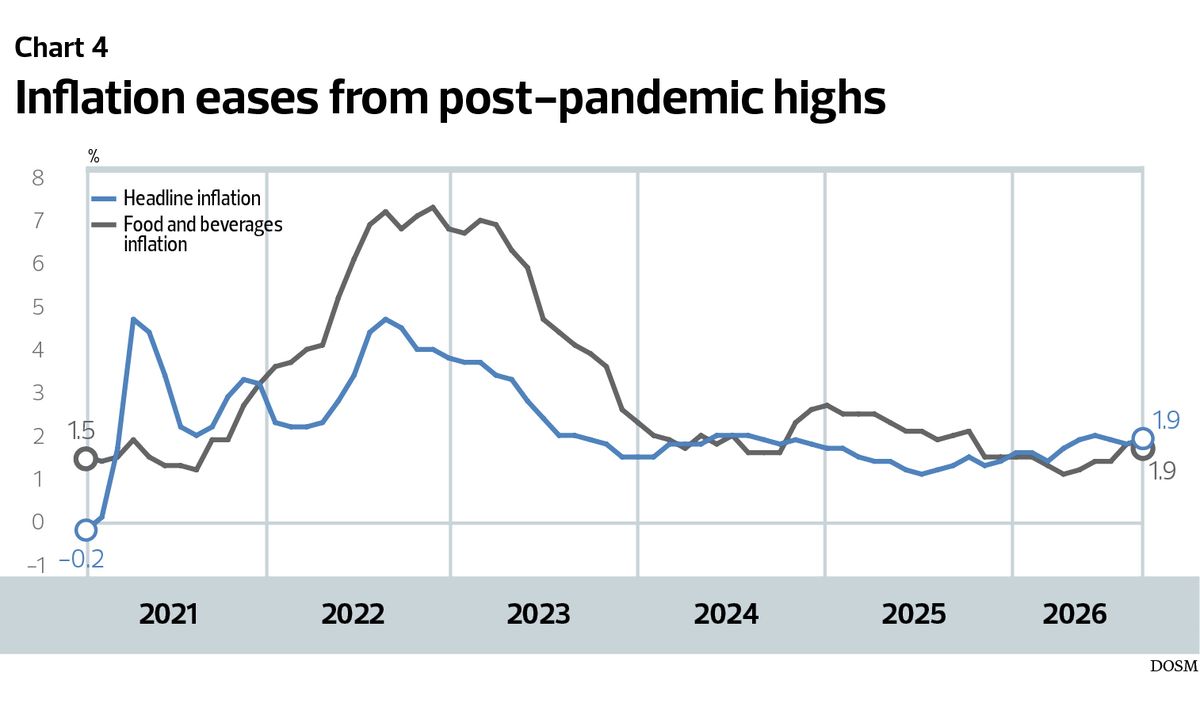
But those numbers do not fully reflect the underlying energy-price shock. Unlike consumers in many other countries in the region, Malaysians have been insulated from much of the surge in global fuel costs through subsidies, helping to contain transport costs and the knock-on effects of higher fuel prices on other goods and services.
This creates a political and fiscal trade-off for Budget 2027. Maintaining fuel subsidies helps keep inflation and household costs down at a time when the government could be approaching an election, but doing so also adds to the subsidy bill and makes further fiscal consolidation more difficult.
Furthermore, lower inflation only means prices are rising more slowly. It does not reverse the cumulative increases households have already experienced.
ISEAS-Yusof Ishak Institute’s Lee says this makes fuel subsidies particularly potent politically because, unlike infrastructure or development projects whose benefits can take months or years to filter through, changes in pump prices are felt almost immediately. “Normally when we talk about fiscal expenditure, government projects, it takes six months to one year to spend on the project before the benefit, the multiplier effect, filters to the people,” he points out.
In contrast, changes to subsidies are felt almost immediately. “You announce today, ‘I’m going to cut the subsidy’, tomorrow you’re going to feel it at the petrol pump. The dissatisfaction will build up and it will linger until the election,” says Lee.
Yeah similarly expects the electoral cycle to influence Budget 2027, with greater emphasis on measures that voters can feel more directly.
“Based on the electoral cycle, you can expect [the budget] to be even more people-friendly over and above the previous years. The government will need to ensure a feel-good factor will prevail during the election,” he says.
Yeah describes most of the electorate as “pocketbook voters” whose assessment of the economy is shaped by whether the government can “provide employment and good jobs and enable wages to increase”.
UOB’s Goh takes a more qualified view, arguing that economic fundamentals and existing fiscal commitments will remain the principal drivers of Budget 2027, although the election cycle is also likely to shape policy priorities.
“We see limited appetite for new broad-based taxes and a greater likelihood of targeted measures to support SMEs (small and medium enterprises) and middle-income households, including possible tax relief enhancements, refinements to income tax brackets, reduced SST (sales and service tax) compliance costs and selective SST exemptions,” she says.
IDEAS’ Nixon describes Budget 2027 as being under a “deepening election shadow”, as electoral considerations shift the emphasis to measures whose benefits are immediate and widely felt. “Election budgets”, he says, tend to prioritise short-term political expediency over long-term investment and deeper reform.
“The government tinkers with existing policies that are highly visible, have an immediate impact and are relatively simple, reaching everyone who can vote rather than the people or activities that would benefit most,” he adds.
Consequently, the question hanging over Anwar as the finance minister is the uncomfortable intersection between economics and politics. Fuel subsidies help contain living costs, but increase expenditure. Fiscal consolidation strengthens the government’s balance sheet, but can limit the resources available for immediate support. Development spending may improve future productive capacity, but competes for the same ringgit.
Budget 2027 will reveal how Putrajaya chooses to navigate these competing pressures as the cost of today’s support, yesterday’s debt and tomorrow’s commitments converge on the same balance sheet.
Save by subscribing to us for your print and/or digital copy.
P/S: The Edge is also available on Apple's App Store and Android's Google Play.