

This article first appeared in The Edge Malaysia Weekly on September 28, 2026 - October 4, 2026
IN the past few years, “buy now, pay later” (BNPL) gave shoppers a quick and easy route to credit. But the days when just about anyone could get instant approval are over.
Since June this year, BNPL service providers are required to conduct affordability assessments for credit extended above the RM1,000 threshold, as part of a broader push to ensure consumers do not take on debt they cannot afford to repay.
Mandating such requirements for the previously unregulated BNPL industry, alongside other safeguards such as transparent effective interest rates and stronger fraud controls, is now possible with the industry coming under the purview of the Consumer Credit Commission (CCC). BNPL providers now require a licence from the CCC to operate (see accompanying story).
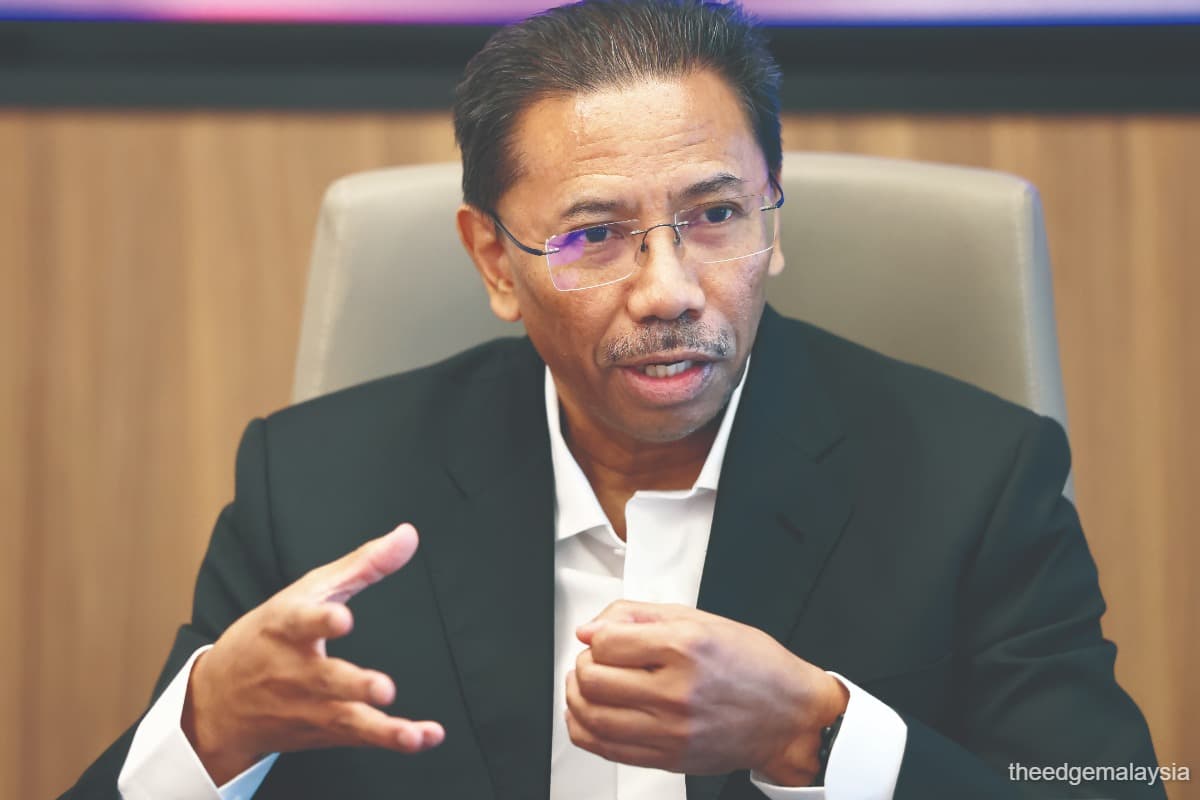
“We expect the BNPL providers to undertake affordability assessments. What this means is that people who utilise this facility must be responsible for repaying their debts. Equally important is that credit providers must ensure that people who cannot afford to borrow are not given credit,” CCC executive chairman Abu Hassan Alshari Yahaya tells The Edge in his first interview since taking the role.
The CCC, established as the statutory body responsible for regulating Malaysia’s non-bank consumer credit industry, derives its powers from the Consumer Credit Act 2025 (CCA) enacted on Dec 31 last year.
The commission has been operational since March 1, 2026, but its journey began in July 2021 with the formation of the Consumer Credit Oversight Board Task Force (CCOB TF), co-led by the Ministry of Finance, Bank Negara Malaysia and the Securities Commission Malaysia (SC), with participation from other ministries.
Abu Hassan, a former Bank Negara assistant governor, explains that the CCA was introduced to address regulatory gaps in the consumer credit ecosystem that exposed consumers to a higher risk of unfair treatment.
“This was due to the presence of credit providers and credit service providers such as BNPL and debt collection agencies that were operating with no legislation to govern their activities,” he says.
Interestingly, the formation of the CCOB TF came around the time when BNPL was gaining popularity in Malaysia, with its growth accelerated by the surge in online shopping during the Covid-19 pandemic.
At the same time, the fragmented oversight of existing non-bank credit providers across multiple ministries and agencies needed to be addressed. According to Abu Hassan, this fragmentation resulted in inconsistent consumer protection standards, uneven supervisory rigour and regulatory arbitrage across sectors.
“Such frictions and gaps will eventually undermine a level playing field for industry and erode consumer trust in the credit market as a whole,” he says.
Abu Hassan points out that the CCA functions as an umbrella Act in that it supplements the power of existing authorities, rather than dismantling the current architecture.
“The CCA serves as a pragmatic solution. It gives each authority the option to draw on its additional powers to issue new standards or pursue a wider range of supervisory or enforcement actions where gaps currently exist in their respective legislations. This ensures that credit consumers benefit from similar safeguards and minimum standards of fair treatment, regardless of which credit provider they approach,” he explains.
Tackling issues in phases
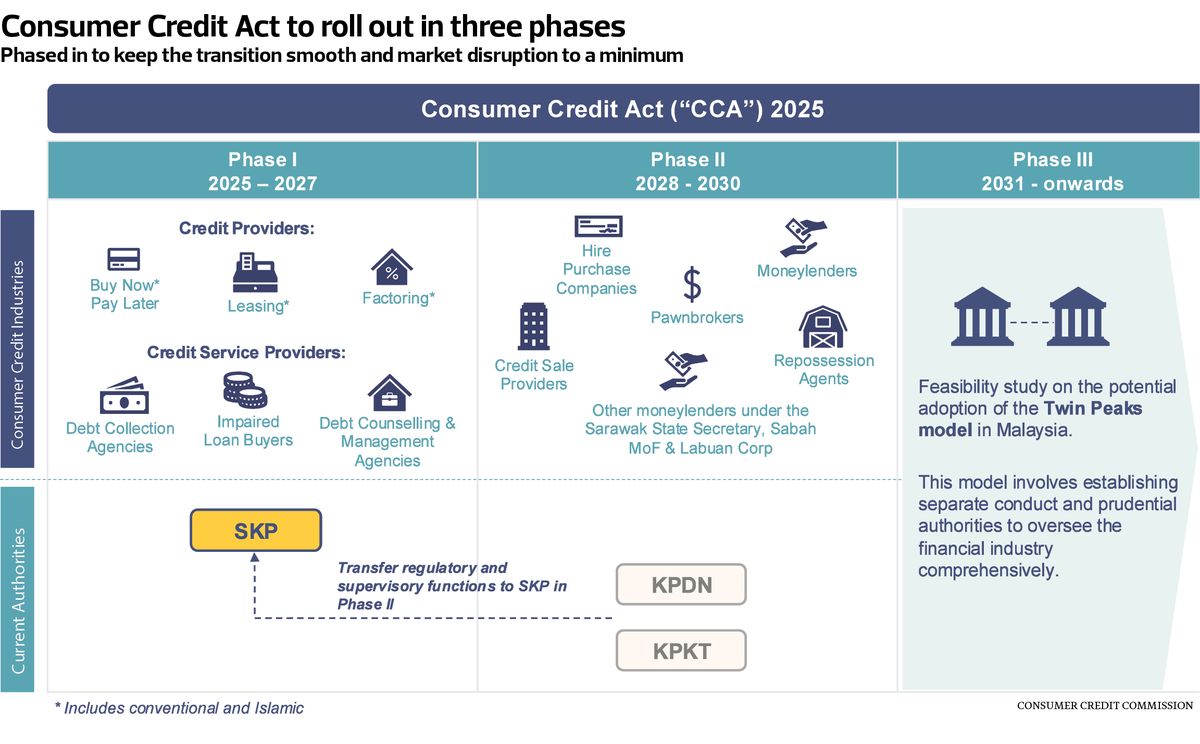
Notably, the CCA will be implemented in three phases. In Phase 1, spanning 2025 to 2027, unregulated credit providers (BNPL, leasing and factoring companies) and unregulated credit service providers (debt collection agencies, impaired loan buyers as well as debt counselling and management agencies) will be brought under the supervision of the CCC.
In Phase 2, covering 2028 to 2030, the CCC’s supervision scope will expand to include credit providers under the purview of the Ministry of Housing and Local Government (KPKT) and the Ministry of Domestic Trade and Cost of Living (KPDN). These include hire purchase companies, moneylenders, pawnbrokers, credit sales providers and repossession agents.
In the final phase, feasibility studies will be undertaken to assess the potential adoption of the “Twin Peaks” model in Malaysia. The studies will examine whether this model, which involves establishing separate conduct and prudential authorities to oversee the financial industry comprehensively, can work in Malaysia.
When asked why the CCA is being implemented in phases that stretch across a long period of time, Abu Hassan replies that there are “a lot of things out there that need to be protected”.
“We don’t think it is practical to tackle everything all at once. The thinking behind first tackling the unregulated industries is that, first of all, there was no protection for consumers in those industries, and there was an emerging risk in BNPL and other credit service providers, such as debt collection agencies. After that, we will take on those under KPKT and KPDN to reduce fragmentation in the industry,” he says.
Abu Hassan adds that, given the diverse range of authorities, credit providers and credit service providers operating under different laws and rules, the sequenced approach provides more time to put the necessary foundations in place while allowing industry participants sufficient time to adapt to the new requirements.
He further says the three-phased road map for the CCA was endorsed by the cabinet and represents a “longer-term, sequenced and whole-of-government approach” in addressing the fragmented consumer credit regulatory landscape, while avoiding undue disruptions to the industries involved.
Making debt collection more ‘professional’
While much of the attention has been on regulating the BNPL industry, the CCC is now turning its focus on debt collection agencies (DCAs).
Abu Hassan notes that news reports of unruly and threatening behaviour by “overzealous” debt collectors have become frequent enough to tarnish the industry’s reputation.
However, he believes that the industry should not be viewed through a negative lens because of a few bad apples. He points out that many DCAs operate legitimate businesses that provide important services to financial institutions and other credit businesses.
“Even in the absence of legislation, market forces have elevated professionalism within the debt collection industry. Competition among industry participants to secure and retain bank outsourcing contracts — which typically include obligations for professional conduct and the fair treatment of borrowers — has incentivised debt collection agencies to raise their standards,” he shares.
As it stands, while Bank Negara does not explicitly regulate the DCAs collecting debt on behalf of banks, its requirements hold banks accountable for the conduct and actions of their agents and representatives. This indirectly ensures that DCAs servicing banks toe the line when it comes to conduct..
Soon, however, DCAs will need to be authorised by the CCC before they can operate. They have been given six months from June to get themselves registered. DCAs will have to demonstrate their ability to consistently deliver fair outcomes for consumers, in order to qualify for registration as a credit service provider under the CCA.
“Registered DCAs are then subject to ongoing supervision and surveillance by the CCC to ensure that they continue to behave in a responsible and fair manner,” Abu Hassan says.
Regulation to reduce illegal moneylending
While Phase 2 is still more than a year away, the CCC, together with other key regulators, has already begun laying the groundwork for its implementation, particularly for the currently unregulated Islamic moneylending and Islamic pawnbroking sectors.
Abu Hassan shares that the CCC is working closely with KPKT, the Malaysia Co-operative Societies Commission of Malaysia and other key stakeholders to issue new standards for authorisation of these specific subsectors in the industry.
“This new class of licence will enable interested and suitably-qualified parties to submit applications for assessment by KPKT in due course, and enhances access to moneylending and pawnbroking facilities that are fully shariah-compliant,” he says
“Eventually, the plan is for KPKT to transfer the regulatory and supervisory functions of moneylending and pawnbroking activities, including Islamic ones, to CCC in Phase 2.”
The moneylending industry in Malaysia is potentially huge. According to Abu Hassan, KPKT data shows that moneylending loans stood at close to RM15 billion as at the end of 2025. This figure is yet to include loans given in Sabah and Sarawak.
He says 55% of the borrowers are individuals while the remaining 45% are businesses. “With 55% being individuals, we are talking about 3.2 million individuals borrowing from moneylenders and about 3,600 companies. Even with the incomplete data, it shows that people do borrow a significant amount from moneylenders.”
The data also goes to show that licensed moneylenders, and even pawnbroking — which is estimated to be a RM31 billion industry — are an important source of financing for households and businesses that are unserved or underserved by financial institutions.
Abu Hassan believes that the opportunity has presented itself to the commission to better understand these businesses once they fall under its purview.
“If the opportunity comes for us to take over [the industry] from KPKT, then the same standards and requirements that are imposed on the regulated sectors under Phase 1 will be done,” he shares.
The executive chairman believes that the problem of illegal moneylending can be partly addressed by “professionalising” the legal moneylending industry. He adds that this would also give the public greater confidence in the sector, helping the industry grow in a more orderly and sustainable manner.
The CCC’s approach across Phases 1 and 2 will follow a two-pronged strategy. First, it will seek to establish a robust supervisory and surveillance framework, supported by a strong gatekeeping regime to prevent bad actors from entering the industry while gradually raising standards of professionalism and compliance. According to Abu Hassan, this can be achieved through continuous engagement with industry participants or timely supervisory intervention.
The next part will be to take swift action against serious or recurring misconduct, both to serve as a strong deterrent and to demonstrate the CCC’s commitment to protecting consumers’ best interests.
Aspirational Twin Peaks model
Under the third phase of the CCA’s implementation, the commission will study the Twin Peaks model, currently adopted by many advanced countries, in which prudential regulation and conduct regulation are carried out separately by two distinct authorities.
The prudential regulator would focus on promoting financial stability as well as safety and soundness of systemically important financial institutions, while the conduct authority focuses on consumer protection, market integrity and fair conduct by all financial services providers.
Abu Hassan describes it as the final piece in the reform of Malaysia’s consumer credit regulatory landscape, aimed at ensuring that the dual objectives of financial stability and consumer protection continue to be effectively met in an increasingly digitalised and interconnected financial market.
“We have observed interesting developments in this space over the last three decades. Australia is the pioneer in its adoption of the Twin Peaks model in 1998, followed by the Netherlands in 2002, in part as a response to the rise of financial conglomerates and the resulting blurring of traditional boundaries in the provision of investment, banking, insurance and pension services in these jurisdictions.
“Advanced countries like the UK, Belgium, France and New Zealand subsequently transitioned to the Twin Peaks model from 2011 onwards, as a response to public pressure and perceived failures of financial sector authorities in preventing the 2008 global sub-prime financial crisis,” explains Abu Hassan.
However, this phase will involve a comprehensive and exploratory assessment of the country’s readiness and the feasibility of transitioning to a Twin Peaks financial sector regulatory model and the establishment of a sole financial conduct authority.
“It will go through a very detailed discussion. There will be a lot of engagement around this where Bank Negara and the SC will be jointly driving this engagement. The CCC will be supporting this effort in our capacity as the key non-bank sector conduct regulator,” he adds.
But whether or not Malaysia ends up adopting the Twin Peaks model will depend on the assessment of the country’s financial system development and whether there is a need to move towards it.
Abu Hassan believes that the work of the CCC will continue regardless of changes in the country’s political landscape, noting that while governments have evolved and changed over time, each has remained committed to the objectives of the CCA, given that the underlying issues facing credit consumers remain relevant.
“Our focus has always been on the mandate entrusted to us under the CCA and the broader goal of building a fairer, more transparent and trusted consumer credit ecosystem. We remain focused on delivering that mandate for the benefit of consumers, regardless of political cycles.
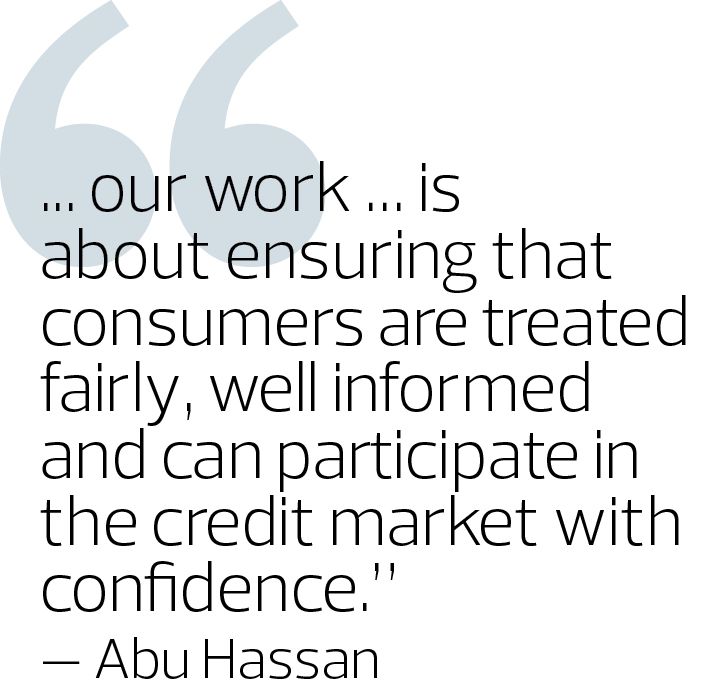
“Ultimately, our work is about the rakyat. It is about ensuring that consumers are treated fairly, well informed and can participate in the credit market with confidence. Those objectives remain important,” he says.
Read also:
Cover Story 2: Malaysia’s BNPL industry gets guard rails as outstanding balance reaches RM6.6 bil
Save by subscribing to us for your print and/or digital copy.
P/S: The Edge is also available on Apple's App Store and Android's Google Play.