


This article first appeared in The Edge Malaysia Weekly on September 21, 2026 - September 27, 2026
MALAYSIA’s economy grew 6% year on year in the second quarter of 2026, its second-fastest pace of growth in three years and well above the 4.4% recorded in 2019, before the Covid-19 pandemic.
The quarterly figure puts Malaysia among the fastest-growing economies in the region, outpacing Singapore (5.9%), Indonesia (5.3%), China (4.3%), South Korea (3.7%) and the Philippines (2.3%).
Beneath the headline figure, however, growth was concentrated in more capital-intensive sectors. Net exports surged 168.5% y-o-y to RM15.8 billion, accounting for almost 40% of the GDP increase, driven partly by strong electrical and electronics (E&E) and liquefied natural gas (LNG) exports.
But these sectors, together with information and communications, account for just 10.7% of employment, limiting how broadly their growth is felt across the workforce.
This helps explain why strong headline growth does not necessarily translate into workers getting a correspondingly larger slice of the economic pie.
In fact, the share of output flowing to workers through wages and other remuneration remains relatively low, in terms of compensation of employees (COE). Surprisingly, workers’ share shrank compared to 10 years ago.
In 2016, COE accounted for 35.6% of gross domestic product (GDP) but the ratio fell to 33.9% in 2025, according to data by the Department of Statistics Malaysia (DOSM).
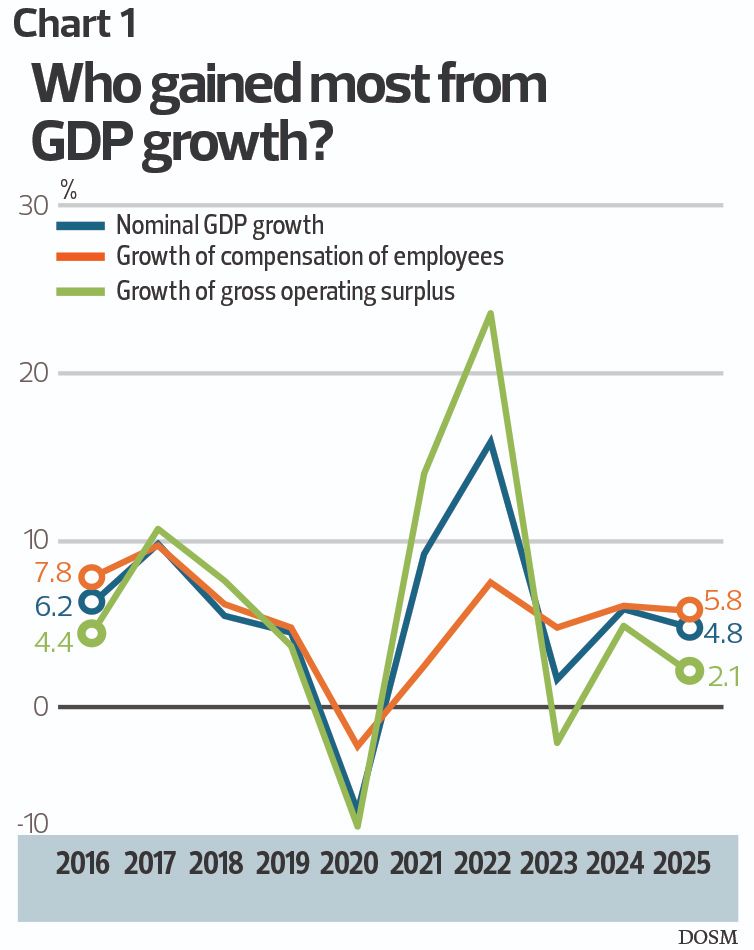
Meanwhile, gross operating surplus (GOS), which broadly represents the income accruing to businesses and owners of capital from production, increased its share of GDP to 62%, from 59.3%, in the same period (see Chart 1).
In simple terms, this means that as Malaysia’s economy expanded, a larger share of the income generated flowed to businesses and capital owners than to workers through wages and other remuneration. While the economy grew bigger overall, labour’s slice of the economic pie became relatively smaller.
The divergence became particularly stark during the pandemic and subsequent reopening. COE’s share rose to 37.4% in 2020 as output contracted more sharply than employment and wages, before tumbling to 32.5% in 2022. GOS moved in the opposite direction, rising to 66.7%, from 59.9%.
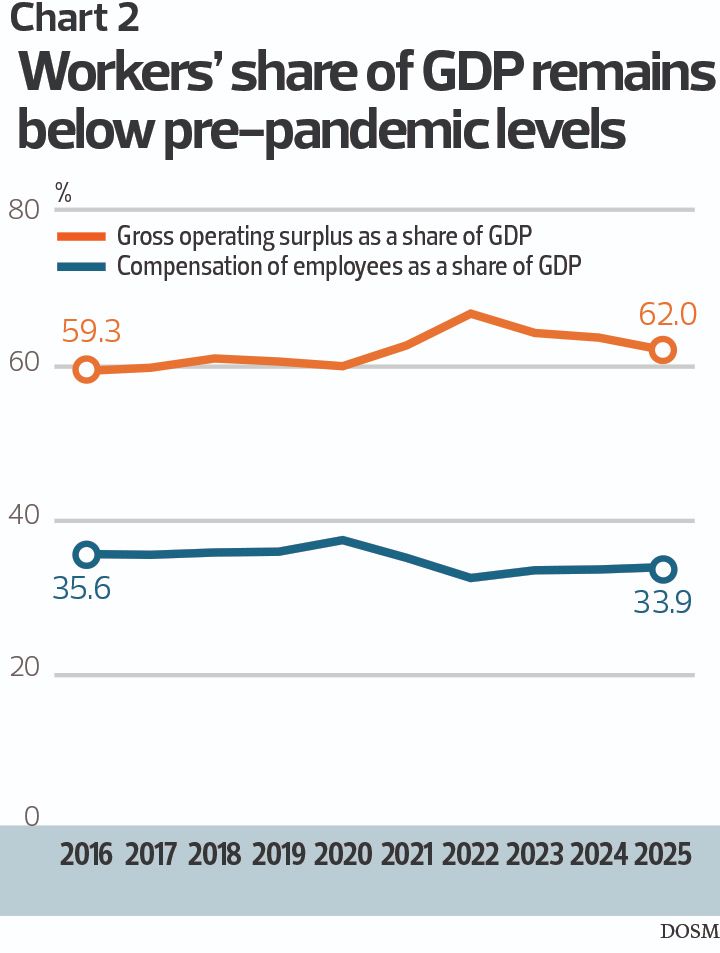
The gap has narrowed somewhat in the following years, as employee compensation began growing faster than the broader economy. COE grew 4.8% in 2023, against nominal GDP growth of 1.7%, while GOS contracted 2.1%. COE continued to outpace both nominal GDP and GOS in 2024 and 2025, helping labour’s share recover from its 2022 low (see Chart 2).
But the recent recovery has not changed the bigger picture, as workers’ share of the economy remains below where it was a decade ago and low by international standards.
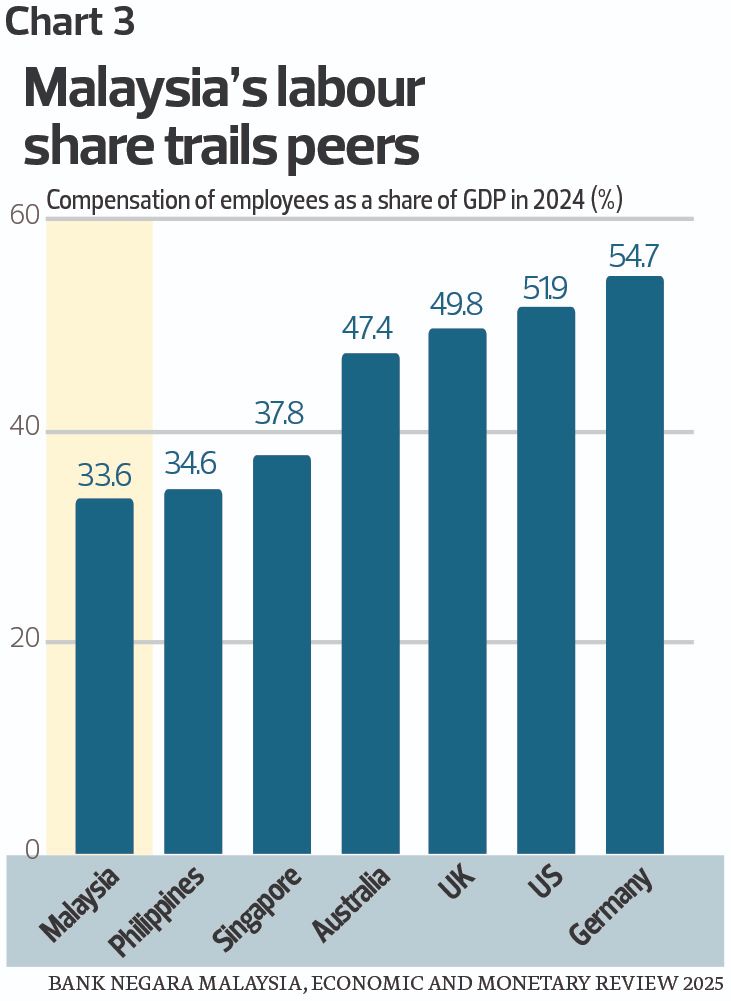
According to Bank Negara Malaysia’s Economic and Monetary Review 2025, COE accounted for 33.6% of Malaysia’s GDP in 2024, compared with 34.6% in the Philippines, 37.8% in Singapore, 47.4% in Australia, 49.8% in the UK, 51.9% in the US and 54.7% in Germany (see Chart 3).
Comparing COE with GOS offers one way of looking at how the income generated by an economy is divided between labour and capital.
Putrajaya, too, has acknowledged the need to address the relatively low share of Malaysia’s economic output flowing to workers.
“When you look at this measure of compensation of employees in Malaysia, it’s about 34% of GDP. It’s relatively low compared to probably any other country, whether developed or even less developed,” Treasury secretary-general Tan Sri Johan Mahmood Merican said at The Edge-HSBC Pre-Budget 2027 Roundtable.
“When people talk of cost-of-living challenges, part of it is the issue where our incomes are not rising fast enough. Maybe it’s the education system, maybe it’s also high levels of automation and mechanisation.”
As Malaysia moves towards a more knowledge-intensive economy, Johan said, part of the GDP pie “must shift from just returns of capital to also providers of talent”.
The 13th Malaysia Plan (13MP) has set a target of lifting COE to 40% of GDP by 2030, requiring a substantial increase from the current 33.9% over the next four years.
Furthermore, the growing use of artificial intelligence (AI) adds another challenge to reaching that target as companies increasingly use the technology to produce more with the same number of workers — or fewer — raising the question of whether those productivity gains will flow to employees through higher wages or accrue disproportionately to capital.
In fact, Malaysia’s recent experience suggests that productivity gains do not automatically translate into higher pay.
Bank Negara found that real median wages grew at a compound annual rate of barely 0.9% between 2019 and 2024, below productivity growth of 1.1%. Wages caught up with cumulative productivity gains only in 2024.
The central bank also found that average annual COE growth moderated to 5.4% post-Covid from 8.2% before the pandemic, while private-sector wage growth slowed much more sharply to 3.4%, from 7.6%.
For workers, therefore, the AI question is not only whether jobs will be displaced, but also who ultimately captures the productivity gains it creates.
Shortage of high-paying jobs
Malaysia’s unemployment rate of around 3% may indicate full employment, but it does not necessarily reflect the quality of jobs or income levels.
Associated Chinese Chambers of Commerce and Industry of Malaysia’s (ACCCIM) Socio-Economic Research Centre (SERC) executive director Lee Heng Guie points to the composition of Malaysia’s labour market as one reason wages and workers’ share of economic output remain relatively low.
According to Lee, semi-skilled workers account for 62% of employment and low-skilled workers another 12.6%, while skilled workers make up only 25.4%.
While large companies in higher-value sectors such as banking, oil and gas, high-tech manufacturing and semiconductors are generally better positioned to offer higher wages, Lee says there are not enough such firms creating high-paying jobs at sufficient scale.
“The top-performing firms are not scaling enough to absorb more skilled workers,” he says. This leaves a large share of the workforce concentrated in semi- and low-skilled jobs, where workers typically have less bargaining power and limited scope for higher wages.
Similarly, Bank Negara points to structural weaknesses as a factor holding back wage growth. According to the central bank, Malaysia has not generated enough high-skilled and high-paying jobs over the past seven years, while dependence on low-cost foreign labour has reinforced low-value production models and suppressed wages, particularly for low- and semi-skilled workers.
Persistent skills mismatches and uneven access to relevant training have also prevented workers from moving into better-paying jobs.
Another factor shaping labour’s relatively low share of the economy is how businesses choose to distribute the gains they generate.
“Corporate value distribution heavily prioritises shareholder returns, such as dividends and share buybacks, and executive compensation over increasing employees’ base wages,” Lee explains.
The widening gap between labour and capital income should not be read, however, as a straightforward measure of how profitable Malaysian companies have become.
Bank Muamalat Malaysia Bhd chief economist Dr Mohd Afzanizam Abdul Rashid cautions against interpreting Malaysia’s GOS share of more than 60% as evidence that companies are necessarily earning extraordinarily high profits.
Companies still have to contend with intensifying competition, regulatory compliance, changing consumer preferences and rapid technological change, all of which affect how much of that operating surplus ultimately translates into profit, Afzanizam says.
“It does not automatically mean firms are doing extremely well. In some sense, it is like a company’s revenue — what matters is the bottom line, or profitability,” he says.
“Having said that, the relatively low COE share does indicate some degree of inequality, as the share of income accruing to workers remains below the desired level, particularly when measured against the 13MP target of 40% by 2030 and the Madani Economy target of 45% by 2033.”
Afzanizam also sees scope to rethink employee compensation beyond basic salaries, overtime, statutory contributions, bonuses and annual increments, including greater use of mechanisms such as employee share option schemes (ESOS) that allow employees to participate more directly in corporate gains.
“The pay structure needs to be looked at again so that excess profits can be shared and reflect the contribution from employees,” he says.
Lee concurs, pointing to productivity-linked wage systems, ESOS and stronger collective bargaining as possible mechanisms to better align workers’ remuneration with productivity and company performance.
More than raising the wage floor
To be fair, the government has already begun pulling several levers to lift incomes.
The minimum wage has been raised several times over the past decade, while the recent Progressive Wage Policy seeks to encourage wage increases alongside improvements in skills and productivity. The current government has also implemented a major revision to civil servants’ salaries.
Bank Negara notes that the introduction of the minimum wage in 2013 and subsequent increases coincided with falling wage inequality and a higher COE in the decade leading up to the pandemic.
But raising the floor alone does not necessarily mean a broad-based increase across job levels. Bank Negara found that the median wage gap between low- and semi-skilled workers narrowed to RM396 in 2024, from RM550 in 2016, reflecting what it calls wage “bunching” around the statutory minimum. In other words, increases at the bottom have not proportionately lifted wages further up the distribution.
The central bank argues that Malaysia therefore needs stronger wage-setting institutions beyond the minimum wage, including mechanisms that better link wages with productivity, competitiveness and economic conditions. It also points to industrial upgrading, better jobs and skills development, alongside efforts to move firms towards more complex and high-value activities and reduce dependence on low-cost foreign labour.
Companies have long relied on foreign workers to keep labour costs down. But as Malaysia seeks to reduce that dependence, the rise of AI and automation raises another question: Will those jobs go to better-paid local workers, or to technology?
With AI reshaping demand for labour and skills, lifting COE to 40% within four years could become an even tougher target to hit.
Read also:
Cover Story: How the AI tidal wave is reshaping the jobs market
Cover Story: Big Money | Taking charge of our critical thinking
Save by subscribing to us for your print and/or digital copy.
P/S: The Edge is also available on Apple's App Store and Android's Google Play.