


This article first appeared in The Edge Malaysia Weekly on September 21, 2026 - September 27, 2026
FOR engineering outfit owner John, using artificial intelligence (AI) in his work has been a game changer. He “trains” the AI to write codes in the company’s style and now merely checks to ensure that the codes are written correctly.
“I use AI to write more routine codes and it has helped me cut down coding time significantly, where a few days of work can be accomplished in 20 minutes. But I still need a few employees because engineers need to be at the physical location to make sure hardware is properly installed and conduct test runs,” he says.
These days, the use of AI is prevalent in all aspects of life, in various sectors of the economy and professions, and more so among white-collar workers. Early research has shown that AI has, by some measure, improved the productivity of workers, but it still depends on the complexity of tasks and the user’s ability in AI prompting.
Even so, AI is increasingly becoming part of everyday life. As a result, companies will soon be able to achieve the same outcomes with fewer workers — or, in some roles, none at all.
The concern among white-collar workers about AI displacing jobs is real. Jobstreet’s Workplace Happiness Index found that while only around one-third of Malaysian workers feel “very” or “extremely” concerned about AI affecting their job security, the score is even higher among professional services workers, coming in at 47%.
While there is no evidence of massive job loss as a result of AI at this juncture, recruitment agencies observe that job postings for certain roles have been declining.
Jobstreet by SEEK in Malaysia managing director Nicholas Lam says AI is certainly putting pressure on some forms of white-collar work, particularly roles involving repetitive, standardised or administrative tasks, many of which are being automated.
Current data points, however, more towards roles being redesigned than entire professions being replaced.
“The clearest early signs of pressure are in selected content and administrative roles. Job ads for positions such as content writer, copywriter, secretary and graphic designer declined between 2024 and 1H2026. We see these trends as directional indicators that automation may be changing how these roles are structured, rather than proof of one-for-one job replacement,” Lam says.
This observation is consistent with a May report by the International Labour Organization (ILO), which found that studies using job postings and online labour-platform data show a significant decline in demand for skills associated with routine writing and translation, following the diffusion of generative AI (GenAI) tools, alongside increased demand for AI-related skills such as machine learning and natural language processing.
PwC Malaysia managing partner Soo Hoo Khoon Yean argues that the gradual redesign of work does not necessarily imply that workers will be displaced. Instead, he says, it points to a gradual shift in the mix of capabilities and skills required in those roles.
“There may be a growing divide between workers who are able to integrate AI into their workflows and adapt to evolving skill requirements, and those who are unable to,” Soo Hoo says.
“As AI becomes more capable, competitive advantage will increasingly come from areas where human strengths like context, judgement and accountability matter most. This includes making high-stakes decisions, solving nuanced problems, managing stakeholder relationships, and bringing together insights from different disciplines to create solutions that AI alone cannot deliver.”
Such expectations are starting to show up in the hiring landscape in Malaysia, with AI or digital tools becoming more common in the workplace. Randstad Malaysia associate director, emerging technology recruitment Dylan Long sees a clear shift in Malaysia’s hiring landscape, where employers are increasingly prioritising talent who are adept in AI and digital tools.
“This trend is no longer confined to specialised tech departments; instead, having basic knowledge and practical experience with AI has rapidly evolved into a fundamental, baseline requirement for almost any professional role. There is an immense demand for individuals who demonstrate high digital agility,” Long says.
He adds that a proactive willingness to embrace self-directed learning and integrate AI into one’s routine work has become a powerful, highly attractive differentiator in the current market.
Statistics from Jobstreet confirm this change in the hiring landscape. According to Lam, the recruitment agency’s data shows that 70% of employers factor AI knowledge into hiring decisions, while one in three treat AI capability as a core hiring requirement.
At the same time, demand for dedicated AI hiring is also increasing rapidly, notes Lam. AI-labelled job ads grew by 131% year on year in 2025. In 1H2026, the number of AI-labelled job ads was already 24% higher than the total for the whole of 2025, he says.
One question that has often been raised is whether junior hiring will be reduced as a result of AI proliferation. A Gartner Inc survey carried out late last year found that 22% of chief human resources officers in the US reported that at least one business leader in their organisation has stopped hiring for entry-level roles as a result of AI automation.
Some argue that removing the routine or repetitive tasks traditionally assigned to junior staff — often a training ground for developing judgement and gaining crucial experience — could ultimately hurt organisations by weakening their future talent pipeline.
According to Soo Hoo, however, PwC’s global research shows that the bar is now higher for junior talent, with emotional quotient, judgement and leadership skills — qualities normally expected of senior hires — being prioritised.
“Organisations will need to rethink how early-career talent is developed, including creating new pathways through which early-career employees can learn through application and experience,” he says. “Traditional apprenticeship models built largely around repetitive tasks may need to evolve into more structured experiences that accelerate the development of these broader capabilities.”
Sufficient AI talent in Malaysia?
While employers today want workers who can use AI in ways that help create value, there is also a need for AI developer roles in the country, notes Soo Hoo.
“Malaysia needs to strengthen both the depth and breadth of its AI talent base. Findings from our 2026 Global AI Jobs Barometer indicate that AI-related roles in Malaysia are currently concentrated in roles that apply AI in business functions (AI user roles) rather than roles focused on developing core AI technologies (AI developer roles),” he says.
Soo Hoo cautions that the pipeline of specialised AI talent in Malaysia may not be sustainable for the country’s long-term ambitions, given the pace at which AI is evolving.
“Malaysia needs both AI user and AI developer roles in our journey towards realising our AI Nation 2030 aspirations. We need to expand the pool of highly specialised engineers, data scientists and technical experts who can develop and commercialise homegrown digital innovation. At the same time, we must equip workers across sectors with AI literacy, applied skills and judgement to use these technologies productively and responsibly,” he explains.
Having said that, every paradigm change will have its drawbacks. Human resources practitioners are reporting that, because of the speed at which the AI world is moving, employees are starting to experience AI fatigue, or “AI brain fry”, as they try to keep pace with the changes.
“Companies need to think about the pace at which and direction in which they are adopting AI in their systems and processes. AI fatigue is a real issue and it’s not because employees are not eager to learn. This could result in a decrease, instead of an increase, in efficiency and productivity,” says an HR practitioner.
A human resources director with a local company says some employees might not want to go down the AI rabbit hole.
“We have reskilling programmes where we reassign certain affected roles to other areas in the company. But some of our employees, typically those who are closer to retirement, say they would rather opt for an early retirement plan, instead of reskilling,” notes the director.
State of the labour market
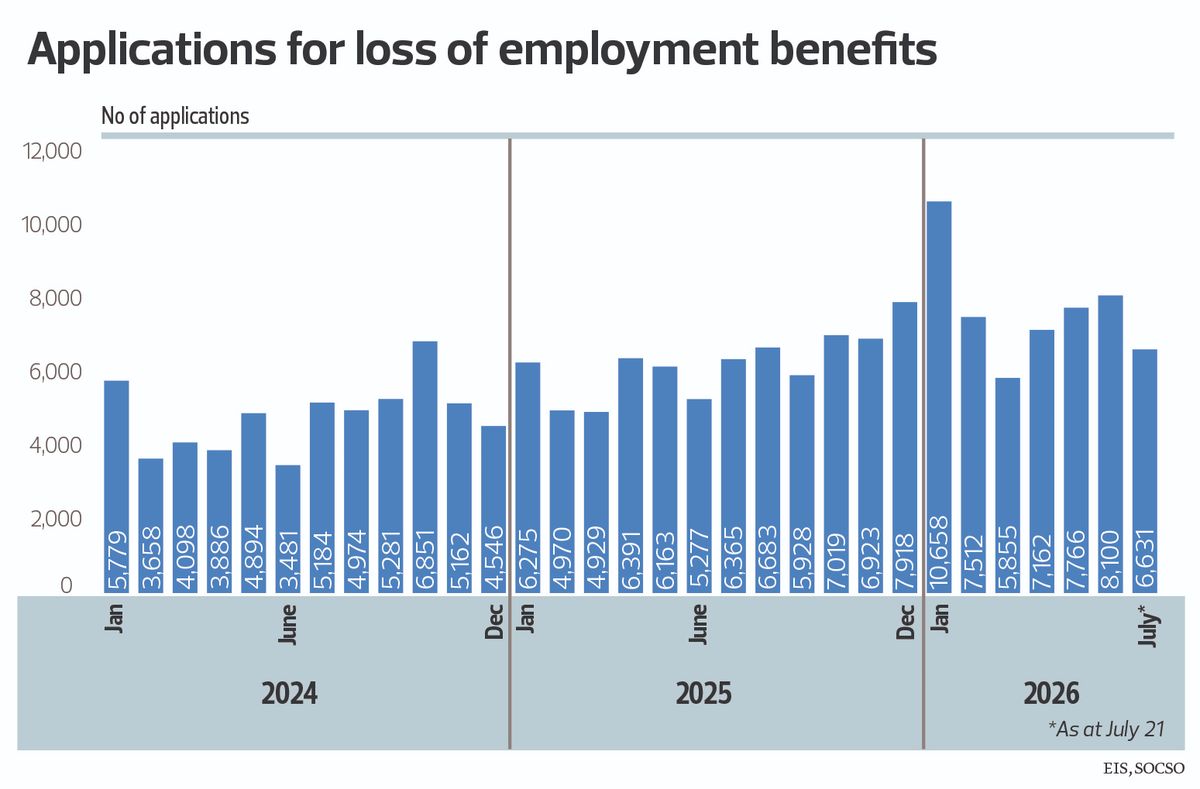
Minister of Economic Affairs Akmal Nasrullah Mohd Nasir said last Friday that a total of 68,177 workers lost their jobs from January to Sept 16, representing an increase of 15,196 over the same period last year.
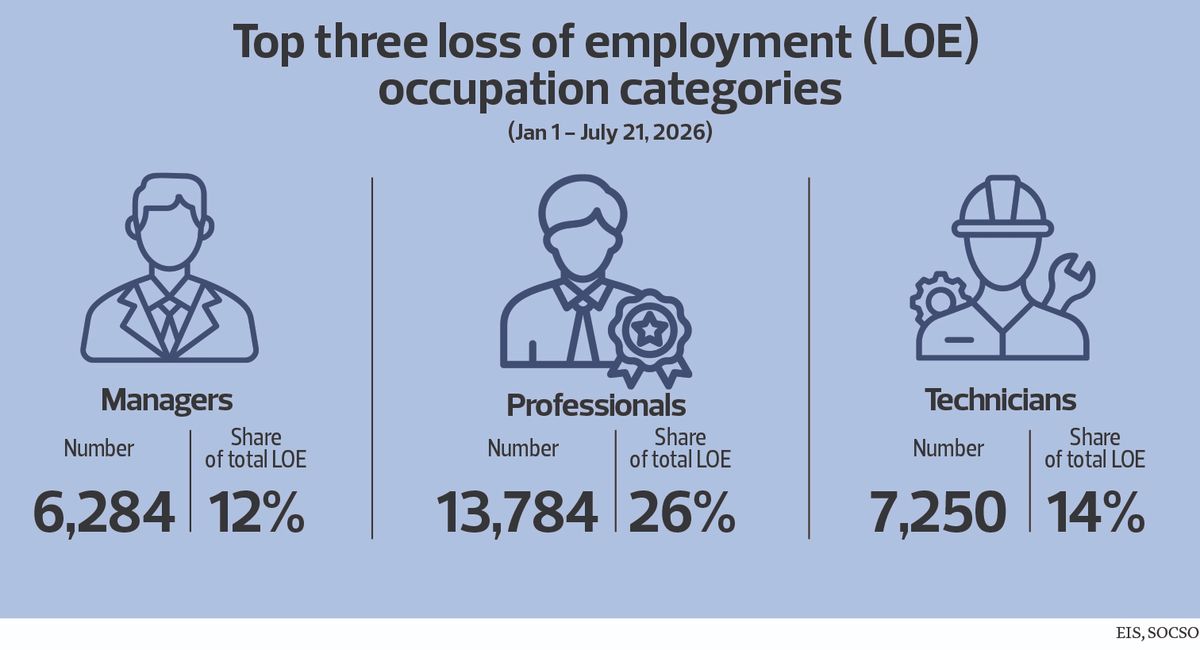
A recent report on the Social Security Organisation’s Employment Insurance Scheme (EIS) shows that professionals, managers, executives and technicians was the occupation category that saw the highest retrenchment rate, at 51% of the total loss of employment (LOE) benefit applications. It is not a new phenomenon, however, and has been in line with the data from 2021 to 2025.
While some have attributed the higher retrenchment numbers partly to the increased adoption of AI or automation in companies, Maybank Investment Bank group chief economist Suhaimi Illias says it is still too early to determine the extent to which AI is driving retrenchments.
He points out that Malaysia’s level of AI adoption, compared to other countries around the world, is still moderate. Citing the Microsoft AI Economy Institute’s Global AI Diffusion Scoring, he highlights that Malaysia ranked 51 out of 147 countries, with AI users accounting for 21.8% of the working-age population as at 1Q2026. Countries ranked among the top 20 have AI adoption rates ranging from more than 30% to 70%.
“There are also other factors behind the higher share of skilled-worker retrenchments. Voluntary/Mutual Separation Schemes or Early Retirement Planning (VSS/MSS/ERP) have consistently ranked among the top three reasons for retrenchments and were the leading reason between 2023 and 2025. Higher-skilled employees may be more inclined to participate in such schemes, given attractive payouts,” Suhaimi says.
He adds that the spike in total retrenchments may also reflect companies managing rising cost pressures through headcount reductions. This year, while the Consumer Price Index has remained moderate at 1.9% y-o-y in June, from 1.4% in February, the Producer Price Index has seen a spike to 9.2% y-o-y, from -3.4%, implying that companies have not passed down much of their higher cost to consumers so far.
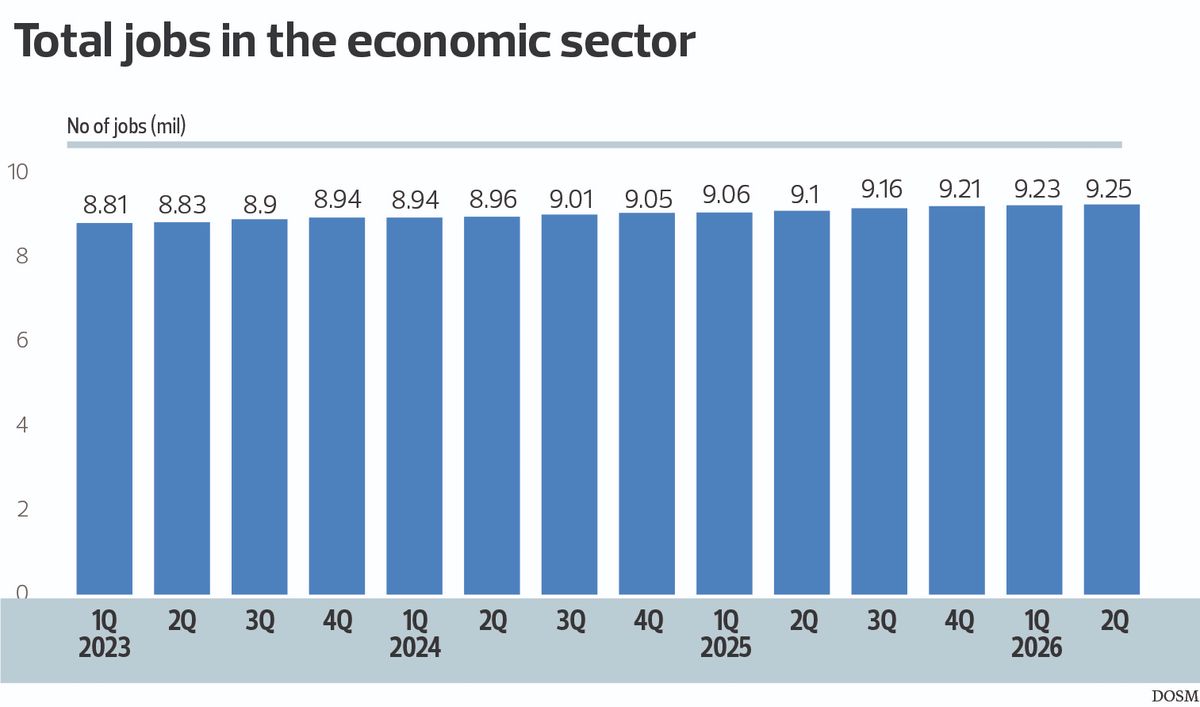
Interestingly, the country’s unemployment rate has held steady around 3% despite rising retrenchments. Suhaimi explains that because job placements continue to outpace layoffs, the economy is still net-positive for job creation. In 1H2026, placements reached 74,874, significantly higher than the 47,030 retrenchments.
The way forward for employees
With 620,000 jobs in Malaysia expected to be reshaped by AI, digitalisation and the green economy over the next three to five years, Jobstreet’s Lam warns that early-career professionals must learn to use these technologies both practically and responsibly.
“AI literacy should increasingly be treated as a baseline capability,” he adds.
Still, being literate in digital tools alone is not enough. Randstad’s Long points out the younger generation are naturally adept at using and eager to adopt new technology, but global employers still prefer “job-ready” candidates who have practical experience.
“New graduates can prepare by actively seeking out structured internships, graduate trainee programmes, and on-the-job training opportunities that offer direct exposure to complex, real-world projects,” he says. “In fact, according to the Randstad 2026 Job Market Outlook and Salary Guide report, continuous learning has become such a non-negotiable for long-term career security that 56% of Gen Z talent in Malaysia would outright reject a job offer if it did not provide clear learning and development pathways to future-proof their skills.”
Meanwhile, Long notes that mid- to late-career professionals must future-proof themselves by blending their vast experience with modern technological efficiency.
Ultimately, Lam concludes, today’s workforce — regardless of seniority — should strive to work with AI while sharpening the human and commercial skills that technology cannot easily replicate.
Read also:
Cover Story: AI may boost productivity, but what about workers’ share?
Cover Story: Big Money | Taking charge of our critical thinking
Save by subscribing to us for your print and/or digital copy.
P/S: The Edge is also available on Apple's App Store and Android's Google Play.