

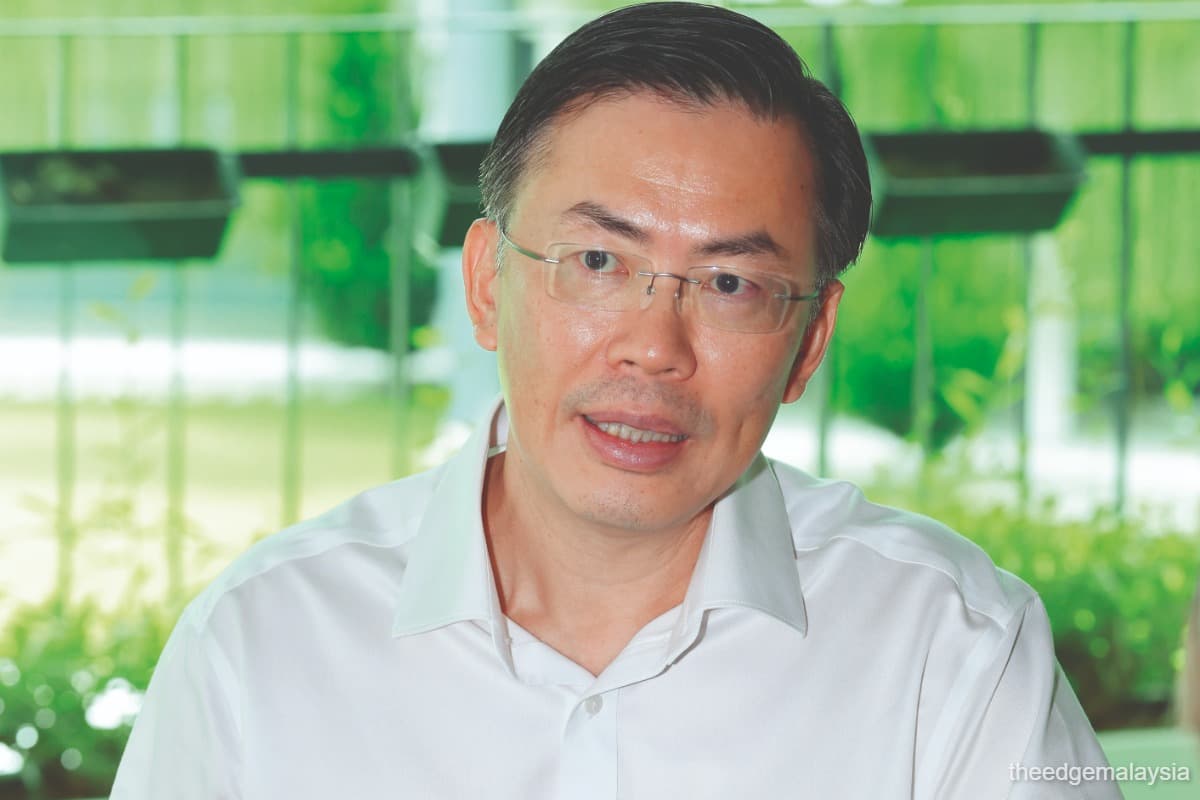
This article first appeared in The Edge Malaysia Weekly on September 21, 2026 - September 27, 2026
ViTrox Corp Bhd (KL:VITROX) broke earnings record in its latest quarter and the growth momentum will continue.
“This year, our numbers will double. We believe strong growth momentum will continue into the next few years,” co-founder and managing director Datuk Chu Jenn Weng tells The Edge in an interview at its campus in Batu Kawan Industrial Park in Seberang Prai, Penang.
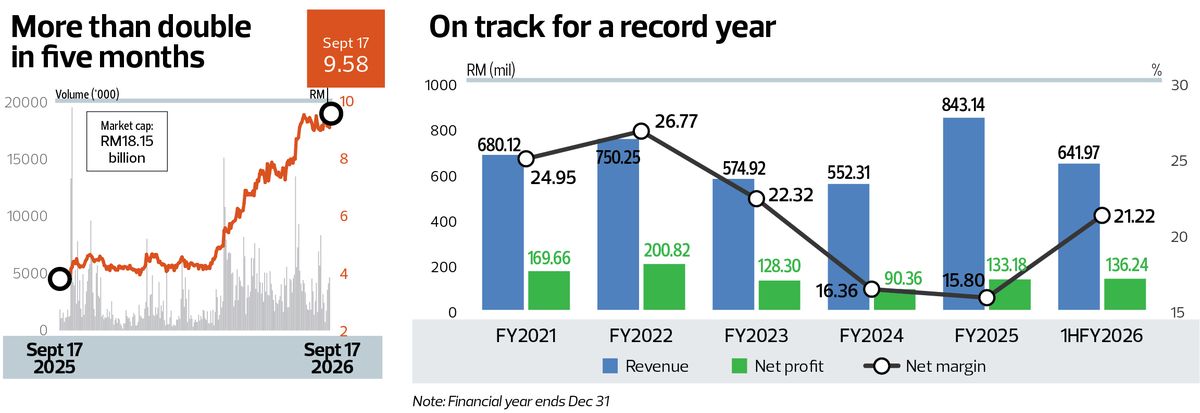
ViTrox’s revenue and net profit climbed to new peaks in the second quarter ended June 30, 2026 (2QFY2026). Its quarterly net profit soared to RM85.04 million, boosting the first six months’ profit to RM136.24 million, or 7.19 sen per share, exceeding last year’s annual net profit of RM133.18 million, or 7.04 sen per share. Revenue ballooned to RM374.92 million, lifting the cumulative six-month revenue to RM641.97 million.
Looking at the earnings figures, Chu’s optimism is understandable.
Like its peers in the semiconductor-related industry, ViTrox is operating at full capacity and expanding to cope with the surge in demand.
“The board and the chips become so complex that humans are no longer able to perform manual inspection,” says Chu, pointing to the growing complexity of multilayer, 2.5D and 3D semiconductor and electronics designs.
In short, this is driving demand for highly sophisticated automated inspection systems as manufacturers grapple with increasingly demanding requirements in power management, data transfer, computing and cooling.
Chu, who is also CEO of the company, says that ViTrox’s advantage is not just the machines it makes. Its long-term relationships with leading technology companies also give the group a better understanding of the evolving manufacturing requirements.
“We have built a long-term relationship with many top-tier customers, be it the chipmakers, cloud service providers, automotive manufacturers, equipment makers, IDMs (Integrated Device Manufacturers) [and those involved in] OSAT (Outsourced Semiconductor Assembly and Test) and EMS (Electronics Manufacturing Services),” says Chu. “All these are our very important clients and networks that have worked very closely with us to build inspection solutions together for two, three years down the road.”
That early preview of customers’ technology road maps allows ViTrox to anticipate emerging requirements and channel its research & development (R&D) investments accordingly. Chu says these insights, gathered by the company’s frontline teams, become an important input when deciding where to invest.
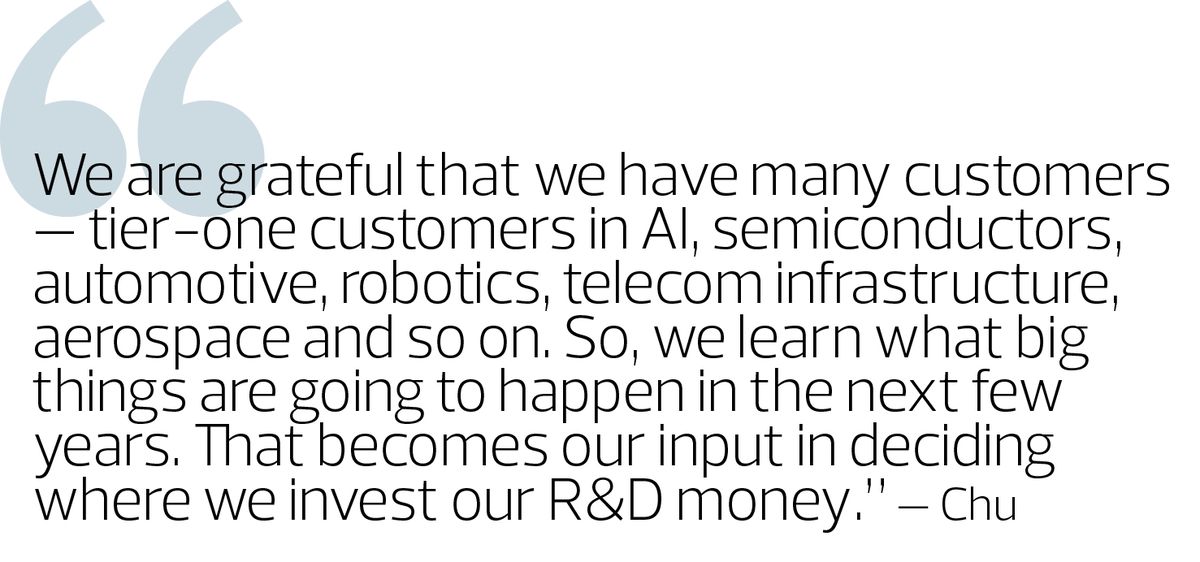
“We are grateful that we have many customers — tier-one customers in AI, semiconductors, automotive, robotics, telecom infrastructure, aerospace and so on. So, we learn what big things are going to happen in the next few years. That becomes our input in deciding where we invest our R&D money,” explains Chu, a Universiti Sains Malaysia graduate who believes Malaysia will have its own Silicon Valley one day.
R&D and finding new customers
ViTrox’s two most important annual KPIs are developing new products and recruiting new customers.
“First, investing in R&D. You have to choose your battlefield — what products are you going to research, develop and build. Now, the second is also very critical — increase the number of customers every year, regardless of the ups and downs,” says Chu.
To drive product development to meet customers’ high requirements, ViTrox invests about 10% of its revenue in R&D annually; the allocation was as high as 30% in some years. This year, it has allocated more than RM100 million to R&D.
For the past 15 years, each business unit has developed at least two new or enhanced products every year, underscoring the company’s long-term commitment to building proprietary intellectual property. “This is not a one-year strategy. It’s a 15- to 20-year strategy,” says Chu, highlighting that the company has consistently invested in its own intellectual property since its founding.
That investment is also closely tied to ViTrox’s direct relationships with tier-one customers, allowing it to work closely with them rather than operating through another layer.
ViTrox currently generates more than 20% of its revenue from new products and innovations. Its QX1 X-ray inspection product, launched last year, is one example of the company developing products ahead of demand.
According to Chu, about 15 years ago, a single customer accounted for as much as 85% to 90% of group revenue. Today, its largest customer contributes about 5%, while its top 10 customers account for less than 50% of revenue.
“This is also the reason why investors are willing to give ViTrox a higher PER (price-earnings ratio). If you look around all the tech companies in Malaysia, you probably won’t find a company that has such a diversified customer base with the largest customer contributing 5% of its revenue,” Chu says.
ViTrox’s shares have surged 130% this year so far, with the stock trading at a trailing PER of 83.6 times and a forward PER of nearly 60 times. At RM9.58, the group has a market capitalisation of RM18.15 billion, placing it among Bursa Malaysia’s 32 largest companies and potentially paving the way for an inclusion into the expanded FBM KLCI 50.
Analysts remain broadly bullish on the stock, with 11 “buy” calls, two “holds” and one “sell”. The consensus target price of RM10.67 implies a potential upside of 11.3% from RM9.58.
Consensus forecasts point to net profit more than doubling to RM306 million this year, followed by growth of 28% to RM392 million in FY2027 and a further 13.4% to RM445 million in FY2028.
CLSA is more bullish on that earnings trajectory, forecasting net profit of RM548 million in FY2028. It has the highest target price of RM13, based on a PER of 45 times on FY2028 earnings.
Chu currently holds a 24.65% stake in ViTrox, while his founding partners Steven Siaw Kok Tong and Yeoh Shih Hoong hold 18.32% and 9.22% respectively.
From March to August this year, they had disposed of shares worth about RM442.29 million, based on disclosed disposal prices of RM4.30, RM5.328 and RM8.531.
The sale of shares is not cashing out, according to Chu, but to raise funds to take over ViTrox’s education arm that is burning cash, raising concern among some investors (see sidebar).
Expanding capacity for the next upcycle
ViTrox is building a new 500,000 sq ft, five-storey manufacturing facility, more than three times the size of its current 150,000 sq ft manufacturing space. Chu expects the new facility to come onstream in about 15 months, with the first two floors potentially being used before the entire building is completed.
The facility is expected to provide at least three times the group’s existing capacity, with further productivity gains possible through greater automation and AI implementation.
The expansion reflects the company’s current capacity crunch.
Nonetheless, Chu, who understands well the cyclical nature of the semiconductor industry, is also conscious that today’s demand may not last forever.
“We have to prepare for rainy days and also further ahead for spring,” he says, referring to the need to develop products and capabilities for the next cycle.
Commenting on the current cycle, Chu says: “If you analyse our revenue and profit growth over the last 20 years, we probably experienced at least five cycles of slowdowns. But if you do a further analysis, every time there’s a slowdown, after two years, we’d double our revenue.
“It’s very consistent, and this pattern is clear. We have found that economic downturns often provide opportunities for us to strengthen our position, as we have historically seen our revenue double within two years of such periods.”
“That’s what we were expecting. But this time, because of the AI boom, probably more than double. So the key question is: what have we done during the downturn?”
Since its listing on Bursa Malaysia in September 2005, ViTrox has remained profitable and paid dividends every year, and has generated positive free cash flow for at least 12 years since 2013.
ViTrox’s efforts to diversify its customer base have helped broaden its international footprint.
The group has more than 1,000 machines installed base across its product categories, giving it a growing customer base from which to deepen relationships and introduce new products.
China is an important part of that global footprint, contributing about 30% of revenue. ViTrox has been operating in the country since 2007 and has spent years building local sales channels, distributors and customer relationships.
This gives the Malaysian technology company exposure to both Western and Chinese technology ecosystems rather than relying exclusively on one.
While China’s manufacturing market is highly competitive, particularly on price, ViTrox relies on its technological moat to differentiate itself from local competitors and focus on higher-end applications where accuracy, reliability and performance matter.
ViTrox wants to cultivate recurring income as a move to counter the industry downcycle.
Service revenue typically accounted for about 15% of revenue annually, according to Chu, who sees it potentially doubling over the next few years as the installed base expands.
The model is straightforward. Machines typically come with a one- to two-year warranty, after which customers can take up service contracts covering maintenance, replacement parts and upgrades. Furthermore, it helps to create customer stickiness.
Save by subscribing to us for your print and/or digital copy.
P/S: The Edge is also available on Apple's App Store and Android's Google Play.