

This article first appeared in The Edge Malaysia Weekly on September 14, 2026 - September 20, 2026
UNDER the Lembaga Tabung Haji (TH) rescue plan in 2018, government-owned Urusharta Jamaah Sdn Bhd (UJSB) took over RM9.7 billion worth of underperforming assets from the pilgrims’ fund at a premium of more than RM10 billion.
Apart from public equities, the assets included low-yielding hotel operations in the country, the MOF Inc Tower on Persiaran KLCC (previously known as Menara TH Platinum) and loss-making oil palm plantations in Sarawak.
Eight years on, the performance of these assets has improved significantly following the necessary intervention, says UJSB chairman Datuk Mohd Shukri Hussin.
“We do not merely hold the assets passively,” he says in an interview with The Edge on UJSB’s performance over the years. “We focused on operational rehabilitation, governance improvements and active management.”
“It was not rocket science,” Shukri explains. “The improvements came largely from disciplined execution and fixing basic operational shortcomings rather than complex financial or technical strategies.”
The strongest example of rehabilitation is TH’s oil palm estate in Sri Aman, Sarawak, which is priced at RM695 million today after its transfer back to the pilgrims’ fund.
TH’s plantation arm, with a landbank of 21,639 acres and a palm maturity profile of 10 years as at 2025, was returned to the fund as part of the restructuring in May this year of UJSB’s first sukuk tranche held by the pilgrims’ fund.
UJSB had taken over the plantation entity — TH Estate (Holdings) Sdn Bhd — in 2018 at RM802 million, which was an overvaluation of RM57 million to its book value at the time.
When it went back to TH, it “was no longer the same asset we had inherited”, says Shukri, who has chaired UJSB since 2018.
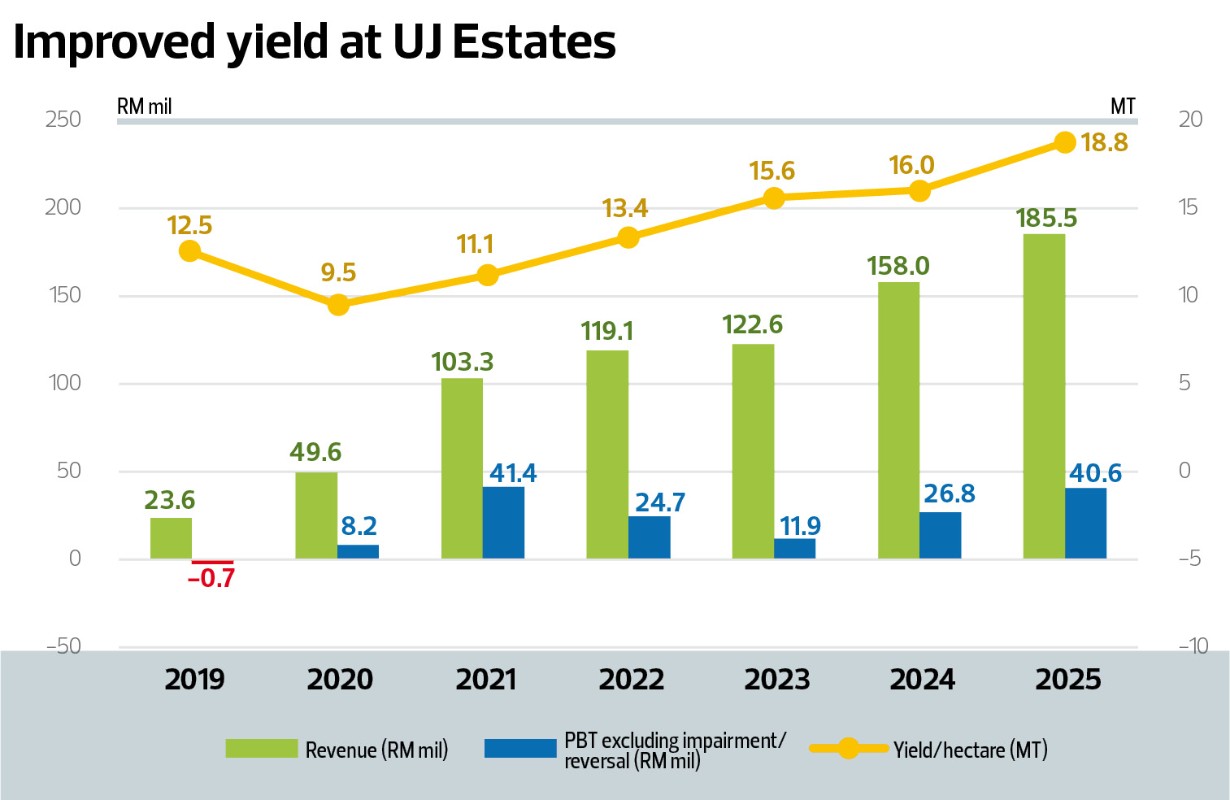
Between 2021 and 2025, the plantation operation, renamed UJ Estates (Holdings) Sdn Bhd, increased its fresh fruit bunch (FFB) yield per hectare by an average of 13.93% annually, rising from 11.14 tonnes to 18.77 tonnes. The estate processed 155,406 tonnes of FFB in 2025, up from 117,750 tonnes in 2021.
UJ Estates’ pre-tax profit, excluding reversal of an impairment, stood at RM40.6 million against revenue of RM185.5 million, compared with RM41.3 million against revenue of RM103.3 million in 2021.
According to Mohd Shukri, UJSB essentially did what should have been done as a plantation outfit: undertake fertilisation and pest control activities, deepen a nearby river to mitigate flood issues at the estate, improve road infrastructure and staff facilities, and appoint independent directors with industry experience alongside other governance oversight.
For now, the prospects for the business appear positive, with crude palm oil prices set to remain elevated close to RM5,000 per tonne as a strong El Niño persists, causing hot and dry weather in oil palm-growing regions. Over the long term, the original owner, which also has plantation operations under TH Plantations Bhd (KL:THPLANT), will have to plan ahead on replanting activities to ensure yields remain strong.
To be clear, UJSB was a reluctant plantation operator. It had planned to dispose of the asset at a loss even back in 2019. However, it did not get the right buyer, resulting in its decision to discontinue the disposal plan in March 2022 before taking over the operations from TH’s TH Agro Management Sdn Bhd by July 2023.
“We took over late because we never had expertise in plantations. But for one reason or another… we took [it] back, and by the time we did that, we had managed to do all these simple, simple things,” Mohd Shukri explains.
Hotels, property yield improvement ongoing
The same approach is being taken for UJSB’s property assets and hotel business. The reason is simple: UJSB does not have the financial firepower of other asset managers and has to manage costs as prudently as possible.
In total, 29 properties were transferred at RM2.25 billion, representing a premium of around RM932 million.
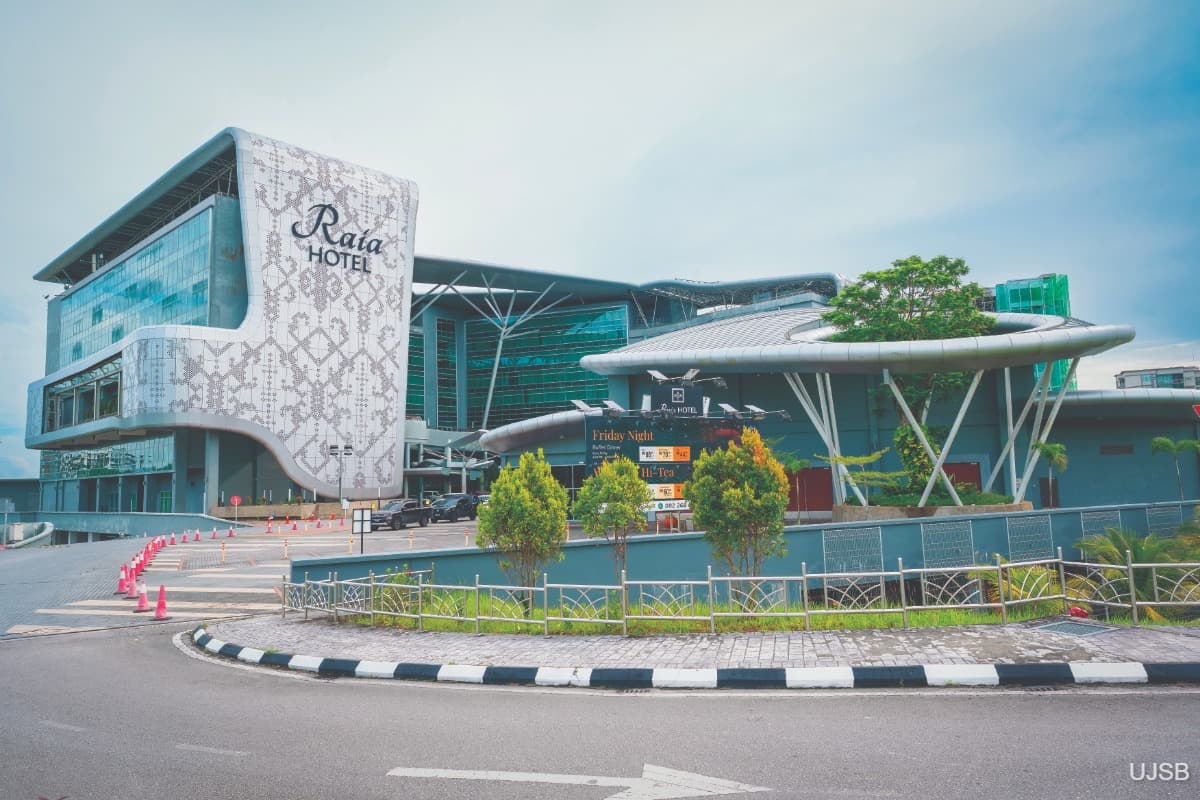
The assets had returns of less than 2.5% per annum at the time. Today, the hotel division’s gross operating profit has exceeded that through the rebranded four-star Raia Hotel chain, with five hotels under its ownership and one under management agreement.
“All the outlets are making money,” says Mohd Shukri.
The first major hotel renovation by the company, named UJ Hotels & Resorts, was carried out in Penang at a cost of RM8 million. The project included the addition of a swimming pool, which helped double revenue. Renovations in Kuala Terengganu and Alor Setar followed.
It also has one Raia Hotel in Kota Kinabalu and another in Kuching, the latter of which was not operational at the time of the takeover and required a soft loan of RM6 million to commence operations.
“It continues to be one of the best performing hotels,” Mohd Shukri says.
Part of that diversification involved improving digital marketing and repositioning Raia beyond its traditional customer base. Management has adopted what it calls a “hotel for all” concept, opening the chain to a broader mix of customers and events while retaining its shariah-compliant positioning.
The group has, for example, hosted Chinese weddings under guidelines drawn up by its shariah adviser, particularly in Terengganu. Its Alor Setar property has also hosted the Yang di-Pertuan Agong and other royal dignitaries visiting the northern region.
“We can say we are the market leader in Alor Setar,” says Mohd Shukri, beaming with pride.
The hospitality segment has grown its gross operating profit margin to over 20%. Beyond property management, the hotel business operates assets under management contracts, including a 20-year agreement to manage the Raia Hotel in Port Dickson, allowing it to expand its footprint without owning hotel assets, which is outside UJSB’s mandate.
“As an operator, you need the scale,” Mohd Shukri says.
That means separating hotel ownership from hotel operations and growing fee income through management contracts without tying up UJSB’s capital. The group is also working on reducing its dependence on government business, which today represents about 30% of its jobs.
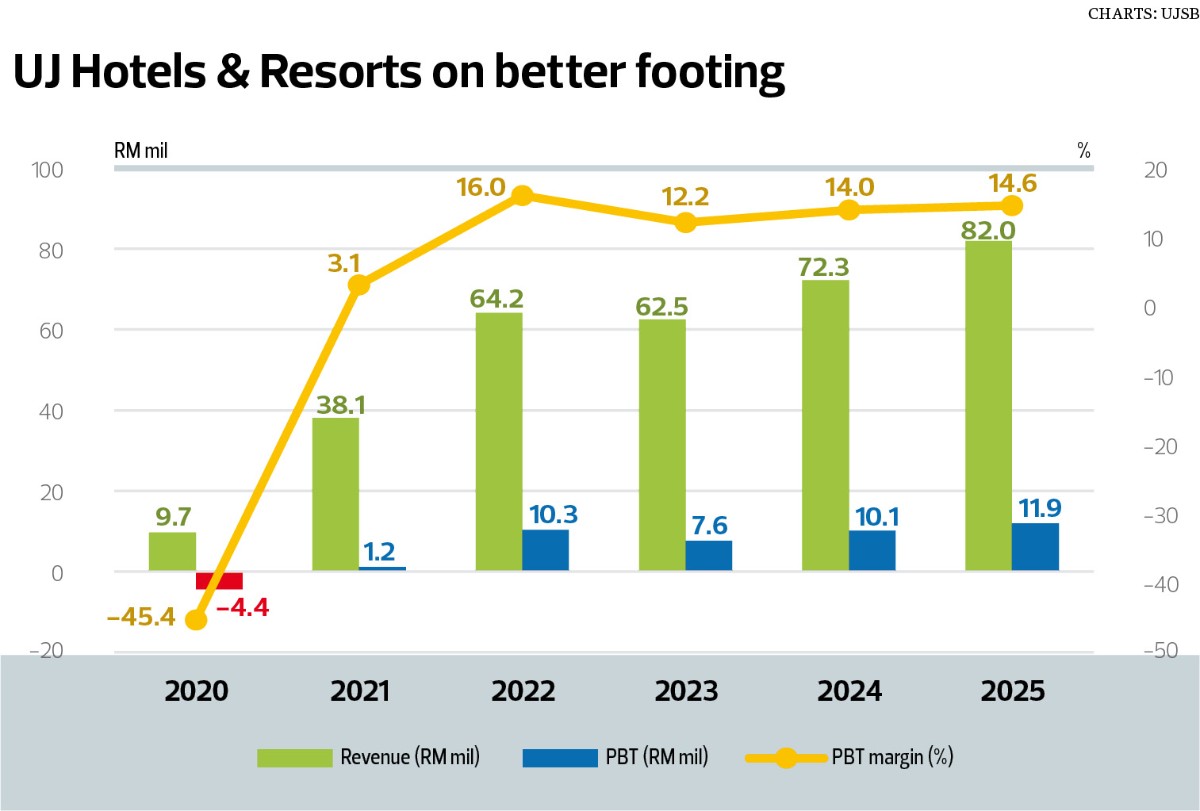
In 2025, the hotel business’ pre-tax profit grew 18.2% year on year to RM11.94 million from RM10.1 million in 2024 as revenue rose 13.4% to RM82 million from RM72.3 million.
As for UJSB’s 38-storey MOF Inc Tower in Platinum Park, revenue now exceeds direct expenses as occupancy has more than doubled to 58% compared with 24% pre-pandemic, with rents improving to RM8.50 psf from around RM3 previously.
Located just across the newly opened Ombak KLCC shopping mall, the Grade A office tower was acquired by TH reportedly for about RM450 million from Naza TTDI Sdn Bhd back in 2014. It was renamed Platinum East Tower in 2020 and subsequently to its current name partly to attract government-linked commercial entities, which has helped lift occupancy.
However, the commercial buildings landscape remains highly competitive. Overall, the property division’s net yield stood at 0.3%.
The majority of UJSB’s properties are shop lots in suburban areas such as Batu Pahat and Kulim, which were originally intended to house TH branches. However, these plans did not materialise as online transactions became increasingly common.
To date, UJSB has sold three underperforming shop lots on the open market. It has also taken back a 1.57-acre parcel of TRX land under the sukuk restructuring for RM270 million, leaving it with 25 properties.
Overall, the hotel and property segments are no longer distressed but not yet sufficiently rehabilitated. The restructured sukuk has a maturity date of May 2036, which means UJSB has until then to recover and create as much value as possible from these legacy assets under its mandate.
“Until and unless the returns are enough to justify the cost of investment, we have to nurture it,” Mohd Shukri adds.
Under its 10-year plan, UJSB anticipates increasing the value of its investment properties by between RM230 million and RM573 million through yield enhancement initiatives, strategic disposals and reinvestment in higher-yielding assets.
It also targets investment portfolio returns of up to RM6.8 billion during the period, as it is obligated to pay tranche 1 sukuk coupon for RM439 million a year or a cumulative RM4.39 billion in the same 10 years.
It is certainly a challenging task for the outfit tasked with rehabilitating TH’s legacy assets while supporting the pilgrims’ fund’s cash flow through coupon payments. Yet the public will expect nothing less from UJSB if it is to eventually close the chapter on the rescue of one of Malaysia’s key government-linked investment companies.
Read also: Save by subscribing to us for
your print and/or
digital copy. P/S: The Edge is also available on
Apple's App Store and
Android's Google Play.
Cover Story 2: Urusharta Jamaah yet to see finishing line
Cover Story 2: ‘We are concentrating on our mission’