

This article first appeared in The Edge Malaysia Weekly on September 14, 2026 - September 20, 2026
WHEN Urusharta Jamaah Sdn Bhd (UJSB) was incorporated in December 2018, the team at the special-purpose vehicle (SPV) had to hit the ground running as Lembaga Tabung Haji’s (TH) financial health was deteriorating fast, raising concerns about the pilgrims’ fund’s status as a going concern.
It is like playing rugby. When the rugby ball is thrown to you, you just have to catch it, and dash towards the opponent’s pitch, touching it on the ground to win the game.
UJSB chairman Datuk Mohd Shukri Hussin, who played rugby at school, knows the rules well. Likewise, given his years of experience in the financial sector, the former banker was well aware right from the beginning that UJSB had embarked on a long and bumpy journey to accomplish its mission — taking over TH’s non-performing assets and recovering their value.
What Mohd Shukri and his team might not have expected was the backlash and criticism in parliament and on social media. From his perspective, his 38-member team had been doing a good job of protecting the 9.7 million TH members’ hard-earned savings.
At a special Dewan Rakyat sitting on Aug 11, several members of parliament questioned UJSB’s asset disposals, cash flow, costs and sukuk obligations.
However, few in the public knew that the type of assets and transfer values had already been decided by the cabinet under Tun Dr Mahathir Mohamad’s administration on Dec 7, 2018, a week before UJSB was established. The asset-transfer agreement was signed on Dec 27, shortly before TH closed its accounts for the financial year ended Dec 31, 2018.
“We accepted the list of assets and the (carrying) values. If we did not do this, there would be no rescue [of TH],” Mohd Shukri tells The Edge in his first press interview, stressing that there was neither negotiation nor cherry-picking. “We were told those were the criteria decided at the time. Period,” says Mohd Shukri, who was appointed to the board on Dec 18, 2018.
So, UJSB inherited 106 listed equities, a plantation company — TH Estates (Holdings) Sdn Bhd, later renamed UJ Estates — and 29 properties, most of which were shoplots in rural backwater.
The assets transferred were valued at RM19.9 billion although the combined market value then was only RM9.633 billion. UJSB had to stomach a valuation gap of RM10.267 billion from the outset. TH, in return, was issued two tranches of zero-coupon sukuk with a combined value of RM19.6 billion as consideration for the assets. The two sukuk were worth RM27.55 billion at maturity excluding early redemptions.
In addition, the Ministry of Finance (MOF) injected RM300 million cash into TH.
The transfer of assets helped clean up TH’s balance sheet, bringing its net worth of assets back into the positive zone.
By 2025, TH declared a profit distribution rate of 3.5% for 2025, which was the highest in eight years. It also declared a zakat of 2.58% for 2025, bringing total payments to all state Islamic religious councils on behalf of depositors to RM95.3 million. This is evidence that the pilgrims’ fund is on strong financial footing.
However, UJSB’s job is far from complete.
The SPV, which is wholly-owned by the Minister of Finance (Inc), recently refinanced the first tranche of the Islamic sukuk that carry an outstanding balance of RM12.48 billion following partial early redemption. To refinance the balance, UJSB executed in-kind transfer of assets worth RM965 million, leaving the oustanding RM11.51 billion to be reissued with 10-year maturity.
The in-kind assets are: a parcel of Tun Razak Exchange (TRX) land transferred at RM270 million compared with its current market value of RM285 million, and an oil palm plantation in Sarawak — UJ Estates — at RM695 million, compared with market value of RM745 million. In fact, these two assets were among the better ones UJSB had got from TH.
TH received the estate in a better condition than when it was handed to UJSB. According to Mohd Shukri, the yield per hectare of the plantation had grown from 12.5 tonnes in 2019 to 18.77 tonnes in 2025.
“Honestly, we are just plucking the low-hanging fruit, doing simple things like having active fertilisation and pest control, mitigating floods by deepening a river, building staff quarters (to turn around the plantation). It is not rocket science,” he says candidly.
Part of the assets also included four underperforming hotels and one which was not in operations, later rebranded to Raia Hotel by UJSB with funding and operational improvements put in place to improve its marketability and profitability. (See also “Steering legacy assets in the right direction” on Page 70.)
Additional seven years of runway
The new debt paper that was issued recently matures in May 2036, meaning UJSB’s runway has been extended by seven years. Its second sukuk, issued in 2018, matures in May 2029.
The sukuk carries a fixed annual coupon of 3.825%. Being the bondholder, TH will receive RM440 million annually beginning May 31, 2027. The cash will come in handy for the pilgrims’ fund, which is subsidising the low-income members’ pilgrimages.
TH did not receive any cash from UJSB under the first two tranches of zero-coupon sukuk.
Realistically, Mohd Shukri knows the chances of an even longer runway ahead simply because the second sukuk matures in three years’ time. The second Islamic bond was issued at RM9.6 billion for 10 years at 4.1%, producing a nominal value of RM14.35 billion.
Refinancing of debt paper is common practice. But it is undeniable that the recent refinancing of the sukuk reflects UJSB’s balance sheet strength, to some extent, considering the SPV is supposed to be a finite mission.
“Why do you want to ask about that? There are still three more years to go. Focus on what matters now,” Mohd Shukri replies when asked about the plan for the maturity of the second tranche.
Nonetheless, he acknowledges that redemption is out of the question without the government lending a helping hand.
“Maybe the answer should come from the MOF. Maybe the right person to see is the Minister of Finance. At the end of the day, it is a sovereign risk.
“If the stakeholders say, ‘Here is everything; pay it out,’ habislah cerita [that is the end of the matter], and we will not even reach 2036,” he says. “By May 2026, we already knew that our runway would run until 2036. But we do not know [what will happen in] 2029.”
“Tranche one, kita boleh (we can manage). Tranche two, not sure. Our runway is not forever. We do not have money continually coming in. We have to live with what we have.”
UJSB’s financials and investments
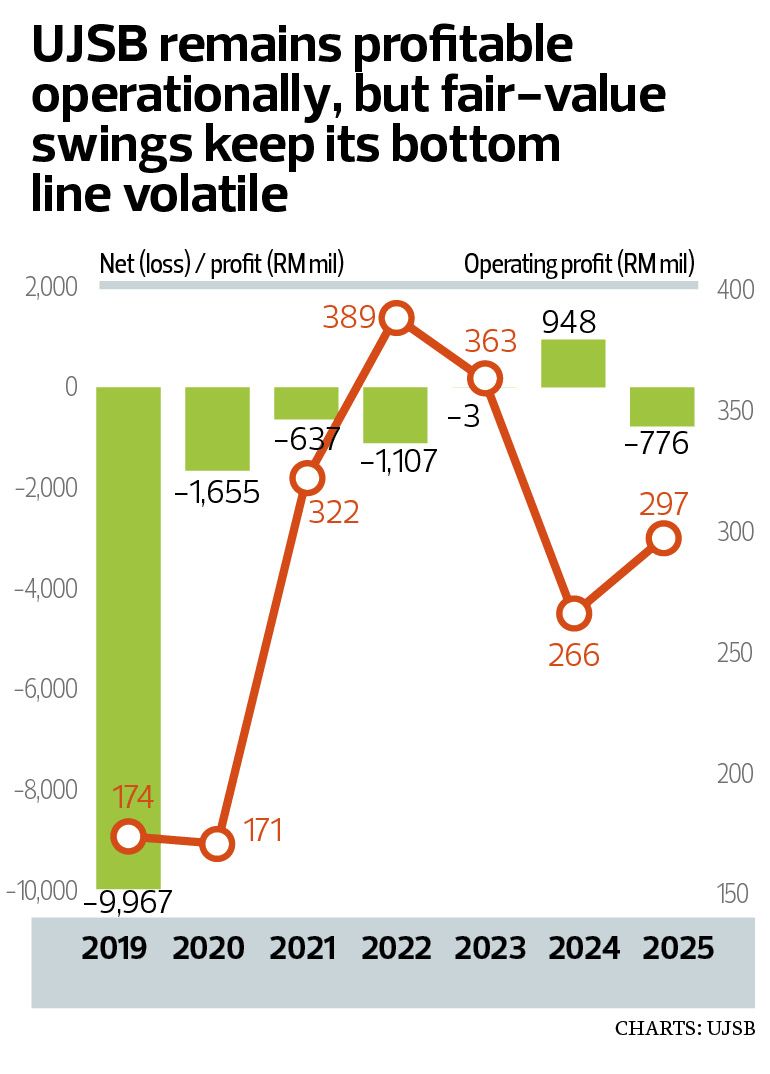
In its first year of operation in 2019, UJSB booked a massive net value loss of RM9.66 billion due to the hefty premium on assets transferred from TH. In 2020, it was RM1.51 billion.
In 2024, a RM1.4 billion fair value gain helped UJSB achieve its maiden net profit of RM948 million.
A portfolio of quoted equities is vulnerable to the volatility of the stock market due to the mark-to-market accounting treatment.
“You should look at operating profit, not the net profit, which is largely affected by fair value gain or loss,” says Mohd Shukri.
Over the past three years, UJSB’s finance cost has been around RM900 million due to the yield of slightly over 4% on the zero-coupon papers. The new tranche sukuk comes with coupon rate of 3.825%, which means it will have to fork out around RM440 million cash each year, to pay TH.
According to Mohd Shukri, the initial plan by the government was to grant RM1.73 billion to UJSB each year for early redemption of the papers. However, the SPV has received only RM930 million from the government in the past six years — a fraction of the amount of at least RM17.8 billion in allocations approved by the cabinet in April 2019, as the Royal Commission of Inquiry (RCI) revealed. The government had also provided a letter of financial support, which is distinct from a statutory guarantee, for the UJSB sukuk.
Mohd Shukri understands that UJSB is not among the top priorities as far as government grants go, pointing out that the government needs to prioritise its expenditure, given the fiscal constraints. In short, he and his team will just have to make do with what is in hand.
UJSB’s investments are not only subject to shariah compliance and but it also needs to have a sizeable portfolio of dividend yielding stocks to ensure regular dividend payments.
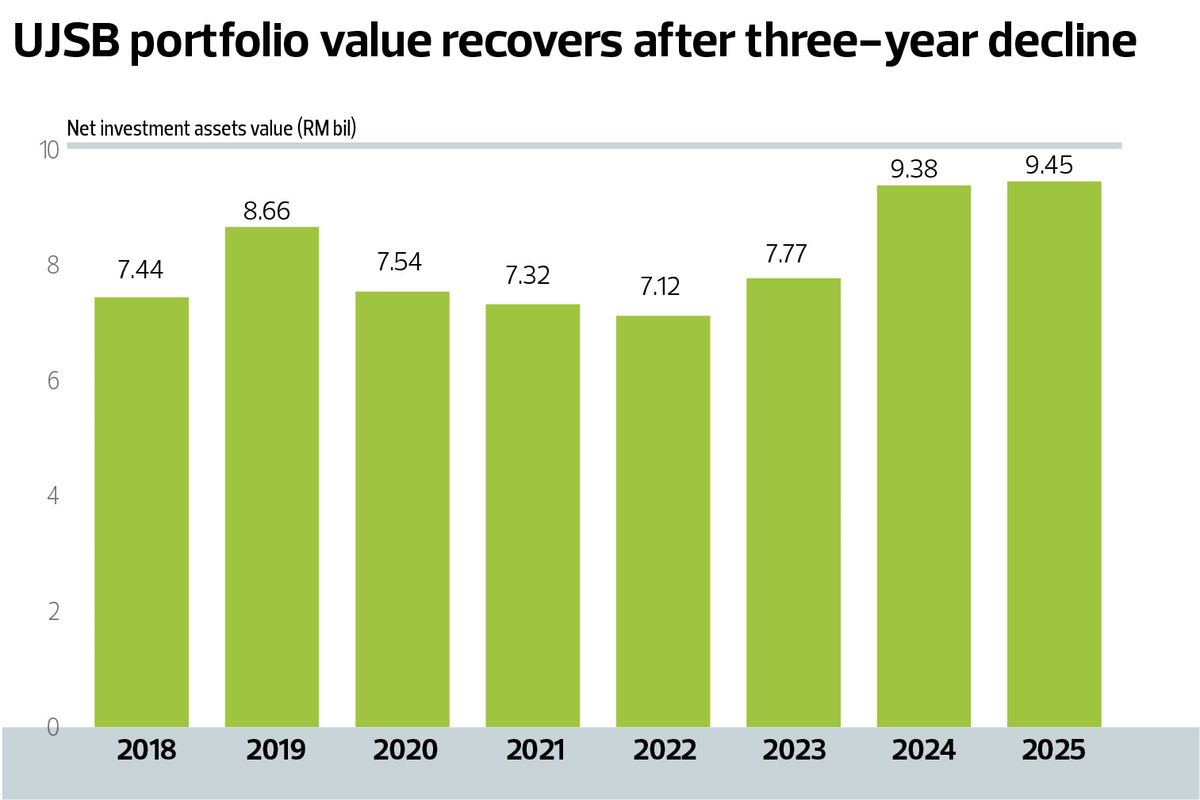
The SPV’s current investment portfolio has produced a cumulative return of 30.8% since its inception as its total investment value had expanded from RM7.444 billion in 2018 to RM9.445 billion in 2025.
Mohd Shukri points out that UJSB’s listed-securities portfolio appears to have produced better returns than its property portfolio, which continues to generate relatively low yields against its inherited cost. The property portfolio, including the hotels, generated a gross yield of about 2.5% and a net yield of only about 2.3%, he says.
As for the equities portfolio, UJSB plans to increase its overseas investments from about 5% of the portfolio to its strategic target of 30%. That could raise its projected excess to around RM2 billion.
The RCI showed that UJSB had disposed of 75 of the 106 listed equities on the open market by 2020 and reinvested the proceeds in 329 Malaysian and international counters. The new portfolio generated RM200 million to RM300 million annually, enough to cover UJSB’s operating and management costs at the time.
Today, UJSB also has more flexibility to transact its assets. Until recently, TH had a first right of refusal on UJSB’s assets but this was mutually terminated during the sukuk restructuring, following discussions with TH, and with Cabinet approval.
Mohd Shukri declines to give an updated tally of the inherited assets that had been sold, reduced or increased or to disclose the realised gains and losses made by the counters.
“Why do we have to explain?” he asks. “Investments [must be] detached from emotion. If you think you have to cut losses, you cut losses. If you think you have to switch into another one, you switch,” he says.
“The EPF (Employees Provident Fund) does that all the time. It even sells good shares because it has already made good money. It cuts some shares because it is cutting losses. It goes back to commercial decisions — detach ownership from sentimentality.”
For Mohd Shukri, UJSB should be judged on the portfolio’s total returns and whether it meets its sukuk obligations.
There are allegations that UJSB sold assets to Datuk Seri Farhash Wafa Salvador. “Whether it is Farhash, who cares? It is a commercial decision. We have not been instructed to sell to anybody. No. We have not been asked to buy from anybody,” he responds when asked about the allegations.
UJSB inherited a 9.2% stake in Datasonic Group Bhd, now known as NexG Bhd (KL:NEXG). It began to pare down its stake in NexG in November 2024, selling most of its shares on the open market, except for a final block of about 3% to 4% that was offloaded to an individual.
Mohd Shukri did not identify the buyer or the price, but revealed that it is not Farhash anyway.
The SPV sold the NexG shares simply because of earnings risks as the company’s contract to supply passports and identity cards — a core income source — was being renewed on a six-month basis.
Filings with Bursa Malaysia show that UJSB ceased to be a substantial shareholder in April 2025 after an open market sale took its interest below the 5% disclosure threshold.
He says UJSB’s future focus is mainly managing its investment portfolio to make sure it meets its financial obligations, particularly the RM440 million annual payment to TH.
Until those obligations are met, UJSB has a long road ahead. Undeniably, to some extent, TH’s financial well-being is dependent on UJSB.
Read also:
Cover Story 2: ‘We are concentrating on our mission’
Cover Story 2: Steering legacy assets in the right direction
Save by subscribing to us for your print and/or digital copy.
P/S: The Edge is also available on Apple's App Store and Android's Google Play.