

This article first appeared in The Edge Malaysia Weekly on September 14, 2026 - September 20, 2026
FOR the Gooi family’s 68%-owned Crescendo Corp Bhd (KL:CRESNDO), the data centre boom has provided a powerful catalyst to unlock the value of the Johor-based property developer’s land bank that has been accumulated over decades.
Crescendo’s net profit reached a record RM526.3 million in the financial year ended Jan 31, 2025 (FY2025), when substantial gains were recognised from five land disposals linked to data centre developments. In FY2026, its net profit fell to RM92.3 million, highlighting the impact of the data centre land sales on its earnings.
Executive director Gooi Seong Heen sees the group’s growth extending beyond sporadic, high-value land disposals, with conventional residential development and recurring property income continuing to provide a stable earnings base.
As at April 30, 2026, Crescendo’s land bank in Johor stood at about 2,426 acres. The figure includes the four data centre-related land disposals worth RM930.5 million that have been announced.
Gooi says the proceeds from some of the previously announced transactions are expected to come in over the next two years, providing a base for the company.
Property pipeline balances lumpy land sales
While data centre land sales can produce sizeable one-off gains, Crescendo continues to build on its core property development business.
In March last year, the group launched its first high-rise residential project, Senyum Residences, with a gross development value (GDV) of RM1.3 billion, near the Johor Bahru-Singapore Rapid Transit System (RTS) Link. The project, priced from RM500,000 to nearly RM1.5 million per unit, has recorded an encouraging take-up rate, according to Gooi.
The group plans to launch 167 mid- to high-end landed residential units at Bandar Cemerlang, 18 semi-detached factories at Bandar Cemerlang Industrial Park and 24 affordable homes at Taman Dato’ Chellam, with a combined GDV of RM252 million. These developments serve to balance Crescendo’s tactical approach of monetising strategically located industrial land when data centre demand supports attractive valuations while retaining other parcels for longer-term development.
The earnings volatility was evident again in 1QFY2027, when net profit surged to RM135.74 million from RM5.21 million a year earlier, while revenue jumped to RM317.87 million from RM65.06 million, mainly because of the recognition of a data centre-related land sale.
Meanwhile, Crescendo’s manufacturing and trading arm, which produces precast concrete products mainly for the Singapore market, recorded an 11.5% jump in revenue to RM67.7 million in FY2026. Profitability was temporarily affected by the relocation and set-up of its new factory, but Gooi says the relocation has been completed and operations are expected to normalise.
Johor remains the focus
Despite opportunities emerging in other parts of Malaysia, Crescendo remains focused on its home state of Johor, says Gooi. The group’s strategy therefore is less about geographical expansion and more about extracting greater value from the land it already owns.
The land sales have also strengthened Crescendo’s financial position, giving management greater flexibility over capital deployment. Total cash holdings rose from RM54.04 million in FY2021 to RM141.04 million in FY2026, while total borrowings fell from RM314.09 million to RM175.27 million. Consequently, its net gearing ratio improved to 2.42%, from 24% in FY2021.
Gooi says the group remains focused on maintaining its property pipeline while considering land bank replenishment when opportunities are attractive. The approach is essentially one of selective monetisation: sell land when valuations reflect its strategic potential, while retaining sufficient acreage to participate in Johor’s longer-term development cycle.
That is particularly relevant to industrial land. Data centres may continue to be in demand, but Gooi indicates that the group’s broader industrial and residential development businesses will continue alongside its land sales.
As he puts it, the residential and shophouse development business is “quite steady”, while data centre transactions provide the occasional step-up in earnings.
He adds that the family is not overly concerned about the company’s market capitalisation, which has grown from about RM300 million previously to about RM1 billion today. For the family, the focus remains on unlocking the value of its land bank and returning cash to shareholders through dividends when appropriate returns have been realised.
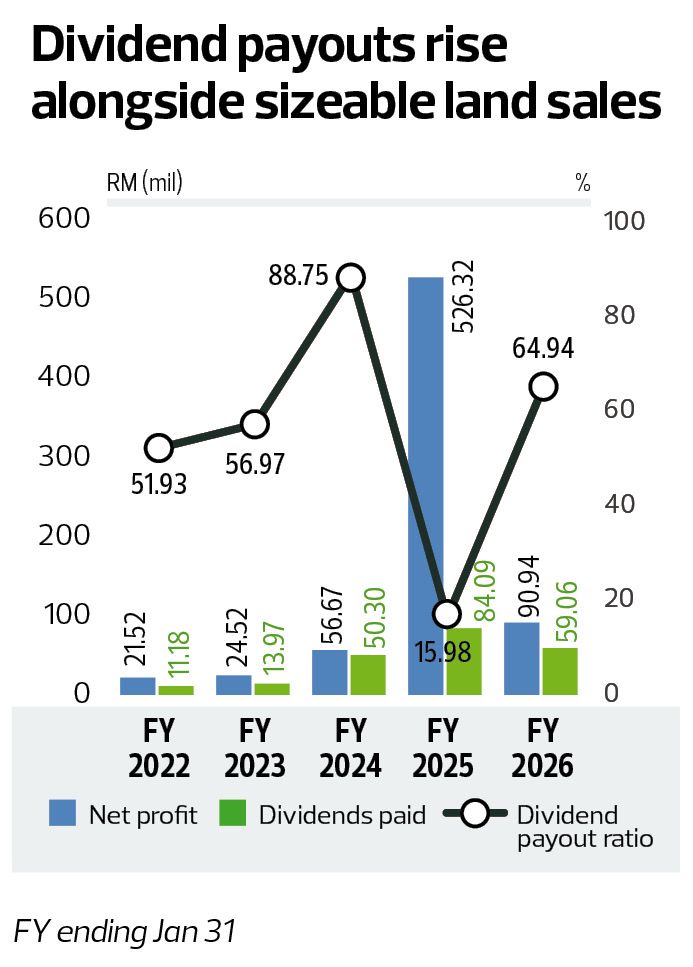
Following the substantial data centre land sales in FY2025, Crescendo generated revenue of RM1.15 billion and net profit of RM526.32 million, and paid out RM84.09 million in dividends. In FY2026, it paid out RM59.06 million in dividends after generating a net profit of RM90.94 million on revenue of RM441.27 million.
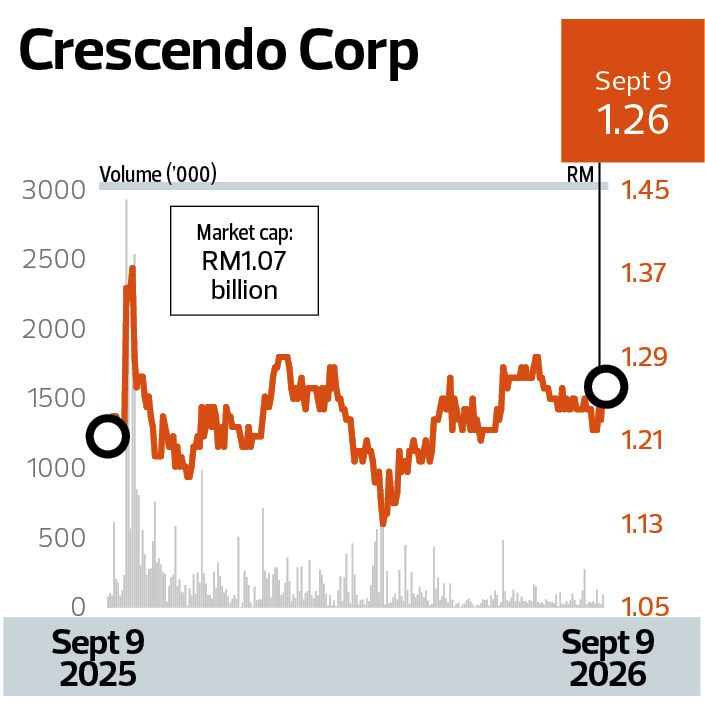
Crescendo’s share price has been largely flat over the past year. It closed at RM1.26 last Wednesday, giving the company a market capitalisation of RM1.07 billion. The shares were trading at a price-to-book value (P/B) of 0.69 times.
For comparison, Johor-centric property developer KSL Holdings Bhd (KL:KSL), which has a 5,972-acre land bank, has a market capitalisation of RM3.12 billion and its shares are trading at a P/B of 0.62 times.
Save by subscribing to us for your print and/or digital copy.
P/S: The Edge is also available on Apple's App Store and Android's Google Play.