

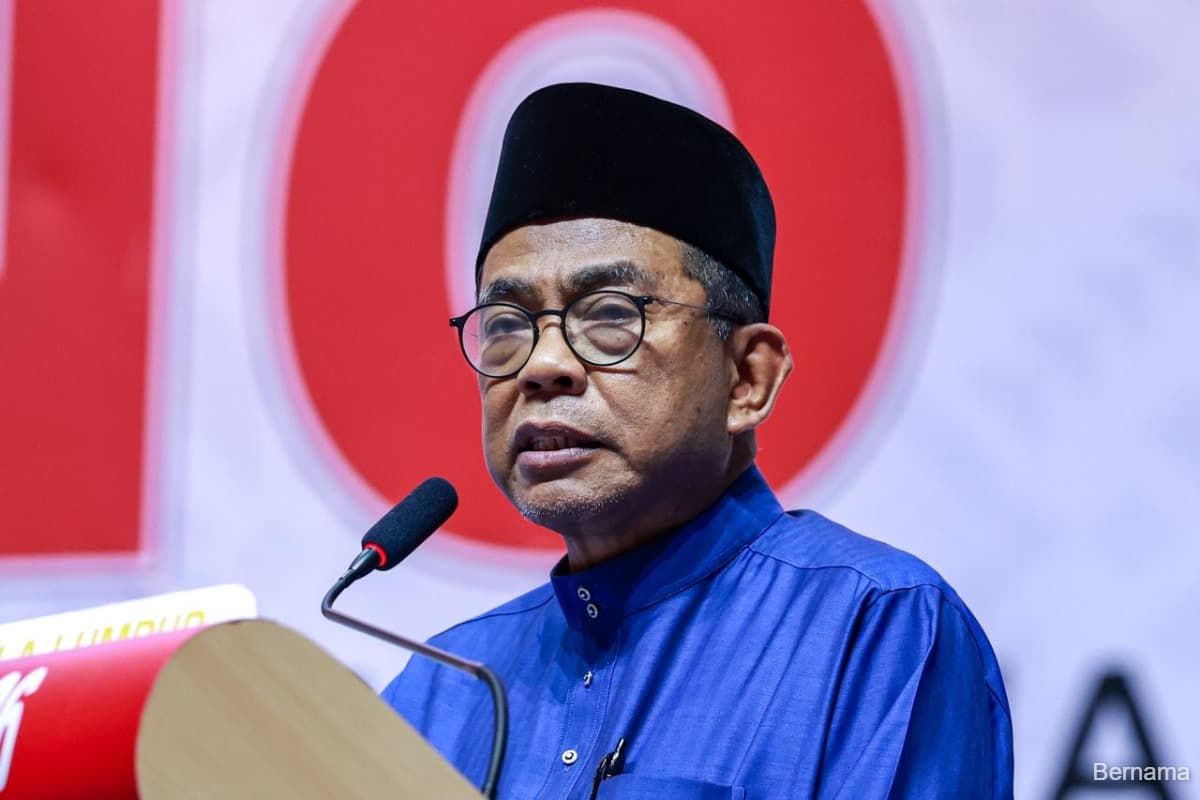
KUALA LUMPUR (Sept 12): Umno is the best option to lead efforts to unite the Malays without sidelining other communities, as compared to other political parties, a party leader claimed on Saturday.
The eigth-decaded old party needs to be the one in power due to its moderation, fairness and inclusivity, its commitment to the Malays’ central position in the country, and its emphasis on progress and modernisation, according to vice-president Datuk Seri Mohamed Khaled Nordin.
“Umno is a Malay party. But Umno is also a party that recognises and accepts non-Malays. Umno has never forced, and will never force, other communities to abandon their identities and cultures,” Mohamed Khaled said in his winding-up speech at Umno's general assembly on Saturday.
“To anyone uneasy about Malay unity led by Umno, do not worry. This unity will not erode the moderate approach that has long characterised Umno’s management of Malaysia,” the defence minister said. He added that the rights and needs of non-Malays had been protected under Umno’s leadership, including the continued operation of Chinese- and Tamil-medium schools.
Umno’s decades of uninterrupted federal rule ended in 2018. Its broader coalition Barisan Nasional (BN) — also consisting of MCA and MIC — subsequently suffered its worst general election result in 2022, winning just 30 parliamentary seats, before joining the administration led by Prime Minister Datuk Seri Anwar Ibrahim.
The party is now leading BN in talks with Perikatan Nasional, led by PAS, following collaboration success in the Negeri Sembilan state election. PAS currently has the most seats in the Dewan Rakyat, prompting questions on which of the two coalitions would be leading the collaboration in the upcoming 16th general election.
Earlier at the assembly on Friday, Umno president Datuk Seri Dr Ahmad Zahid Hamidi called for renewed Malay-Muslim unity in the presence of senior PAS leaders, urging former allies to put past differences behind them.
“Umno accepts diversity. Umno celebrates diversity. Indeed, Umno leads amid diversity through BN,” Mohamed Khaled said.

“Our task is to convince everyone that Malay unity has never been, and will never be, built by bringing others down. It must be pursued in a way that inspires confidence and trust, not through extremism, intimidation or irrationality.”
However, he made clear that inclusivity would not mean retreating from Umno’s core political commitments. Umno had maintained its commitment to the Malays’ central position in a plural Malaysia throughout the alliances it had joined over the past eight years, he added.
“There is no other way to restore Malay political power except through unity among the Malays themselves,” he said.
Malay division could diminish East Malaysia confidence
He argued that the proliferation of Malay political parties had weakened, rather than strengthened, the community’s position, and said Umno’s initiative sought to bring that political strength together.
Mohamed Khaled also warned that continued division could diminish the confidence of political partners in Sabah and Sarawak. “If we cannot manage Malay politics well, how will we convince our partners in Sabah and Sarawak to continue trusting us to lead Malaysia?” he asked.
He said leaders in both states are entitled to question the peninsula’s continued claim to national leadership. “They certainly have the right to ask: Must people from the peninsula still be given the leading role in steering Malaysia?” he said.