


This article first appeared in The Edge Malaysia Weekly on September 7, 2026 - September 13, 2026
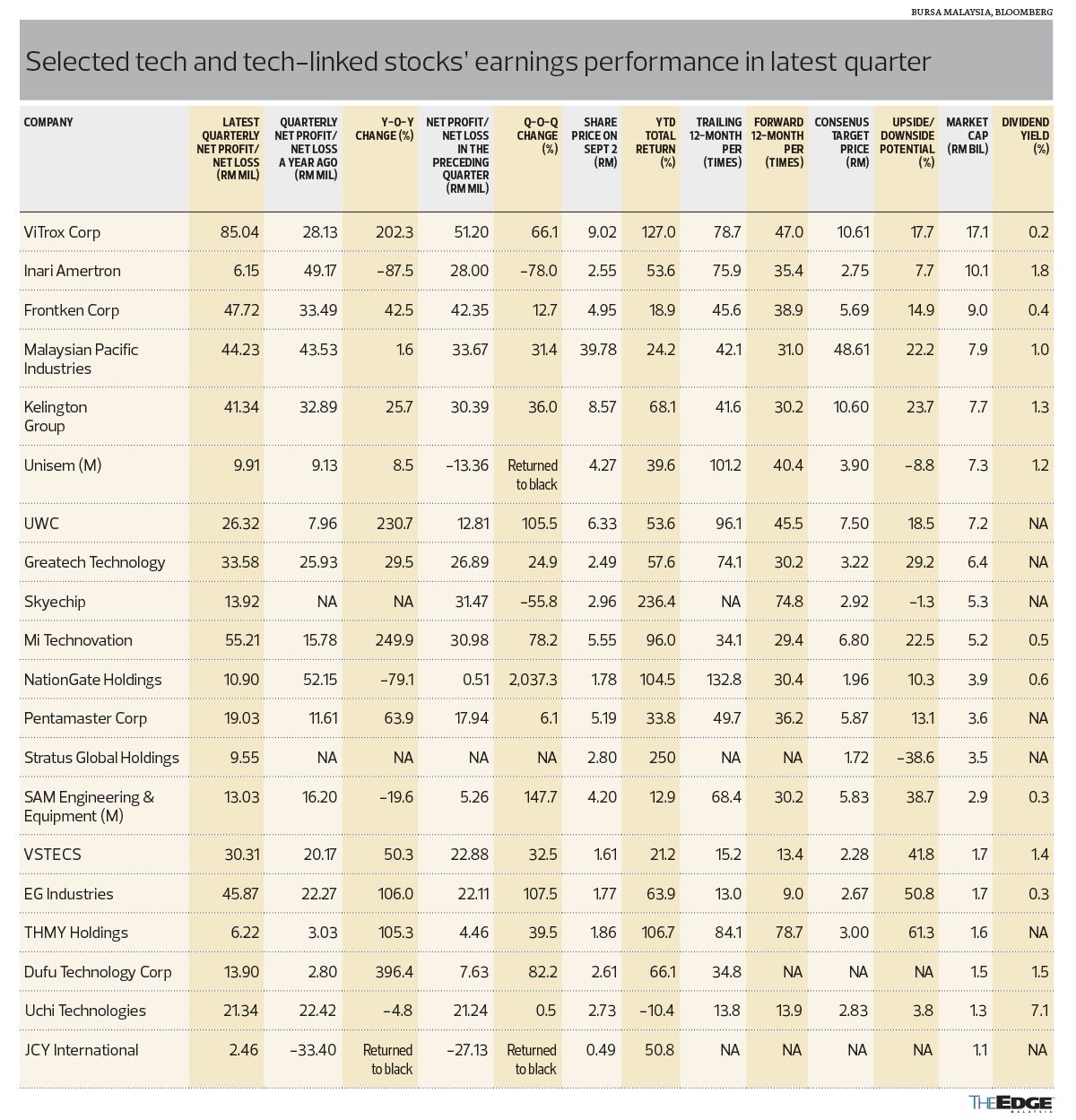
LARGE technology stocks are now being valued at target price-earnings (PE) multiples of between 30 and 55 times after delivering strong second-quarter results. But analysts warn that while a meaningful earnings recovery is expected across the sector, growth may still fall short of the elevated expectations already priced into share valuations.
This could limit further valuation gains unless earnings forecasts continue to be raised.
Most tech companies delivered results that were in line with market expectations in the just-ended second-quarter earnings season, supported by robust demand for artificial intelligence (AI), data centres (DCs) and advanced semiconductor applications. The stronger outlook has led several research houses to raise their target prices for selected tech stocks.
Still, analysts remain selective. The recovery is uneven and after gaining about 30% this year, the Bursa Malaysia Technology Index is trading at a rich PE multiple of 52.2 times.
TA Securities tech analyst Tony Chan says tech companies’ earnings may struggle to keep pace with the strong expectations already reflected in elevated valuations.
“Companies with direct exposure to structural growth areas, such as advanced packaging, photonics and AI-related applications, may be able to justify higher multiples if they deliver sustained earnings growth,” he tells The Edge.
“In contrast, companies still largely exposed to traditional end-markets, including smartphones, PCs and conventional consumer electronics, may find it more challenging to meet market expectations.”
As investors have already priced in strong earnings growth, Chan says the risk-reward proposition may not be particularly attractive at current levels.
“If earnings fall short of expectations, technology stocks trading at extremely high valuations are likely to be among the first to face huge selling pressure. Even if earnings meet expectations, their share prices may not necessarily rise significantly, given that much of the anticipated growth has already been priced in.”
Chan notes that key headwinds for the sector include rising material and logistics costs, as well as a strengthening ringgit. Potential de-rating factors include a slowdown in AI and DC capital expenditure, interest rate hikes and changes in US trade policies that could disrupt Malaysia’s semiconductor supply chain.
AI exposure supports optimism
Despite the rich valuations, PublicInvest Research tech analyst Chong Hoe Leong believes sentiment on tech stocks will remain broadly positive, particularly for semiconductor-related companies, pointing to improving order books, higher book-to-bill ratios and longer lead times.
He also observes significantly increased inventory levels among tech firms, which he says indicate growing backlogs and preparations for bigger orders.
“Tech companies are expected to post stronger earnings in the second half than in the first half. Also, Malaysia is in a strong position because of the Taiwan-plus-one and China-plus-one strategies as well as the Middle East tensions and its business-friendly environment.”
Chong stresses that valuation decisions should remain highly selective and case-specific. Premium valuations are more defensible for companies with substantial innovation and research and developement, high entry barriers, strong products, attractive market share and significant backlog.
Among the major technology counters, ViTrox Corp Bhd (KL:VITROX) was the standout performer.
The company, the largest technology stock on Bursa Malaysia by market capitalisation at roughly RM17 billion, delivered better-than-expected earnings as stronger shipments of machine-vision systems and automated board-inspection products benefited from accelerating global semiconductor demand.
It is notable that among the big tech stocks, only ViTrox came in above consensus estimates, after its net profit more than tripled year on year (y-o-y) to RM85 million, from RM28.1 million a year earlier. Net earnings jumped more than 60% quarter on quarter (q-o-q).
AmResearch says ViTrox has successfully positioned itself as a key beneficiary of AI infrastructure spending, with AI capex filtering through its traditional customer base while its largest customer is now a hyperscaler, contributing about 10% to group revenue.
“Order visibility continues to strengthen, capacity expansion is accelerating and profitability is poised to improve further. Combined with its rapidly rising market capitalistion, ViTrox is increasingly emerging as one of Bursa’s defining AI beneficiaries,” the research house says, upgrading its target price for the stock to RM10.25 based on a PE multiple of 40 times.
CIMB Securities notes that ViTrox’s book-to-bill ratio increased to 1.5 times, the highest quarterly level since 2018, indicating that strong order momentum is likely to extend into 4QFY2026.
It maintains a RM10 target price based on 54 times PER, arguing that the premium valuation is justified by ViTrox’s superior growth profile. It forecasts a 58% compound annual growth rate (CAGR) in core net profit for FY2025 to FY2027, driven by margin expansion from its product upgrade cycle and sustained structural demand from AI-related semiconductor investment.
Recovery uneven across sector
Other semiconductor counters are also benefiting from improving prospects.
TA Securities has upgraded Unisem (M) Bhd (KL:UNISEM) to a “hold” from a “sell” and raised its target price to RM4.81 from RM3.45, supported by a stronger earnings outlook and growing AI and DC exposure. It has also upgraded Malaysian Pacific Industries Bhd (KL:MPI) to a “hold” from a “sell”, with a higher target price of RM47.30, reflecting its stronger outlook and increasing AI exposure.
TA Securities raised the PE multiple for Unisem and MPI to 38 times and 32 times, from 29 times and 30 times respectively.
MBSB Research has kept Inari Amertron Bhd (KL:INARI) as its top pick, even though it posted the lowest quarterly net profit of RM6.15 million in 14 years, owing partly to a fire at its Philippines plant.
“Despite weak 2Q financial performance, we anticipate a commendable revival in the group’s business moving into 2H2026,” says the research house.
Kenanga Research also believes Inari’s FY2027 earnings recovery is gaining traction, supported by stronger radio frequency (RF) loading for the upcoming smartphone cycle and the accelerating ramp-up of its photonics business.
Similarly, RHB Research is positive on Inari as the worst appears to be behind the company, with its growth plan in photonics well positioned to capitalise on the boom in generative AI.
RHB Research says strong demand for wafer fabrication equipment (WFE) and automated test equipment (ATE) continued to benefit ATE and engineering support services players and kept growth momentum on improved economies of scale and cost optimisation.
Meanwhile, outsourced semiconductor assembly and test (OSAT) players remained firmly on an upward profit trajectory with stronger q-o-q performance, supported by higher loadings and stronger capex driven by AI and DC build-outs, alongside growth in power management and automotive integrated circuits (ICs).
Electronics manufacturing services (EMS) players also continued to show sequential improvement in revenue and utilisation, although earnings remained subdued as low utilisation continued to weigh on fixed cost absorption. While supply-chain risks remain a near-term constraint, RHB Research expects a gradual recovery into 2027, albeit at a measured pace.
The research house favours MPI for its strong execution in growth strategies, higher utilisation and operating leverage. At the same time, management’s strategic pivot towards higher-margin segments such as AI servers and sensors — alongside opportunities in humanoids and wide-bandgap semiconductors — underpin a bullish outlook for FY2027and FY2028.
Pentamaster Corp Bhd (KL:PENTA) is RHB Research’s pick in the ATE segment, underpinned by its multiyear high outstanding order book of RM550 million, consisting mainly of sustainable growth in the factory automation solutions (FAS) business, fuelled by medical and AI-driven automation demand, alongside expanding opportunities in advanced packaging (9-Samurai) as well as power-related test solutions amid the ongoing semiconductor capex upcycle.
Pentamaster’s net profit jumped 63.9% y-o-y to RM19.03 million on stronger demand from FAS, coupled with lower administrative expenses and foreign exchange gains.
Overall, CIMB Securities expects major ATE and OSAT players to post stronger 3QFY2026 results on sustained AI infrastructure spending, new customer wins, portfolio expansion and upcoming product launches.
In the semiconductor precision engineering segment, UWC Bhd (KL:UWC) posted a 230.7% y-o-y and 105.5% q-o-q surge in net profit to RM26.32 million.
CGS International recently initiated coverage on UWC with a target price of RM9.13, based on a 45 times FY2028 PE multiple — well above the consensus target price of RM7.50.
The research house believes the valuation is justified, given UWC’s strong growth outlook, which is leveraged on the global logic and memory capex upcycle and backed by a high-quality customer portfolio across the WFE, back-end testing and integrated device manufacturer segments. It is also expected to register a three-year earnings per share CAGR of 48% from FY2026 to FY2029.
Read also: Save by subscribing to us for
your print and/or
digital copy. P/S: The Edge is also available on
Apple's App Store and
Android's Google Play.
Cover Story 2: Solid 2Q corporate earnings bolster market outlookk