

This article first appeared in The Edge Malaysia Weekly on September 7, 2026 - September 13, 2026
TRAFFIC congestion is rarely just a transport problem — it is also about land use. In other words, the issue is not a shortage of roads, but the distance between where people live and where they need to go.
When homes, jobs, schools and amenities are scattered across a sprawling urban footprint with poor connectivity, the private car becomes the only realistic option, and congestion inevitably follows.
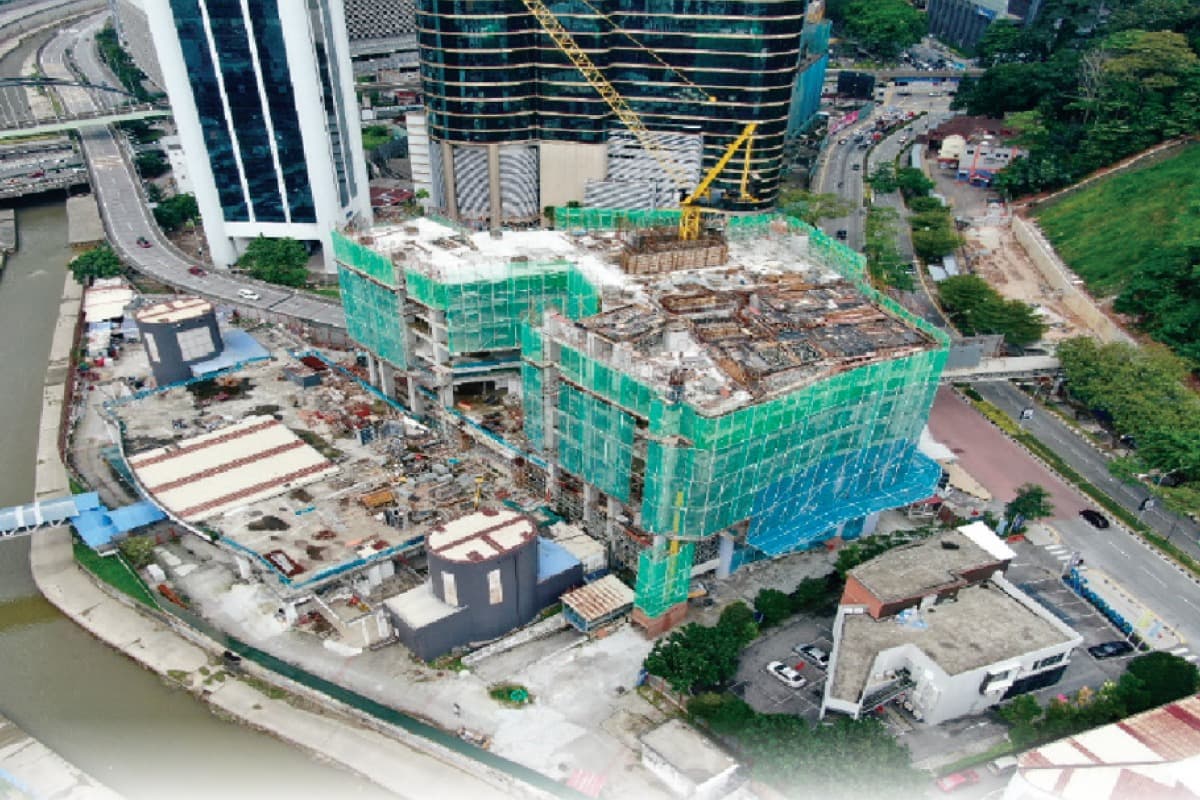
An integrated transport system — where rail, bus, pedestrian walkway and bicycle lanes work as one connected network rather than isolated modes — reduces the number of car trips a city generates in the first place, rather than merely managing traffic that already exists. Transit-oriented development (TOD) is the land-use half of this equation.
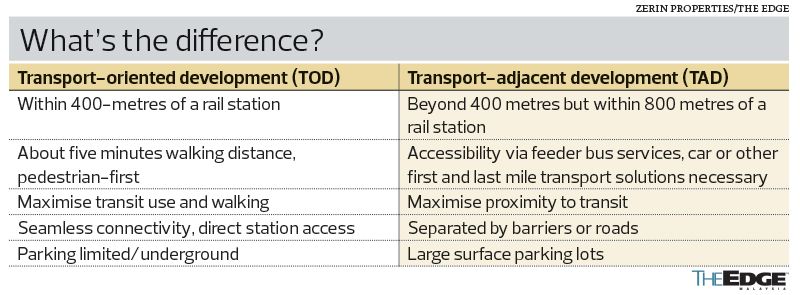
Instead of building stations and hoping development follows, TOD deliberately concentrates housing, retail and offices within comfortable walking distance — typically 400m to 800m — of a transit node, so that using public transport becomes the convenient default rather than a compromise.
Malaysia has been moving in this direction with the existing multiple light rail transit (LRT) and mass rapid transit (MRT) lines.
At the launch of the LRT3 Shah Alam Line on June 29, Prime Minister Datuk Seri Anwar Ibrahim pushed for land around rail hubs — including LRT and MRT stations — to prioritise affordable housing, small and medium enterprises and improved parking infrastructure.
Among LRT3’s 20 stations, Sri Andalas, Kayu Ara, Bandar Bukit Tinggi and Johan Setia have been flagged as having land suitable for commercial centres or affordable housing, with officials noting that park-and-ride land has historically been under-optimised — serving only the fixed number of cars it can hold, rather than the wider community.
It is an encouraging shift, but one that raises an obvious question — can genuinely affordable housing be built on land valued primarily for its proximity to a train station?
The Real Estate and Housing Developers’ Association Malaysia (Rehda) says it recognises the importance of affordable housing in TODs, given the B40 and M40 communities’ reliance on public transportation, which enables them to enjoy shorter commutes, lower travel costs and improved access to employment, education and essential services. From an urban planning perspective, a balanced social mix with such developments contributes towards creating more vibrant, inclusive and sustainable communities.
“However, the commercial viability of such developments must also be carefully considered. Land surrounding major transport hubs are typically more premium due to its strategic location, accessibility and development potential,” says Rehda.
“Consequently, development costs are significantly higher than those of conventional housing projects. At the same time, affordable housing selling prices are regulated by the government and substantially below prevailing market values. This creates a challenge, particularly for small and medium-sized developers, where rising land, construction and compliance costs continue to narrow development margins.”
To mitigate the issue, developers have resorted to cross-subsidisation, raising prices of open-market homes slightly to offset the lower prices of affordable housing units. “While this approach has enabled the private sector to continue meeting affordable housing requirements, it is becoming increasingly difficult to sustain, particularly in high-value locations such as TODs,” Rehda says in a written response to questions from The Edge.
Rehda represents private real estate and housing developers in Malaysia.

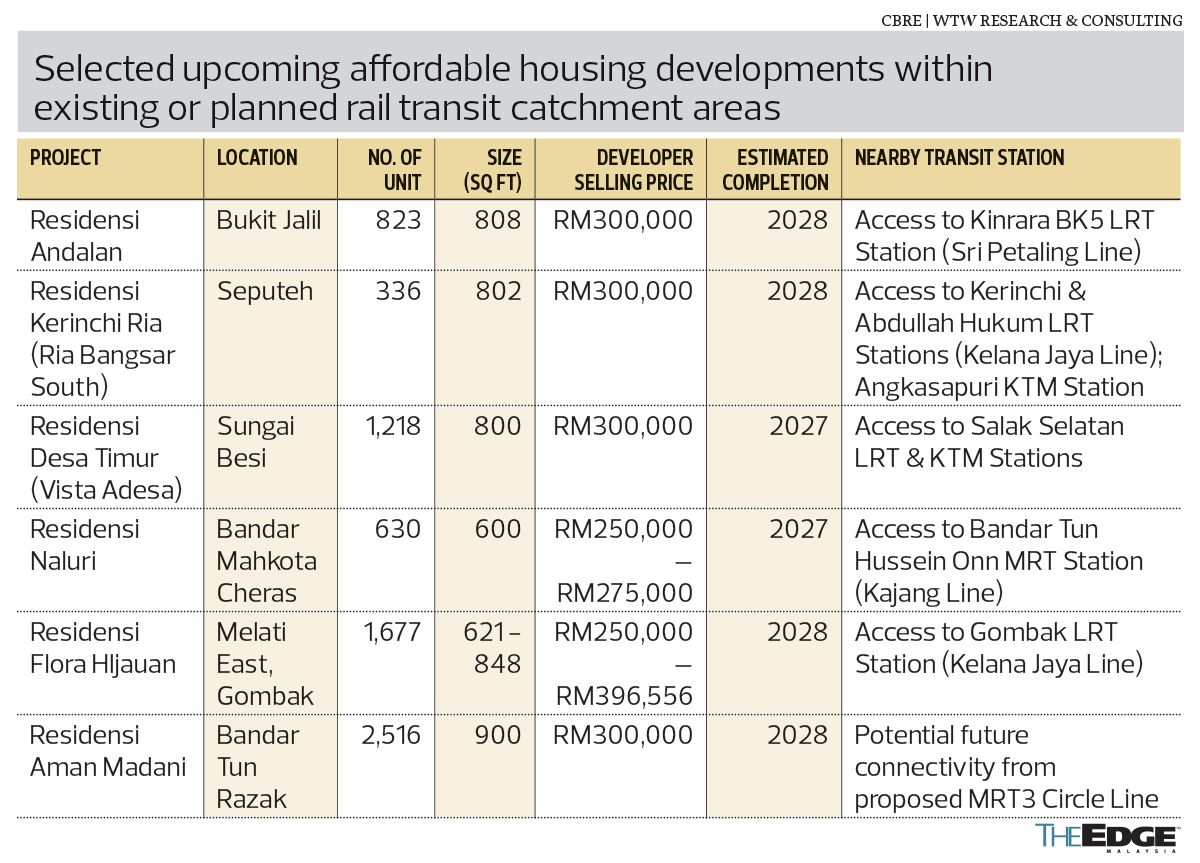
Tan Ka Leong, group managing director of CBRE | WTW, notes that although TODs have gained prominence in Malaysia over the past decade, there is no official national database that specifically tags affordable housing developments as TOD. “Based on publicly available information, relatively few affordable housing developments have been purpose-planned as TODs,” he says.
Why aren’t more affordable projects purpose-built as TOD? Tan points to simple economics: land around major transit stations attracts stronger market values because of its accessibility and development potential; so, it has traditionally been reserved for higher-value residential, commercial or mixed-use projects. “This makes it more challenging to deliver affordable housing without government intervention or policy support,” he says.
Many affordable schemes sit within or near rail catchment areas without having been conceived as TOD from the outset — and proximity alone, Tan stresses, does not qualify a development as TOD. A genuine TOD incorporates walkable pedestrian connectivity, mixed land uses, appropriate density, supporting amenities and reduced dependence on private vehicles.
Zerin Properties founder and group CEO Previn Singhe draws a similar but more formal distinction between TODs and transit-adjacent developments (TADs). Both are rail-connected, he explains, but TAD relies more on feeder buses, pedestrian infrastructure and other first- and last-mile solutions, with effective catchments sometimes stretching to about a kilometre, depending on demand and network design.
Selangor’s example
Previn notes that Selangor already required affordable housing quotas in private developments before the Rumah Selangorku 3.0 Circular took effect in 2023. The circular sharpened the framework by carving out a dedicated Zone 1 covering TOD, TAD and central business district (CBD) areas, as well as all areas under city councils — encompassing Shah Alam, Bukit Raja, Sungai Buloh, Damansara, Petaling and Bandar Petaling Jaya, all served by existing or planned rail lines.
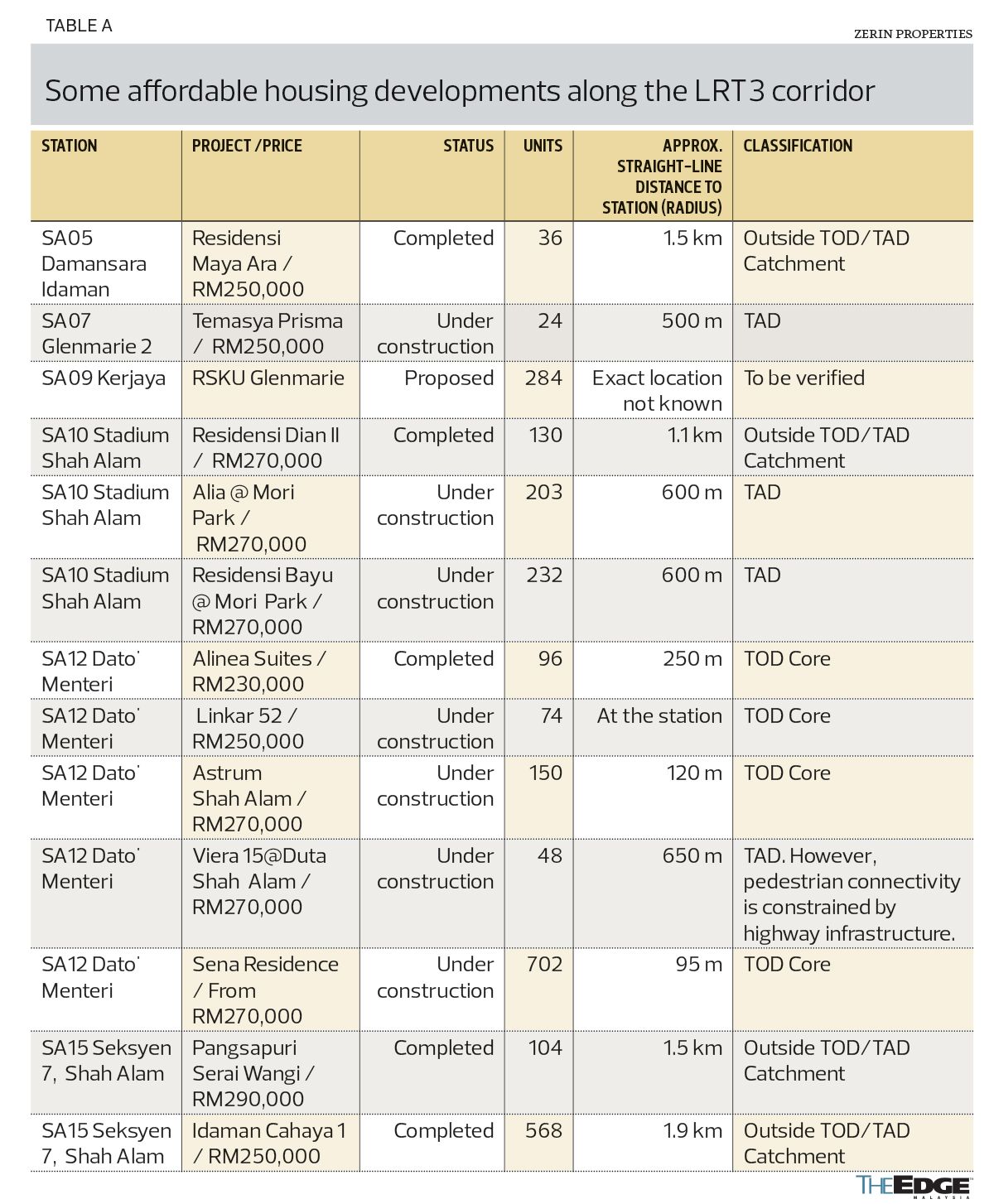
The latest figures from the Selangor Housing and Property Board (LPHS) show that about 5,430 affordable housing units have been completed, are under construction or are being planned within 1.5km of the LRT3 corridor, spanning Rumah Selangorku, Pangsapuri Perkhidmatan Mampu Milik, Rumah Idaman MBI and SOHO Mampu Milik schemes, priced roughly between RM170,000 and RM270,000 (see Table A).

Whether that supply qualifies as TOD in the strict sense is debatable — LPHS applies a 1.5km corridor radius, broader than the conventional 0m-to-800m TOD/TAD catchment used for individual stations.
Land near a train station is priced for its accessibility premium, while affordable-housing price caps — roughly RM250,000 to RM350,000 — leave a thin margin once construction cost, financing and developer profit are factored in. “On its own, this combination usually kills a project’s viability,” says Knight Frank Malaysia executive director of research and consultancy Amy Wong.
In Wong’s view, genuinely affordable TODs tend to work only when a state agency or government-linked company absorbs the land cost, instead of a private developer bearing the full market price — with Kwasa Damansara cited as the standout example. “Without that kind of intervention, ‘affordable’ and ‘TOD’ don’t naturally sit in the same sentence,” she quips.
Nevertheless, she points to levers that can still make the numbers work, such as cross-subsidisation within a single development. One example is Perla @ Ara Sentral, a joint venture between Prasarana Malaysia Bhd (owner and operator of the country’s major urban rail services) and TRC Synergy Bhd’s (KL:TRC) subsidiary, which combines 180 affordable units with 648 market-rate units priced from RM390,000, with the latter effectively carrying the land premium.
Other factors include density bonuses, where higher plot ratios are granted in exchange for an affordable housing quota; basement parking to free up surface land for saleable or rentable floor area without additional land acquisition; deferred land monetisation instead of an upfront land sale, where Prasarana takes a share of gross development value (GDV) or income, easing developers’ cash flow; and expedited approvals, as lengthy multi-agency processes add to higher holding and financing costs.
Tan concurs with the Prasarana land model, noting that its typical JV structure, rather than an outright sale, allows developers to avoid paying the full market-value land cost upfront. Beyond land cost, he adds, feasibility also hinges on allowable density, planning flexibility and whether complementary commercial components — such as SME retail space — can generate additional revenue to support the project.
Not every TOD is out of reach

All three property consultants disagree with the notion that TODs are inherently unaffordable.
Previn argues that affordability depends heavily on location, positioning and unit size: TODs in mature city centres command a premium from stronger connectivity and limited developable land, whereas those in suburban or emerging corridors remain comparatively affordable. Compact unit layouts, he adds, increasingly allow developers to hold down absolute selling prices even where land values are high — making many TOD homes accessible to dual-income middle-class households.
Tan agrees that Malaysia’s more prominent TODs are skewed towards the mid- to upper-market segment, since buyers in these locations tend to pay for convenience, but he cautions against concluding that TODs and affordability are mutually exclusive, noting that affordability should also be measured by the transport-cost savings of living near good transit, not purchase price alone.
“If the government intends to expand affordable housing within TODs, complementary measures should be introduced to enhance project feasibility such as higher permissible development densities, expedited planning approvals, reductions or waivers of selected development charges and infrastructure contributions, or other fiscal incentives that help offset the higher cost of TOD land,” says Rehda, as such measures encourage greater private sector participation while ensuring that affordable housing remains commercially sustainable.
Rehda notes that it has also consistently advocated for a longer-term review of the nation’s affordable housing delivery model. One approach worth considering, it says, is for the government to take over the role of providing affordable housing, funded in part by structured contributions from the private sector.
“Such a model would allow affordable housing to be better planned and delivered based on actual demand, while reducing the reliance on cross-subsidisation and enabling market-priced homes to remain more affordable for the wider public,” it explains.
“Ultimately, the shared objective is not merely to increase the number of affordable homes, but to ensure that they are delivered in locations where they provide the greatest social and economic value while remaining financially sustainable for all stakeholders.”
Meanwhile, redeveloping underutilised park-and-ride land is one of the more contested ideas in the current push. Here, the consultants converge on the same caveat: it depends entirely on the station.
For stations within walkable residential catchments, converting surface parking to housing “makes obvious sense”, says Knight Frank’s Wong. For stations functioning as regional park-and-ride hubs pulling commuters from 10km to 15km away, however, removing a surface lot without having a fully built basement replacement ready before construction begins risks depressing ridership and leaving “a half-built development sitting where a functioning car park used to be”.
Previn frames the upside in similar terms: where park-and-ride facilities are genuinely underutilised, redevelopment can unlock land for higher-density TODs, especially affordable housing, while sidestepping land acquisition costs since the sites are government-owned. But he warns that suburban commuters often still depend on cars for first- and last-mile journeys; so, cutting parking without an adequate alternative “could affect commuter convenience and discourage public transport usage”. His preferred fix is to shift parking into multi-storey or basement facilities so that housing, retail and commuter parking can coexist on the same site.
Towards a win-win model
Asked for a solution, the consultants point to variations of the same structure: the government retains land value through equity rather than a cash sale, developers get density incentives in exchange for real (not diluted) affordable quotas, and buyers get protected pricing.
Emphasising enforcement over new policy, Wong says: “All the above are not new. What has been missing are the regulations during execution” — faster approvals, contractually sequenced parking replacement, and holding developers to the mixed-tenure structure “rather than letting the affordable component quietly disappear once the market-rate units are sold”. If the prime minister’s mandate to Prasarana enforces that discipline, she says, it could work; if not, it risks joining a list of TOD projects that “never quite got delivered”.
CBRE | WTW’s Tan frames it as a three-way alignment: landowners — especially public agencies — should prioritise long-term value through leases, JVs or phased payments rather than upfront sale proceeds; developers need density, planning flexibility and streamlined approvals to stay viable; and homebuyers should think of affordability as extending beyond purchase price to the transport-cost savings of transit-connected living.
Zerin Properties’ Previn agrees, describing TOD affordable housing as “a long-term public-private partnership, where each party contributes according to its strengths”. He points to the Rumah Selangorku 3.0 Circular — with its Zone 1 framework for TOD, TAD and CBD areas — as an existing template, and calls the federal proposal to build on Prasarana-owned land “strategically significant”, since it removes land acquisition, one of the largest cost components, from the equation entirely.
Malaysia’s TOD ambitions are no longer just aspirational — the LRT3 rollout, the Rumah Selangorku 3.0 framework and the Prasarana land proposal all suggest genuine policy movement. But as the consultants make clear, proximity to a train station does not automatically make housing affordable, nor does affordability happen by accident near premium land. It requires deliberate cross-subsidy, density incentives, patient public landowners and — perhaps most critically — the discipline to enforce these structures through to completion, rather than letting the affordable component quietly disappear once the market-rate units have sold.
What developers think
The Edge also spoke to several developers on their take on transit-oriented developments (TODs) and affordable housing. Some agree that the current model — squeezing affordable housing onto premium TOD land via a developer cross-subsidy — is structurally strained, and better government mechanisms (direct delivery, funding from elsewhere) are needed rather than relying on private developers alone.
Here are some of their views:
1 Segregate TOD by tiers
Prime TOD (for example, TRX, KLCC) should remain integrated commercial hubs — retail, office, hotel, serviced apartments — since luxury residents rarely rely on public transit anyway. Affordable housing should be located at feeder TODs further from the central business district (CBD), paired with neighbourhood malls, co-living and higher-density homes under RM500,000.
2 Mass housing drives ridership
Without mass-market homes near transit hubs, public transport usage stays low and authorities keep mandating excessive car parking. Malaysia still needs Park & Ride, but existing surface car parks could be redeveloped into integrated projects. Malaysia lags behind China and other developed markets on this front.
3 Cross-subsidy isn’t sustainable
Since affordable units are sold at fixed, below-market prices, someone absorbs the gap — usually the developer, through open-market unit sales. If take-up on those market units is weak, developers bear the loss, which is not healthy in the long term. Singapore’s model is cited as a better alternative: the Housing Development Board delivers public housing directly with government backing, rather than expecting private developers to subsidise it.
4 M40 being squeezed out
Many middle 40% (M40) households don’t qualify for affordable housing, but also can’t afford open-market homes near TODs — so they end up commuting further, at greater cost, with some risk of sliding towards B40. One view argues M40 should get priority access to TOD living, while affordable or people’s housing is better located in lower-land-cost urban-fringe areas where subsidised pricing is more economically sustainable — funded by profits from TOD projects rather than embedded within them.
Read also: Save by subscribing to us for
your print and/or
digital copy. P/S: The Edge is also available on
Apple's App Store and
Android's Google Play.
Cover Story 1: Prasarana says it’s committed to incorporating affordable housing in TODs — where appropriate