

PARTS 1 and 2 of this three-part article looked at who sits around Malaysia’s palm oil table and how those many voices might work together more effectively. But coordination alone is not enough.
Before deciding what the industry should do next, we also need to understand the rather unusual industry we are trying to coordinate.
Oil palm has been called many things over the years — golden crop, commodity, export earner, rural economic engine and, depending on who is speaking, occasionally the source of almost every environmental problem known to mankind.
But there is one description I think deserves more attention: It is different.
Not necessarily more important than every other sector, and certainly not deserving immunity from regulation, taxation, scrutiny or change. But oil palm and its supply chain possess characteristics that make them fundamentally different from many manufacturing, service and even other agricultural industries.
That distinction matters because good policy begins with understanding the thing being governed.

Malaysia’s oil palm sector stretches from nursery and smallholder to plantation, mill, refinery, oleochemicals, biodiesel, biomass, logistics, trading and consumers around the world. Behind those activities sit workers, researchers, engineers, transporters, dealers, financiers, ports, suppliers and rural communities.
So when we talk about the palm oil industry, we are not talking merely about trees. We are talking about an interconnected biological, economic and social ecosystem. Their numbers remind us why palm oil is more than another line in Malaysia’s export statistics.
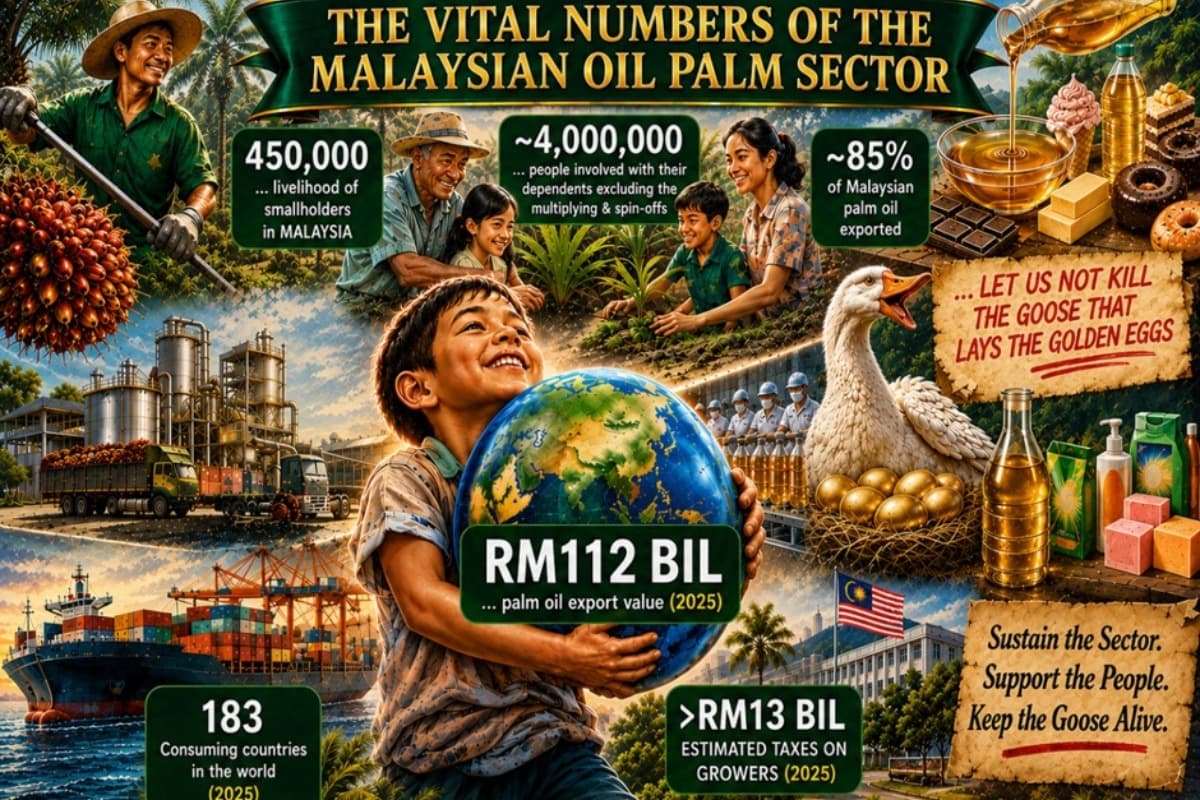
The sector supports the livelihoods of some 450,000 smallholders, directly and indirectly touches an estimated 4 million people and their dependents, exports about 85% of its production to 183 countries, which generated around RM112 billion in export value in 2025. At the same time, growers are estimated to contribute more than RM13 billion in taxes and related fiscal payments in 2025. Behind those numbers are rural families, workers, businesses, investments and communities, together with the multiplier effects flowing through the wider supply chain.
The socio-economic imperative is therefore straightforward: Malaysia must continue to draw a fair return from this golden crop, but also leave sufficient capacity for reinvestment, productivity and renewal. Sustaining the industry ultimately means sustaining the people whose livelihoods grow with it.
You cannot tell the palm to hurry up
The first difference is obvious but sometimes forgotten in air-conditioned meeting rooms: Oil palm is biological. It is a business sector which is organic, living and perennial.
A factory can theoretically add another shift, install another production line or increase throughput. An oil palm is rather less impressed by management instructions.
It needs sunshine, rain, nutrients, good planting material, sound agronomy, effective management and time. It grows across different soils, terrains and topographies, from relatively accessible plantations to operations deep in Sabah and Sarawak.
Mother Nature has never attended a KPI meeting. Too much rain affects harvesting and crop evacuation. Too little rain creates another set of problems. Floods disrupt access. Drought can affect production months later. Solar radiation, temperature and biological cycles all matter.
A CEO can issue a circular. The palm does not necessarily read it. That sounds humorous, but the implication is serious. Agricultural productivity cannot be managed exactly like factory productivity because some of its most important variables remain outside management’s control.
Today’s decision may still be standing there in 2046
Oil palm is also perennial.
Plant today and there is roughly a three-year wait before meaningful harvesting begins. Thereafter, the same investment remains rooted in the ground for more than two decades before the cycle eventually returns to replanting.
This is a long-haul investment. A poor annual decision in some businesses can be corrected next year. A poor planting-material or agronomic decision may wave at you from the field for the next 20 years.
That becomes particularly important when we discuss replanting. Everyone agrees Malaysia needs younger, more productive palms. But replanting means sacrificing current production and income while waiting for the next generation to mature.
For a large plantation company, that is a capital-allocation and crop-age-profile discussion. For a smallholder, it can be a kitchen-table question: What do we live on while the new palms grow?
Same biological problem; very different bank account.
That is why enabling policies must understand not merely how many hectares should be replanted, but how estates and smallholders finance the years between felling the old palm and receiving the first meaningful cheque from the new one.
A price taker with a cost problem
Then comes another peculiarity. Palm oil is an internationally traded commodity, and producers are fundamentally price takers.
A restaurant whose costs rise may change its menu prices. A professional firm may revise its fees. A manufacturer with sufficient pricing power may pass higher costs to customers.
The oil palm grower cannot wake up tomorrow morning and announce: “Fertiliser has gone up, wages are higher, compliance costs have increased and taxes are heavier, so from today my CPO will cost 10% more.”
Palm oil prices are determined by global supply and demand, competing vegetable oils, energy markets, weather, inventories, currencies, government policies and market expectations. That is why cost-productivity, competitiveness and sustainability cannot be separated.
Every additional requirement may be perfectly defensible when viewed individually: higher wages, better worker housing, certification, traceability, environmental compliance, machinery, fertiliser, energy, transport, financing, taxes and levies. Each may have a sound rationale.
But collectively they become the cost of producing a tonne of palm oil. And the international buyer is under no obligation to reimburse Malaysia for being more expensive.
That is why policy cannot treat cost, productivity and competitiveness as separate conversations. They meet in the same tonne of oil.
The industry pays tax — substantially
This brings me to taxation, where the discussion can become unnecessarily polarised.
Palm oil should pay tax. It benefits from many roads, ports, security, enforcement, public administration, research infrastructure and the wider stability within which businesses operate. The industry is not asking to live tax-free.
Indeed, available industry estimates suggest quite the opposite: oil palm is already a substantial taxpayer.
The Malaysian Estate Owners’ Association’s projected 2025 tabulation estimated around RM13.29 billion in contributions from MPOB cess, the Windfall Profit Levy, State Sales Taxes in East Malaysia and corporate income tax. Importantly, that estimate did not include CPO export duties, which were estimated separately at more than RM1.26 billion. Income tax alone accounted for an estimated RM8.76 billion, with State Sales Taxes in Sabah and Sarawak, the Windfall Profit Levy and MPOB cess adding further layers.
Those are not the numbers of an industry refusing to contribute. They are evidence of an industry already making a significant fiscal contribution to the country.
So the argument should not be: “Why must palm oil pay tax?” The better question is: “How should a long-cycle, price-taking agricultural industry be taxed fairly while retaining sufficient capacity to reinvest?”
That is a very different conversation.
Fair tax does not mean no tax
When harvests and prices are good, government revenue naturally rises. That is normal. It is not inherently unfair. A successful industry should contribute more when it earns more.
But a strong harvest should not be confused with unlimited capacity.
Plantation cash flow has other claims upon it: wages, fertiliser, harvesting, transport, machinery, roads, drainage, housing, safety, certification, traceability, environmental requirements, replanting and technological renewal.
Only after all those obligations are recognised does today’s apparent profit become tomorrow’s productive capacity.
That leads to the key fiscal question: How much can reasonably be collected today - and how much must remain to sustain tomorrow’s harvest?
MEOA’s analysis also points to a regional dimension. Its estimates suggest taxes represented around 26.1% of business profit in Peninsular Malaysia in 2025, compared with about 40.0% in Sabah and 38.7% in Sarawak, largely reflecting the additional State Sales Tax layer in East Malaysia. These are industry estimates and should be read as such, but the policy question they raise is legitimate.
Malaysia is one palm oil industry, yet the fiscal load can differ materially depending on where that palm happens to be rooted.
State revenue autonomy is important. So too is national competitiveness. Both truths can occupy the same table.
Reinvestment is the silent partner
This is where taxation and productivity finally meet. Oil palm does not renew itself.
Old palms must be replanted. Machines must be bought. Roads must be repaired. Drains must be maintained. Workers must be housed. Digital systems must be installed. Traceability must be strengthened. Mechanisation, automation and sustainability improvements all require capital.
When too much of today’s profit leaves before reinvestment, tomorrow’s yield can weaken.
And unlike a factory, an oil palm plantation cannot simply relocate to an industrial park offering a better incentive package.
The trees are rather stubborn about remaining where they were planted. But investment can move - or stop. Replanting can be delayed. Mechanisation can be postponed. Maintenance can be stretched. Roads can deteriorate. Technology adoption can wait another year.
The palm does not complain. It simply yields less later. That is why tax policy affecting a perennial crop should always contain a reinvestment lens.
A good tax system collects fairly from prosperity. A better one also encourages the investment that creates the next round of prosperity.
Tax incentives can be development policy
Perhaps we should therefore think more deliberately about fiscal policy not only as a mechanism for collecting revenue, but also as a tool for encouraging the outcomes the country says it wants.
If Malaysia wants faster replanting, can tax incentives reinforce it? If we want deeper mechanisation, automation and robotics, can reinvestment allowances or accelerated capital treatment help? If we want better yields from existing land rather than expansion, can tax policy reward productivity-enhancing investment? If stronger traceability, worker welfare and sustainability systems are required, can part of that burden be recognised as investment in national market access?
These are not requests for a free lunch. There is no free lunch in plantations. Even lunch usually requires a purchase order.
The broader question is whether fiscal architecture can support the same national objectives government is asking the industry to deliver. Taxation and incentives should not sit in separate rooms pretending they have never met.
The labour question we have been discussing for decades
Oil palm remains surprisingly labour-intensive for an industry of its scale and maturity, and labour provides perhaps the clearest current example of why plantation policy cannot simply borrow solutions from other sectors.
We have mechanised many operations and made genuine progress, but harvesting remains the critical bottleneck because an oil palm estate is not a factory floor. Palm height varies. Terrain varies. Soil conditions vary. Fruit must be harvested at the correct stage, bunches cut efficiently and loose fruits collected. Machines must survive rain, mud and slopes rather than merely improve the PowerPoint.
We have been saying mechanisation will solve the labour problem for so long that mechanisation itself is approaching retirement age. But the objective remains right. The challenge is moving faster from prototype to deployment - from a machine that works beautifully when its inventors are standing beside it to one that still works six months later when everybody has gone home.
That is also why blanket labour policy can be risky. Manufacturing may often automate repetitive processes in a controlled environment; plantations cannot simply run another shift when a harvesting round is missed. Better yields can even require more harvesting capacity in labour availability, because more bunches still have to come down from the palms.
So the policy question should not be reduced to “How quickly can foreign labour be cut?” It should also ask: what can genuinely be mechanised now, what is commercially viable, where labour savings are real, and how many workers are still needed until better technology arrives?
This is not an argument against technology. Mills lend themselves increasingly to automation; plantations remain a tougher frontier for mechanisation and robotics because biology, terrain and weather refuse to be standardised. The answer is sector-sensitive implementation, not a blanket prescription.
Policy should push the industry to change, but it must also understand what it is trying to change. One shoe may fit the factory floor. It need not fit the plantation field - especially when the field is muddy.
And moving from labour dependence to workable mechanisation requires research, technology and capital. Which brings us back, once again, to reinvestment.
One fruit bunch, an extraordinary family tree
Another reason palm oil is different is the depth of its intertwined supply chain.
Nursery to plantation. Plantation to mill. Mill to refinery. Refinery into food, oleochemicals and specialised products. Palm kernels into kernel oil and cake. Oil into biodiesel. Biomass into energy, materials and circular-economy applications.
The humble fruit bunch develops quite an impressive CV by the time everyone has finished with it.
And every link depends upon another. The grower needs the mill because FFB is perishable. The mill needs sufficient crop to utilise expensive processing capacity. The refinery needs feedstock. The downstream manufacturer needs quality and consistency. The exporter needs competitive logistics. Everyone ultimately needs a customer.
This is why policies affecting one segment should always be stress-tested further along the chain. Pull one thread and something may move at the other end.
Rural Malaysia matters
There is another dimension that spreadsheets sometimes understate.
Much of oil palm’s socio-economic footprint lies outside Malaysia’s largest cities. Plantations and smallholdings create activity in rural districts where employment and alternative businesses may be more limited. Their spending circulates through workshops, shops, contractors, transporters, housing, schools, clinics and local services.
This is where the industry’s multiplying and spin-off effects matter.
A tonne of palm oil represents more than its export price. Somewhere behind it was a harvester. A driver moved the bunch. A mill processed it. Someone repaired the tractor. Someone supplied fertiliser. Someone maintained the road. Somebody’s family bought groceries from income generated somewhere along that chain.
Economics eventually returns to people. That is why productivity and reinvestment are not merely corporate matters. They have social consequences.
Sustainability is no longer an optional appendix
Nor should economic importance be used as an excuse to resist sustainability. That world has gone.
Sustainability now touches land use, biodiversity, emissions, labour standards, worker welfare, traceability, smallholders, water, waste, food safety and market access. Malaysia has mandatory MSPO certification, while many businesses also participate in RSPO or meet other customer and market requirements.
The danger is not sustainability itself. The danger is measuring sustainability by the thickness of the certification file rather than by improvements on the ground. Many planters are already showing signs of certification fatigue - not because they reject sustainability, but because audit after audit, checklist after checklist and portal after portal can begin to feel like running a plantation with one hand and feeding paperwork with the other.
And another kind of fatigue may be waiting in the wings: digitalisation fatigue, AI fatigue, dashboard fatigue. These tools can be powerful, but only when the ground is ready. There is little point installing an AI cockpit where basic connectivity is weak, data are incomplete, field processes are inconsistent and the people expected to use the system have not been properly prepared.
Technology should solve problems, not simply add another password. The sequence matters: get the basics right, prepare the people, build the data, then add the intelligence. Otherwise we risk replacing certification fatigue with digital fatigue - and eventually needing an app to tell us why everyone is tired.
Yes. A large plantation may have GIS specialists, sustainability professionals, lawyers and sophisticated digital systems. The smallholder may have a smartphone, a folder and his wife reminding him where he left the receipt. Both are expected to travel towards the same destination. Policy must recognise the difference in their vehicles.
The three-legged stool
For me, the entire argument eventually comes down to three interconnected imperatives: Cost-productivity. Competitiveness. Sustainability.
Not one at the expense of the others. Productivity without sustainability may eventually lose market acceptance. Sustainability without competitiveness may produce an exemplary industry whose cost structure becomes increasingly difficult. Competitiveness achieved by under-investing may weaken tomorrow’s productive capacity. And taxation that captures too much of today’s success without enabling tomorrow’s renewal risks becoming counterproductive over the long haul.
The three legs must support the same stool. This is why palm oil needs enabling policies built around both the industry’s “know-hows” and its “must-haves.”
Know how the biology works. Know how commodity pricing works. Know how smallholder economics works. Know how labour and harvesting work. Know how Sabah and Sarawak differ from Peninsular Malaysia. Know how costs accumulate. Know how taxation interacts with reinvestment. Know how requirements imposed upstream ultimately affect the whole supply chain.
Then identify the must-haves: guest workers, skilled people, productive planting material, mechanisation, R&D, infrastructure, efficient logistics, credible sustainability, market access, appropriate incentives and - most importantly - implementation.
Do not kill the goose — Help it lay better eggs
This brings me back to the old goose and the golden eggs. I do not use that metaphor to argue that palm oil should be protected from tax, regulation, sustainability requirements or change. Quite the opposite.
The goose must become healthier, more productive, less labour-dependent, more technologically capable, more sustainable, more competitive, more inclusive of smallholders and better able to create value from every tonne produced.
But there is little wisdom in continuously adding weight to the goose while simultaneously complaining that it is not laying enough eggs.
The industry should pay its fair share. It already does. But fair contribution and adequate reinvestment should be partners, not opponents.
The question for policymakers is therefore not merely: “What more can we collect or require from this industry?” It should also be: “What must remain — or be reinvested — so this industry can produce more productively, competitively and sustainably for the next 25 years?”
That is not anti-tax. It is stewardship.
A thoughtful fiscal framework should collect what is due while leaving sufficient strength in the field for replanting, mechanisation, worker welfare, infrastructure, innovation and the next generation of productivity.
Taxation should contribute to national needs without quietly weakening the productive base from which tomorrow’s taxes will themselves be generated.
Plantation people understand one simple rule: You do not harvest without reinvesting. The same wisdom applies nationally.
Take what is fair. Encourage what must be renewed. Leave enough for the palms, the people and the land to produce again.
Because oil palm takes years to mature. Our policies should not take quite as long to recognise what keeps it productive.
Understand the biology. Understand the economics. Understand the taxpayer. Understand the need to reinvest. Understand the whole supply chain.
Then give this very Malaysian golden goose the enabling conditions to do what we have been asking of it all along: lay better eggs - sustainably, competitively and for another generation.
Joseph Tek Choon Yee is a former president of the Malaysian Estate Owners’ Association and past chief executive of the Malaysian Palm Oil Association.