

ONE of the questions I am asked surprisingly often — especially by people trying to find their way around the Malaysian oil palm industry — is: who is who, who does what, and which association or agency should I speak to?
I usually try to help. After spending most of my working life in and around the industry, I should still be able to point somebody in the right direction without consulting Google.
But I confess to a small irritation: most of this information is already sitting quite happily on the internet waiting to be found. Websites exist, search engines exist, contact details exist. Yet somehow it remains easier to WhatsApp: “Joe, who handles this-ah?”
Perhaps that is simply human nature. Why search for ten minutes when you can ask somebody in ten seconds? And if that somebody happens to be retired, surely he has plenty of time. That last assumption, I have discovered, is particularly dangerous.
Still, the repeated questions reveal something useful. The problem is not a shortage of information but the breadth of Malaysia’s palm oil ecosystem — ministries, statutory bodies, associations, professional institutions, representative organisations and commercial groups — which can make it difficult to see how everything fits together.

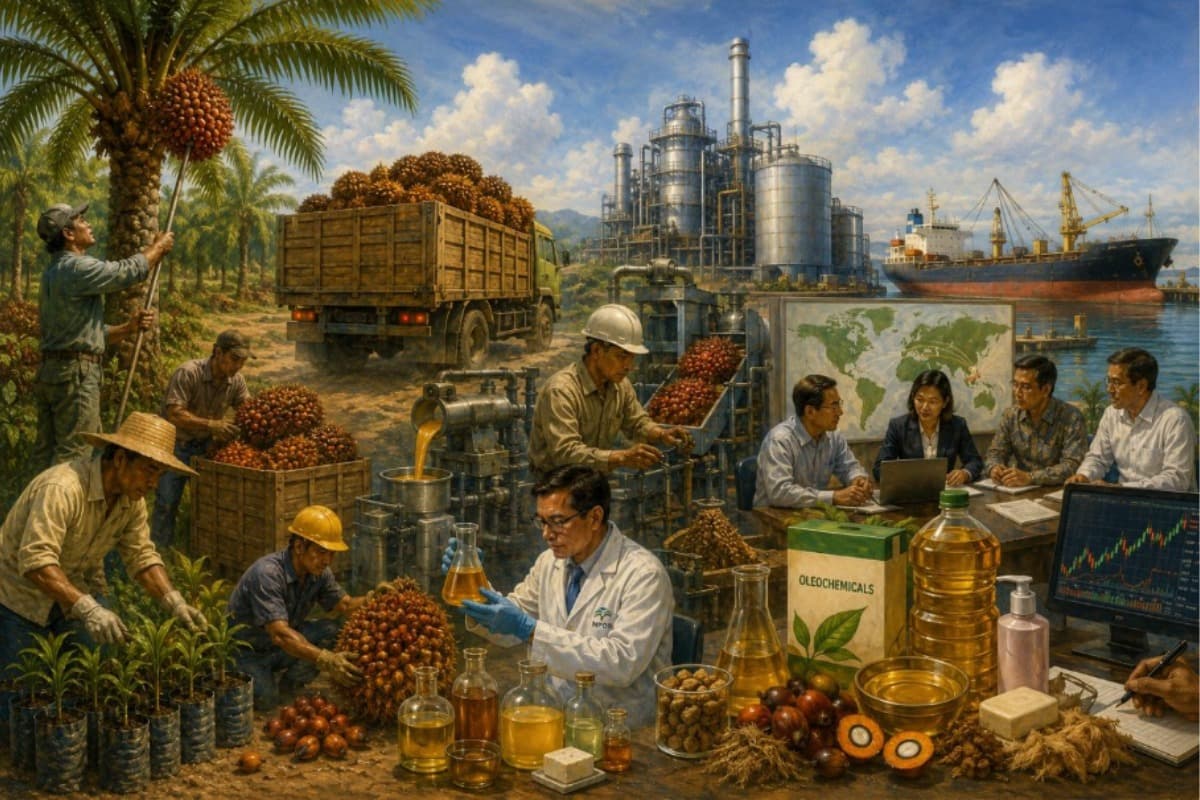
Palm oil begins with a fairly simple fruit bunch. Somewhere along the journey from soil to shelf, it acquires an alphabet: MPOB. MPOC. MSPO. MPOA. MEOA. EMPA. SOPPOA. NASH. ISP. MAPA. NUPW. MOSTA. POMA. PORAM. MEOMA. MOMG. MBA. MBIC - and assorted relatives.
Welcome to Malaysian palm oil’s ABC soup. The soup is thick enough that newcomers may need a spoon before they need a glossary.
I should also confess that this “guide” did not begin yesterday. I started parts of it a few years ago, when being surrounded by acronyms was something of an occupational hazard. It never quite crossed the finishing line, so I have now dusted it off, cleared away a few institutional cobwebs and brought the cast of characters up to date.
What began as a simple who-is-who guide has somehow grown into three parts. Consider it, tongue partly in cheek, Tek’s Guide to the Malaysian Oil Palm Industry — FOC. Perhaps it is my small contribution to helping the next person navigate the alphabet soup without learning every acronym the hard way.
If I have omitted an organisation deserving mention, my apologies. Attribute it partly to space and perhaps partly to the ageing process. The memory may occasionally misplace an acronym. Hopefully, it has not yet misplaced the industry.
Start with the public institutions
So where does one begin? As with many Malaysian palm oil matters, perhaps with three familiar letters: KPK.
At the centre of federal palm oil policy sits the Ministry of Plantation and Commodities, around which are agencies with distinct roles. The Malaysian Palm Oil Board, MPOB, covers research, development, licensing, regulation and technical advancement - from planting materials and agronomy to milling, processing and downstream applications. MPOB is not an industry association; it is a statutory body, funded in part through cess paid by growers. That distinction matters.
The Malaysian Palm Oil Council, MPOC, also supported by grower cess, has a more outward-facing role, particularly in market development, promotion and communicating Malaysian palm oil internationally.
MPOB and MPOC therefore do very different jobs despite being separated by only one letter. Indeed, one of the first examinations for anybody entering the industry could be: MPOB is not MPOC. MPOC is not MPOA. And MPOA is definitely not MEOA. Discuss. Twenty marks.
Sustainability adds another layer. Malaysia has the Malaysian Sustainable Palm Oil, MSPO, its national mandatory certification framework, while the Roundtable on Sustainable Palm Oil, RSPO, operates as an international voluntary system driven largely by business-to-business and market requirements. Particular customers and markets may demand still other assurances.
At the international level, there is also the Council of Palm Oil Producing Countries, CPOPC, based in Jakarta, through which producer countries cooperate on common palm oil interests.
A plantation can occasionally feel that it is growing not only oil palms but certificates as well. Certification serves an important purpose, but the challenge is to improve alignment and interoperability where possible so that sustainability produces better practices on the ground rather than simply more audits, paperwork and cost. The true measure should be what changes in the field, mill and supply chain — not the thickness of the certification file.
There are also bodies such as the Malaysian Palm Oil Green Conservation Foundation, MPOGCF, likewise supported by grower cess, bringing conservation and biodiversity into the institutional landscape.
Already the family photograph is getting crowded. And we have not even met the industry associations yet.
The growers have several voices
At the plantation end sits the Malaysian Palm Oil Association, MPOA, one of the main national voices for commercial plantation interests.
MPOA is itself an interesting chapter in our industry's ABC soup. It was formed in 1999 following a rationalisation that brought together three long-established plantation organisations: the Rubber Growers Association (RGA), the United Planting Association of Malaysia (UPAM) and the Malaysian Oil Palm Growers Council (MOPGC). The idea was straightforward: instead of several organisations representing overlapping plantation interests, create a stronger umbrella body capable of speaking more effectively for growers and the plantation industry.
Alongside it is the Malaysian Estate Owners’ Association, MEOA, another established plantation voice, including many medium-sized interests.
We often begin the palm oil story with a mature plantation. Yet every productive palm began rather less impressively as a seedling in somebody’s nursery. That brings in the Malaysian Oil Palm Nurseries Association, MOPNA.
The employees and staff have their respective unions in National Union of Plantation Workers, NUPW and All Malayan Estate Staff Union, AMESU. There is also the Malaysian Agricultural Producers Association, MAPA, with its broader agricultural employer and producer constituency and longstanding links to plantation agriculture.
The upstream also include the millers which have their own representative organisations. There are integrated and independent mills with the latter having its Palm Oil Millers Association, POMA.
Their concerns may differ in emphasis, constituency and geography, but they also overlap considerably. That should surprise nobody. Yet once the arguments are unpacked, the common ground is often larger than the differences. One association may frame the issue through cost, another through competitiveness and another through implementation, but the underlying problem can be much the same.
Different voices are useful. Common concerns are powerful. Unnecessary duplication is less so.
Cross the South China Sea
Any map of Malaysian palm oil that stops in Peninsular Malaysia is incomplete. Sabah and Sarawak are fundamental parts of the national production landscape and bring their own geographic, operational and policy realities.
The East Malaysia Planters’ Association, EMPA, formed in 1889 is among the region’s long-established plantation organisations. In Sarawak, the Sarawak Oil Palm Plantation Owners Association, SOPPOA, represents plantation-owner interests, while the Dayak Oil Palm Planters Association, DOPPA, adds an important indigenous grower perspective.
These voices matter because one national industry operates across very different conditions. A policy conceived in Putrajaya may look beautifully symmetrical on a PowerPoint slide. By the time it reaches an estate several hours upriver in Sarawak or a remote property in Sabah, the symmetry may have encountered several potholes.
Infrastructure differs, labour realities differ, land matters differ, distances differ, logistics differ and connectivity differs. That is not an argument against national policy. It is an argument for national policy informed by local reality.
Then come the smallholders, another essential constituency. They are not simply scaled-down plantation companies. Their economics, resources and ability to absorb costs can be very different.
A listed plantation group may discuss five-year capital allocation, digitalisation, mechanisation strategy and return on invested capital. A smallholder may be asking whether this month’s FFB cheque will cover fertiliser, household expenses and the motorcycle instalment. Same palm. Different spreadsheet.
Smallholder organisations like National Association of Smallholders Malaysia, NASH or PKPKM therefore matter, while FELDA, FELCRA, RISDA, SALCRA and others occupy important positions within Malaysia’s broader smallholder landscape.
Smallholder inclusion should not mean inviting them after a policy is finished and asking whether they can comply. It means understanding their circumstances while the system is still being designed.
The profession and academia matter too
The Incorporated Society of Planters, ISP, occupies another place in the ecosystem. Its role is professional rather than primarily commercial - developing knowledge, competence, continuing learning and professionalism among planters and agricultural practitioners.
And for the science behind the oil, there is the Malaysian Oil Scientists’ and Technologists’ Association, MOSTA — an organisation whose name, refreshingly in our acronym-rich industry, tells you almost exactly who most of its members are.
That matters because an industry cannot rely indefinitely on institutional knowledge stored inside the heads of people approaching retirement. Some of us are already discovering that those heads occasionally misplace acronyms.
Professional institutions help transfer experience before the previous generation begins asking where it left its spectacles.
Then there is academia. Public and private universities, colleges and research institutions are included. Industry gives academia real problems. Academia should help return knowledge, talent and possible solutions.
The danger comes when one side speaks only in papers and the other only in tonnes per hectare. Innovation requires translation between both languages.
From fruit to oil
The grower, incidentally, does not actually produce palm oil. The grower produces fresh fruit bunches, FFB.
Once harvested, those bunches begin a race against time to the mill. Millers therefore form another important constituency, whether within integrated plantation groups or independent operations purchasing crop from estates, dealers and smallholders.
Their world revolves around crop supply, utilisation, oil extraction rate, quality, maintenance, energy, effluent, methane, biomass and keeping expensive machinery productively occupied.
Growers naturally want the best possible FFB price. Millers naturally want good-quality fruit at a workable margin. Thus begins one of agriculture’s oldest traditions: each side explaining politely why the other fellow’s expectations are unreasonable.
Yet neither survives without the other. That is the supply chain in one sentence.
Once crude palm oil leaves the mill, the vocabulary changes. Rainfall becomes refining margin, loose fruits become inventory, harvesting rounds become freight schedules and somebody begins discussing futures before breakfast.
Moving downstream, the Palm Oil Refiners Association of Malaysia, PORAM, represents an important part of the refining industry. PORAM specifications have become standard for palm oil trade globally.
For the cooking-oil end of the chain and related packers, there is the Malayan Edible Oil Manufacturers’ Association (MEOMA) — reminding us that after all the plantations, mills, laboratories and trading screens, much of the journey still ends rather simply in somebody’s kitchen.
Further downstream sits the oleochemical and biodiesel stakeholders which are represented by the Malaysian Oleochemical Manufacturers Group, MOMG and the Malaysian Biodiesel Association, MBA.
By this stage the original bunch has become refined oils, fractions, fatty acids, fatty alcohols, glycerine and ingredients entering food, soap, detergents, cosmetics, personal-care products and industrial applications.
The harvester who cut the bunch might be surprised at just how sophisticated its journey eventually becomes. That is also why the seemingly simple phrases “oil palm industry” or “palm oil industry” can conceal a much more complex reality: there is no single commercial perspective running seamlessly from soil to shelf.
Growers, millers, refiners, traders and downstream manufacturers occupy different points along the same chain, with interests that may not always align - yet each can be entirely rational from where they stand.
Biomass and the wider bioeconomy
The value chain does not stop with food and oleochemicals.
Then there is the wider biomass economy, with organisations such as the Malaysia Biomass Industries Confederation, MBIC. Oil palm produces much more than oil. Empty fruit bunches, fibres, shells, trunks, fronds and other streams offer routes into renewable energy, materials and bio-based products.
The phrase “waste to wealth” sounds wonderful on a conference banner. The hard part begins when the waste is wet, bulky, dispersed and somebody asks who is paying for the waste and truck. Eventually, the banker’s calculator gets a vote.
One tonne, many perspectives
The same tonne of palm oil therefore looks different depending on where one sits. The grower sees production cost, the miller sees throughput and extraction, the refiner sees feedstock and margin, the trader sees market position, the biodiesel producer sees energy feedstock and the smallholder sees household income.
The sustainability manager sees compliance, the researcher sees yield potential, the academic sees questions worth investigating, and the policymaker sees exports, employment and economic value.
Everyone is looking at the same elephant from a different angle. In our case, the elephant happens to have bunches.
And who discovers the price?
Another important player is Bursa Malaysia Derivatives, BMD — or what some older hands may still instinctively call MDEX.
Its Crude Palm Oil Futures contract, FCPO, plays an important role in price discovery and risk management. The price flashing across a screen is more than a number for plantation people to celebrate when it rises and suddenly become experts in macroeconomics when it falls. It is the market continuously trying to answer one deceptively simple question: what is palm oil worth?
Producers, refiners, traders, investors and other market participants bring expectations about supply, demand, competing oils, weather, currencies, policy and uncertainty into the marketplace. Their views meet and a price emerges.
Palm oil may grow on trees. Its price does not.
More than an alphabet exercise
A palm may begin in a nursery, move into a smallholding or plantation, pass through a mill and refinery, enter domestic or export markets and eventually reappear as food, oleochemicals, biodiesel or other products.
Around that journey and across the supply chain sit researchers, universities, unions, professional bodies, certification systems, regulators, traders, dealers, inputs and technology providers — and more.
That explains why no single association, agency or company can represent every dimension of “the palm oil industry”. The ABC soup exists for a reason.
Different constituencies need different voices. Regional realities matter. Smallholders matter. Upstream and downstream interests differ. Professional knowledge and academia matter. New value chains bring different economics. Government carries responsibilities beyond those of any commercial player.
The challenge is not to eliminate the alphabet. It is to make the alphabet work together when the problem is common.
Malaysia’s palm oil sector does not lack associations, agencies, technical expertise or institutional history. What it increasingly confronts are cross-cutting challenges — labour, ageing palms, replanting, mechanisation, rising costs, taxation, market access, sustainability, competitiveness, innovation and smallholder inclusion - that refuse to stay neatly within any one organisation’s boundary.
No single acronym owns these problems. And no single acronym can solve them. That is where the real test begins: not whether Malaysian palm oil has enough voices, but whether those voices can work together when the issue is common.
In Part 2, we turn from who sits where to what happens when everyone needs to sit at the same table.
Read Part 3 here.
Joseph Tek Choon Yee is a former president of the Malaysian Estate Owners’ Association and past chief executive of the Malaysian Palm Oil Association.