

This article first appeared in The Edge Malaysia Weekly on August 17, 2026 - August 23, 2026
THE Royal Commission of Inquiry (RCI) report on the RM19.9 billion bailout of Lembaga Tabung Haji (TH) was finally made public and tabled in Parliament on Aug 11, 2026 — four years after it was completed. The report was ready in May 2022. But it was not released by then prime minister (PM) Datuk Seri Ismail Sabri Yaakob because he was planning to call a general election, which he did in November. However, the non-release of a report that would have made his party look bad did not help him and Umno, as the party had its worst performance ever, winning only 26 seats.
After Datuk Seri Anwar Ibrahim became the PM, he too did not release the report because Umno became part of his unity government led by his Pakatan Harapan. His decision to finally release the report was clearly because Umno has now chosen to align with the opposition Perikatan Nasional.
But politics aside, the RCI report has revealed the damning malfeasance and mismanagement at Tabung Haji.
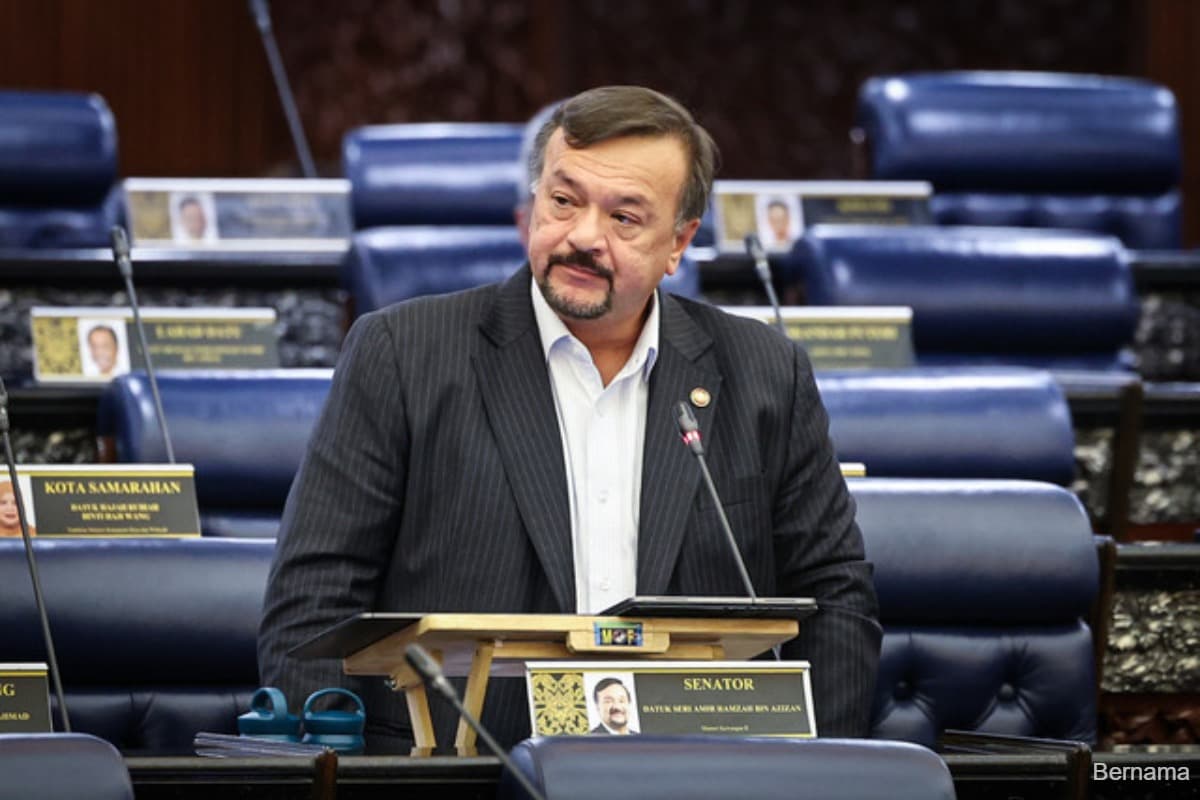
As the technocrat and non-politician Minister of Finance II Datuk Seri Amir Hamzah said in winding up the debate in Parliament — “Tabung Haji does not belong to the government or any political party. It is a trust that belongs to Muslims who save little by little in the hope of reaching the house of Allah.”
We produce here the abridged version of what he said and other stories to help readers understand what happened.
By Datuk Seri Amir Hamzah, Minister of Finance II
(Abridged version of his winding up speech in Parliament on Aug 11)
Allow me to summarise the central issues because there are parties attempting to distort the facts by claiming that no misconduct occurred, that Tabung Haji’s losses were merely the result of normal fluctuations in the stock market, or by questioning the measures taken to rescue Tabung Haji.
First, the RCI found that there were irregular investment processes involving the manipulation of investment-suitability reports, creative accounting practices, misleading representations and the concealment of information. These were among the causes of nearly RM13 billion in losses arising from problematic investment decisions made before 2018.
Second, the RCI recommended that active politicians be prohibited from serving on the Tabung Haji board and the boards of its subsidiaries. Tabung Haji must be managed professionally, without political interference or investments connected to party interests.
Third, action has been and continues to be taken against those responsible, including disciplinary action, police reports, court claims and investigations by enforcement agencies. The government will not wash its hands of the matter and will not protect anyone.
Fourth, the government’s intervention through Urusharta Jamaah in 2018 saved Tabung Haji. Problematic and underperforming assets were transferred to a wholly government-owned company and were not sold to foreign parties. Without this measure, profit distributions for 2018 and subsequent years could not have been made.
Fifth, the government had to bear a rescue cost of RM10.2 billion, and the price of this rescue ultimately had to be borne by depositors, taxpayers and all Malaysians.
This is the true picture of what happens when problematic investments cause losses. Governance weaknesses allowed the losses to continue. Political interference prevented corrective action. Creative accounting obscured the true state of Tabung Haji’s finances, and the government and the people ultimately had to bear the consequences.
This special sitting is not about passing judgement based on sentiment or political interests. Our responsibility is to establish the truth. Those responsible must be held accountable, and the same weaknesses must never be allowed to recur.
14 problematic investments with seven down to zero
The RCI disclosed 14 problematic investments. The investment losses that had to be borne were estimated at nearly RM13 billion. This comprised the RM10.2 billion government bailout in 2018 through UJSB, while RM2.6 billion in impairments or net losses were borne by Tabung Haji itself between 2018 and 2025 for investments that remained under its management.
Even worse, seven of those 14 investments suffered 100% losses — not partial losses, but total losses. This was the price that had to be paid to protect the savings of Muslims.
This was not merely an accounting issue. Financial statements only show the signs or symptoms. The disease, or root cause, was financial and investment misconduct. These losses did not suddenly appear in the financial statements. They resulted from investment decisions made by the previous leadership.
Accounting is like a thermometer. It only tells you that you have a fever. Hiding the thermometer does not cure the fever. What must be treated is the disease: investments that lost their value, uncontrolled risks and weak decision-making processes.
Allow me to explain the actual causes, namely the problematic investments.
First, concerning the investment in Al-Rawda in Saudi Arabia. This represented the largest loss on the list of problematic investments.
Through lease agreements entered into between 2015 and 2017, Tabung Haji paid 1.4 billion riyals, or RM1.5 billion, to an intermediary to lease four hotels in Madinah and Makkah to accommodate haj pilgrims. The intermediary was supposed to operate all four hotels and promised to pay rental proceeds of 2.49 billion riyals to Tabung Haji.
Unfortunately, those payments were not made. The question is how the Tabung Haji leadership at the time could have been so bold as to make an upfront payment exceeding RM1.5 billion? The only security supporting the investment was effectively a personal promissory note. According to the RCI’s records, Tabung Haji’s Risk Management Department had requested a bank guarantee, but Al-Rawda failed to provide one.
The due-diligence report was also incomplete. Nevertheless, Tabung Haji’s leadership proceeded with the transaction based on that promissory note. More than RM1.5 billion belonging to Muslims was placed at risk without security of any meaningful value.
Al-Rawda stopped making payments in the first quarter of 2019. The promissory note was not honoured, and Tabung Haji had to bear the loss. The investment was fully impaired by RM1.86 billion in 2024. That was one of the seven investments mentioned earlier.
Tabung Haji put RM1.55 billion at risk for that third party to provide accommodation for our haj pilgrims, but it was not provided.
After the haj season ended, the hotels could also have been rented out to generate additional returns. However, those returns for the other periods were also not received. All that Tabung Haji had in its hands were the promissory notes. We did not receive even a small portion of the money.
This transaction was clearly defective from the beginning, one-sided and failed to protect the interests of Malaysian Muslims. The question that must be investigated is: whose interests were being protected? Who benefited from this transaction?
Could the investment panel of the country’s principal Muslim institution really have been so superficial in carrying out its oversight, unless there was another agenda or a particular interest involved? The authorities must investigate this matter immediately.
Second, the acquisition of Putrajaya Perdana. In December 2014, TH paid RM193.3 million to Cendana Destiny Sdn Bhd for a 30% equity interest in Putrajaya Perdana,(See sidebar ‘Tabung Haji’s link to Putrajaya Perdana, Jho Low, SRC & 1MDB’) which had been delisted from Bursa Malaysia since 2010. The acquisition was based on two promises: that the company would be relisted within one year and that it would achieve a profit of RM86 million in 2015.
Unfortunately, neither promise was fulfilled. The RCI also recorded that the Tabung Haji chairman at the time concurrently held the position of Putrajaya Perdana chairman. Initially, Tabung Haji’s research division did not agree with the proposed valuation of RM206 million for the 30% stake. It valued the stake at between RM124 million and RM155 million.
Nevertheless, the investment was ultimately approved at RM193.5 million, which was higher than the internal valuation. There was no written justification for the higher valuation or for increasing the proposed equity interest from 25% to 30%.
The due-diligence exercise was only carried out after all the approvals had been obtained. It was not presented to either the investment panel or the board of directors before the agreement was signed. One fact that was never disclosed to the decision-makers was that the seller had acquired the entire economic interest in the company for RM260 million in 2012. A 30% share of that valuation would have been RM78 million.
Two years later, Tabung Haji paid RM193.5 million for the 30% interest — three times the corresponding 2012 value.
When the two promises were not fulfilled, Tabung Haji was forced to exercise a RM210.7 million put option against the seller in March 2018. The seller was required to take back the shares. However, the seller did not make the payment even though the put option remained in force.
As at the 2024 financial year, the investment had been fully impaired by RM193.5 million. This was the second of the seven investments mentioned earlier. TH is pursuing the matter in court, and a writ has been filed. A Mareva injunction, which is an order freezing assets, has been obtained.
The court-directed mediation was set aside on Aug 11, which is today — it had been fixed for Aug 11, today. The trial has been fixed for June 23, 2027.
Regarding the connection between Putrajaya Perdana and Jho Low (Low Taek Jho), I would like to provide clarification based on two records.
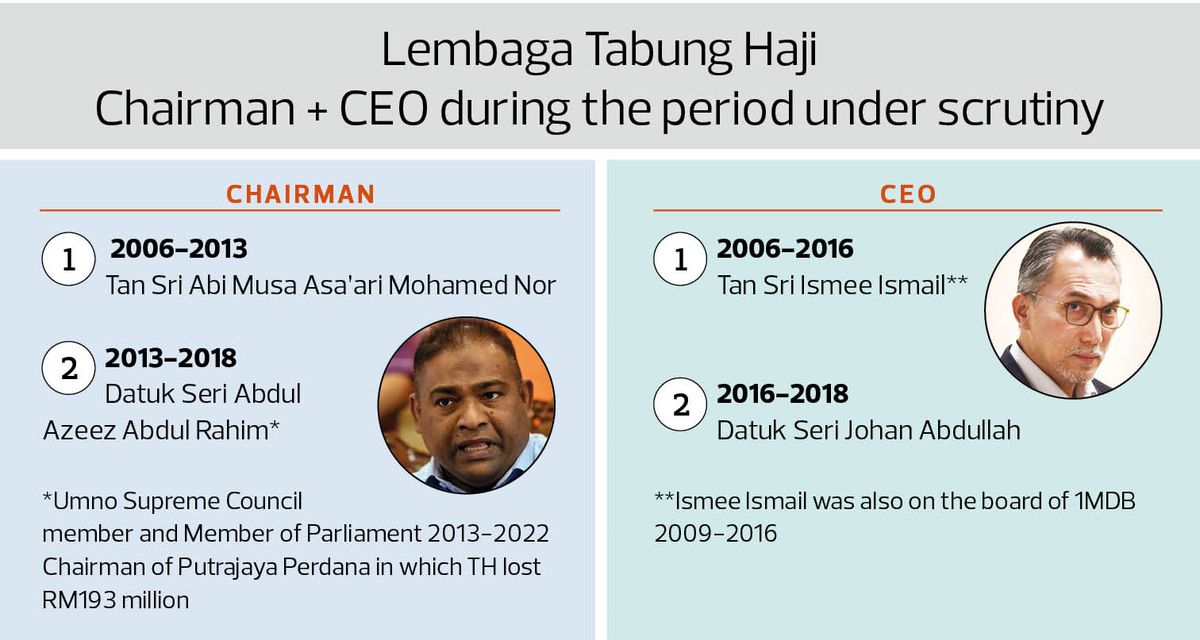
These are the court proceedings in the SRC International case, which were concluded at the Federal Court in 2022, and the limited factual assessment carried out in 2023.
According to the sworn testimony of Datuk Rosman Abdullah, a director of Putrajaya Perdana, SRC International channelled RM170 million to Putrajaya Perdana subsidiaries in three tranches between July and August 2014.
This was his testimony as recorded in court. Until the sale of the company by UBG was completed — and it was only completed on April 13, 2015 — Putrajaya Perdana remained under Jho Low’s control through UBG.
Rosman himself did not have the final say in the company’s management at the time.
I therefore wish to clarify that the court did not make any finding concerning this investment. It remains sworn testimony contained in the court record. If we carefully examine the chronology, the investment panel approved the transaction on July 24, 2014. The board approved it on Aug 25, the minister approved it on Aug 27, and the sale and purchase agreement was signed on Dec 3, 2014.
Every approval and the signing of the agreement fell within the period referred to in that testimony.
In addition, the 2023 factual assessment found that on July 24, 2014, the Tabung Haji investment panel had asked management to identify the seller’s ultimate shareholder. However, the assessment found no recorded response from management, and the transaction proceeded nevertheless.
Based on the sworn testimony in the court record, it was while Putrajaya Perdana remained under Jho Low’s control that the investment panel, board and minister approved the acquisition and the sale and purchase agreement was signed.
Third, the Offshore Patrol Vessel project for the Malaysian Maritime Enforcement Agency, involving THHE, which was also mentioned in the RCI in connection with an impairment that had not been recorded.
On Jan 19, 2017, the government awarded a contract valued at RM739.89 million to THHE Destini Sdn Bhd.
It was a joint venture between THHE Fabricator Sdn Bhd, a wholly-owned THHE subsidiary holding 49%, and Destini Shipbuilding Engineering Sdn Bhd, a wholly-owned subsidiary of Destini Armada Sdn Bhd holding 51%.
What actually happened?
The joint venture subcontracted the entire construction scope to a Destini subsidiary. THHE only received a letter of appointment for advisory services, while the actual construction work was carried out by Destini from the beginning. A forensic audit of the project identified RM48.1 million in fund irregularities and a further RM195 million in potential irregularities that remain under investigation.
For example, RM31.6 million in contract proceeds was diverted to the subcontractor’s parent company. This was clearly contrary to the agreed arrangements.
The forensic report stated that a former Destini Bhd director received RM1 million through the company concerned. Ultimately, only one of the three vessels was completed. All three vessels were supposed to be completed within 42 months, or by approximately the middle of 2020.
The first vessel was only delivered on Jan 2, 2024, which was three and a half years late. The contracts for the second and third vessels were terminated by mutual agreement with effect from Dec 31, 2024.
The cost of completing the vessels was estimated to require an additional RM310 million, equivalent to 40% above the original comparable cost for the three vessels. The investment-governance weaknesses involving TH and Destini did not merely result in losses. The government also had to incur additional expenditure to complete the remaining two OPVs.
Fourth, the sale of the PT TH Indo Plantations estate in Riau, Indonesia.
This transaction provides one of the clearest and easiest-to-understand examples of blatant mismanagement.
Tabung Haji sold a 95% equity interest in the plantation for an estimated US$910 million, or RM2.8 billion, as stated by the RCI in its report.
One condition after another was then relaxed in favour of the buyer. The price was reduced by US$100 million, or approximately RM310 million. The shares were transferred before full payment was received.
When the buyer failed to meet its obligations, Tabung Haji advanced US$178.6 million, or RM540 million, for an obligation that should have been borne by the buyer. What this means is that the seller financed the buyer. This was an extreme level of mismanagement that went against the interests of Tabung Haji and Muslims.
I understand that the funds channelled by Tabung Haji to PT TH Indo Plantations were used to pay the company’s debts. A police report was lodged, and Tabung Haji issued disciplinary charge sheets against four officers in May 2020 in connection with the sale, as recorded by the RCI.
Internal and external forensic investigations were conducted, and the investigation is continuing.
Fifth, Trurich Resources Sdn Bhd, involving an oil palm plantation in Kalimantan.
Tabung Haji’s investment of RM364.31 million was fully impaired, in accordance with the audited financial statements. The irregularities began at the most fundamental level: the land itself.
The joint venture’s objective was to own as much as 200,000ha of plantation land. However, only 40,880ha was ultimately acquired. The RCI reported allegations that the land-suitability report was manipulated to justify the land’s purported potential, resulting in Trurich acquiring the plantation for US$58 million, or RM200 million.
The seriousness of the matter can be seen from the fact that a police report concerning the acquisition irregularities was lodged by a member of the board itself on Dec 13, 2018. The disposal of Trurich’s subsidiaries was approved on Dec 22, 2020, and the company is now undergoing the disposal process.
Summary of the failings
Based on these five examples, the causes of Tabung Haji’s investment failures are as clear as daylight.
When upfront payments were made without security, shares transferred before money was received and project funds were diverted, these could not be dismissed as investments that simply suffered bad luck.
This was clearly and unmistakably a failure at multiple levels.
The same transaction pattern was repeated in Emrail, Wellspring (see ‘Some of the bad lth investments’ on Page S4) and Putrajaya Perdana. These were three minority investments made before proposed listings, using the same transaction structure: a proposed company listing, profit conditions and a put option as a risk-control mechanism.
Ultimately, none of the three companies was listed. When the put options were exercised, the counterparties failed to make the required payments. The 2023 limited factual assessment recorded a similar pattern in the processes involved. Four investments did not undergo the required due diligence, while the Risk Management Department’s recommendations were not adequately addressed.
How could such a situation have continued for so many years? The RCI attributed the answer to the composition of the board itself.
Three board members were active politicians, and the RCI linked political pressure to damaging decisions.
Hibah distributions were maintained at high levels after 2014 even though they were unaffordable. Political pressure in the lead-up to elections also influenced decisions that became principal causes of TH’s financial crisis. On that basis, the RCI recommended prohibiting active politicians from serving on the Tabung Haji board.
I have many more examples of non-compliance. There were also claims that Tabung Haji’s losses resulted from a decline in the stock market.
However, if we examine the strength of the stock market, it reached its highest level during the same period. The market’s decline in 2018 was only 6%, whereas the value of Tabung Haji’s shareholdings fell much more severely. (See sidebar on the shares owned by TH that were taken off its book in the bailout). Therefore, this was not a problem caused by the decline in stock market values.
I believe the changes to Tabung Haji’s management and board have significantly helped to tighten its controls.
We can see this from Tabung Haji’s performance after 2018. Even after it had to recognise RM2.6 billion in impairments on the assets that remained with Tabung Haji, it was still able to distribute hibah, and the hibah rate increased every year.
This is an example of what has been achieved through the changes made at Tabung Haji. We also note that, as recommended by the RCI, hibah is now only declared after the financial statements have been audited. Previously, it was declared based only on pro forma accounts.
Therefore, concerns about the previous issues have been addressed through the improvements that have now been implemented.
A great deal has been said about Tabung Haji’s accounting issues. As explained earlier, the problem was that it used net realisable asset value as its basis.
However, the net realisable value was determined using an approach in which management itself set the relevant prices. Only a small proportion of the assets were supported by independent valuations. We can see that asset values were increased to make the pro forma accounts appear profitable. Once they appeared profitable, TH could distribute hibah.
However, as we demonstrated earlier, Tabung Haji incurred losses every year from 2014 to 2017 because of the deception involved and the hibah declarations that were made. The hole in Tabung Haji’s finances reached the point where, to save the institution, the government had to undertake a process in which RM10.2 billion was provided through a rescue involving the issuance of sukuk.
This is an important point, and I hope everyone understands it.
To rescue Tabung Haji, we took the uncompetitive assets held by the institution. We examined the assets that were causing losses for Tabung Haji. Going forward, those assets had no prospect of generating returns for the institution. The government therefore took those assets and transferred them from Tabung Haji to UJSB.
The market value of the transferred assets was only approximately RM9.6 billion. However, when they were transferred, the government paid RM19.8 billion. This meant that Tabung Haji received an additional RM10.2 billion.
I do not know how else to put this. If I were buying assets, I would not buy them above their actual value. But we had to save Tabung Haji. If we had not rescued Tabung Haji, it would not have had the opportunity to distribute hibah for many years.
If we had not saved Tabung Haji, the value of depositors’ money would have fallen. If I had deposited RM1, perhaps I would have recovered only 50 sen, 60 sen or 80 sen. That is not consistent with Tabung Haji’s objective.
However, we must remember that the government stepped in and bailed out Tabung Haji by RM10.2 billion.
We bailed it out. No one can deny that. If we had not bailed it out, the country would have faced a much larger problem. The government fulfilled its responsibility as provided under the Tabung Haji Act.
I will conclude with several points. I wish to emphasise three pledges by the Madani government to Tabung Haji’s 10 million depositors.
First, the truth will continue to be disclosed. The government has released the RCI report for public scrutiny and presented it in Parliament. We have concealed nothing, even though some of the figures are painful.
Second, accountability will be enforced without fear or favour. In accordance with the decree of His Majesty the Yang di-Pertuan Agong, investigations must be conducted comprehensively, and there will be no compromise with any party found to have committed wrongdoing.
Third, Tabung Haji will be strengthened so that history does not repeat itself. Act 535 will be amended so that active politicians are legally prohibited from serving on the board of directors.
Tabung Haji’s investments will be regulated by the Securities Commission.
Hibah distributions will be based on audited accounts, and every decision concerning Tabung Haji will be measured against only one standard: the interests of the ummah.
Tabung Haji does not belong to the government or any political party. It is a trust belonging to Muslims who save little by little in the hope of reaching the House of Allah. May Allah grant us the strength to safeguard this trust honestly, giving the millions of savers the opportunity to answer the call to perform the haj.
Read also:
Cover Story: Tabung Haji’s link to Putrajaya Perdana, Jho Low, SRC and 1MDB
Cover Story: Some of the bad TH investments
Cover Story: What shares did Tabung Haji transfer to UJSB for RM16.87 bil?
Cover Story: The 30 biggest stocks sold to UJSB and how they are doing now
Save by subscribing to us for your print and/or digital copy.
P/S: The Edge is also available on Apple's App Store and Android's Google Play.