

This article first appeared in The Edge Malaysia Weekly on August 3, 2026 - August 9, 2026
EVEN without one of its key weapons, the Ministry of Defence (Mindef) insists the country’s first littoral combat ship (LCS1) — to be commissioned as KD Maharaja Lela — remains on track for delivery this December.
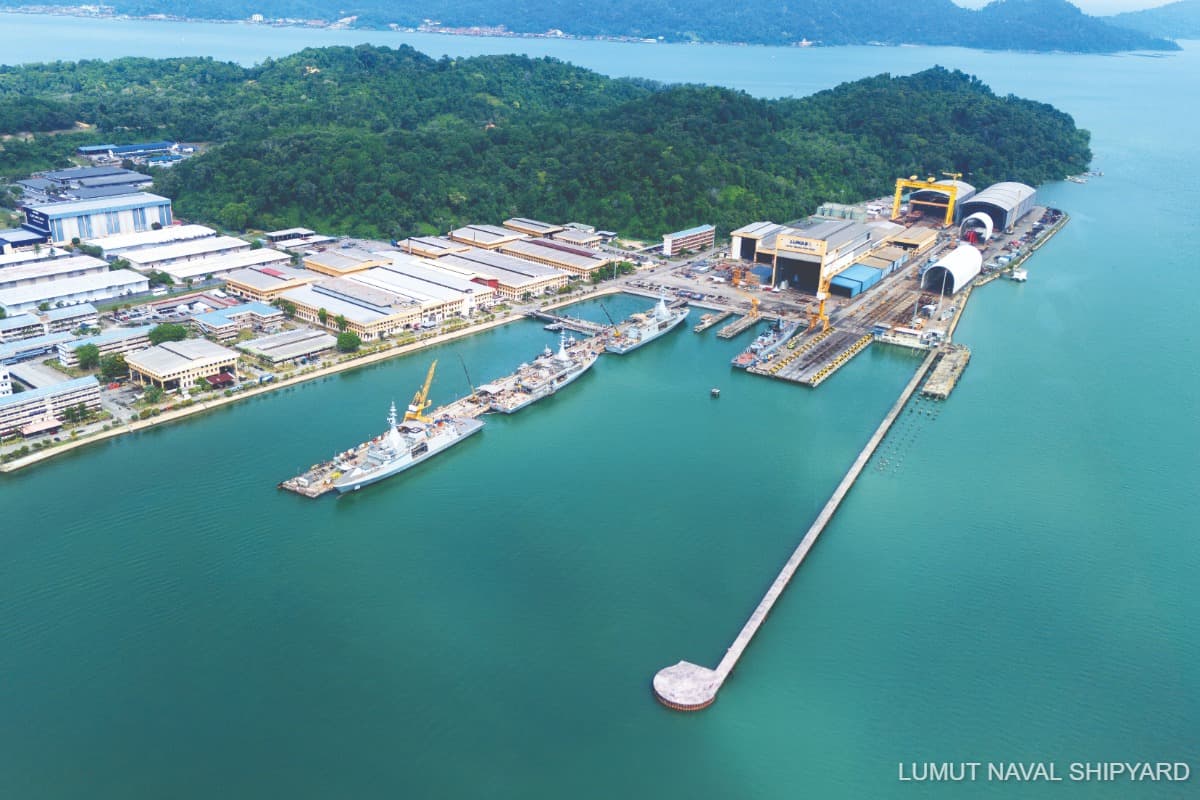
That assurance has kept shipbuilder Lumut Naval Shipyard Sdn Bhd (Lunas), which is wholly-owned by the Ministry of Finance, busy working to meet the year-end deadline after six years of delays. The LCS1 was supposed to have been delivered in April 2019.
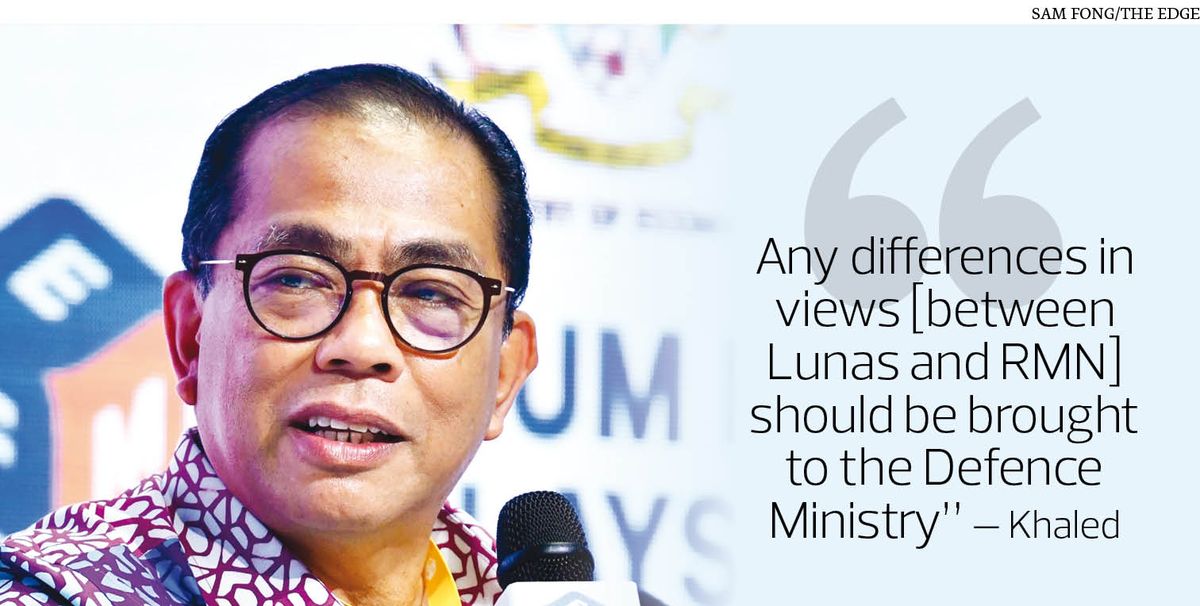
The minister’s remark has also put to rest the concern over whether the Royal Malaysian Navy (RMN) will accept the warship without its principal surface-to-surface strike weapon. When asked about the differences between Lunas, the contractor which is to build five combat ships, and the RMN over a warship without the Naval Strike Missile (NSM) system, Defence Minister Datuk Seri Mohamed Khaled Nordin says “any differences in views should be brought to the Defence Ministry”.
“All the other weapon systems have already been installed except for the NSM,” Khaled tells The Edge in a text message. While that assurance keeps the delivery schedule intact, it does not resolve the question of operational readiness.
Meanwhile, Mindef must decide whether the RMN should commission the warship first and integrate a replacement missile later or wait until a replacement missile is installed. The procurement process of a surface-to-surface missile will take more than a year, according to RMN chief Admiral Tan Sri Zulhelmy Ithnain.
For Lunas CEO Captain Azhar Jumaat, however, the missing missile is now the biggest uncertainty on the horizon. Any delay in the delivery will add costs to Lunas as keeping the combat ship docked at the yard will incur costs on insurance, maintenance and preservation of sensitive systems.
Lunas, formerly known as Boustead Naval Shipyard Sdn Bhd, is awaiting the government’s direction on whether the existing missile launcher and integration components should eventually be removed while assessing whether the circumstances surrounding the cancelled missile procurement should be treated as force majeure under its contractual arrangement.
“We have actually put a caveat on this and we are open to discussion — we are not forgoing any of our rights whatsoever at this stage. But at the same time, we have highlighted that we want greater clarity on how the government intends to treat this situation,” Azhar tells The Edge in an interview at the LCS project site on the Lumut naval base in Perak.
“KDA (Kongsberg Defence & Aerospace AS) is now invoking [the cause of] force majeure. So, I asked the government, do you treat this as a force majeure? That is a pertinent question that needs to be discussed and addressed so that we can find a more amicable way forward.
“Ultimately, my point to the government is that Lunas and Mindef have to speak with one voice and one position as a nation,” says Azhar, who has overseen the project since 2010.
The answer may eventually provide greater clarity on contractual claims, redesign requirements and compensation discussions between the shipbuilder and the Norwegian defence group KDA, following the latter’s failure to fulfil the contract.
But contrarily, Khaled tells The Edge that the missile procurement remained a matter between the Malaysian government and Norwegian defence company KDA rather than between Lunas and the supplier.
Mindef is already seeking RM1.06 billion in compensation from KDA, comprising RM604 million in direct payments already made and RM448.12 million in indirect claims arising from the failed supply. The cancellation by KDA came shortly before the missiles were due to be shipped. The Malaysian government had already paid more than 95% of the contract value.
A warship without its principal strike weapon
The incomplete LCS1 will remain one of the RMN’s most capable surface combatants and can still serve its purpose even without the anti-ship missile, according to Azhar. The ship’s anti-submarine warfare suite, sonar systems, anti-air warfare capability, electronic warfare systems and naval gun remain intact.
The missing piece is just the weapon designed to give the ship its longest reach against hostile surface targets. With a strike range of about 250km, the weapon fundamentally changes the ship’s deterrence value, particularly in the South China Sea, where the ability to engage hostile vessels at long range forms a critical part of modern naval operations.
The missile launch systems has been integrated to the main combat management system in the war room of the 111m long vessel. The launcher ramp has been installed, and the launch pad completed in accordance with NSM specifications — taking into account factors such as backblast (missile thrust at launch) and launcher dimensions, ensuring a snug fit without increasing the ship’s radar signature. In short, KD Maharaja Lela is ready to receive the NSM missiles.
Without it, the ship can still patrol Malaysian waters, conduct anti-submarine operations and contribute to maritime security missions. But it cannot fully perform one of the principal missions for which it was originally designed.
That has led Lunas to propose what it considers the “most practical solution”, which is deliver the vessel first and install the missile later once the government finalises its replacement procurement.
The ball is now in Mindef’s court. The RMN’s leadership has consistently maintained that strategic assets should ideally be delivered at full operational capability. If delivery proceeds after the missile issue is resolved, the completed vessel may remain alongside the jetty rather than at sea.
All these decisions will carry crucial consequences for the RMN, Lunas and taxpayers alike.
Missiles aside, issues related to crew training are still pending finalisation. Lunas has begun training RMN personnel to operate the ships but the long-term programme has yet to be formally concluded.
“So this isn’t a simple technical decision. It’s a commercial and contractual discussion that needs to take place fairly soon. At the moment, we’re waiting for the government’s direction,” Azhar says.
For the 52-year-old naval captain who has been with the LCS project since day one, the latest uncertainties are a reminder of how prolonged government decision-making had previously contributed to the programme’s delays.
The change of government in 2018 after the Barisan Nasional government fell and the Pakatan Harapan coalition took over Putrajaya did not help expedite the project that was already facing cost overrun and a slew of variation orders that hindered its progress.
Between 2017 and 2019, the project saw three major variation orders involving the surface-to-surface missile system for diversification of suppliers (2015-2017), the decoy system due to supplier issues (2017-2019), and integrated platform management system for greater commonality with other Navy assets (2017-2019). Delays in decision-making were likely compounded by three federal government changes since 2018.
BNS indicated it was prepared to absorb the direct costs arising from the variation orders, but requested additional time as they were introduced midway through construction.
“The problem wasn’t that the government requested changes. The problem was that although the variation orders were issued, the implications of those changes — in terms of cost and additional time — were never finalised. As a result, from 2017 until 2023, the programme remained trapped in a prolonged period of indecision,” Azhar says.
That period contributed significantly to escalating costs because the project remained stalled without a definitive resolution, he adds. In addition, the lockdown caused by the Covid-19 pandemic also affected the progress.
Searching for a replacement
So far, Mindef has shortlisted four countries — France, Italy, Türkiye and South Korea — to replace the cancelled NSM. Ironically, the search for a replacement missile may ultimately bring Malaysia back to where the programme first began.
According to Azhar, the RMN’s original preference during the early years of the LCS programme was a French-made anti-ship missile supplied by MBDA France. The government subsequently opted for Norway’s NSM after deciding to diversify suppliers.
At the time, much of the RMN’s missile inventory — including surface-to-surface, surface-to-air and submarine-launched missiles — was already sourced from France. Thus, the move reflected concerns over placing too much of the RMN’s strategic firepower in the hands of a single supplier, Azhar opines.
That policy resulted in the NSM procurement process beginning in 2011, before a €124 million contract was signed in 2018 for the LCS fleet. A second contract worth €9.19 million was awarded in 2023 for two launcher sets intended for the Lekiu-class frigates KD Jebat and KD Lekiu, the biggest navy ships after LCS.
With Norway having revoked the export licence, coming back to anti-ship missiles supplied by MBDA France may not be the best option either as France’s footprint in the LCS programme has already grown.
The entire LCS is basically based on the Gowind design developed by France’s Naval Group, which remains the programme’s Design Authority. This means any major modification affecting the ship’s combat architecture — including integrating a different anti-ship missile — must therefore be reviewed to ensure the vessel’s design integrity and operational safety are preserved.
Only two weeks ago, on July 20, Mindef signed a letter of acceptance with MBDA France for the acquisition of the LCS fleet’s surface-to-air missile (SAM) system. The SAM launching system was contracted directly between Lunas and MBDA in 2014, and has already been installed on board the first ship.
Thus choosing another French-made missile could simplify integration since the ship’s design authority, combat architecture and several key combat systems originate in France. However, such a move might appear inconsistent with the government’s long-standing policy of avoiding excessive reliance on a single supplier for strategic defence assets.
“The Defence Ministry’s position is that Malaysia will not accept any strategic procurement that creates excessive dependence or allows any external party to influence the country’s operational decisions, asset utilisation or defence policy,” Khaled said in a parliamentary reply on June 22.
For Lunas, December delivery is a major milestone to cross after six years of delays for the 12-year-old LCS programme that came under public scrutiny.
Like it or not, many factors are beyond Lunas’ control, given that Mindef is the procuring party but the RMN is the one that sails the combat ship on the South China Sea. But one thing is for sure, taxpayers are the ones footing the RM11.2 billion bill.
Read also: Save by subscribing to us for
your print and/or
digital copy. P/S: The Edge is also available on
Apple's App Store and
Android's Google Play.
Cover Story: From standstill to sea, LCS faces fresh headwinds