

This article first appeared in The Edge Malaysia Weekly on August 3, 2026 - August 9, 2026
EXACTLY four years ago, The Edge joined the media tour of the highly scrutinised littoral combat ship (LCS) project site, then known as Boustead Naval Shipyard, at the Lumut naval base in Perak.
The visit took place just days after the Public Accounts Committee (PAC) released a 247page report exposing financial, management and governance problems that was plaguing the multibillionringgit LCS project. The project had been awarded to Boustead Naval Shipyard Sdn Bhd (BNS) in 2010, with the first construction contract signed four years later in 2014.
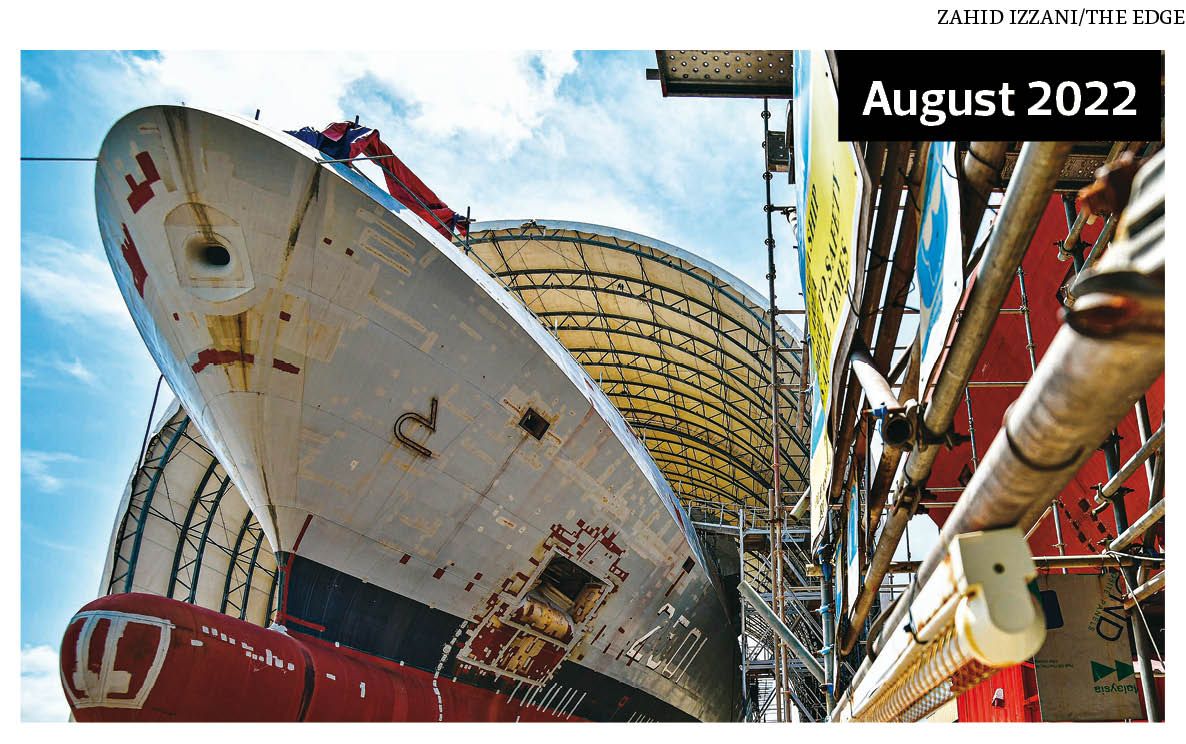
The scene at the shipyard was as bleak as the PAC’s findings: halfbuilt vessels stood in an almost deserted yard, warehouses were stacked with equipment but there was little sign of shipbuilding. By 2022, the project had been stalled for nearly four years.
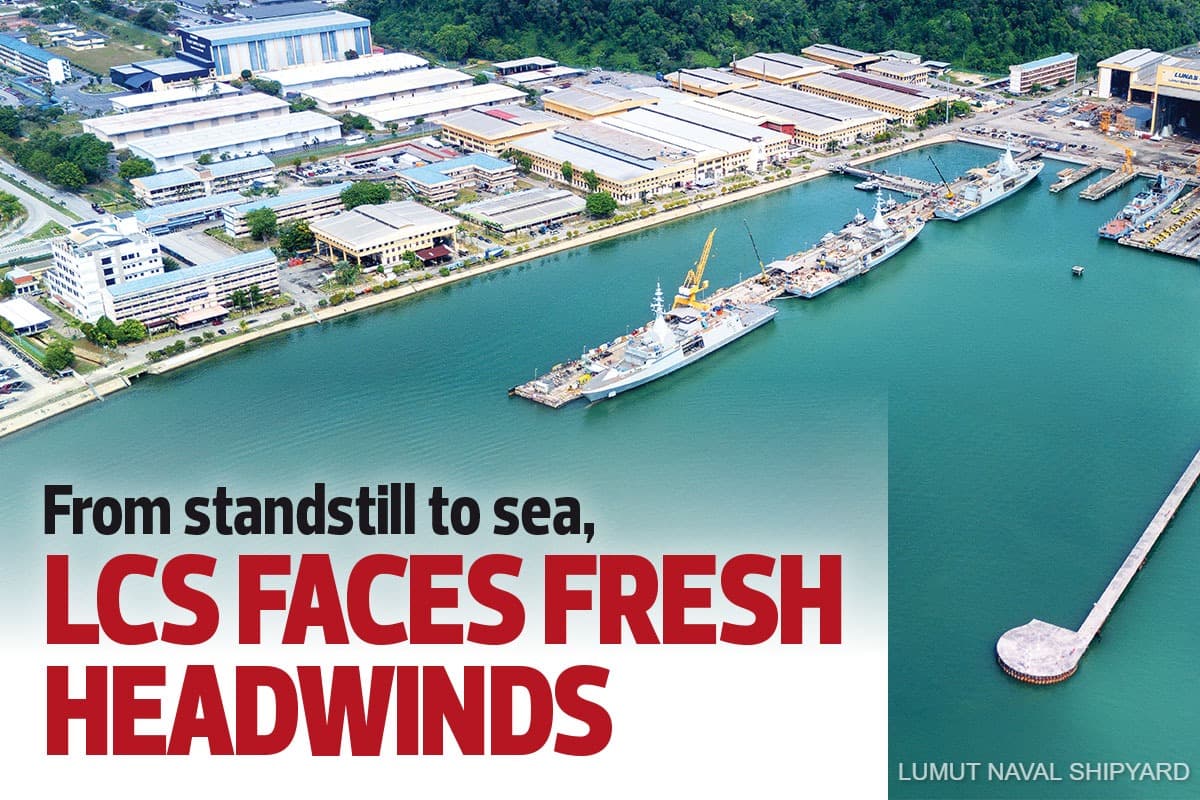
Fast forward to today, the shipyard tells a very different story. On a recent return visit by The Edge, the 113acre facility, now renamed Lumut Naval Shipyard, was bustling with activity as workers raced to complete five vessels — effectively rebuilding both the project and the company behind it. New shipbuilding facilities had been added to expedite the progress.
Aboard the first warship, the transformation is clear. It has taken its final form — with torpedo launchers and combat systems installed, a flight deck and hangar capable of accommodating large military helicopters, and its digital navigation and combat control systems in place.
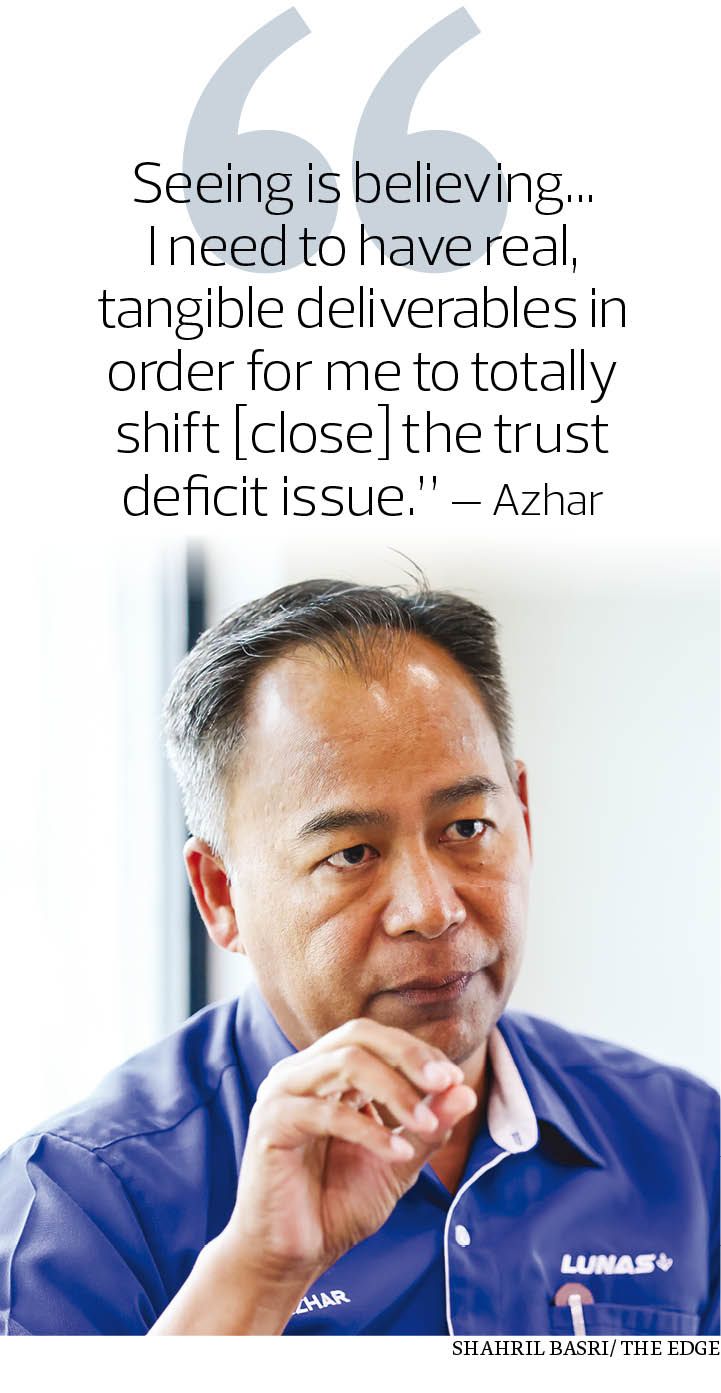
“Seeing is believing,” says Captain Azhar Jumaat, CEO of the contractor now named Lumut Naval Shipyard Sdn Bhd (Lunas). “I need to have real, tangible deliverables in order for me to totally shift [close] the trust deficit issue.”
“The major issue back then [was] our severe trust deficit. The idea is to share the perspective that become lessons learned for us as a country, [and] for the public to know, so that we don’t repeat those pitfalls again in the future.”
The LCS project was originally meant to deliver six combat ships at a cost of RM9.13 billion, with the first due in April 2019 and the sixth in 2023. But BNS missed the deadlines, and suffered from cost overrun and governance issues.
Boustead Holdings Bhd was the majority shareholder of BNS with 68.85%, followed by its subsidiary Boustead Heavy Industries Bhd at 20.77%, and parent company Lembaga Tabung Angkatan Tentera at 10.38%.
In October 2023, the current government decided to salvage the project — a move that raised many eyebrows. Cost had escalated by RM2.1 billion to RM11.2 billion for five ships, instead of six.
BNS was taken over by Minister of Finance Inc (MOF Inc) in 2024 and renamed Lunas.
The government has paid RM8.5 billion (close to 76% of total contract value), while Lunas has raised borrowings from Exim Bank Malaysia, a unit of Bank Pembangunan Malaysia Bhd (BPMB), to finance the project. Lunas also applies for funding from MOF for the modernisation of the more than 40-year-old yard, Azhar says.
When asked the rationale to revive the costly problematic project, Azhar points out some RM6 billion had sunk in for purchase of equipment and other purposes. Furthermore, termination of the project would trigger litgations, let alone loss of jobs in the shipbuilding industry.
“Lunas” means a ship’s keel in Malay, but it carries another deliberate message. “I always remind my staff that we have this commitment to melunaskan (deliver or settle) everything entrusted to us. So you need to deliver,” says Azhar, who served as project director of BNS from 2017 before becoming CEO in 2022.
The project is now about 79% complete, compared with around 57% before the restart in 2023. Three vessels are already in the water, while the last two are being built concurrently.
This year is supposed to be a redeeming one for the project, with the first ship LCS1 — named KD Maharaja Lela — scheduled to be handed over to the Royal Malaysian Navy in December, less than five months from now.
However, just as Lunas’ management is confident in delivering LCS1 this year, the Ministry of Defence (Mindef) as well as Lunas received notices from missile supplier Kongsberg Defence & Aerospace that in May, the Norwegian government had blocked it from exporting its surface-to-surface naval strike missiles (NSM) — one of its most consequential combat systems — to Malaysia.
The episode highlights the complexity facing Lunas as a contractor. The government procures the missiles, while Lunas is responsible for the launchers and their integration into the vessels.
Lunas’ long sail toward completion seems to be even longer now.
Minister of Defence Datuk Seri Mohamed Khaled Nordin has since confirmed that LCS1 will still be delivered in December without the surface-to-surface missiles (see sidebar). The government is evaluating replacement systems, but the ship will retain its anti-submarine and anti-air warfare, electronic warfare and naval gun capabilities.
Cascading effects
Aboard LCS1, the NSM launcher ramps are already installed and connected to its onboard systems, as per Lunas’ contract obligations.
Lunas also has launchers for three vessels in hand.
“We are waiting for the government’s decision (on missile procurement),” says Azhar. “Meanwhile, we need to address what [we] want to do with the existing system … changing the missile is not as straightforward as plug and play.”
Naval Group, the French designer and design authority, must review and approve significant changes related to the missile, while Bureau Veritas provides independent classification.
A replacement missile could therefore require changes to the launcher footprint, deck structure, weight and stability, cabling, radar cross-section and systems integration. Naval Group’s role also provides assurance on the performance and specifications of the approved design.
LCS1 is especially important, according to Azhar, because it serves as a reference for the remaining vessels. “The first one is the hardest one, because you need to establish it as a reference … Once it’s agreed and accepted by the Navy, the second, third, fourth and so on will just be a repetition.”
On top of the technical impact, any decision must also be harmonised with the contract, which stipulates that Lunas is to deliver the vessel with full capabilities.
The NSM conundrum, with its ripple effect, represents just one of the myriad challenges that have weighed on the LCS project, now in its 12th year since the first construction contract was signed.
While the NSM situation remains uncertain, the Ministry of Defence’s (Mindef) procurement of surfacetoair missiles will also take time, as it only signed a letter of acceptance with manufacturer MBDA France on July 20.
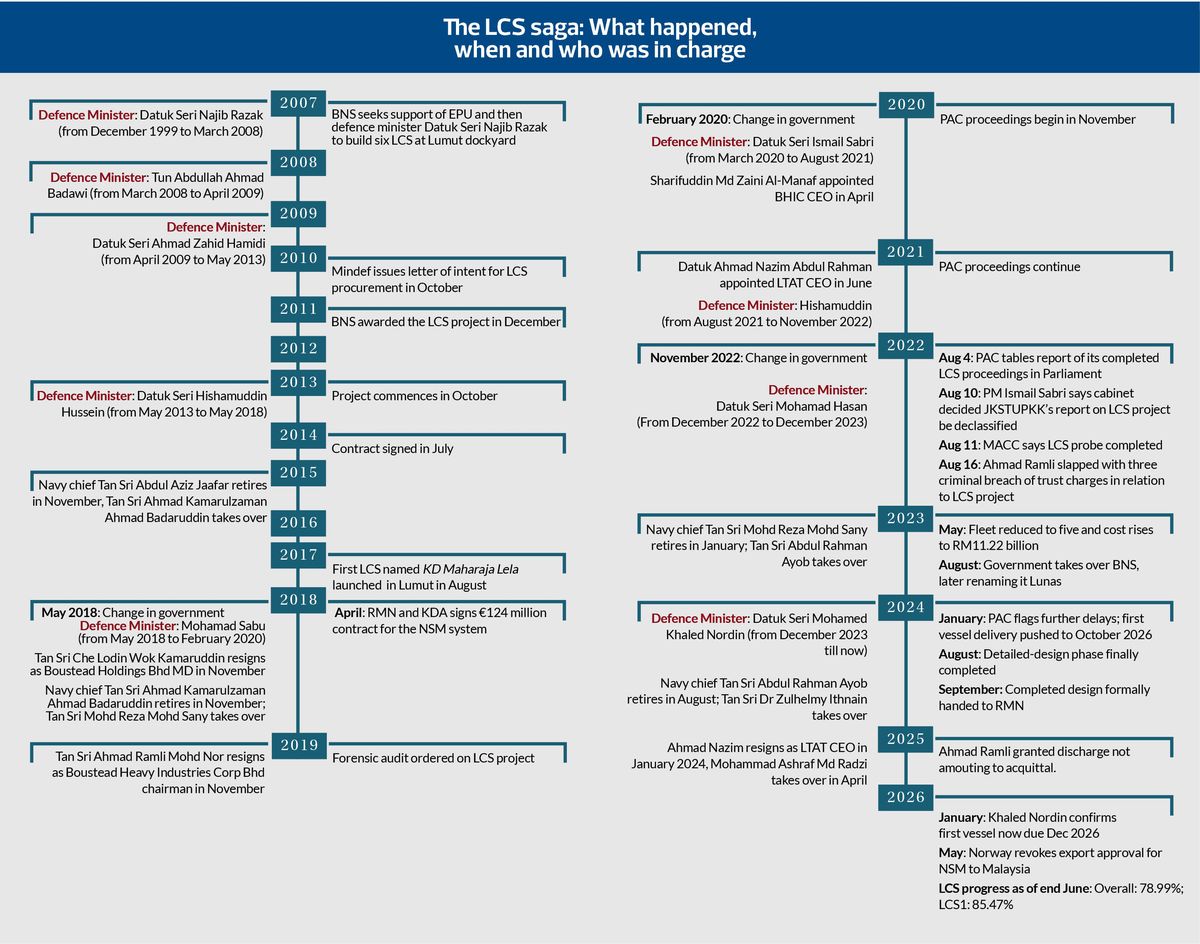
However, this will not affect Lunas’ delivery of LCS1. The delivery timeline for the first two vessels was recently extended from October to December (see chart), due to equipment-sourcing challenges after manufacturers went bankrupt post-pandemic, and following a piping and cabling design review by Naval Group.
Lunas has also begun training Navy crew to man the ships, according to recent PAC reports, although this scope has yet to be formally signed. The letter of intent (LOI) was only given to Lunas in May last year.
Problems went beyond engineering issues
The LCS programme, one of Malaysia’s largest domestic defence projects, was meant to be a game changer for the Navy and a catalyst for the local defence industry.
Azhar has been involved with the LCS project since its inception — he was among the Navy officers tasked with conceptualising it in 2010. “I was just promoted to captain then ... When the contract was signed in July 2014, I was the first project director for the Navy, up to 2016 when we started to see issues that were really bringing up concern within the government.”
Azhar was then tasked to join BNS as a project director “to try to help” and translate the Navy’s requirements into design and production. But the problems extended well beyond engineering.
“I thought it was going to be a quick undertaking, but about 1½ years [after] I was in BNS, I realised that it’s much more than just actually understanding the technicality and specifications.
“The implementation of the project management, the financial management, was a bit sketchy and not properly monitored. So governance, in a nutshell, was really a major issue.”
By 2019, a slew of problems had cropped up, ranging from cash flow and governance issues to the utilisation of project funds for other purposes and additional costs from major specification changes.
BNS failed to pay its vendors and construction effectively ground to a halt.
Adding to the problems, the pandemic prolonged the standstill. Original equipment manufacturer (OEM) teams dispersed, equipment remained in storage, and when the government eventually sought to restart the programme, the vendors demanded remobilisation costs.
A forensic audit was completed in 2020 and referred to the Malaysian Anti-Corruption Commission (MACC). In August 2022, the PAC issued its damning report on the project.
That same month, former navy chief Tan Sri Ahmad Ramli Mohd Nor, who was BNS managing director from 2005 to 2019, was charged in court for criminal breach of trust involving RM21 million in relation to the project. He was granted a discharge not amounting to an acquittal in March 2025. MACC told the PAC in February this year that its criminal investigation into LCS remained active.
When MOF Inc took over BSN, the fleet was reduced from six ships to five, and an additional RM2.1 billion was injected, increasing the construction contract to RM11.2 billion.
It marked another rescue for the Lumut yard. BNS’ former parent, Boustead Heavy Industries Corp Bhd, had itself taken over PSC Industries Bhd after the latter ran into trouble building six offshore patrol vessels for the Navy.
A tighter ship
Azhar, who says he had raised the red flag over financial mismanagement in BNS, stresses that the revived project is being run very differently.
“If you want me to turn the programme around and deliver it, I want the authority that can match the responsibility. I cannot be entrusted with the responsibility without authority,” he recalls telling the government when the rescue was being considered.
Remobilisation negotiations with the OEMs were conducted with MOF Inc, Mindef and Navy representatives present, while payments under the revived contract use the earned-value method: physical progress must be validated before Lunas can claim.
To recap, the contention surrounding the LCS project was that by 2022, RM6.1 billion had been disbursed by the government, yet not a single vessel had been delivered by BNS. Consequently, the MACC was probing the project.
Back then Azhar, who was then CEO, explained to the journalists visiting the shipyard in Lumut, that waiting for each vessel to be completed sequentially would prolong the programme and add substantial holdings costs. The project’s progress was affected by events such as changes in design, stop-work pending investigations, cash flow issues and the pandemic, among others.
He emphasised that money had been spent on purchase of equipment that required pre-ordering. On top of that, some RM2.5 billion had been spent on “overhead, project management and financing costs, insurance, electricity, infra[structure] [and] construction”.
Azhar, who has remained in the captain’s seat since, tells The Edge that reviving the project was never smooth sailing.
Lunas had to rebuild its talent pool and supplier base after the prolonged stoppage, while workers and processes had to meet naval classification standards.
Financing processes took months due to the nature of military procurement, which initially delayed delivery from equipment manufacturers.
It also has to juggle multiple activities at once: vessel construction, system testing, Navy acceptance as well as Naval Group’s design reviews.
All said, Azhar is confident in completing the building of the five ships. He reiterates several times during a candid interview that Lunas is capable of doing the job and that it has no technical issues.
To reduce the risks, Azhar says Lunas has invested in a shore integration facility equipped with an additional set of combatsystem gear. Systems can be tested on land before being replicated on board, while the same equipment can be used for crew familiarisation and as contingency stock if a critical component on a ship needs replacing.
Beyond delivering the ships, the question is whether Malaysia will gain lasting value from the programme.
Lunas is modernising the yard for current and future projects, including the construction of a new jetty, purchase of a modular transporter, and the building of a new breakwater to accommodate vessels with deeper draughts.
Azhar says Lunas has also passed capability assessments by HD Hyundai Heavy Industries and Dubai’s Drydocks World, opening the door to potential future collaboration. HD Hyundai publicly conducted an in-depth assessment of the yard in April as the two sides explored closer technical cooperation.
A number of its vendors are now able to go to bigger markets. One example is Protank Mission Systems, a Malaysian company involved in developing the LCS’s helicopter refuelling capability. The capability it built has since been commercialised into its own helicopter-refuelling products for offshore facilities and overseas customers. Local precision-engineering firm Innopeak (M) Sdn Bhd has also fabricated the NSM launcher ramps for Kongsberg Defence.
After Lunas completed the LCS’ detailed design, several senior Malaysian designers became sufficiently valuable to be recruited overseas, including in Europe. Some, however, have remained with or returned to the company to see through the handover of at least the first LCS.
Similarly, Azhar, now 52, has set his sights on the completion of the final vessel by 2029. He would have reached retirement age by then, and completed nearly two decades of involvement in the project.
Despite the long journey, he remains convinced that building naval vessels locally was the right ambition. Türkiye began its MLGEM indigenous warship programme only a few years before Malaysia conceptualised the LCS; it now designs and exports corvettes and frigates, including vessels being built for Malaysia.
“I believe Malaysians have what it takes. It is just that we have this mental block — we do not want to move beyond our comfort zone and accept the challenge,” Azhar says.
Future activities by Lunas will help gauge the extent of Lumut’s successful economic and operational turnaround — and after a state takeover, tighter controls and billions of ringgit in additional commitments, that is what taxpayers should expect.
Yet, just as the shipyard appears to have solved the problems within its control, unresolved questions over key systems and the contractual changes they bring mean that, even after 12 years, Malaysians may not be able to close the chapter on the LCS story.
Read also: Save by subscribing to us for
your print and/or
digital copy. P/S: The Edge is also available on
Apple's App Store and
Android's Google Play.
Cover Story: LCS1 faces more than a missile dilemma ahead of December delivery