

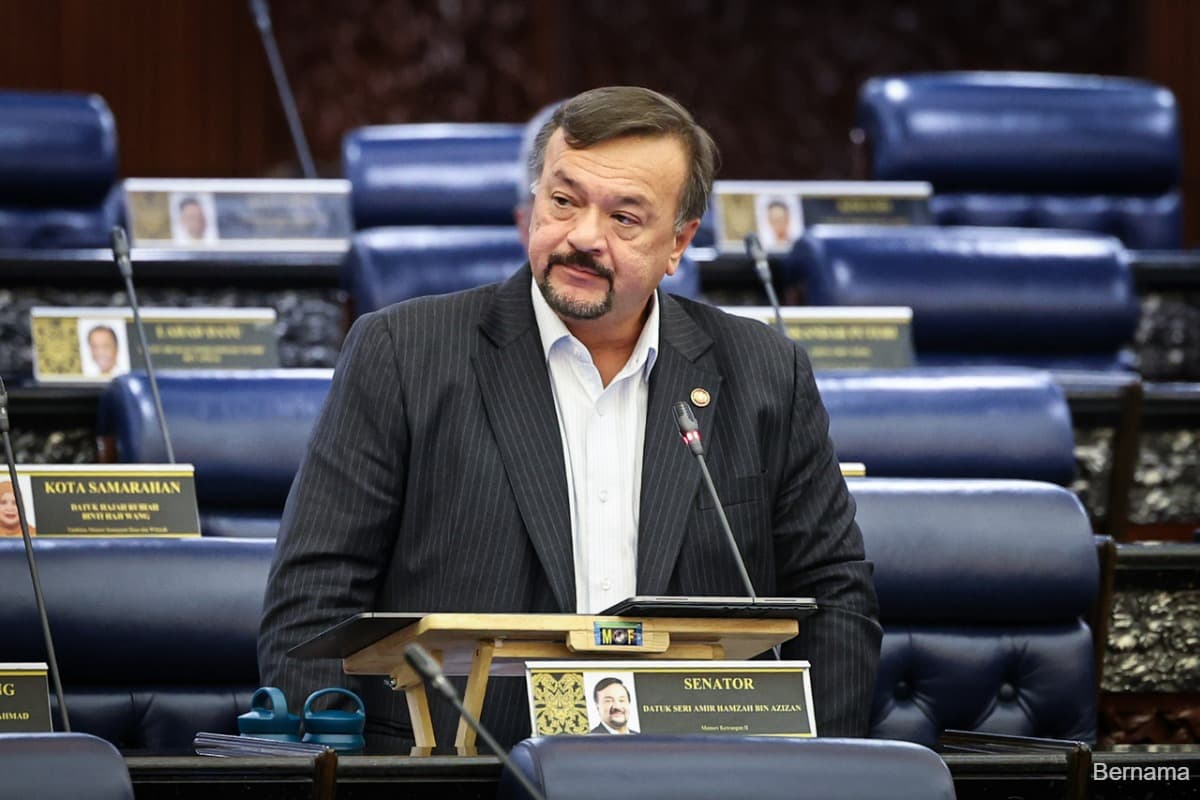
KUALA LUMPUR (Aug 11): Finance Minister II Datuk Seri Amir Hamzah Azizan told the Dewan Rakyat that “failures at multiple levels” led to seven of Lembaga Tabung Haji’s (TH) 14 troubled investments suffering total losses.
The biggest loss was Al-Rawda Real Estates Development & Project Management Co Ltd in Saudi Arabia, which was fully impaired by RM1.86 billion as at Dec 31, 2024, Amir said during the winding-up of a special parliamentary debate on the Royal Commission of Inquiry (RCI) report into TH’s management and operations from 2014 to 2020.
A separate Finance Ministry statement later highlighted RM193 million in losses from Putrajaya Perdana Bhd and RM364 million from Trurich Resources Sdn Bhd, both of which were fully impaired.
The RCI also found that TH’s RM63 million investment in Alfareeda Residential Fund was completely written off. Its RM198 million investment in TH Marine was also fully impaired, along with RM80 million of the RM136 million in financing provided to the company.
Overall, Amir said the losses comprised RM10.2 billion absorbed by the government through the 2018 rescue and restructuring of TH’s troubled assets via Urusharta Jamaah Sdn Bhd, and RM2.6 billion in impairments recorded by TH between 2018 and 2025 on legacy investments it continued to hold.
Amir said the full list of the seven investments that suffered total losses would be provided in writing following requests from several MPs.
He said the losses were caused not only by poor investments but also by weak decision-making and misconduct by former directors.
The RCI found 14 troubled investments and suspicious approval processes, including the hiding of information and manipulation of investment reports.
The misconduct included payments without proper security, transactions without guarantees, shares transferred before payment was received, and the diversion of project funds.
“This is not merely an accounting issue. Financial statements only show the symptoms. The root cause was financial and investment misconduct,” Amir said.
“Accounting is like a thermometer. It only tells you that you have a fever. Hiding the thermometer does not cure the fever. What must be treated is the disease — investments that lost their value, uncontrolled risks and weak decision-making processes.”
Al-Rawda: More than RM1.5 billion paid without bank guarantee
Between 2015 and 2017, TH paid about 1.4 billion Saudi riyals (more than RM1.5 billion) upfront to Al-Rawda for agreements involving four hotels in Makkah and Madinah. Al-Rawda was supposed to operate the hotels and pay TH 2.49 billion Saudi riyals in rental proceeds over the lease period.
TH’s risk management team requested a bank guarantee, but Al-Rawda failed to provide one. TH also proceeded with the deals before completing its due-diligence checks.
Instead, TH received promissory notes backed by a personal guarantee from Al-Rawda’s owner.
“More than RM1.5 billion belonging to Muslims was put at risk without security of any meaningful value,” Amir said.
Al-Rawda stopped making payments in the first quarter of 2019, and the promissory notes were not honoured. TH subsequently fully impaired RM1.86 billion arising from the investment by FY2024. This transaction was flawed from the outset, one-sided and incapable of adequately protecting the interests of TH and its depositors, Amir said.
“The question that must be investigated is: whose interests were being protected, and who benefited from this transaction?” he said. “How could the investment panel of a major institution belonging to Muslims have conducted such shallow scrutiny, unless there was another agenda or a particular interest involved?”
TH fully impaired investment in allegedly Jho Low-linked Putrajaya Perdana
The second case involved TH’s RM193.5 million purchase of a 30% stake in Putrajaya Perdana from Cendana Destini in December 2014. The company was allegedly linked to fugitive Low Taek Jho, or Jho Low, at the time.
The investment was based on two conditions: Putrajaya Perdana would be relisted on Bursa Malaysia within a year and make RM86 million in profit in 2015. Neither condition was met.
TH’s internal research team had valued the stake at RM124 million to RM155 million, but the deal was approved at RM193.5 million. There was no written explanation for the higher price or for increasing the proposed stake from 25% to 30%.
Amir said the due-diligence process was completed only after the approvals were obtained and was not presented to TH’s investment panel or board before the share sale agreement was signed. The RCI also noted that TH’s chairman at the time later became chairman of Putrajaya Perdana.
TH later exercised its put option after the investment conditions were not met, but the seller failed to buy back the shares. The RM193.5 million investment was fully impaired by FY2024.
TH has since filed a civil claim and obtained a Mareva injunction, which temporarily prevents certain assets from being sold, transferred or hidden. The trial is scheduled to begin on June 23, 2027.
On alleged links between Putrajaya Perdana and Jho Low, Amir cited sworn testimony from the concluded SRC International Sdn Bhd trial proceedings. The testimony alleged that RM170 million was transferred from SRC to Putrajaya Perdana subsidiaries in three payments in July and August 2014, and that Putrajaya Perdana remained under Jho Low’s control through the UBG group until its sale in April 2015.
Amir stressed that the court had not made any specific finding about TH’s acquisition, and that the allegations remained sworn testimony in the court record.
He also said the investment panel approved the acquisition in July 2014, followed by approval from TH’s board and the minister responsible for religious affairs in August. The share sale agreement was signed in December 2014.
The investment panel had asked TH management to identify the seller’s ultimate shareholder, but a 2023 assessment found no recorded response before the acquisition went ahead.
Repeated pattern of failed safeguards
Amir said a similar structure was used for TH’s investments in Emrail Sdn Bhd, Wellspring Worldwide Ltd and Putrajaya Perdana.
The investments were made ahead of planned listings and included profit targets and put options to protect TH if the conditions were not met. However, none of the companies was listed, and the counterparties failed to make the required payments when TH exercised the put options.
Responding to a lawmaker who asked whether the recurring methods pointed to a single mastermind, Amir said the RCI traced the long-running problems partly to TH’s board structure.
Three board members were active politicians, while political pressure influenced decisions such as maintaining high hibah distributions after 2014 despite TH’s inability to afford them, he said. Political considerations surrounding elections had also contributed to decisions that became major causes of TH’s financial crisis, he added.
Amir also rejected suggestions that TH’s losses were principally caused by a stock market downturn. He argued that the value of TH’s holdings had fallen considerably more sharply than the broader market over the same period.
“This was not a problem caused by the decline in the stock market. These were investments that were not carried out properly,” he said.
According to the Finance Ministry's statement, five investigation papers have been opened, while civil claims are being pursued both locally and overseas. Investigations also involve a former chairman and a senior management member over unexplained wealth.
The government said it will not interfere or protect anyone, with decisions on prosecution resting entirely with the public prosecutor.
It said to prevent similar problems, the government will amend the Tabung Haji Act 1995, including giving the Securities Commission Malaysia oversight of TH’s investment activities, in line with the RCI’s recommendations.
As of Dec 31, 2025 TH had RM98.58 billion in assets, compared with RM95.63 billion in liabilities. Depositor savings rose from RM75.4 billion in 2018 to RM93.4 billion in 2025. The distribution rate increased from 1.25% in 2018 to 3.50% in 2025, totalling RM3.22 billion.
The government stressed that all depositors’ savings are guaranteed by the government under Section 24 of the Tabung Haji Act 1995, a guarantee that has been in place since TH was established.
Read also:
Tabung Haji RCI report delay: Religious minister questions why Ismail Sabri sat on findings first
Govt never defaults on public debts despite Tabung Haji’s financial woes, says Amir Hamzah
Muhyiddin: Bersatu MPs stayed for Tabung Haji RCI debate to represent 10 million depositors
Umno MPs turn tables, push for fresh probe into TH post-2018 restructuring
MPs call for forensic audits, multi-agency task force to probe 14 Tabung Haji investments
Govt to revamp Tabung Haji Act to put investments under SC oversight
Investment in Putrajaya Perdana dragged TH into 1MDB deal, incurring RM145.3 mil loss
BNM issued five warnings on TH's financial standing — Zulkifli
Anwar slams opposition for ‘drama’ during special Parliament sitting on Tabung Haji RCI report
Govt faced RM74.5b liability risk if bank run had occurred in 2018, Parliament told
Govt’s RM10b bailout of Tabung Haji to restore its finances; no assets sold to non-Muslims — minister
PM apologises for absence at special Parliament sitting on Tabung Haji RCI report
Investment in Putrajaya Perdana dragged TH into 1MDB deal, incurring RM145.3 mil loss
Tabung Haji RCI: MPs want transparent probe to uphold justice for people
Syed Saddiq questions whether Tabung Haji truly ‘saved’ after RM11.5 bil sukuk refinancing