

This article first appeared in The Edge Malaysia Weekly on August 10, 2026 - August 16, 2026

WHEN the dust settled on the Negeri Sembilan state election, Pakatan Harapan (PH) was quick to attribute its disappointing performance to one factor — the resurgence of identity politics.
Although PH leaders governed at both federal and state levels, they argued that racial and religious narratives deployed by their opponents once again overshadowed governance, entrenching voting patterns along ethnic lines and eroding support for the unity government.

Yet, a closer look at the election results suggested a more complex picture than just a triumph of identity politics. PH won just 11 of the state’s 36 seats, with the Democratic Action Party (DAP) securing nine and Parti Keadilan Rakyat (PKR) two, while Amanah lost the only seat it was defending.
The outcome reflected not only the consolidation of votes behind the Barisan Nasional-Perikatan Nasional (BN-PN) electoral arrangement, particularly in Malay-majority constituencies, but also revealed signs that PH struggled to sustain enthusiasm among segments of its traditional support base.
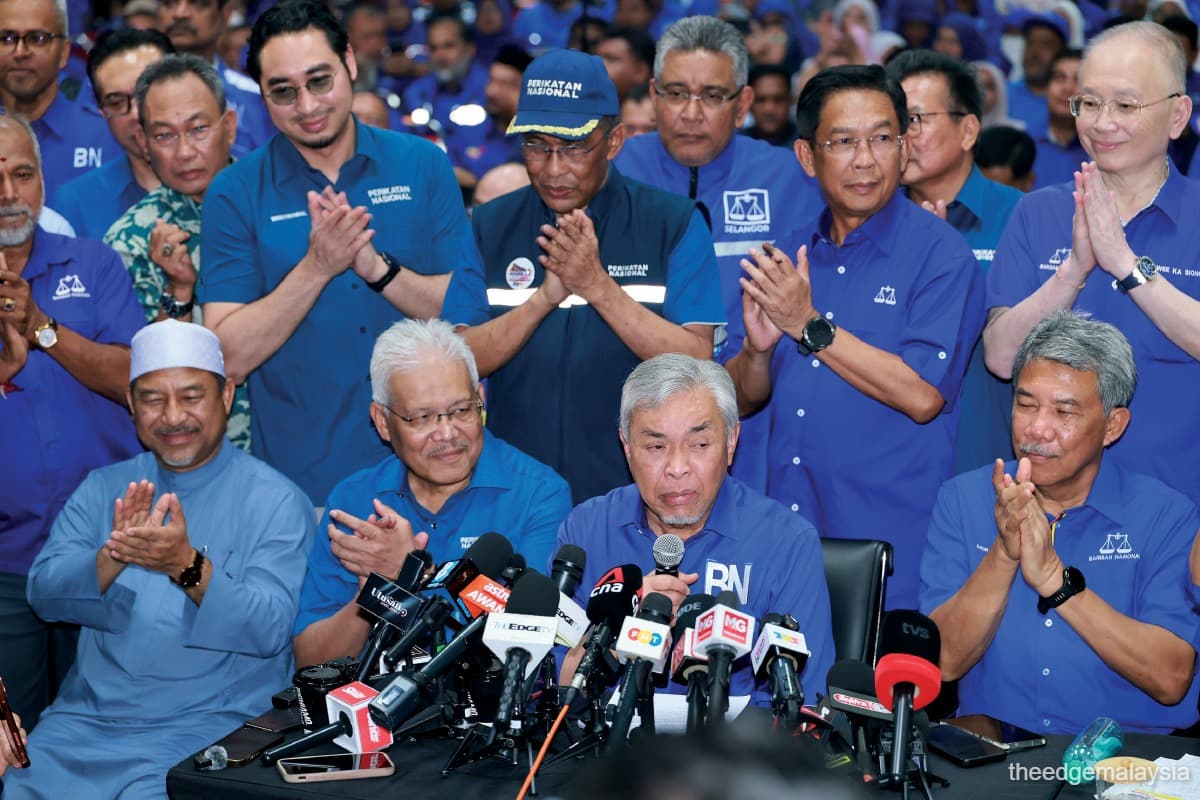
The BN-PN alliance captured 25 of the state’s 36 seats, securing a two-thirds majority in its first electoral test in the Minangkabau heartland. The biggest casualty of the realignment was Bersatu, which failed to win a single seat, while 23 of its 24 candidates lost their deposits.

DAP’s losses in Chennah and Repah
If there was one constituency that both reinforced and challenged PH’s narrative, it was Chennah.
The mixed seat — where Malays make up 47.8% of registered voters and Chinese voters account for 42.6% — witnessed one of the biggest upsets of the election after DAP secretary-general Anthony Loke Siew Fook lost to Barisan Nasional’s (BN) MCA candidate Siow Kong Choon in a straight fight.
Loke, who had represented the constituency since 2013, secured 5,038 votes — down from 5,888 in the 2023 state election — despite voter turnout rising to 76% from 67%. Siow, meanwhile, polled 5,726 votes, more than 55% higher than the tally secured by Loke’s opponent in the previous election.
At first glance, the result appeared to lend weight to PH’s argument that identity politics had strengthened the opposition’s appeal. The informal BN-PN electoral pact effectively removed the possibility of a split anti-PH vote, allowing voters opposed to the ruling coalition to rally behind a single challenger.
The outcome also suggested that anti-PH sentiment, particularly among Malay voters, may have coalesced behind BN in a constituency where no single ethnic group forms a majority.
But the numbers also pointed to another reality.
Loke’s own vote tally fell even as voter turnout increased, suggesting that PH was not only challenged by a more united opposition but also struggled to mobilise segments of its traditional support base.
Political analysts argue that the coalition would be mistaken if it attributed the defeat solely to identity politics.
“I think there’s a decline in support for PH among its core supporters, many of whom apparently did not quite come out to vote,” says Oh Ei Sun, principal adviser at the Pacific Research Centre of Malaysia.
Universiti Malaya political analyst Muhammad Tawfik Yaakub agrees, saying it would be “an oversimplification” to view identity politics as the principal or sole explanation. “Racial and religious narratives were effective because they interacted with deeper political dissatisfaction, including concerns over the cost of living, the pace of institutional reform, PH’s political direction and the perceived contradictions within the federal unity government,” he adds.
A similar pattern emerged in Repah, another DAP stronghold that fell to MCA.
Unlike Chennah, Repah’s demographic profile makes the result harder to explain through Malay consolidation alone. The constituency has a non-Malay majority, with Chinese and Indian voters making up a combined 58.4% of the electorate, compared with 40.1% Malays.
DAP’s Veerapan Superamaniam lost by a narrow margin of 444 votes in a straight fight against MCA’s Koh Kim Swee.
Veerapan secured 9,335 votes, an 18% decline from the 11,507 votes he received in the previous election, despite voter turnout increasing to 69% from 63%. Koh, meanwhile, obtained 9,779 votes, nearly 76% higher than the tally secured by Gerakan in the previous contest.
The result also raised questions over whether PH suffered erosion within its traditional support base, particularly among Indian voters, who have long been an important pillar of the coalition’s support.
The arithmetic of ‘penyatuan ummah’
Nevertheless, the effectiveness of the BN-PN electoral arrangement in reshaping the state’s political landscape is difficult to ignore. The so-called “penyatuan ummah”, or Malay unity, narrative appeared to have gained traction in Negeri Sembilan, at least when viewed through the arithmetic of the election results.
The clearest beneficiary was PN, which expanded its footprint in the state despite fielding several relatively new candidates.
Parti Wawasan Negara (Wawasan), making its electoral debut under the PN banner, captured three seats — Klawang, Sikamat and Gemas — all in constituencies with predominantly Malay electorates.
The margins were significant. Wawasan won Klawang with a 13.4% majority, Sikamat with 16.8% and Gemas with a commanding 61%.
The results suggested PN was able to consolidate significant Malay support in areas where opposition votes had previously been divided.
The trend was even more apparent for the PN’s anchor party, PAS. The Islamist party strengthened its hold on several Malay-majority constituencies, with its incumbents in Serting, Paroi and Bagan Pinang recording substantially larger winning margins.
PAS retained Serting with a 55.5% majority, compared with just 4.3% previously. Its margins in Paroi and Bagan Pinang increased to 34.4% and 51.7%, from 12.9% and 18.6% respectively.
More significantly, PAS managed to wrest Ampangan — a constituency located within the Greater Seremban metropolitan area and traditionally regarded as a more competitive urban seat — from PKR.
Perhaps the most intriguing result came from Nilai, where the relatively little-known Malay-based party Parti Berjasa Malaysia (Berjasa) retained its electoral deposit by securing 18% of the vote in a closely contested five-cornered fight.
The result was notable, given Nilai’s mixed demographic profile. Malays account for 46.4% of voters, while Chinese and Indian voters make up 29.9% and 20.8% respectively.
Had Berjasa’s votes gone to BN’s MCA candidate instead, the contest could have been much closer, potentially threatening DAP’s hold on the seat, which it ultimately retained with an 18.3% majority.
While the state election demonstrated the electoral benefits of the BN-PN arrangement, whether the partnership can be sustained over the longer term remains an open question.
Sunway University political scientist Professor Wong Chin Huat says the BN-PN cooperation is likely to endure if support for PH continues to weaken, as it would create more opportunities for both coalitions to capture PH-held seats and make seat-sharing negotiations easier.
“PH is paying the price for failing to address the root cause of Malay anxiety. Criticising PH for also relying on the communal anxieties of non-Malays through the ‘green wave’ narrative completely misses the point. If you don’t change the high-risk political system, it is perfectly rational for any political party to resort to some form of communal mobilisation,” he says.
However, Pacific Research Centre’s Oh has a different view, describing the BN-PN alliance as a marriage of convenience that could unravel at any time, given the long history of cooperation and rivalry between Umno and PAS.
“If you look at history, Umno and PAS have alternated between working together and going their separate ways, whether in the 1970s or during (Datuk Seri) Najib Razak’s administration. It’s a political marriage of convenience that could end in divorce at any time,” he explains.
PH’s remaining fortress
Despite its disappointing performance, PH still managed to retain 11 seats in Negeri Sembilan, largely on the back of its continued support among non-Malay voters.
Nowhere was this more evident than in DAP’s performance. Of the party’s nine seats won, eight were Chinese-majority constituencies, underscoring its continued dominance among its traditional support base.
In Lobak, where Chinese voters make up 71.5% of the electorate, DAP retained the seat with a commanding 73.3% majority. However, the margin was lower than the 88% recorded in the previous election.
A similar pattern was evident in Mambau, another DAP stronghold. With Chinese voters accounting for 58.7% of the electorate, DAP won the seat with a 60% majority, down from 77.4% previously.
Voter turnout in both seats were similar to the 2023 state election.
For PKR, support from non-Malay voters proved crucial in preventing a complete wipeout. The party retained two seats — Chuah and Sri Tanjung — both located within the wider Port Dickson area.
In Chuah, a mixed constituency with Chinese voters making up 53.4% and Indian voters 21.1%, PKR secured a 23.6% majority, although this was significantly lower than the 62.7% margin achieved in the previous election.
Sri Tanjung, where Chinese and Indian voters account for 31.3% and 27.1% respectively, also remained in PKR’s hands, but its winning margin narrowed to 10% from 32% .
Notably, voter turnout in both constituencies were slightly better than the last state election.
Universiti Malaya’s Muhammad Tawfik says the election underscored the need for PKR and Amanah to rebuild their grassroots networks in Malay and semi-rural constituencies, as the parties could no longer depend solely on Prime Minister Datuk Seri Anwar Ibrahim’s appeal or DAP’s organisational strength in urban areas.
“PH needs credible local candidates who are continuously present, not just introduced during elections. It must also re-energise its Chinese and Indian supporters through a convincing reform agenda and tangible results in government, rather than relying solely on warnings about BN-PN. Unless PH can rebuild Malay confidence while keeping its non-Malay base engaged, the BN-PN formula will continue to put it at a serious disadvantage,” he adds.


Read also:
The new political equation: What the maths shows about the likely outcome of GE16 in Peninsular Malaysia
Negeri Sembilan election: A lens on Malaysia’s politics
Negeri Sembilan state seat composition over the years
Save by subscribing to us for your print and/or digital copy.
P/S: The Edge is also available on Apple's App Store and Android's Google Play.